PESTEL Analysis: Scanning the Forces You Do Not Control
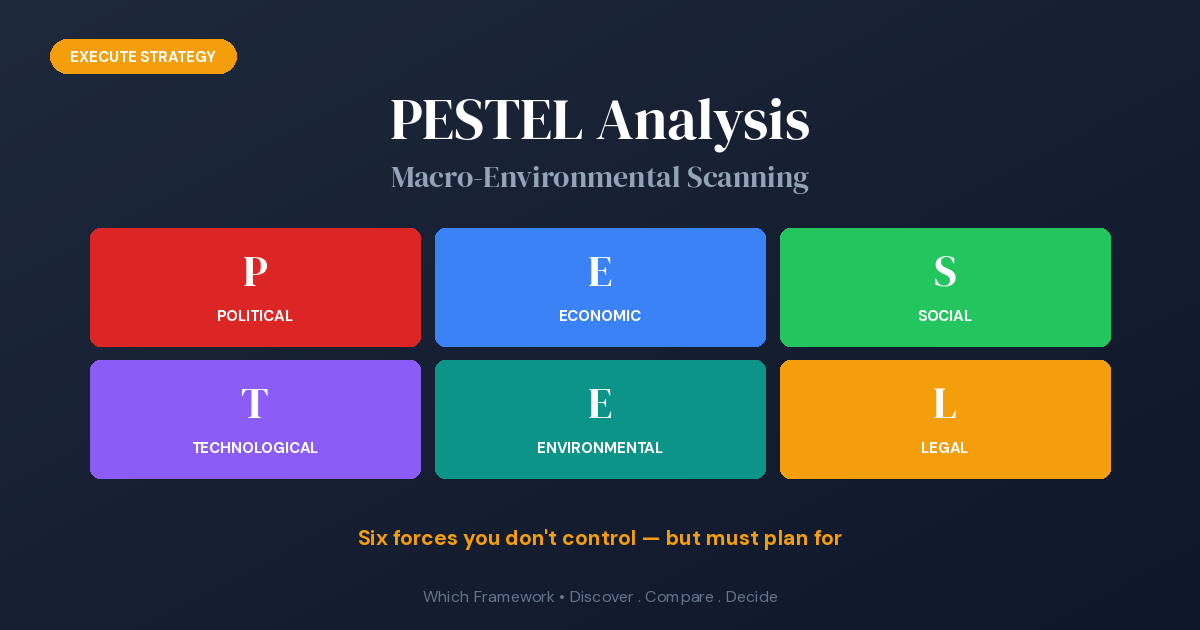
PESTEL Analysis is a structured scan of the six external forces that shape an organization's options — Political, Economic, Social, Technological, Environmental and Legal — used to surface opportunities and threats that sit outside management control.
Before you start
Is PESTEL actually your framework?
PESTEL maps forces that sit outside your control and act on everyone in your market at once: regulation, demographics, technology shifts, macroeconomics. It is a scan of the weather, not a plan.
That shared quality is also its trap. If a factor affects you and every competitor identically, it is context rather than a finding — it changes what the whole market must cope with, not what you should do differently. The only PESTEL entries worth acting on are the ones where your exposure differs from your rivals’.
| If your real problem is… | You probably want |
|---|---|
| We do not understand our industry’s competitive dynamics | Porter’s Five Forces — industry structure, not macro forces Compare PESTEL and Five Forces |
| We need to know what we are actually good at | VRIO or SWOT Not sure which? Compare |
| We have identified risks and need owners and mitigations | Risk Management Framework — PESTEL surfaces exposure but has no ownership mechanism |
| The future could go several ways and we need to prepare | Scenario Planning — the natural successor when uncertainty is high Compare PESTEL and Scenario Planning |
| We are choosing which market or product to grow into | Ansoff Matrix or Blue Ocean Strategy Not sure which? Compare |
| Deciding whether and how to expand into a new market | The market expansion playbook, where PESTEL is stage 1 of 6 |
| Something outside our control is about to reshape the market | PESTEL — you are in the right place |
The distinction that matters
PESTEL is unscoped by default, and useless in that state. “PESTEL for our business” produces a list of everything happening in the world. “PESTEL for entering Germany in the next eighteen months” produces factors you can assess, rank and assign. The scope statement is not preparation for the analysis — it is most of the analysis.
What Is It?
Every organization operates inside conditions it did not choose and cannot change: interest rates, regulation, demographic shifts, the pace of technology. PESTEL is a checklist for looking at those conditions deliberately, before they arrive as surprises. It does not tell you what to do. It tells you what you are standing in.
The approach traces back to Francis J. Aguilar, whose 1967 book Scanning the Business Environment proposed that firms systematically monitor external conditions rather than react to them. Aguilar's original grouping was ETPS — Economic, Technical, Political, Social. Over the following decades the letters were reordered into PEST, and two more factors were added as they became impossible to ignore: Environmental, as climate and resource constraints turned into operational risk, and Legal, as compliance regimes grew complex enough to warrant separate treatment.
No single author is credited with the six-factor version. It emerged through use, which is why you will encounter the same framework under several names — a point worth understanding before you pick one.
PESTEL, PESTLE, PEST and STEEPLE: The Same Tool
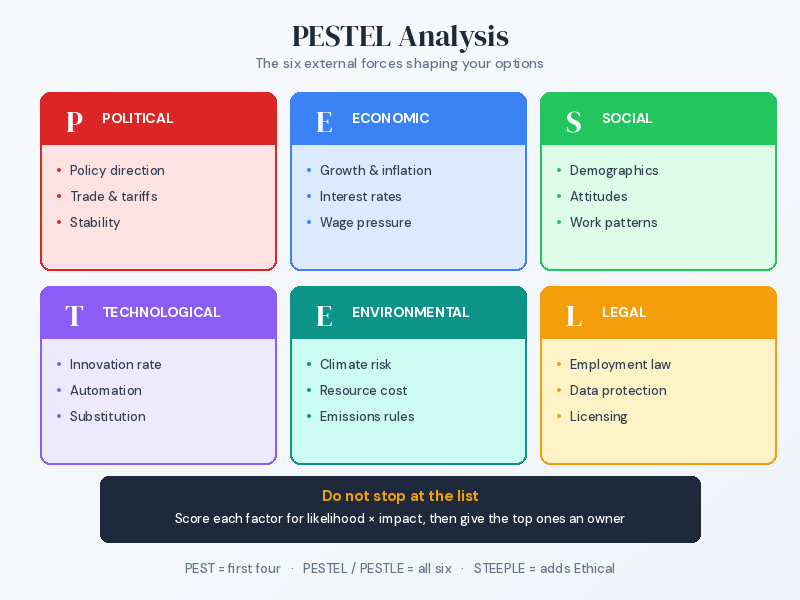
These are not competing frameworks. They are the same scan with different letters included:
- PEST — Political, Economic, Social, Technological. The original four. Still adequate for a quick scan in a stable, lightly regulated market.
- PESTEL / PESTLE — the same six factors; only the letter order differs. PESTEL is more common in strategy and business education, PESTLE in UK project and program management. Choose whichever your audience uses and stay consistent.
- STEEPLE — adds Ethical as a seventh factor. Useful where reputational and ethical exposure is a board-level concern in its own right, such as healthcare, extractives or AI products.
- STEEP, PESTLIED, SPELIT — regional and sector variants. None adds anything structural.
The choice matters less than the discipline. A thorough PEST beats a superficial STEEPLE every time.
The Six Factors
Political. Government stability, trade policy, tariffs, subsidies, public-sector procurement rules, tax policy direction, geopolitical alignment. Distinguish political intent from legal fact — a stated policy direction is a political factor; the statute that enacts it is a legal one.
Economic. Growth rates, inflation, interest rates, exchange rates, unemployment, wage pressure, credit availability, consumer confidence. This is the factor most likely to have hard numbers attached, so it is the easiest to over-weight simply because it is measurable.
Social. Demographics, education levels, cultural attitudes, health trends, work patterns, income distribution, migration. Social factors move slowly and then matter enormously — they are the ones most often missed because nothing changed this quarter.
Technological. Rate of innovation, automation, R&D investment, infrastructure maturity, technology adoption curves, and the substitution risk from adjacent industries. The relevant question is rarely "what is new" but "what has just become cheap enough to be ubiquitous."
Environmental. Climate exposure, resource scarcity, energy costs, waste and emissions requirements, supply-chain physical risk, and shifting expectations from customers and investors. For many organizations this has moved from CSR reporting into operational and financing reality.
Legal. Employment law, competition and antitrust, data protection, consumer protection, health and safety, sector licensing, intellectual property. Legal factors differ from political ones in a useful way: they are enforceable now, with defined consequences.
Worked example
A scoped PESTEL: entering Germany
An illustrative composite. A UK direct-to-consumer homeware brand, roughly $12m revenue, assessing entry into Germany over eighteen months. Note the scope: one country, one time horizon, one decision. A PESTEL of “Europe” would have produced none of the findings below.
The middle column is what the whole market faces. The right column is the only one that generates action — where this company’s exposure differs from a German-domiciled competitor’s.
| Factor | What everyone in the market faces | Where we are differently exposed |
|---|---|---|
| Political | Stable regulatory environment, EU single market rules | Post-Brexit, we are a third-country seller. Incumbent EU rivals are not. Adds customs handling and lead time they do not carry. |
| Economic | Consumer caution, elevated energy costs | Symmetric. Everyone selling homeware into Germany faces the same demand softness. Context, not a finding. |
| Social | Strong consumer preference for paying on invoice rather than card | Our checkout is card and wallet only. German competitors offer invoice as standard. This is a conversion problem, not a marketing one. |
| Technological | Dense parcel-locker network, high mobile commerce share | Mildly favorable. Our mobile conversion is already strong; the locker network reduces our delivery-cost disadvantage. |
| Environmental | Packaging registration and take-back obligations apply to all sellers | Incumbents registered years ago. For us it is a prerequisite with lead time — miss it and listings can be suspended before launch. |
| Legal | Statutory right of withdrawal, mandatory site disclosures, German-language terms | Largely symmetric, but our returns process is built around a 28-day goodwill window and needs restating in statutory terms. |
What the scan actually decided
Two rows changed the plan. Payment method and packaging registration are both prerequisites with lead times, and both were invisible in the original launch schedule — which had budgeted for translation and advertising.
Four rows did not change anything, and that is the point. The economic row in particular is the kind of entry that fills PESTEL grids: true, important, and identical for every competitor. Ask of each factor: would a well-run local rival be affected differently? If no, it is weather. Record it once and move on.
How to Run One
The common failure is producing a six-column list nobody reads. Four steps keep it useful:
- Fix the scope first. "PESTEL for our business" is too broad to be actionable. "PESTEL for entering the German market in the next 18 months" produces factors you can actually assess. Name the geography, the time horizon, and the decision the scan is meant to inform.
- Gather, then filter. Brainstorm widely across all six factors, then discard anything that does not plausibly change a decision. A factor that would not alter your course regardless of how it resolves is context, not input.
- Score what survives. Rate each remaining factor on likelihood and on impact if it occurs. This is the step most teams skip, and skipping it is why PESTEL outputs so often go unused — an unranked list gives the reader nowhere to start.
- Assign the top items. Every high-likelihood, high-impact factor gets a named owner and a monitoring trigger. Without this, the analysis is a snapshot of a moment that has already passed.
When to Use
- Entering a new geography, where local political and legal conditions are unfamiliar
- Annual or multi-year strategic planning cycles
- Building the Opportunities and Threats halves of a SWOT Analysis on evidence rather than intuition
- Preparing inputs for Scenario Planning, where PESTEL factors become the scenario axes
- Investment cases and due diligence, where external risk needs to be stated explicitly
- Regulated sectors facing a known change in the compliance regime
When NOT to Use
- For internal problems. PESTEL is external only. Capability, culture and process issues need McKinsey 7S or Value Stream Mapping.
- For competitor or industry analysis. Rivals, suppliers and buyers are the domain of Porter's Five Forces. PESTEL sits one level above the industry.
- For tactical or near-term decisions. Macro factors move too slowly to inform a quarterly choice.
- As a one-off deliverable. A PESTEL run once and filed is worth very little; the value is in periodic re-scanning.
In the room
How PESTEL goes wrong
The weaknesses above describe the framework. These are the observable symptoms of a scan going wrong while you are running it, and what to do about each.
| What you see | What it usually means | What to do |
|---|---|---|
| The grid fills up easily and fast | You are recording the news, not assessing exposure | Apply the asymmetry test to every row: would a well-run local competitor be affected differently? Most entries will not survive it. |
| Factors have no dates attached | Trends were recorded instead of changes | “AI will reshape the sector” is unusable. Require a horizon on every factor — within this planning cycle, or not in this scan. |
| The team argues whether something is Political or Legal | You have hit a boundary that was never designed — see the origins below | Put it wherever it will get read and move on. Placement carries no analytical weight; the letters are a mnemonic, not a taxonomy. |
| Every surviving factor is high impact | Scoring was done without forcing separation | Rank against each other rather than scoring each in isolation. If you cannot name the top three, no ranking has happened. |
| The output is a slide, not a change to a plan | Nothing downstream was obliged to respond | Each surviving factor needs a named owner and a decision it feeds. An unowned factor is a fact, not an input. |
| Scope is “our industry” or a whole continent | The scan was never bounded, so nothing can be assessed | One market, one horizon, one decision. Regional scans need one pass per market — France and Germany do not share findings. |
Sourced
What the evidence says
It began as ETPS, in a book about how managers gather information.
Francis J. Aguilar, who joined the Harvard Business School faculty in 1964, published Scanning the Business Environment in 1967. In it he set out a four-part taxonomy — Economic, Technical, Political, Social — abbreviated ETPS. The letters were reordered later by others; nothing in the original work uses the word PEST.
Aguilar, F. J., Scanning the Business Environment, Macmillan, 1967.
The letters accumulated over decades, added by different hands.
Shortly after Aguilar’s book, Arnold Brown at the Institute of Life Insurance reorganised the same categories as STEP, for Strategic Trend Evaluation Process. That became STEPE with the addition of ecological factors, and the sequence continued through PEST to today’s PESTEL, PESTLE and STEEPLE. No single author designed six categories, and none of the variants replaced its predecessor by argument — they simply accreted.
The attribution to Aguilar is contested.
Recent scholarship argues PEST is mistakenly credited to him: Aguilar studied how senior managers acquire outside information, and his taxonomy was a passing list within that study rather than a method for organising or analyzing it. Freeman, writing in 1984, credited Aguilar with a framework for understanding environmental scanning but not with any analytical method. On this reading PESTEL has no single originator at all — it is a mnemonic that grew letters.
Discussed in “Scanning the Business Environment: the Acquisition of Environment Knowledge by Top Management and the Development of the PEST and SWOT models”, 2025.
What that means for using it.
This matters more practically than it first appears. Because the categories were never derived from a theory, the boundaries between them carry no meaning — which is exactly why teams argue about whether carbon pricing is political, economic, environmental or legal, and why that argument is unwinnable and not worth having. The six letters are a prompt to look in six directions, nothing more. Judge a PESTEL by whether it surfaced an exposure you did not already know you had, not by whether the grid is complete or correctly filed.
Key Strengths
- Catches blind spots. The six categories force attention onto factors a team would not have raised unprompted — particularly Environmental and Legal, which rarely surface in unstructured discussion.
- Universally applicable. Works for any sector, size or geography, including public sector and nonprofit.
- Cheap and fast. A useful first pass takes a half-day workshop and no specialist tooling.
- Feeds other frameworks. Its output is the natural input to SWOT, scenario planning, and risk registers.
- Shared language. Gives cross-functional groups a neutral structure for discussing uncertainty.
Key Weaknesses
- Produces lists, not decisions. Without scoring and ownership the output is inert. This is the single most common failure mode.
- No weighting is built in. The framework treats all six factors as equally important, which they never are.
- Categories overlap. Carbon pricing is simultaneously political, economic, environmental and legal. Teams can spend more time arguing about placement than about substance.
- Rewards breadth over depth. Six headings invite six shallow answers.
- Ages quickly. A scan reflects the moment it was made, and macro conditions can shift faster than the planning cycle that commissioned it.
Quick Reference
How It Works
| 1 Primary Input | Industry reports, government and central bank publications, regulatory trackers, demographic data, technology and climate research |
|---|---|
| 2 Data You Need | Policy direction, economic indicators, demographic and cultural trends, technology adoption rates, environmental exposure, statutory changes |
| 3 Primary Output | A scored register of external opportunities and threats, with owners and monitoring triggers for the highest-priority items |
Comparison with Related Frameworks
PESTEL vs SWOT
PESTEL is external only and produces evidence; SWOT combines internal and external and produces a summary. In practice PESTEL runs first and feeds the Opportunities and Threats quadrants, which is what stops those quadrants from being guesswork.
PESTEL vs Porter's Five Forces
Five Forces analyzes your industry — rivals, buyers, suppliers, entrants, substitutes. PESTEL analyzes the environment the whole industry sits inside. Five Forces explains why an industry is profitable; PESTEL explains what could change that.
PESTEL vs Scenario Planning
PESTEL identifies and scores uncertainties. Scenario Planning takes the two or three with the highest impact and uncertainty and builds coherent futures around them. PESTEL is the input stage of that method.
Sequencing
What to run before and after PESTEL
PESTEL is the widest-angle tool in common use, which makes it a natural first step and a poor last one. It identifies what is changing; it says nothing about industry structure, your own position, or what to do.
Before
Fix the scope
Not a framework — a sentence. One market, one horizon, one decision the scan must inform. This is the step that determines whether anything downstream is usable, and it is the one most often skipped.
During
Macro first, then industry
PESTEL covers forces acting on the whole market; Five Forces covers how value is captured within it. Running them together stops macro trends being mistaken for competitive dynamics.
After
Turn exposure into a decision
High-impact, high-uncertainty factors go to scenario planning. High-impact, high-likelihood factors go to a risk owner. Anything that survives both belongs in the strategy itself.
Part of a playbook: How to Expand into a New Market. PESTEL is stage 1 of 6, before Five Forces.
Common questions
PESTEL: quick answers
What does PESTEL stand for?
Political, Economic, Social, Technological, Environmental and Legal. These are the six categories of external, macro-level factors that affect an organization but sit outside its direct control.
What is the difference between PESTEL and PESTLE?
None. They contain the same six factors and differ only in the order of the final two letters. PESTEL is more common in strategy and business education; PESTLE is more common in UK project and program management.
Is PEST still valid, or should I always use PESTEL?
PEST remains valid for a fast scan in a stable, lightly regulated market. PESTEL is the better default because Environmental and Legal factors now carry material operational and financial consequences in most sectors, and treating them separately makes them harder to overlook.
Who invented PESTEL Analysis?
The origin is Francis J. Aguilar's 1967 book Scanning the Business Environment, which proposed the ETPS grouping — Economic, Technical, Political, Social. The letters were later reordered to PEST, and the Environmental and Legal factors were added through general use rather than by a single credited author.
How often should a PESTEL Analysis be refreshed?
Annually as part of the planning cycle for most organizations, and whenever a major decision such as market entry or a large investment is under consideration. Individual high-impact factors should have monitoring triggers rather than waiting for the next full review.
What is the most common mistake when running a PESTEL?
Stopping at the list. Teams brainstorm across six headings, produce a document, and never score the factors for likelihood and impact or assign owners to the important ones. An unranked list gives the reader no starting point and is rarely acted on.
Can I run one PESTEL for a whole region such as Europe?
No — not usefully. Regulation, consumer behavior and legal obligations differ enough between France, Germany and the Netherlands that a single regional scan collapses into generalities. Run one pass per market, each with its own time horizon and decision. A regional view is then the comparison across those passes, not a substitute for them.
Frameworks related to PESTEL Analysis
- SWOT AnalysisClassic strategic framework assessing Strengths, Weaknesses, Opportunities, and Threats for…
- Porter's Five ForcesRigorous industry analysis framework examining five competitive forces to determine industry…
- Scenario PlanningStrategic planning method that explores multiple plausible futures to prepare organizations…