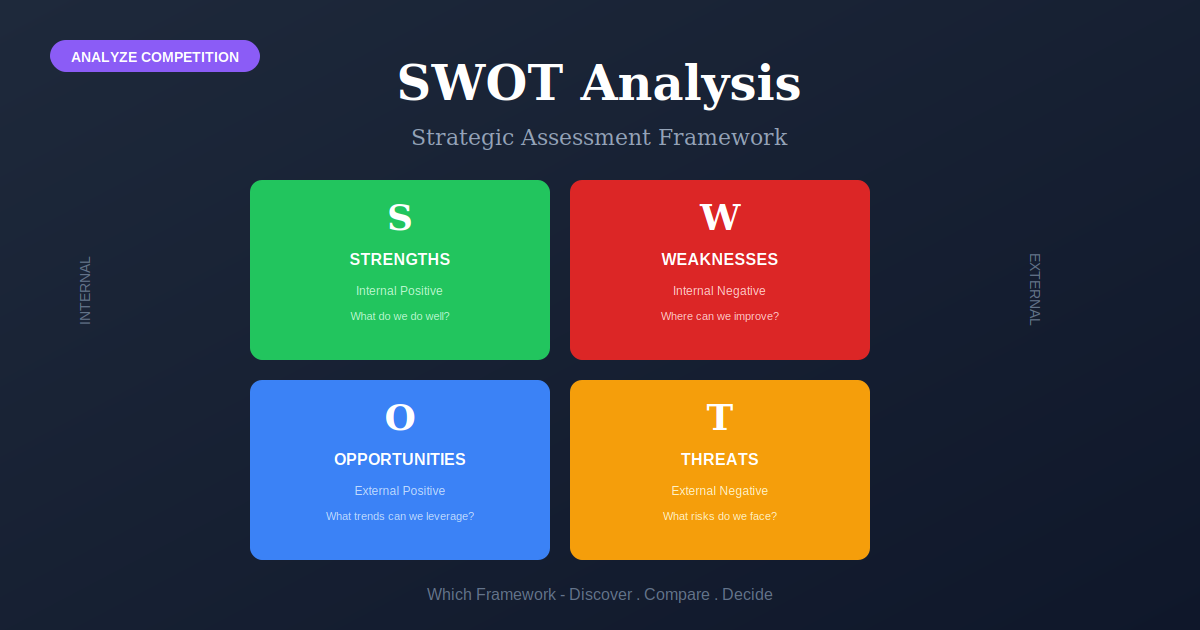
SWOT Analysis: Strategic Assessment Framework
SWOT Analysis is a strategic planning framework that evaluates Strengths, Weaknesses, Opportunities, and Threats to understand competitive position and inform strategy.
Before you start
Is SWOT actually your framework?
SWOT is the most widely used and least respected framework in management, and both facts have the same cause: it is a container, not an analysis. It gives you four boxes to sort conclusions into. It supplies no method for reaching those conclusions, no way to rank them, and no step that turns them into a decision.
That makes it genuinely useful for one job — getting a group to a shared picture quickly — and useless for almost everything people expect from it. A SWOT is only ever as good as the thinking that happened before the boxes were drawn.
| If your real problem is… | You probably want |
|---|---|
| We need rigour about our actual strengths | VRIO — tests whether a strength is defensible instead of merely listing it Compare SWOT and VRIO |
| We need rigour about external forces | PESTEL for macro forces, Five Forces for industry structure Not sure which? Compare |
| We have a SWOT and need strategies out of it | The TOWS matrix — Weihrich’s 1982 pairing of internal with external, described in the evidence section below |
| We need to choose between several options | Ansoff Matrix or Blue Ocean Strategy Not sure which? Compare |
| The future is genuinely uncertain, not merely unknown | Scenario Planning Not sure which? Compare |
| Deciding whether and how to expand into a new market | The market expansion playbook, where SWOT is an optional one-page summary between stages 3 and 4 |
| We need a group aligned on the situation, fast, before deeper work | SWOT — you are in the right place |
The distinction that matters
SWOT has no generating mechanism. Five Forces tells you where to look. VRIO tells you what test to apply. SWOT tells you where to write the answer down. Treat it as the meeting-room summary of work done elsewhere, and it earns its place. Treat it as the work itself and you get four lists of adjectives.
What Is It?
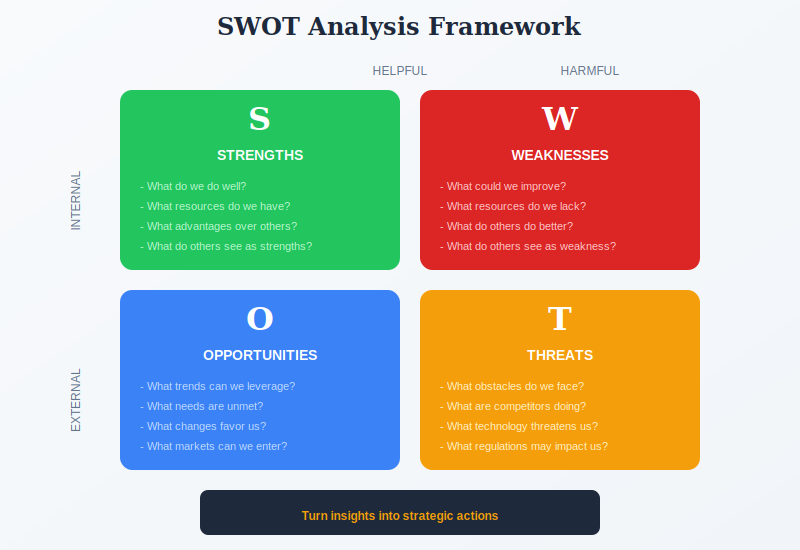
SWOT Analysis is perhaps the most recognized strategic framework in business. Developed at Stanford Research Institute in the 1960s, it provides a simple 2x2 matrix for assessing strategic position by examining internal factors (Strengths and Weaknesses) and external factors (Opportunities and Threats).
Strengths: Internal positive attributes—what you do well, unique resources, advantages over competitors. Weaknesses: Internal negative attributes—areas for improvement, resource gaps, competitive disadvantages.
Opportunities: External positive factors—market trends you can leverage, unmet customer needs, favorable changes. Threats: External negative factors—competitive pressures, regulatory changes, economic headwinds.
SWOT's power is in its simplicity. It's a starting point for strategic discussions and pairs well with deeper frameworks like Porter's Five Forces and PEST Analysis.
Quick Reference
Core Features
- 2x2 Matrix: Simple visual structure everyone understands
- Internal/External: Considers both controllable and uncontrollable factors
- Positive/Negative: Balanced view of helpful and harmful factors
- Team Exercise: Great for collaborative strategy discussions
- Foundation: Starting point for deeper strategic analysis
Worked example
How to SWOT a company properly
The usual failure is not laziness — it is that entries get written as adjectives rather than as claims. An adjective cannot be wrong, so it cannot be argued with, so it cannot lead anywhere.
Below, a mid-sized B2B software company as it is usually written, and as it should be. The test for every line: could this be false, and compared to whom?
| Quadrant | As usually written | As it should be written |
|---|---|---|
| Strength | “Strong brand” | “Named unprompted by 34% of buyers in our category, against 11% for our nearest rival.” Falsifiable, comparative, and it tells you what to protect. |
| Weakness | “Limited resources” | “Two engineers hold all knowledge of the billing system; neither is documented.” Every company has limited resources. Only some have this. |
| Opportunity | “Growing market” | “Regulation from January requires audit trails we already ship; three of five competitors do not.” A growing market is not an opportunity if it grows for everyone equally. |
| Threat | “Competition” | “Our two largest accounts, 31% of revenue, renew within the same quarter.” Names the exposure and its size. |
| The test | None applied | Could the line be false? Compared to whom? By when? If a line survives all three, keep it. |
Then pair them, or it stops here
A completed SWOT is still four lists. The step that produces strategy is pairing across quadrants — the TOWS matrix. In the example above, the strength and the opportunity combine into something actionable: lead with audit-trail capability into the regulated segment before competitors can build it. That sentence is a strategy. “Strong brand, growing market” is not.
If you are researching a specific company from outside it, the same test applies and is harder: you will have the adjectives from their marketing and none of the numbers. Say which lines are evidenced and which are inferred, or the analysis will read as confident and be worthless.
When to Use
- Starting strategic planning or annual reviews
- Quick competitive assessment
- Team alignment on strategic position
- New product or market entry decisions
- Foundation before deeper analysis (Five Forces)
When NOT to Use
- Need detailed industry analysis (use Porter's Five Forces)
- Need macro-environmental scan (use PEST Analysis)
- Require actionable prioritization
- Complex strategic decisions needing rigorous analysis
In the room
Why most SWOTs are useless
SWOT is easy to complete and hard to complete well, which is why so many exist and so few change anything.
| What you see | What it usually means | What to do |
|---|---|---|
| Entries are single adjectives | Nobody had to defend anything | Require every line to be falsifiable and comparative. “Strong” compared to whom, measured how? |
| The four boxes are roughly equal in length | The boxes were filled to look balanced | Real situations are lopsided. A tidy SWOT is usually a symmetrical one, and symmetry is a sign of padding. |
| Opportunities are really strengths | The internal / external boundary has collapsed | Strengths and weaknesses are things you control. Opportunities and threats exist whether or not your company does. Sort by that test alone. |
| An opportunity applies to the whole market | Shared conditions were recorded as advantages | “AI is growing” is weather. Ask whether a well-run rival is positioned differently. If not, it is context. |
| The output is the grid itself | Nothing paired the quadrants | Cross the quadrants: strength × opportunity, weakness × threat. That pairing is where strategies come from, and it is the step nearly everyone skips. |
| Completed in one meeting from memory | No external input reached the room | SWOT has no research method of its own. Bring findings from PESTEL, Five Forces or VRIO, or you are recording opinion. |
Sourced
Where SWOT actually came from
Albert Humphrey almost certainly did not invent it, and this page said otherwise until recently.
The standard account — repeated on hundreds of pages, and previously in our own framework data — is that Humphrey created SWOT at the Stanford Research Institute around 1960. In 2023 Richard Puyt, Finn Lie and Celeste Wilderom published the first proper archival study, reading the original SRI reports and interviewing surviving participants. They confirm the SRI origin, but the work was led by Robert Franklin Stewart; Humphrey was one member of the team. Much of the popular attribution traces to an account Humphrey circulated decades later, in 2005.
Puyt, R. W., Lie, F. B. & Wilderom, C. P. M., “The origins of SWOT analysis”, Long Range Planning, 2023. Paper
It began as SOFT, and the letters changed later.
The SRI work produced SOFT — Satisfactory, Opportunities, Faults, Threats — in the mid-1960s. The F became a W somewhere in the following years, and the acronym SWOT appears in print in 1972, in a paper by the British consultant Norman Stait. So the tool circulated for roughly a decade before it had the name everyone now uses.
The Harvard attribution is, in the authors’ words, an academic urban legend.
Many textbooks credit SWOT to the Harvard authors of Business Policy: Text and Cases (1965). Puyt and colleagues reject this: the book uses the underlying ideas about matching internal capability to external conditions, but contains neither the acronym nor the four-box matrix. Worth knowing if you are citing a source in academic work — the Harvard reference is a common and checkable error.
The matrix everyone draws is Weihrich’s, from 1982.
Heinz Weihrich introduced the TOWS matrix, which pairs internal factors against external ones — strength with opportunity, weakness with threat, and so on — to generate candidate strategies. This is the step that turns four lists into something you can act on, and it arrived roughly two decades after the lists did. Most SWOT exercises stop before reaching it, which is the single largest reason the technique disappoints.
Weihrich, H., “The TOWS Matrix — A Tool for Situational Analysis”, Long Range Planning 15(2), 1982.
What that means for using it.
Two things. First, if you need to cite an origin, cite Puyt and colleagues rather than the Humphrey story — it is the only account built from the primary record. Second, and more practically: the technique was designed inside a process about why corporate planning failed, not as a standalone worksheet. Extracting the grid from that process is what turned it into the thing people complain about. If you are going to run one, run the pairing step too.
Key Strengths
- Universally Understood: Everyone knows SWOT
- Quick: Complete in hours, not weeks
- Simple Visual: Easy to communicate
- Collaborative: Great team exercise
Key Weaknesses
- Can be superficial without rigor
- Often produces generic lists
- No prioritization mechanism
- Lacks actionable insights
How It Works
| 1 Primary Input | Team knowledge, market research, competitive intelligence |
|---|---|
| 2 Data You Need | Internal capabilities, external trends, competitor information |
| 3 Primary Output | Completed SWOT matrix, strategic discussion foundation |
Comparison with Related Frameworks
SWOT vs Porter's Five Forces
Porter's Five Forces provides rigorous industry analysis. SWOT is quicker and broader. Use SWOT first, then Five Forces for deeper competitive understanding.
SWOT vs PEST Analysis
PEST focuses only on external macro factors. SWOT includes internal factors too. They complement each other—PEST can inform the O and T of SWOT.
Sequencing
What to run before and after SWOT
SWOT sits in the middle and supplies nothing of its own. Everything that makes it worth doing happens on either side of it.
Before
Generate the entries somewhere else
This is the step that decides whether the exercise is worth anything. SWOT has no research method, so the quality of the grid is entirely inherited from what you bring to it.
During
Sort, then pair
Filling the grid takes an hour. Pairing across quadrants to produce candidate strategies takes longer and is the only part that produces anything. Do not stop at the grid.
After
Choose, and give it a number
Candidate strategies still need a decision and an owner. SWOT ranks nothing, so something downstream has to.
Part of a playbook: How to Expand into a New Market. SWOT appears as an optional step, summing up the first three stages before the growth route is chosen.
Common questions
SWOT analysis: quick answers
What does SWOT stand for?
Strengths, Weaknesses, Opportunities and Threats. Strengths and weaknesses are internal — things the organization controls. Opportunities and threats are external and exist whether or not the organization does. That boundary is the only rule the technique actually enforces, and it is the one most often broken.
Who invented SWOT analysis?
Not Albert Humphrey, despite the standard account. Archival research published by Puyt, Lie and Wilderom in Long Range Planning in 2023 traces it to the Stanford Research Institute in the mid-1960s, where the work was led by Robert Franklin Stewart and Humphrey was one team member. It began as SOFT — Satisfactory, Opportunities, Faults, Threats — and the acronym SWOT first appears in print in 1972.
Is SWOT analysis from Harvard Business Review?
No. Many textbooks credit the Harvard authors of Business Policy: Text and Cases (1965), but Puyt and colleagues call that an academic urban legend — the book uses the underlying ideas but contains neither the acronym nor the four-box matrix. If you need a citable origin, use the 2023 Long Range Planning paper.
How do I do a SWOT analysis of a specific company?
Same method, harder evidence. Write every entry so it could be false and names a comparison — not “strong brand” but “named unprompted by 34% of category buyers against 11% for the nearest rival”. Researching a company from outside, you will have their adjectives and none of their numbers, so mark clearly which lines are evidenced and which are inferred. Then pair quadrants to produce strategies, or you have written a description rather than an analysis.
What is the TOWS matrix, and how is it different?
TOWS is the pairing step. Introduced by Heinz Weihrich in 1982, it crosses internal factors with external ones — strength with opportunity, weakness with threat — to generate candidate strategies. SWOT produces four lists; TOWS turns them into options. Most SWOT exercises stop before this step, which is the main reason they disappoint.
What are the alternatives to SWOT analysis?
Depends which part you need. For rigour on internal strengths use VRIO; for external forces use PESTEL or Porter’s Five Forces; for choosing between growth options use the Ansoff Matrix; for genuine uncertainty use Scenario Planning. SWOT’s advantage is speed and shared understanding, not analytical depth.
Deep Resources
Frameworks related to SWOT Analysis
- Porter's Five ForcesRigorous industry analysis framework examining five competitive forces to determine industry…
- PESTEL AnalysisMacro-environmental scanning across Political, Economic, Social, Technological, Environmental,…
- Competitive Positioning MapVisual 2-axis framework mapping competitor positions to identify market gaps and strategic…