
RACI Matrix: Clarify Roles and Responsibilities
RACI Matrix is a responsibility assignment chart that clarifies who is Responsible, Accountable, Consulted, and Informed for each task or decision—eliminating confusion and ensuring clear ownership.
Before you start
Is RACI actually your framework?
RACI answers one question about a defined body of work: for each task, who does it, who answers for it, who gets asked, and who gets told. It is a clarification device, not a management method.
It assumes the work is already agreed, the people already exist, and the disagreement is about roles rather than about direction. Where that is not true, a RACI chart will document the confusion very neatly and change nothing.
| If your real problem is… | You probably want |
|---|---|
| Nobody agrees what we are trying to achieve | OKR — RACI assigns work, it does not choose it Not sure which? Compare |
| The organization itself is wired wrong | McKinsey 7S — a role chart cannot fix a structural contradiction Compare 7S and RACI |
| Roles are clear and people still are not doing it | Kotter’s 8-Step or ADKAR — that is adoption, not ambiguity Not sure which? Compare |
| Work is invisible and stalls between people | Kanban — handoff delays are a flow problem Not sure which? Compare |
| We need to know who our stakeholders even are | Stakeholder Analysis — run before RACI, not instead of it |
| Decisions stall because nobody knows who decides | RACI — you are in the right place |
The distinction that matters
The whole value of RACI sits in one test: can the accountable person say no? If they cannot veto, stop or redirect the work, they are not accountable — they are senior and copied in. A chart where no A holds real authority is an org chart with extra steps.
What Is It?
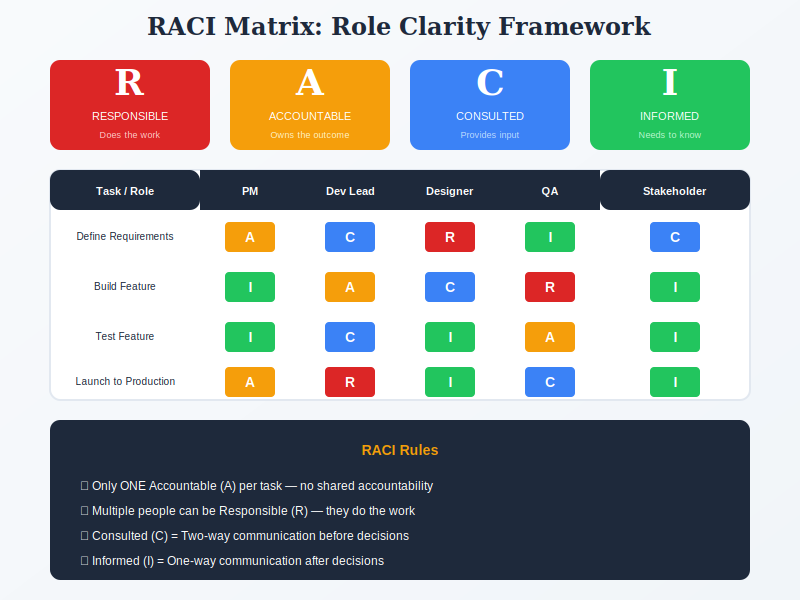
The RACI Matrix (also called RACI Chart or Responsibility Assignment Matrix) is a simple but powerful tool for clarifying roles and responsibilities in any organization, project, or process. Each letter represents a different level of involvement.
R - Responsible: The person(s) who do the work. Multiple people can be Responsible. A - Accountable: The one person who owns the outcome and has final authority. There must be exactly one A per task. C - Consulted: People whose input is sought before decisions (two-way communication). I - Informed: People who need to know after decisions are made (one-way communication).
The matrix format lists tasks/decisions as rows and roles/people as columns. Each cell contains R, A, C, I, or is left blank. This simple visual immediately reveals gaps (no Accountable), overlaps (multiple Accountables), and bottlenecks (too many Consulteds).
RACI is particularly valuable during organizational change, project kickoffs, or whenever roles are unclear. It pairs well with Hoshin Kanri for strategy deployment and Balanced Scorecard for performance management.
Quick Reference
Core Features
- Responsible (R): Does the work to complete the task
- Accountable (A): Owns the outcome, has final authority (only one per task)
- Consulted (C): Provides input before decisions (two-way)
- Informed (I): Needs to know after decisions (one-way)
- Matrix Format: Tasks as rows, roles as columns
- Gap Analysis: Quickly reveals missing or duplicate accountability
The confusing part
Responsible vs Accountable: the difference in RACI
This is the single most common point of confusion in RACI, and most explanations restate it rather than resolve it. “Responsible does the work, accountable owns it” is true and useless, because it gives you no way to decide which letter a person gets.
The underlying distinction is older than the framework. Responsibility is about doing — the obligation to carry out the work, and personal culpability for how it is done. Accountability is about answering — being the one required to justify the outcome to someone else, and to face the consequences. One faces the task; the other faces scrutiny.
| Test | Responsible (R) | Accountable (A) |
|---|---|---|
| Can they say no? | No. They can raise concerns, but cannot stop the work. | Yes. Authority to approve, halt or redirect. If absent, the A is nominal. |
| How many per task? | Several is fine, and often correct. | Exactly one. Two people accountable means nobody is. |
| Who is asked when it fails? | “What happened?” | “Why did you let it happen, and what now?” |
| Can it be delegated? | Yes — hand the task to someone else. | No. You can delegate the doing; you cannot delegate having to answer for it. |
| Same person as both? | Common and legitimate for small tasks. But if every row has R and A on the same person, the chart is not distinguishing anything and you are keeping a task list. | |
The shortcut
When a row is contested, do not argue about definitions. Ask: if this goes wrong, whose judgement is being questioned? That person is A. Everyone whose work is being examined is R.
Worked example
A RACI chart before and after it was fixed
An illustrative composite. A 60-person company launching a new pricing page. The first chart was produced in an hour, looked complete, and did not prevent a single one of the delays it was meant to prevent.
| Task | As drafted | What went wrong | Fixed |
|---|---|---|---|
| Approve pricing | A: CEO and CFO | Two accountable. Each assumed the other had decided; the page sat for three weeks. | A: CFO alone. CEO becomes C. |
| Write copy | R: Marketing. C: everyone in the company | Eleven consulted parties meant eleven rounds of edits and no authority to stop them. | C: Sales lead and Legal only. Everyone else I. |
| Legal review | A: Head of Legal | Nominally accountable, but had no authority to delay launch — so the review was advisory and got skipped under time pressure. | A retained, with an explicit right to hold launch. Accountability without a veto is decoration. |
| Publish page | R: Engineering. A: Engineering | Reasonable. Small task, one team, no ambiguity. | Unchanged. Not every row needs splitting. |
What actually changed
Two edits did nearly all the work: removing the second A on pricing, and giving the legal A real authority to stop a launch. Neither required a new process, more meetings, or anyone’s consent beyond the room.
Note the fourth row. Combining R and A on one person is fine when the task is small and unambiguous — a chart is not better for being more elaborate. The failure is doing it on every row, at which point you have a task list with extra columns.
When to Use
- Roles and responsibilities are unclear or overlapping
- New project or team kickoff
- Organizational restructuring or change
- Process improvement requiring role clarity
- Cross-functional initiatives with many stakeholders
- Complementing Hoshin Kanri for strategy deployment
When NOT to Use
- Very small teams where roles are naturally clear
- Highly fluid, self-organizing teams (may feel bureaucratic)
- When tasks themselves are undefined
- If organization won't enforce the defined roles
- Creative brainstorming where structure inhibits
In practice
How RACI charts go wrong
RACI is quick to fill in and quick to fake. These are the recurring patterns and what to do about each.
| What you see | What it usually means | What to do |
|---|---|---|
| Two or more A’s on a row | A political disagreement has been recorded rather than resolved | Force it to one. If the room cannot agree who, you have found the real problem and the chart has already earned its keep. |
| The A has no authority to stop anything | Seniority was mistaken for accountability | Apply the veto test. If they cannot halt the work, either give them that authority or move the A to whoever has it. |
| Almost everyone is C | Consultation is being used to avoid objections later | C means their input changes the outcome. If it does not, they are I. Every extra C is a round of edits and a delay. |
| R and A are the same person on every row | The chart is not distinguishing doing from answering | Fine on individual rows, meaningless as a pattern. If it holds everywhere, you have a task list and do not need RACI. |
| Letters assigned to departments | The chart resolves to a team, so it resolves to nobody | A must be a named person. Departments cannot be called to account, and “Marketing is accountable” is how a task goes missing. |
| Built once, filed, never reopened | It was treated as a deliverable rather than a working agreement | Bring it to the meeting where something is stuck. A RACI that is never consulted during a dispute was never doing anything. |
Sourced
What the evidence says
Nobody can reliably say who invented it.
Unlike most frameworks on this site, RACI has no traceable founding paper. Sources commonly assert it appeared in the 1950s, sometimes as a “Decision Rights Matrix”, sometimes under the name responsibility charting — but these claims cite each other rather than any primary document. We looked and could not verify a first author or publication. Our own framework data previously recorded it as emerging from the project management community around 1970, which is honest about the vagueness but no better evidenced.
Its documented lineage is the linear responsibility chart.
What is established is that RACI is one form of a responsibility assignment matrix — a mid-twentieth-century project management technique also known as a linear responsibility chart, mapping stakeholders against tasks. The Project Management Institute treats RACI this way in the PMBOK Guide: not a framework in its own right, but the most common notation for a broader class of chart.
Project Management Institute, PMBOK Guide; also treated as a responsibility assignment matrix in the BABOK Guide.
The Responsible / Accountable distinction predates RACI and is sharper than RACI makes it.
In the governance literature the two words carry genuinely different meanings. Responsibility concerns the internal obligation to perform — duty, professional judgement, personal culpability. Accountability concerns the external function of scrutiny: being required to justify what happened, and being subject to consequences for it. RACI collapses that into two letters, which is why teams argue about them. The accountable party is conventionally defined as the single person holding yes-or-no authority over the activity.
The variants exist because the original leaves gaps.
RASCI adds Supportive, for people who actively help without owning the outcome. RACI-VS adds Verifier and Signatory where approval and assurance are separate acts. DACI and RAPID replace the letters entirely and are built for choosing rather than executing — a useful distinction, since RACI handles decision rights poorly. Reach for a variant when your problem is genuinely the missing role, not when the base version feels too simple.
What that means for using it.
Treat RACI as notation rather than method. It has no research base, no validation, and nothing to say about whether the work is worth doing — it is a convention for writing down an agreement you have already reached. That is not a criticism: a shared notation is genuinely valuable, and this one has survived decades of use precisely because it is thin enough to adapt. Judge a chart by whether it settled an argument, not by whether it is complete.
Key Strengths
- Clarity: Eliminates ambiguity about who does what
- Accountability: Ensures single ownership for outcomes
- Speed: Quick to create and understand
- Conflict Prevention: Reduces role-related disputes
- Universal: Works for any team, project, or organization
Key Weaknesses
- Can feel bureaucratic if over-applied
- Requires maintenance as roles evolve
- Doesn't address how work gets done, only who
- May create rigid boundaries in fluid environments
- Useless if not actually followed
How It Works
| 1 Primary Input | List of tasks/decisions, list of roles/people involved |
|---|---|
| 2 Data You Need | Understanding of who currently does what, stakeholder analysis |
| 3 Primary Output | Matrix showing R, A, C, I assignments for each task and role |
Comparison with Related Frameworks
RACI Matrix vs Hoshin Kanri
Hoshin Kanri cascades strategic objectives through the organization. RACI clarifies who's responsible for each element. Use Hoshin for strategy deployment, RACI for role clarity within that deployment.
RACI Matrix vs Balanced Scorecard
Balanced Scorecard defines what to measure across perspectives. RACI defines who's responsible for each metric or initiative. They're complementary—use both for complete performance management.
Sequencing
What to run before and after RACI
RACI takes both the work and the people as given. It sits late, and it needs something on either side of it to be worth the hour.
Before
Know the work and the people
You cannot assign letters to tasks nobody has listed, or to stakeholders nobody has identified. A vague task list produces a vague chart, and the vagueness will look resolved because it is in a grid.
During
Assign, then stress-test
Filling the grid takes an hour. The value comes from the rows people argue about — those are the real ambiguities, and resolving them is the whole point.
After
Put it where the work happens
A chart in a folder changes nothing. Attach the accountable name to the actual unit of work, in whatever system the team already uses, or it will be forgotten within two weeks.
Common questions
RACI matrix: quick answers
What does RACI stand for?
Responsible, Accountable, Consulted, Informed. Responsible parties do the work; the accountable party answers for the outcome and holds yes-or-no authority; consulted parties give input that changes the result; informed parties are told what happened. There should be exactly one A per task and there may be several Rs.
What is the difference between Responsible and Accountable in RACI?
Responsibility is about doing — the obligation to carry out the work. Accountability is about answering — being the one required to justify the outcome and face the consequences. Three practical tests: the A can say no and the R cannot; there is exactly one A and may be many Rs; responsibility can be delegated, having to answer for it cannot. When a row is contested, ask whose judgement is questioned if it goes wrong. That person is A.
Can the same person be both Responsible and Accountable?
Yes, and for small unambiguous tasks it is usually correct. The problem is when it happens on every row — at that point the chart is not distinguishing doing from answering, and you have a task list with extra columns rather than a RACI.
Can there be more than one Accountable person?
No. Two accountable people means neither is, because each can assume the other decided. If the room cannot agree who holds the A, you have found the genuine ambiguity the chart exists to expose — resolve it rather than recording both.
Who invented the RACI matrix?
There is no reliable answer, which is unusual for a framework this widely used. Sources commonly place it in the 1950s, variously as a Decision Rights Matrix or under the name responsibility charting, but these claims cite one another rather than any primary document. What is established is that RACI is one notation for a responsibility assignment matrix, a mid-twentieth-century project management technique also called a linear responsibility chart.
What is the difference between RACI and RASCI?
RASCI adds S for Supportive: people who actively help deliver the task without owning the outcome. It is worth adding when a genuine support role keeps getting mislabelled as Responsible or Consulted. Other variants include RACI-VS, which separates Verifier and Signatory, and DACI or RAPID, which are built for decision-making rather than execution.
Deep Resources
Frameworks related to RACI Matrix
- Hoshin Kanri (Policy Deployment)Japanese strategic planning methodology that cascades breakthrough objectives through the…
- Balanced ScorecardStrategic management framework that translates strategy into measurable objectives across…