Hoshin Kanri: How Catchball and the X-Matrix Turn Strategy Into This Year's Work
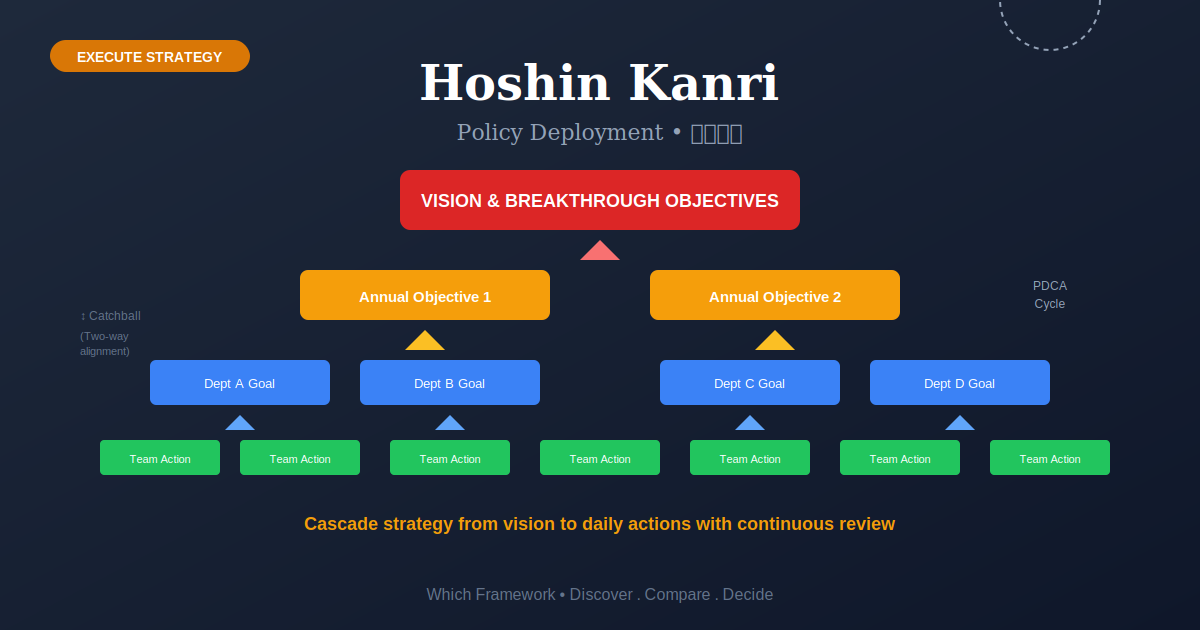
Hoshin Kanri is an annual management system that converts a few multi-year breakthrough objectives into departmental work through two-way negotiation of targets and a single-page matrix of goals, projects and measures.
Before you start
Is this your framework?
Hoshin Kanri answers one question: how does a very small number of multi-year objectives become the work every department does this year. Two things make it distinctive: goals are negotiated up and down rather than cascaded, and the whole plan sits on one page.
It is an annual system for large organizations, and it is heavy. A full cycle costs senior time in months rather than days. If you want quarterly goal-setting, or you have fifty people, the table below points somewhere lighter.
| If your real problem is… | You probably want |
|---|---|
| We want a faster goal cycle and less ceremony | OKR — quarterly, lighter, and designed for teams rather than for a whole enterprise Compare Hoshin Kanri and OKR |
| We need to measure the business across more than financials | Balanced Scorecard — a measurement system, where this is a deployment system Compare Hoshin Kanri and Balanced Scorecard |
| We cannot explain how our strategy is supposed to work | Strategy Map — the causal logic behind the objectives, which Hoshin assumes you already have |
| Our problem is incremental improvement on the floor | Kaizen — continuous small improvement, which Hoshin deliberately separates from breakthrough work |
| The strategy itself is unclear, not its deployment | SWOT or Scenario Planning — Hoshin deploys a strategy; it does not produce one |
| Work stalls between departments once it is assigned | Value Stream Mapping — the horizontal flow problem, which vertical alignment does not fix |
| A large organization, a few multi-year goals, and no line from them to this year's work | Hoshin Kanri — you are in the right place |
What Is It?
Hoshin means direction, or compass needle. Kanri means management. The English name usually given is policy deployment, which undersells it: this is a full annual management cycle, not a cascade of targets.
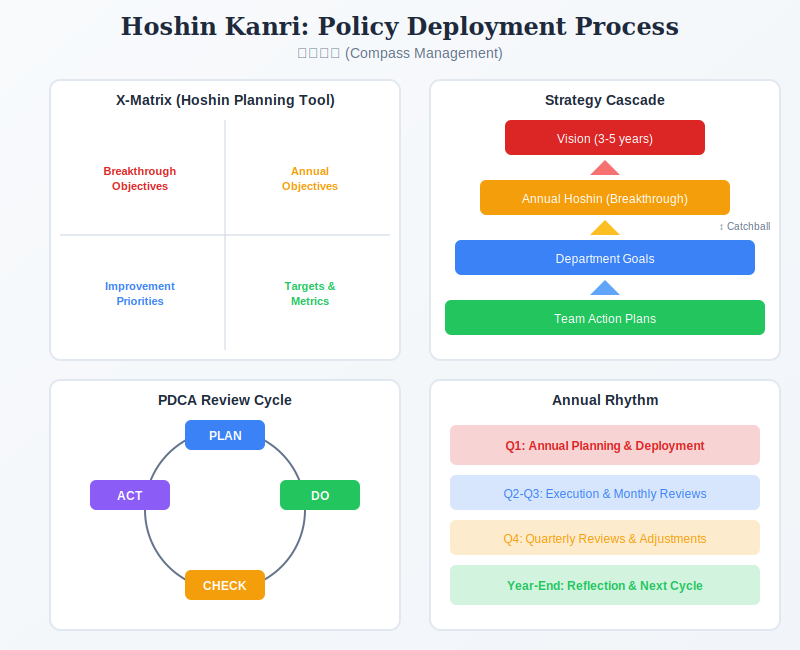
Leadership picks three to five breakthrough objectives that need several years and fundamental change, then takes the slice of each that must happen this year. That slice goes to the next level down, and this is where the method departs from ordinary goal setting: the receiving level argues back. They state what is achievable, what it would need, and what they think is wrong with the target. The exchange runs until both sides commit.
The whole plan then lives on one page. Long-term goals, this year's objectives, the improvement work, the metrics and the owners are laid out in a single grid so the connections between them are visible and checkable. Everything is reviewed against plan on a fixed cadence, and gaps are treated as problems to be investigated rather than as performance failures.
Quick Reference
The mechanism
Catchball, and why it is not a cascade
Catchball is the part people come looking for and the part most often skipped, because it is slow and it invites disagreement with senior management. Skipping it turns Hoshin Kanri into an ordinary target cascade with a Japanese name.
| Pass | What goes down | What comes back up |
|---|---|---|
| 1. Proposal | A draft objective and the reasoning behind it, not a number to hit | Questions. What problem is this solving, and why this target rather than another? |
| 2. Challenge | Any revision leadership is willing to make | What the level believes is actually achievable, and what it would take. This is the pass that gets cut, and cutting it removes the method |
| 3. Means | Agreement on the target, or an explanation of why it stands | The specific projects and process changes this level will run, with owners and measures |
| 4. Commitment | Resources, and the removal of anything now out of scope | A commitment both sides believe. Nothing is signed until then |
What catchball is actually buying
Not consensus, and not comfort. It buys two things a cascade cannot. First, the target gets tested against what the people doing the work know, before it is committed rather than at the year-end review. Second, the level that has argued its own number owns it in a way that nobody owns a number handed to them.
The cost is real and should be stated plainly: several rounds across several levels takes weeks, and it exposes senior managers to being told their target is wrong. An organization unwilling to pay both should use something else rather than run Hoshin Kanri with the argument removed.
The artifact
What the X-Matrix holds
The plan is drawn as one page with four lists around the edges of a grid, so that each connection between them can be marked and checked. It is a communication device, not a calculation.
| Side | Holds | The question it answers |
|---|---|---|
| South | Breakthrough objectives, three to five years out | Where are we trying to get to? |
| West | Annual objectives | Which slice of that are we doing this year? |
| North | Improvement priorities and projects | What work delivers that slice? |
| East | Metrics and the owner against each | How will we know, and who is answerable? |
The value is in the empty cells
Marking every link between adjacent lists is the point. An annual objective with no project against it is not funded. A project with no link to any objective is work nobody asked for. A metric attached to nothing measures nothing.
Most first attempts produce a matrix that is far too full, which is a legitimate finding rather than a formatting problem. A page listing eleven breakthrough objectives is telling you the organization has not chosen.
Core Features
- Three to five breakthrough objectives: multi-year, requiring fundamental change rather than improvement
- Catchball: targets negotiated up and down until both levels commit
- The X-Matrix: goals, objectives, projects, metrics and owners on one page with the links marked
- Annual cycle, regular review: one full loop a year with checks inside it
- PDCA at strategic level: a gap against plan is investigated, not punished
- Breakthrough separated from daily improvement: incremental work runs on its own track
Worked example
A packaging manufacturer in Graz, and the target that came back halved
An illustrative composite. An Austrian packaging group of about 2,400 people across five plants ran its first Hoshin cycle after three years of annual plans that nobody could connect to daily work.
| Stage | What happened |
|---|---|
| The breakthrough objective | Cut order-to-delivery lead time from 21 days to 7 over three years. Year one target set by the board at 12 days. |
| What catchball returned | Plant management came back with 16 days, not 12, and with a reason: two of the five plants shared a single laminating line, and no scheduling change could get past that. Nobody at board level had known. |
| What changed as a result | The board agreed 16 days for year one and funded a second laminator, roughly EUR 1.9 million, which had not been in any plan. The three-year goal was left at 7 days. |
| What the X-Matrix caught | Eleven improvement projects were already running. Four had no link to any annual objective and were stopped, releasing about 3,000 engineering hours. |
| What went wrong | The first cycle took five months, against the eight weeks planned. Two plants had never been asked to disagree with a board target and initially just accepted the number, which had to be sent back. |
The disagreement was the return on the investment
A cascade would have shipped the 12-day target and missed it, and the shared laminating line would have surfaced at the year-end review instead of during planning. The board would have concluded the plants underperformed.
Note also the cost. Five months of senior attention is not a small thing, and two plants had to be taught that arguing was the expected behavior. An organization where that lesson is not welcome will get a cascade whatever the process is called.
When to Use
- A large organization where strategy reliably fails to reach the front line
- A small number of genuine multi-year goals that need departments to change how they work
- Where too many improvement projects are running and nobody can say which matter
- Manufacturing and operations settings, where the method has the deepest track record
- When leadership is willing to have its targets contested before they are set
- Alongside an existing continuous improvement practice, which Hoshin assumes
When NOT to Use
- In a startup or a small company, where the overhead exceeds anything it can return
- Where goals need to change quarterly, since this is an annual system
- When leadership will not accept a target being negotiated downward
- As a way to produce a strategy, which it deploys but does not create
- Where no improvement capability exists yet, leaving nothing to deploy into
- If the real intent is a cascade, in which case call it that and save the months
In practice
How Hoshin deployments fail
The characteristic failure is adopting the artifacts and dropping the argument, which leaves a heavier version of what was already happening.
| Failure mode | What it looks like | What to do instead |
|---|---|---|
| Catchball as consultation | Levels are asked for input and the number never moves | Change at least one target in the first cycle, visibly. Nothing else convinces anyone the process is real. |
| Too many breakthroughs | Eleven objectives on the matrix, all top priority | Cut to three to five. If that is impossible, the prioritization problem is the finding. |
| The matrix as a report | A page produced for a steering committee and never used to make a decision | Use it to stop projects. A link that cannot be drawn is a project that should not run. |
| Breakthrough and daily work merged | Routine improvement listed as a breakthrough objective, filling the page | Keep the two tracks separate. Hoshin covers the change that would not happen anyway. |
| Review as performance appraisal | A gap against plan treated as a failure, so gaps stop being reported | Treat every gap as a problem to investigate. That is what the PDCA framing is for. |
| Set annually, then abandoned | A plan agreed in January and next opened in December | Fix the review cadence before the cycle starts, and hold it. |
Sourced
Evidence, and how to cite it
The term was coined at Bridgestone Tire.
Japanese firms competing for the Deming Prize had to show planning and strategy in their quality systems from 1958, and each developed its own approach. Bridgestone Tire studied what the prize winners were doing and published the results in 1965, effectively the first manual, giving the practice its name. Toyota and Komatsu refined it, and it was widely established in Japan by the mid-1970s.
Bridgestone Tire Co. (1965), report on hoshin kanri activities; summarized in the Lean Enterprise Institute's account of hoshin kanri as a management system.
Akao systematized it rather than inventing it.
Yoji Akao, better known as a developer of Quality Function Deployment, edited the standard treatment and is the name most often attached to the method in English. His own account places the origin in the transition from statistical to company-wide quality control between 1961 and 1965, across several firms, rather than with any one person.
Akao, Y. (ed.) (1991) Hoshin Kanri: Policy Deployment for Successful TQM. Cambridge, MA: Productivity Press.
It reached the West through a joint venture.
Hewlett-Packard's joint venture with Yokogawa Electric was among its weakest divisions until Yokogawa introduced hoshin kanri; HP then took the method back into the wider company. Adoption outside Japan has been patchy since, and is concentrated in manufacturing and in organizations with an existing lean practice.
Documented in accounts of HP's adoption from the mid-1970s; see also King, B. (1989) Hoshin Planning: The Developmental Approach. Methuen, MA: GOAL/QPC.
The comparative evidence is thin.
There is no controlled study showing that organizations running Hoshin Kanri outperform comparable organizations using another deployment method. What exists is six decades of practitioner case reporting, largely from firms that also run other lean practices, which makes the contribution of Hoshin specifically hard to separate.
No comparative outcome studies isolating hoshin kanri are available in the operations management literature as of 2026.
How to cite it.
Harvard: Akao, Y. (ed.) (1991) Hoshin Kanri: Policy Deployment for Successful TQM. Cambridge, MA: Productivity Press.
APA: Akao, Y. (Ed.). (1991). Hoshin kanri: Policy deployment for successful TQM. Productivity Press.
For the origin rather than the systematization, cite Bridgestone Tire (1965). Do not cite a single inventor: the method came out of several firms at once.
Key Strengths
- Tests targets before committing them: catchball surfaces the constraint during planning, not at year end
- Forces a small number of goals: the matrix will not hold eleven priorities legibly
- Kills unlinked work: a project with no line to an objective is visible on one page
- Real ownership: a level that argued its own number behaves differently about it
- Long track record: six decades of continuous use in large manufacturers
Key Weaknesses
- Expensive in senior time: a first cycle runs to months, not weeks
- Annual rhythm: too slow where conditions change quarterly
- Degrades into a cascade: remove the argument and nothing distinctive remains
- Assumes an improvement capability: there must be something to deploy into
- Thin comparative evidence: case reporting rather than controlled study
- Needs leadership willing to be contradicted: which is the binding constraint more often than the method
Sequencing
What to run before and after
Hoshin Kanri deploys a strategy and reviews it. It does not produce the strategy, and it does not do the improvement work itself.
Before
Have a strategy worth deploying
The method takes a small set of multi-year objectives as given. If leadership cannot state where the organization is going and why, catchball produces argument about the target rather than about how to reach it.
During
Give the annual objectives somewhere to land
An annual objective becomes real as improvement projects with owners. Organizations without an existing improvement practice have nothing to put in the north of the matrix.
After
Decide what the review actually measures
The east side of the matrix needs measures that reflect whether the objective is being met, rather than whether people are busy. This is where most matrices are weakest.
Common questions
Hoshin Kanri: quick answers
What is Hoshin Kanri?
A Japanese annual management system that turns three to five multi-year breakthrough objectives into the work each department does this year. Hoshin means direction or compass needle and kanri means management. It is distinguished from ordinary goal cascading by catchball, a two-way negotiation of targets, and by the X-Matrix, which puts the whole plan on one page.
What is catchball in Hoshin Kanri?
The process of passing a proposed objective down a level and receiving a considered response back, repeatedly, until both levels commit. The receiving level is expected to say what is achievable, what it would take, and what is wrong with the target. It is the mechanism that separates Hoshin Kanri from a cascade, and it is the step most often dropped.
How does the catchball process work step by step?
Leadership sends down a draft objective with its reasoning rather than a number. The level below responds with questions about the underlying problem. Leadership revises or explains. The level below then states what it believes is achievable and what it would need, and proposes the specific projects it will run. Nothing is committed until both sides believe the result. Several rounds across several levels typically take weeks.
What is the X-Matrix?
A single page with four lists arranged around a grid: breakthrough objectives at the south, annual objectives west, improvement projects north, and metrics with owners east. Links between adjacent lists are marked. Its value is in what fails to connect, since an unlinked project is work nobody asked for and an unlinked objective is unfunded.
What is the difference between Hoshin Kanri and OKR?
Cadence, direction and scope. Hoshin runs an annual cycle across a whole enterprise, negotiates targets in both directions, and holds everything on one matrix. OKRs run quarterly, are usually set by teams with lighter coordination, and carry no equivalent negotiation step. Hoshin is heavier and slower; OKRs are faster and align less thoroughly.
Who invented Hoshin Kanri?
No single person. It emerged across several Japanese firms between 1961 and 1965 as they moved from statistical quality control to company-wide quality control, driven partly by Deming Prize criteria. Bridgestone Tire coined the term and published the first manual in 1965. Yoji Akao edited the standard treatment and is the name usually attached to it in English, but he systematized the practice rather than inventing it.
How long does a Hoshin Kanri cycle take?
One year for a full loop, with reviews inside it, typically monthly or quarterly. The first cycle is much slower than later ones because catchball has to be learned: several months is common where eight weeks was planned, largely because levels unaccustomed to contradicting leadership initially just accept the target.
Is Hoshin Kanri the same as policy deployment?
Policy deployment is the usual English translation and the terms are used interchangeably. Strategy deployment and hoshin planning refer to the same thing. The translation is slightly misleading, since policy deployment suggests distributing decisions downward, which is the opposite of what catchball does.
Deep Resources
Frameworks related to Hoshin Kanri
- OKR (Objectives and Key Results)The quarterly, lighter alternative, with no negotiation step in it…
- Balanced ScorecardA measurement system rather than a deployment system, and often run alongside…
- Strategy MapThe causal logic behind the objectives Hoshin takes as given…