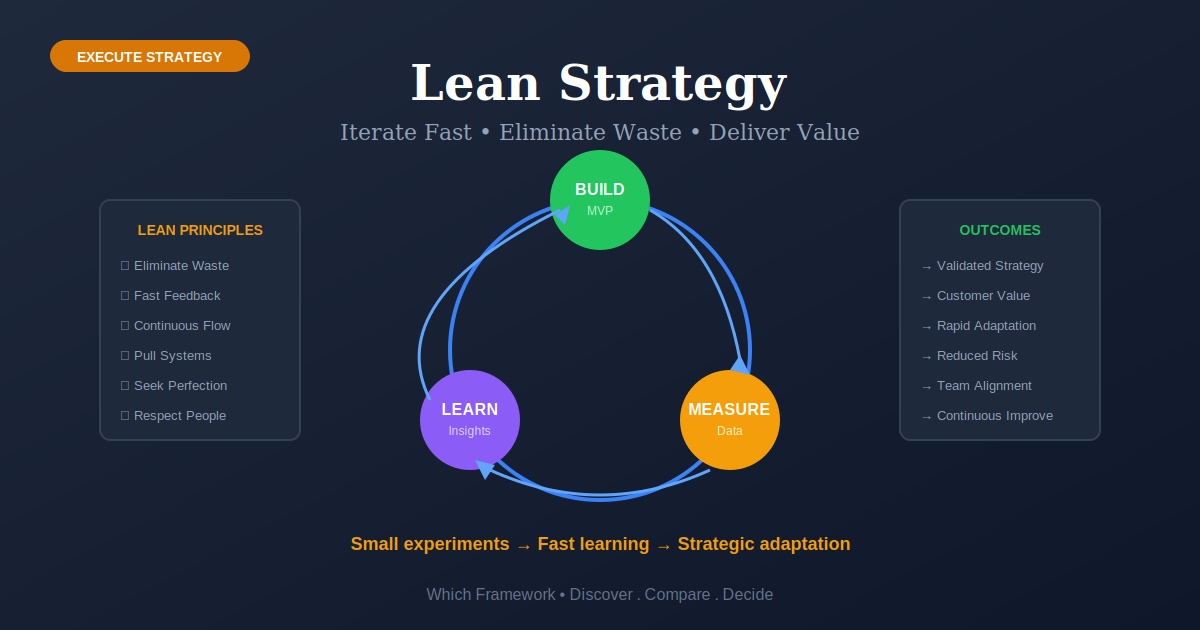
Lean Strategy: Setting a Direction You Already Know Will Change
Lean Strategy is a strategy process in which a fixed vision and a deliberate objective, scope and advantage form a boundary, inside which experiments run and whose results then revise the boundary.
Before you start
Is this your framework?
This process answers one question: how do you keep enough direction to be coherent while changing course often enough to survive. It sets deliberate boundaries, runs experiments inside them, and lets the results move the boundaries.
Two unrelated things are published under this name, which is worth settling before you go further. This page covers the strategy process for ventures under uncertainty. The other is an argument that lean manufacturing is itself a business strategy; the comparison below separates them.
| If your real problem is… | You probably want |
|---|---|
| We need to test whether the product works at all | Lean Canvas — the business model hypotheses themselves, which this process assumes you are already testing Compare Lean Strategy and Lean Canvas |
| We have a strategy and cannot get it into the organization | Hoshin Kanri or OKR — deployment, which is a different problem from deciding under uncertainty Compare Lean Strategy and OKR |
| We cannot say what our strategy actually is | Business Model Canvas — the shape of the business on one page, before any process runs on it |
| The future is genuinely unknowable and we need options | Scenario Planning — several plausible futures, rather than one direction with experiments inside it |
| Our processes are wasteful and slow | Lean Core Principles — the operational lean tradition, which shares only the word |
| We are chasing every opportunity that appears | That is the problem this page addresses, and the answer is the scope boundary in the deliberate strategy |
| A venture that keeps pivoting and has lost any through-line | Lean Strategy — you are in the right place |
What Is It?
Strategy and entrepreneurship pull in opposite directions. Strategy means committing to one path. Entrepreneurship means changing direction whenever better information arrives. Run purely on strategy and a venture becomes central planning; run purely on opportunism and it becomes chaos.
The reconciliation is to make the strategy a boundary rather than a plan. Leadership fixes a vision, then commits to a near-term objective, a scope of what the firm will and will not do, and a statement of how it intends to win. Those three define the space inside which people are free to experiment.
Everything after that is a loop. Daily decisions and deliberate experiments run inside the boundary; their results feed back and change it. The strategy is a screen new ideas must pass and a yardstick for judging the experiments, and the only part that stays fixed is the vision.
Quick Reference
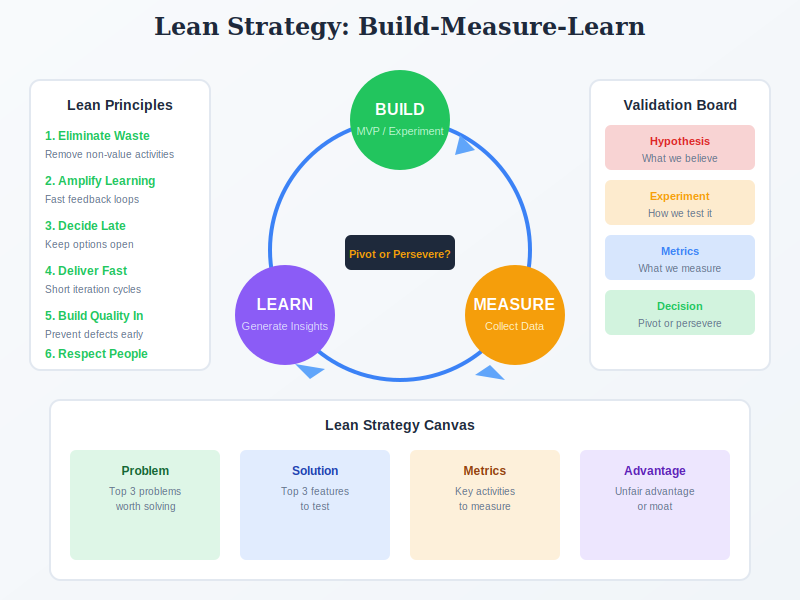
The loop
The five phases, and which one is fixed
Four of the five repeat. The vision is set once and is the only part that is supposed to survive contact with what the experiments return.
| Phase | What it produces | Changes |
|---|---|---|
| 1. Vision | The venture's ultimate purpose, in a sentence | Almost never. This is the anchor |
| 2. Analysis | An honest read of resources, capabilities and the competitive situation | Each loop |
| 3. Deliberate strategy | Objective, the near-term goal that describes success. Scope, what the firm will and will not do. Advantage, why a customer would choose it | Every few quarters. The scope line is what stops opportunity chasing |
| 4. Learning | Daily decisions and deliberate experiments, run inside the boundary | Constantly |
| 5. Emergent strategy | What the results actually showed, and the revisions they force | Each loop, back into analysis |
The scope line does most of the work
Objective and advantage are the parts teams enjoy writing. Scope, and specifically the half that says what the firm will not do, is the part that gets softened, and it is the one that decides whether the process changes any behavior.
A scope statement with no exclusions is not a boundary. Its whole function is to let someone decline an attractive opportunity in a meeting without relitigating the strategy, and that requires having written down in advance what kind of opportunity is out.
Disambiguation
Two different things called lean strategy
Searching this term returns two bodies of work that share nothing but the word lean. They are not variants of each other.
| The work | The claim | Who it is for |
|---|---|---|
| The lean strategy process this page | Strategy should be a boundary for experiments, not a plan. Deliberate and emergent strategy combined | Ventures and growing companies deciding under uncertainty |
| Lean as strategy Balle, Jones and colleagues | Lean is not an operations toolkit but a competitive strategy in itself, built on learning and developing people | Established firms running or considering a lean transformation. Closer to Lean Core Principles |
| Lean Startup often confused with both | Build, measure, learn. Validate the product hypothesis before scaling | Founders testing whether a product works at all. A narrower question than either of the above |
Why the confusion matters
The three answer different questions and are often blended into a single vague recommendation to be lean and iterate. Lean Startup asks whether the product works. The process on this page asks which opportunities the venture should allow itself to pursue. Lean as strategy asks how an established firm competes through learning.
The practical consequence is that a founder who has read only Lean Startup has a method for testing a product and none for declining a distracting one. That gap is what the deliberate half of this process fills.
Core Features
- Deliberate and emergent held together: a fixed boundary containing genuine experimentation
- Three-part deliberate strategy: objective, scope, competitive advantage
- Scope includes exclusions: what the firm will not do, written down in advance
- Strategy as a screen: new ideas must pass it before they get resource
- The vision is the only fixed part: everything below it is revisable
- A loop, not a plan: results return to analysis and the cycle repeats
Worked example
A logistics software venture in Lisbon, and the contract it turned down
An illustrative composite. A Portuguese company of 34 people sold route optimization to mid-size road hauliers. Growth had stalled and the team was arguing about three unrelated directions at once.
| Phase | What it produced |
|---|---|
| Vision | Small hauliers should plan routes as well as the largest ones can. Unchanged throughout. |
| Deliberate strategy | Objective: 200 paying fleets within eighteen months. Scope: road freight in Iberia, fleets of 10 to 200 vehicles, explicitly not warehousing and not enterprise logistics. Advantage: setup in a day, against competitors quoting six weeks. |
| What the boundary cost | A warehousing group offered roughly EUR 400,000 for a custom build. It was declined in one meeting rather than debated for a month, because it sat outside a scope line agreed in advance. |
| What the experiments returned | Four pricing and onboarding tests inside the boundary. Self-serve onboarding lifted trial-to-paid conversion; a per-vehicle price band did not, and was dropped in three weeks. |
| What the boundary itself became | Two loops in, the data showed fleets of 10 to 40 converting far better than larger ones. Scope was narrowed to that band. The vision did not move; the boundary did. |
The declined contract is the whole point
A venture with no written scope takes the EUR 400,000, and spends the next year building warehousing features for one customer. The revenue is real, which is exactly why the decision is hard to make in the moment and easy to make in advance.
Note that the boundary was not permanent either. It narrowed when the experiments said so, which is the difference between this and a business plan. What did not move was the vision, and that is what made the narrowing feel like progress rather than another pivot.
When to Use
- A venture past product validation but with no agreed direction
- A team that pivots so often nobody can say what the company is for
- Attractive opportunities keep arriving and each one is debated from scratch
- Growth has stalled and the leadership team disagrees on where to go
- Investors are asking for a strategy and a static plan would be dishonest
- Any setting where the plan will demonstrably be wrong within a year
When NOT to Use
- Before there is a product anyone wants, where the question is validation not direction
- In stable, slow-moving markets where a conventional strategy cycle works
- As a deployment method for a large organization, which needs something built for that
- Where leadership will not write down what the firm will not do
- As a synonym for lean manufacturing, which is unrelated despite the name
- Where the real constraint is execution capacity rather than direction
In practice
How it goes wrong
Almost every failure is the same one: keeping the emergent half, which is enjoyable, and quietly dropping the deliberate half, which is constraining.
| Failure mode | What it looks like | What to do instead |
|---|---|---|
| Scope with no exclusions | A scope statement listing what the firm does and nothing it declines | Write the exclusions first. If nothing attractive is excluded, there is no boundary. |
| Experiments with no boundary | Continuous testing in every direction, described as being lean | The deliberate strategy comes first. Experiments without it are just activity. |
| The vision keeps moving | Purpose rewritten every time a test disappoints | Move the boundary, not the anchor. If the vision is wrong, that is a separate and much larger decision. |
| Results never revise anything | Experiments run, get reported, and the strategy is unchanged a year later | Book the revision. The emergent phase is a scheduled decision, not a mood. |
| Confused with Lean Startup | Build-measure-learn adopted and the deliberate half never written | They answer different questions. Validation is not direction. |
| Boundary used to dodge bad news | A failing objective defended because it is in the strategy | The objective is the most revisable of the three. Analysis exists to reopen it. |
Sourced
Evidence, and how to cite it
The process is David Collis's, published in 2016.
Collis, a professor at Harvard Business School, set out the lean strategy process as a way for start-ups to innovate in a disciplined fashion: vision, analysis, a deliberate strategy of objective, scope and advantage, then learning and emergent strategy feeding back. The objective, scope and advantage triad comes from his earlier work with Michael Rukstad on stating a strategy in a single sentence.
Collis, D.J. (2016) ‘Lean Strategy’, Harvard Business Review, 94(3), pp. 62–68; Collis, D.J. and Rukstad, M.G. (2008) ‘Can You Say What Your Strategy Is?’, Harvard Business Review, 86(4).
The deliberate and emergent distinction is Mintzberg's.
Henry Mintzberg and James Waters separated strategy as intended from strategy as it turns out in practice, and argued that real strategies are almost always a blend. Collis's contribution is not that distinction but a working process for holding both at once, with the deliberate half acting as the boundary for the emergent half.
Mintzberg, H. and Waters, J.A. (1985) ‘Of strategies, deliberate and emergent’, Strategic Management Journal, 6(3), pp. 257–272.
Two unrelated bodies of work carry this name.
The Lean Strategy by Michael Balle, Daniel Jones, Jacques Chaize and Orest Fiume argues that lean, in the Toyota sense, is itself a competitive strategy rather than a set of operational tools. It shares the title and almost nothing else with the process described here. Neither work is a version of the other, and citing one for the other is a common error.
Balle, M., Jones, D., Chaize, J. and Fiume, O. (2017) The Lean Strategy. New York: McGraw-Hill.
There is no outcome evidence for the process.
The 2016 article is an argument illustrated with cases, not a study. No trial or cohort analysis compares ventures using this process with ventures that do not, and the underlying claim that written scope exclusions improve venture outcomes has not been tested directly. The reasoning is sound and the mechanism is plausible; that is a different thing from demonstrated effect.
No comparative outcome studies of the lean strategy process are available in the strategy literature as of 2026.
How to cite it.
Harvard: Collis, D.J. (2016) ‘Lean Strategy’, Harvard Business Review, 94(3), pp. 62–68.
APA: Collis, D. J. (2016). Lean strategy. Harvard Business Review, 94(3), 62–68.
Check which lean strategy you mean before citing. For lean as a competitive strategy, cite Balle et al. (2017). For build-measure-learn, cite Ries (2011), which is a third thing again.
Key Strengths
- Makes declining an opportunity cheap: the scope line is agreed before the tempting offer arrives
- Keeps experimentation without losing coherence: both halves, held together
- Honest about a changing plan: revision is designed in rather than treated as failure
- Short enough to be used: objective, scope and advantage fit on a page
- Names what stays fixed: the vision, which stops every setback becoming a pivot
Key Weaknesses
- No outcome evidence: an argument with cases, not a study
- Depends entirely on the exclusions: and those are the first thing softened
- The name collides with two other things: which causes real confusion in practice
- Says little about how to experiment: the learning phase is thin on method
- Assumes leadership can agree: a split team produces a scope that excludes nothing
- Not built for large organizations: it is a venture process
Sequencing
What to run before and after
The process needs a business worth directing, and it stops at the point where the direction has to reach people.
Before
Establish that the business works at all
Setting a scope boundary around a product nobody wants is premature. The question at that stage is validation, and it has its own tools.
During
Give the objective something measurable
The near-term objective has to describe success concretely enough that an experiment can succeed or fail against it. That is a measurement problem the process does not solve.
After
Get the boundary into the organization
A scope line only works if the people fielding opportunities know it. Past thirty or forty people that stops happening by conversation and needs a deployment method.
Common questions
Lean Strategy: quick answers
What is lean strategy?
A strategy process for ventures under uncertainty. Leadership fixes a vision, then sets a deliberate strategy of three parts: a near-term objective, a scope of what the firm will and will not do, and how it intends to win. Experiments run inside that boundary and their results revise it. The strategy acts as a screen new ideas must pass rather than as a plan to follow.
Who created lean strategy?
David J. Collis, of Harvard Business School, in a 2016 Harvard Business Review article. The objective, scope and advantage triad comes from his earlier work with Michael Rukstad, and the deliberate versus emergent distinction underneath it is Henry Mintzberg's.
What are the five phases of the lean strategy process?
Vision, the venture's ultimate purpose. Analysis, an honest read of resources, capabilities and competitive position. Deliberate strategy, comprising objective, scope and competitive advantage. Learning, where daily decisions and experiments run inside that boundary. Emergent strategy, where results revise the boundary and the loop returns to analysis. Only the vision is meant to stay fixed.
Is lean strategy the same as lean startup?
No. Lean Startup asks whether a product works, through build, measure and learn. This process asks which opportunities a venture should allow itself to pursue, which only becomes the live question once something works. A founder with only Lean Startup has a way to test a product and no way to decline a distracting one.
Is lean strategy the same as lean manufacturing?
No, and the shared word causes real confusion. There is also a separate book called The Lean Strategy, by Michael Balle, Daniel Jones and colleagues, arguing that lean in the Toyota sense is itself a competitive strategy. That is a different subject with a different audience, and neither work is a version of the other.
What goes in the scope statement?
What the firm will do and, more importantly, what it will not. The exclusions are the part that does the work, because their function is to let someone decline an attractive opportunity without reopening the strategy. A scope statement that excludes nothing is not a boundary and will not change any decision.
How often should the strategy be revised?
The deliberate strategy every few quarters, or whenever experiments return something that contradicts it. The vision almost never. The common failure is at both extremes: revising the vision every time a test disappoints, or running experiments for a year without letting any result change the boundary.
Does lean strategy work?
The reasoning is sound and the mechanism is plausible, but there is no outcome evidence. The 2016 article is an argument illustrated with cases rather than a study, and no research compares ventures using the process with ventures that do not. Treat it as a well-argued way to structure a decision, not as a demonstrated method.
Deep Resources
Frameworks related to Lean Strategy
- Lean CanvasThe validation question that comes before there is a direction to set…
- Scenario PlanningFor uncertainty deep enough that one boundary will not hold…
- Hoshin KanriDeployment, once the venture is too large for the boundary to travel by conversation…