
Scenario Planning: Critical Uncertainties and the 2x2 Matrix
Scenario Planning is a strategic foresight method that identifies the driving forces acting on an organization and builds several internally consistent narratives of how the future could unfold, so that strategy can be tested against each one.
Before you start
Is this your framework?
Scenario planning is for one situation: the decision matters, the horizon is long, and the important uncertainties cannot be settled by gathering more data. If better information would resolve the question, buy the information. Scenarios are for the uncertainties that will not resolve until after you have had to commit.
It also needs a decision to attach to. A scenario exercise with no pending commitment produces four interesting stories and nothing else, which is the commonest way the method wastes a year.
| If your real problem is… | You probably want |
|---|---|
| We need to know which external forces are acting on us in the first place | PESTEL Analysis — the sweep that produces the driving forces a scenario exercise then ranks Compare Scenario Planning and PESTEL |
| We want to explore the space of futures broadly, not commit to four of them | Futures Thinking — a wider family of methods, of which scenario building is one Compare Scenario Planning and Futures Thinking |
| The uncertainties are known and can be assigned probabilities | Risk Management Framework — likelihood and impact, where scenarios refuse to assign probabilities |
| We need to judge whether this industry is structurally attractive | Porter’s Five Forces — the present shape of an industry rather than its possible futures |
| We need a current internal and external picture for a planning cycle | SWOT Analysis — faster, shallower, and anchored in today |
| We have a direction and need it turned into measurable commitments | OKR or Balanced Scorecard — execution, which scenarios deliberately stop short of |
| A long-horizon commitment hangs on uncertainties that will not resolve in time | Scenario Planning — you are in the right place |
What Is It?
Most planning assumes one future and argues about the details. Scenario planning assumes several, and asks a different question: not what will happen, but what would we do if this happened instead. The output is a small set of stories about how the world could develop, each internally consistent, none of them a forecast.
The method separates two kinds of force. Predetermined elements are things already in motion and reasonably knowable — the age profile of a population, infrastructure already under construction. Critical uncertainties are forces that would change your decisions and that genuinely could go either way. Scenarios are built from the second kind, because the first kind appears in every future.
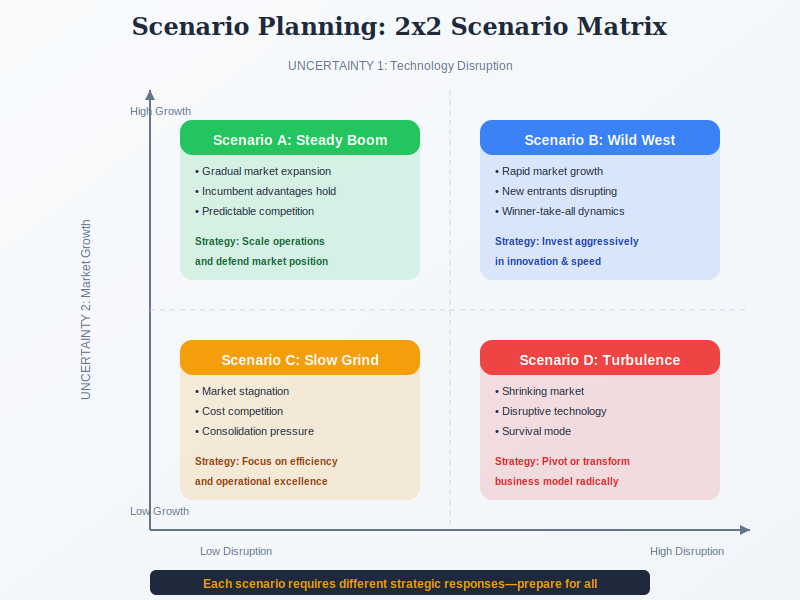
The best-known way of building them is the 2x2 matrix: rank the driving forces by impact and by uncertainty, take the top two, make each an axis, and develop the four resulting quadrants into narratives. That technique is set out in the next section. It is almost always attributed to Shell, and it did not originate there — the evidence section covers who actually codified it.
What the method is for is worth stating plainly, because it is routinely misunderstood. Pierre Wack, who built the practice at Shell, called it the gentle art of reperceiving. The purpose is to change what decision-makers can imagine, so that when something unexpected occurs they recognize it rather than dismiss it. A scenario that comes true is a coincidence. A scenario that made someone notice a signal early has done its job.
Scenario planning draws its raw material from PESTEL Analysis and sits inside the wider family of methods covered under Futures Thinking.
Quick Reference
The method
Building the scenarios
Six steps. The third and fourth carry the exercise; the rest is preparation and follow-through. Each step has a test, and a step that cannot pass its test produces a scenario set that looks finished and decides nothing.
| Step | What it requires | The test |
|---|---|---|
| 1. Frame the focal question | A specific decision with a horizon attached, not a topic. “Should we commit to this refinery for twenty years” works; “the future of energy” does not. | Is there a commitment this will inform? |
| 2. List the driving forces | A wide sweep of what could shape the answer: political, economic, social, technological, environmental, regulatory. Breadth matters more than precision here. | Did anything on the list surprise the room? |
| 3. Rank by impact and uncertainty | Score every force twice. Both scores must be high to qualify. A force that is important but knowable is a predetermined element and belongs in every scenario, not on an axis. | Can you name the predetermined elements you set aside? |
| 4. Choose the two axes | The two top-ranked uncertainties, each given a clear low and high end. They must vary independently, or two of the four quadrants describe worlds that cannot exist. | Can you describe all four corners as plausible? |
| 5. Write the narratives | Each quadrant developed into a story with a name, a causal chain and consequences. Stories rather than bullet lists, because the point is to be remembered and repeated. | Could someone retell one of them a month later? |
| 6. Draw implications and set signposts | Test current strategy against each scenario, note which moves work everywhere, and name the early indicators that would tell you which world is arriving. | What would you watch for on Monday? |
The axis test, and the moves that matter
Two axes that move together are one axis drawn twice. Economic growth and employment rise and fall in step, so a matrix using both leaves two quadrants describing worlds nobody can imagine. The check is to describe all four corners aloud; if two sound absurd, change an axis. The same failure appears whenever two dimensions are chosen without testing independence, including on a competitive positioning map.
Step six is where the value actually lands. Testing a strategy across all four scenarios — sometimes called wind tunneling — separates robust moves that pay in every future from bets that pay in one. Organizations that get something out of scenario planning usually get it here, in the form of a decision they could take immediately, rather than from the stories themselves.
Core Features
- Multiple futures: several plausible worlds, none of them a forecast
- No probabilities: scenarios are deliberately not weighted or ranked
- Critical uncertainties: high impact and high uncertainty, both required
- Predetermined elements: the knowable forces that appear in every scenario
- Narrative form: stories, because stories are what people retain
- Signposts: early indicators that show which world is arriving
Worked example
A sugarcane mill, and the axes that had to be redrawn
An illustrative composite. A sugarcane processor in São Paulo state, Brazil, producing both raw sugar and fuel ethanol, facing a decision on whether to commit around R$400 million to new crushing and distillation capacity with a twenty-five year life.
| Step | What it produced |
|---|---|
| Focal question | Not “the future of biofuels” but a specific commitment: should the mill add capacity now, and configured for which output mix? |
| The first pair of axes | Electric vehicle adoption and carbon policy stringency. The quadrants collapsed. Stringent carbon policy drives electrification, so “fast adoption with weak policy” and “slow adoption with strong policy” were worlds nobody could describe. The axes were measuring one force. |
| The second pair | Electric vehicle adoption against the global sugar price. Both matter enormously to a mill that can shift its crush between sugar and ethanol, and neither drives the other. All four corners were describable. |
| The narratives | Four stories, developed and named. Ethanol demand holding with thin margins; a swing to sugar; a squeeze where neither product pays; and a full pivot to sugar and bioproducts. |
| The robust move | Only one investment paid in all four: flexibility itself. Equipment that let the mill shift its sugar-to-ethanol ratio faster and further cost about 12% more than a fixed configuration, and improved the outcome in every scenario. |
What the exercise produced, and what it did not
The correlated axes were caught because someone tried to describe all four corners aloud. Two of them could not be said without absurdity, which is what a failed independence test sounds like in a room. Had the first matrix survived, the mill would have built narratives around two impossible worlds and taken a decision on the two remaining ones, without ever noticing that half the analysis was void.
Three years on, none of the four scenarios has occurred. Electric adoption ran faster than the slow case and slower than the fast case, and sugar prices moved for reasons nobody had listed. This is the normal outcome and not a failure. The mill had bought flexibility, so it did not need to have been right; and it had signposts, so it saw the mix shifting a full season before the market commentary did. That is what Wack meant by reperceiving.
When to Use
- A commitment is long-lived and hard to reverse
- The key uncertainties are structural, not statistical, so no data settles them
- Leadership shares one unexamined view of how the future will go
- The industry has been disrupted before and the last plan assumed it would not be
- You need to stress-test an existing strategy rather than generate a new one
- Capital, infrastructure, energy, policy or anything with a decade-scale horizon
When NOT to Use
- The horizon is a year or two, where forecasting works better
- The uncertainty could be resolved by research you could simply commission
- No decision is pending, so the output has nothing to attach to
- Senior people will not take part, since the point is to change their thinking
- It would be used to justify a commitment already made
In practice
How scenario planning goes wrong
The characteristic failure is not a bad scenario. It is a good set of scenarios that changes nothing.
| Failure mode | What it looks like | What to do instead |
|---|---|---|
| Best case, worst case, base case | Three scenarios along one dimension, so everyone plans for the middle one and the exercise is a forecast in disguise | Use genuinely different dimensions. Scenarios that can be ranked are not scenarios. |
| Correlated axes | Two quadrants describing worlds that cannot exist, quietly ignored during the write-up | Describe all four corners aloud before writing anything. If two sound absurd, change an axis. |
| Scenarios without a decision | A handsome report, presented once, with no pending commitment to inform | Start from the decision. If none exists, wait until one does. |
| Assigning probabilities | Percentages attached to each scenario, at which point three of them stop being considered | Refuse probabilities. Their absence is what forces all four to be taken seriously. |
| Built by the planning team alone | Excellent scenarios produced by analysts, presented to executives who never wrestled with them | Involve the decision-makers in building them. Reperceiving cannot be delegated. |
| No signposts | Four futures and no indication of which is arriving, so nothing is monitored afterwards | Name the early indicators for each scenario and give someone the job of watching them. |
Sourced
Evidence, and how to cite it
The technique began at RAND, and reached business through Shell.
Herman Kahn developed systematic what-if storytelling at the RAND Corporation from the late 1940s, applying it to nuclear strategy; the name “scenarios” was suggested to him by the screenwriter Leo Rosten. Pierre Wack and Ted Newland brought the approach into Royal Dutch Shell’s planning group around 1971, replacing a forecasting system built for a world of more of the same. Wack set out the thinking publicly only in 1985, in two Harvard Business Review articles.
Kahn, H. (1960) On Thermonuclear War. Princeton University Press; Wack, P. (1985) ‘Scenarios: uncharted waters ahead’ and ‘Scenarios: shooting the rapids’, Harvard Business Review, 63(5) and 63(6).
The 2x2 matrix is not Shell’s method, despite being universally attributed to it.
Angela Wilkinson, a former head of Shell scenarios, and Roland Kupers wrote in Harvard Business Review in 2013 that deductive methods such as a 2x2 matrix with axes were never core to Shell practice, and are associated with Shell only because Peter Schwartz — Wack’s successor there — later promoted them at Global Business Network. Andrew Curry’s history of the field states that the literature repeatedly and incorrectly conflates the two. Thomas Chermack, Wack’s biographer, reported finding just two 2x2 diagrams in the entire Wack archive, one of which was not about scenarios at all. The technique was published as an appendix to Schwartz’s The Art of the Long View.
Wilkinson, A. & Kupers, R. (2013) ‘Living in the futures’, Harvard Business Review, May; Schwartz, P. (1991) The Art of the Long View. New York: Doubleday; Curry, A. (2021) ‘A critical history of scenario planning’, in Handbook of Social Futures.
Whether Shell’s scenarios caused its response to 1973 cannot really be established.
The founding story of the field is that Shell foresaw the oil shock and profited while rivals did not. Shell’s scenarios did explore a sharp price rise beforehand, and the company is generally held to have moved faster afterwards. But no controlled comparison exists. Crediting the outcome to the scenarios, rather than to other differences between the oil majors, is more than the evidence can support. Wack himself insisted scenarios do not predict, which sits awkwardly with a reputation built on an apparent prediction.
Wilkinson & Kupers (2013); Cornelius, P., van de Putte, A. & Romani, M. (2005) ‘Three decades of scenario planning in Shell’, California Management Review, 48(1).
How to cite it.
Harvard: Wack, P. (1985) ‘Scenarios: uncharted waters ahead’, Harvard Business Review, 63(5), pp. 72–89.
APA: Wack, P. (1985). Scenarios: Uncharted waters ahead. Harvard Business Review, 63(5), 72–89.
For the 2x2 technique, cite Schwartz, P. (1991) The Art of the Long View. New York: Doubleday. For the origin, cite Kahn (1960). For Shell’s own retrospective, cite Wilkinson and Kupers (2013).
Key Strengths
- Breaks a single view: forces a room to hold more than one future at once
- Finds robust moves: decisions that pay whichever way things go
- Memorable: narratives survive in an organization where analyses do not
- Works without data: useful precisely where forecasting has nothing to work with
- Builds early warning: signposts turn a study into ongoing attention
Key Weaknesses
- Slow and expensive: months of senior time, which is the scarce input
- The axes decide the output: two poor choices waste the whole exercise
- Rarely matches events: the future usually lands between the scenarios
- Hard to evaluate: no way to show what a changed mental model was worth
- Easily shelved: the report is admired and the strategy proceeds unchanged
Sequencing
What to run before and after
Scenarios need raw material going in and a decision waiting at the other end. Without either, the exercise floats.
Before
Gather the driving forces
Step two of the method is an environmental sweep, which is exactly what PESTEL produces. Running it first means the scenario workshop starts with a list to rank rather than a blank wall.
During
Test the strategy against every scenario
Wind tunneling is where the value appears. Take the current plan into each world in turn and ask what breaks, then separate the moves that pay everywhere from the ones that need a particular future.
After
Commit to the robust moves and watch the signposts
Turn the moves that pay in every scenario into funded commitments, and give the early indicators an owner and a review date. A scenario set nobody monitors expires quietly.
Common questions
Scenario planning: quick answers
What is scenario planning?
A method for preparing an organization for several plausible futures instead of one forecast. It identifies the forces acting on the business, isolates the ones that are both consequential and genuinely uncertain, and builds internally consistent stories of how things could unfold. Strategy is then tested against each story rather than against a single expectation.
How do you build a 2x2 scenario matrix?
List the driving forces acting on your focal question. Score each on two things: how much it would change your decisions, and how uncertain it genuinely is. Take the two that score highest on both, put one on each axis, and give each a clear low and high end. The four quadrants become four scenarios, each written up as a narrative.
What are critical uncertainties?
Driving forces that are both high impact and high uncertainty. High impact alone is not enough: an aging population matters enormously but is largely predictable, which makes it a predetermined element rather than an uncertainty. High uncertainty alone is not enough either, since plenty of unpredictable things would not change what you do. Only forces scoring on both make useful axes.
Is the 2x2 matrix Shell's method?
No, though it is almost universally attributed to Shell. Angela Wilkinson, a former head of Shell scenarios, and Roland Kupers wrote in Harvard Business Review in 2013 that deductive methods such as a 2x2 matrix were never core to Shell practice. The technique was promoted by Peter Schwartz, Pierre Wack's successor at Shell, after he left to found Global Business Network, and was set out in an appendix to The Art of the Long View.
How many scenarios should you build?
Usually three or four. Two invites people to read them as a best case and a worst case and split the difference. Five or more stops being memorable, and teams cannot hold them in mind during a decision. Four is the number the 2x2 produces, which is part of why the technique became popular.
What is the difference between scenario planning and forecasting?
A forecast gives one answer with a confidence interval and works well when the future resembles the past. Scenario planning gives several answers with no probabilities attached and works when the important uncertainties are structural rather than statistical. Pierre Wack described the aim as reperceiving: changing how decision-makers see their situation, not telling them what will happen.
Did Shell predict the 1973 oil crisis?
That is the standard story, and it should be treated carefully. Shell's scenarios did explore a sharp oil price rise before 1973, and the company is generally held to have responded faster than its competitors. But whether the scenarios caused that advantage is difficult to establish, since no controlled comparison exists. Wack himself maintained that scenarios do not predict.
How do I cite scenario planning?
Harvard style: Wack, P. (1985) 'Scenarios: uncharted waters ahead', Harvard Business Review, 63(5), pp. 72-89. APA style: Wack, P. (1985). Scenarios: Uncharted waters ahead. Harvard Business Review, 63(5), 72-89. For the 2x2 technique cite Schwartz, P. (1991) The Art of the Long View. New York: Doubleday. For the origin of scenarios cite Kahn (1960); for Shell's own retrospective, Wilkinson and Kupers (2013).
Deep Resources
Frameworks related to Scenario Planning
- PESTEL AnalysisPolitical, economic, social, technological, environmental and legal forces — the sweep that feeds…
- Futures ThinkingThe wider family of foresight methods, of which scenario building is one…
- Risk Management FrameworkIdentifying and treating risks by likelihood and impact, where scenarios refuse probabilities…