Porter's Five Forces: Industry Analysis Framework
Porter's Five Forces is an industry analysis framework that examines five competitive forces to determine industry attractiveness and profitability potential.
Before you start
Is Five Forces your framework?
Five Forces explains why some industries are structurally more profitable than others. Its unit of analysis is the industry, not your company — a point that sounds pedantic and turns out to decide whether the exercise is useful.
If you want to know why you specifically are winning or losing against a rival in the same industry, this is the wrong lens. The forces act on all of you at once.
| If your real problem is… | You probably want |
|---|---|
| Why are we behind a rival facing identical conditions? | VRIO or the Resource-Based View — the opposing tradition, looking inward Compare Five Forces and VRIO |
| What macro forces are reshaping our world? | PESTEL — wider than the industry, and not about profitability Compare with PESTEL |
| We need a fast shared picture of our position | SWOT — Five Forces is one good way to fill in its O and T Not sure which? Compare |
| How should we compete once we are in the industry? | Porter’s Generic Strategies — Porter’s own answer to the next question Not sure which? Compare |
| Can we avoid this competition altogether? | Blue Ocean Strategy — built explicitly against the assumption that structure is fixed |
| Deciding whether and how to expand into a new market | The market expansion playbook, where Five Forces is stage 2 of 6 |
| Should we enter this industry, and what will it cost us? | Five Forces — you are in the right place |
The distinction that matters
Five Forces asks “how much profit is available in this industry, and who captures it?” — not “how do we win?”. An analysis concluding “rivalry is high” has described the weather. The useful output is which force is currently taking your margin, and whether anything you control can change that.
What Is It?
Porter's Five Forces, introduced by Harvard Business School professor Michael Porter in 1979, is one of the most influential frameworks in strategic management. It analyzes the competitive dynamics that shape every industry.
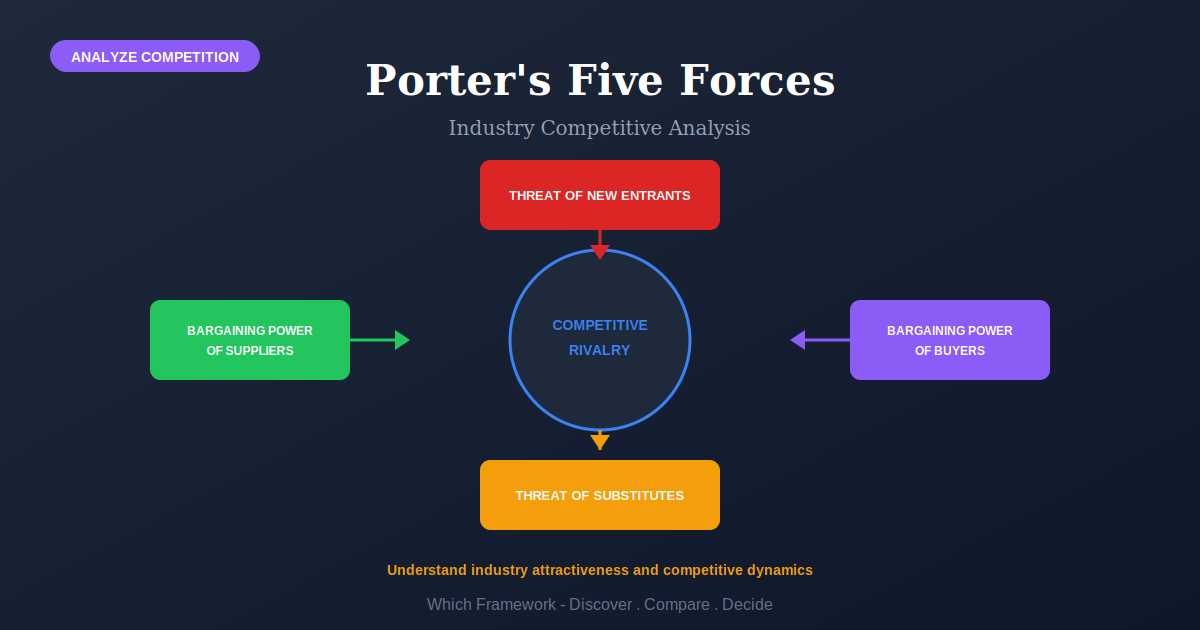
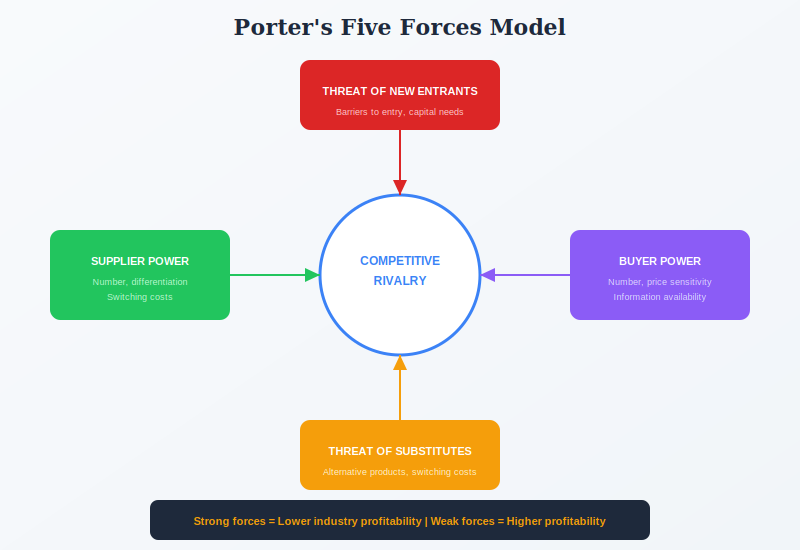
The five forces are: Threat of New Entrants (how easily can competitors enter?), Bargaining Power of Suppliers (can suppliers dictate terms?), Bargaining Power of Buyers (can customers demand lower prices?), Threat of Substitutes (what alternatives exist?), and Competitive Rivalry (how intense is current competition?).
Strong forces reduce industry profitability; weak forces increase it. The framework helps identify attractive industries and informs positioning strategy. It complements broader tools like SWOT Analysis and PEST Analysis.
Quick Reference
The core structure
Each of the five forces, and what actually determines it
Each force is a claim about who can extract value from your industry. The middle column is what most summaries say; the right column is the question that decides the answer.
| Force | What drives it | The question that decides it |
|---|---|---|
| Threat of new entrants | Capital requirements, economies of scale, brand loyalty, regulation, access to distribution | What would it actually cost, in money and years, for a competent, funded newcomer to reach your position? Put a number on it. |
| Bargaining power of suppliers | Supplier concentration, switching costs, uniqueness of input, threat of forward integration | If your largest supplier raised prices 10% tomorrow, what could you actually do about it within a quarter? |
| Bargaining power of buyers | Buyer concentration, price sensitivity, switching costs, threat of backward integration | What share of revenue sits with buyers who could leave inside a year without real pain? |
| Threat of substitutes | Alternative ways of getting the same job done, relative price and performance, switching cost | What did your customers do before your category existed, and what would they do if it vanished? Substitutes usually come from outside the industry, which is why they are missed. |
| Rivalry among existing competitors | Number and balance of competitors, industry growth, exit barriers, fixed cost structure | The force everyone rates “high” and the one that explains least on its own. Rivalry is largely an outcome of the other four — treat a high rating as a symptom and go find its cause. |
On the sixth force
Complementors — products that make yours more valuable — are frequently proposed as a sixth force, following Brandenburger and Nalebuff’s work on co-opetition. Porter’s position is that complements are a factor that shapes the five forces rather than a separate force: a complement affects demand and entry conditions, but does not itself capture industry profit. Whether you add it as a sixth box matters less than noticing complements exist; in platform businesses they routinely determine more than rivalry does.
Core Features
- Industry-Level Analysis: Examines entire competitive landscape
- Five Distinct Forces: Comprehensive view of competitive dynamics
- Profitability Focus: Directly links to profit potential
- Strategic Positioning: Guides how to compete effectively
- Research-Based: Requires data and analysis
Worked example
Five Forces that changed a decision
An illustrative composite. A profitable UK equipment-hire business considering entry into on-site industrial cleaning — adjacent customers, adjacent logistics, apparently obvious. The board expected the analysis to confirm the move.
Note the last column. A rating on its own decides nothing; the entry only matters if it changes what you would do.
| Force | Rating | Why | What it changed |
|---|---|---|---|
| New entrants | High | Two vans and certification. No meaningful scale economics below regional level. | Any margin earned would be competed away within about two years. |
| Suppliers | Low | Chemicals and equipment are commodities from many sources. | Nothing. Genuinely not a constraint. |
| Buyers | Very high | Purchased through facilities-management intermediaries who run reverse auctions annually. Three intermediaries controlled most of the addressable market. | The decisive finding. The customer was never the site owner — it was a procurement function whose job is to compress the price. |
| Substitutes | Medium | In-house cleaning teams, and increasingly automated equipment sold to the site owner. | Put a ceiling on long-run pricing. |
| Rivalry | High | Fragmented, low differentiation, high fixed costs on vehicles. | Symptom, not cause. The rivalry followed from low entry barriers and buyer power above. |
What the analysis decided
The board did not enter. Not because rivalry was high — rivalry is high in their existing business too — but because buyer power was structurally concentrated in intermediaries whose entire function is to remove supplier margin, and nothing the company controlled would change that.
Note what the rivalry row contributed: almost nothing on its own. It was an effect of the other forces. That is the usual case, and it is why an analysis that stops at “rivalry is intense” has not started.
When to Use
- Evaluating industry attractiveness for entry
- Understanding competitive dynamics
- Strategic positioning decisions
- Investment analysis
- After quick SWOT for deeper analysis
When NOT to Use
In practice
How Five Forces analyzes fail
The framework is durable. The exercise is easy to perform badly, and nearly always in the same handful of ways.
| What you see | What it usually means | What to do |
|---|---|---|
| Every force is rated “high” | Difficulty was rated rather than structure | Force a ranking. Which single force takes most of the available margin today? If all five are equally binding, none has been analyzed. |
| The industry is defined as “our sector” | Boundaries were never set, so nothing can be assessed | Define it by where buyers actually substitute. Draw it too wide and every force averages to medium; too narrow and you miss the substitutes that will kill you. |
| Named competitors appear in the analysis | Company analysis has crept into an industry framework | Five Forces describes structure, not rivals. Specific competitors belong in positioning analysis or VRIO. |
| Substitutes are listed as competitors’ products | The force was misread | A substitute meets the same need a different way — video calls against airlines, not one airline against another. Substitutes come from outside the industry, which is why they get missed. |
| The output is five ratings and no decision | The analysis stopped at description | Each force should end with a consequence: what it costs you, and whether anything you control changes it. A force you cannot influence and cannot avoid is a reason not to enter. |
| Done once, five years ago | Structure was treated as permanent | Structure moves — deregulation, a new platform, a supplier merger. Re-run when something structural changes, not on a calendar. |
Sourced
How much does industry actually matter?
It began in 1979, and Porter substantially revised it in 2008.
The framework first appeared in “How Competitive Forces Shape Strategy” in Harvard Business Review in 1979, and was developed in Competitive Strategy the following year. In 2008 Porter published an extended update, “The Five Competitive Forces That Shape Strategy”, which added guidance on defining industry boundaries, addressed common misapplications, and dealt directly with factors people kept proposing as additional forces. Most summaries still teach the 1979 version.
Porter, M. E., “How Competitive Forces Shape Strategy”, Harvard Business Review, March 1979; “The Five Competitive Forces That Shape Strategy”, Harvard Business Review, January 2008.
Economists have measured the framework’s core premise, and the answer is smaller than you would expect.
Five Forces rests on the claim that industry structure substantially determines profitability. That is a testable claim, and it has been tested repeatedly by decomposing the variance in business-unit returns. Schmalensee found in 1985 that industry effects explained around a fifth of the variance, supporting the industry-analysis view. Rumelt reinvestigated in 1991, separating stable from fluctuating effects, and reached markedly different conclusions: negligible corporate effects, small stable industry effects, and very large stable business-unit effects. His conclusion was that the most important sources of economic rents are business-specific, and that industry membership matters much less than had been assumed. Subsequent studies using Line of Business data have generally put industry membership at roughly 17–20% of the variance in firm financial performance.
Schmalensee, R., “Do Markets Differ Much?”, American Economic Review 75, 1985, pp. 341–351; Rumelt, R. P., “How much does industry matter?”, Strategic Management Journal 12(3), 1991, pp. 167–185.
Porter answered, and the argument is genuinely unresolved.
McGahan and Porter revisited the question in 1997 with broader data covering sectors beyond manufacturing, and found industry effects considerably larger than Rumelt had — particularly outside manufacturing, where Rumelt’s data was concentrated. Later work has continued to produce a range rather than a settled figure. What every study agrees on is that industry structure explains some of firm profitability and firm-specific factors explain more. The disagreement is about proportions, not direction.
McGahan, A. M. & Porter, M. E., “How Much Does Industry Matter, Really?”, Strategic Management Journal 18, 1997, pp. 15–30.
This is why the resource-based view exists.
The industry-structure view and the resource-based view are the two poles of modern strategy, and the empirical debate above is exactly where they meet. If industry membership explains a fifth of the variance, four fifths sits inside the firm — which is the case for VRIO. Rumelt’s 1991 paper is cited as foundational by both traditions, which tells you how genuinely contested the ground is.
What that means for using it.
Use Five Forces for the question it answers well: is this industry worth being in, and which force will take our margin? Do not use it to explain why you are outperforming a neighbour — the evidence says most of that difference is firm-specific and the framework has nothing to say about it. Run it alongside an internal analysis rather than instead of one. A strategy built on industry structure alone is working with roughly a fifth of the picture.
Key Strengths
- Rigorous: Systematic, analytical approach
- Comprehensive: All competitive factors
- Widely Respected: Industry standard
- Actionable: Guides strategic decisions
Key Weaknesses
- Time-consuming and complex
- Requires extensive research
- Static snapshot of dynamic markets
- May not capture digital disruption
How It Works
| 1 Primary Input | Industry data, competitive intelligence, market research |
|---|---|
| 2 Data You Need | Market size, competitor analysis, supplier/buyer concentration, entry barriers |
| 3 Primary Output | Industry attractiveness assessment, strategic positioning recommendations |
Comparison with Related Frameworks
Five Forces vs SWOT
SWOT is broader and quicker. Five Forces provides deeper competitive insight. Use SWOT first, then Five Forces for rigorous industry analysis.
Five Forces vs Blue Ocean
Blue Ocean Strategy seeks to escape competitive forces entirely. Five Forces analyzes existing competition. Complementary perspectives.
Sequencing
What to run before and after
Five Forces looks outward at structure. On its own it tells you where to stand, not how to stand there, and nothing about what you bring.
Before
Define the industry
Not a framework — a sentence, and the step that decides whether anything downstream is meaningful. Draw the boundary where buyers actually substitute, and state the geography.
During
Structure outside, capability inside
The evidence says firm-specific factors explain more of profitability than industry does. Running an internal analysis alongside is not thoroughness, it is covering the larger share of the variance.
After
Decide how to compete, or whether to
Five Forces ends at a description of the terrain. Porter’s generic strategies were his own next step; Blue Ocean rejects the premise that the structure must be accepted at all.
Part of a playbook: How to Expand into a New Market. Five Forces is stage 2 of 6, after PESTEL and before VRIO.
Common questions
Porter’s Five Forces: quick answers
What are Porter's five forces?
Threat of new entrants, bargaining power of suppliers, bargaining power of buyers, threat of substitutes, and rivalry among existing competitors. Together they describe how much profit is available in an industry and who captures it. Rivalry is largely an outcome of the other four, which is why an analysis that stops at “rivalry is high” has not really started.
Who created Porter's Five Forces and when?
Michael E. Porter, in “How Competitive Forces Shape Strategy”, published in Harvard Business Review in March 1979 and developed in his 1980 book Competitive Strategy. He published a substantially extended update in Harvard Business Review in January 2008, adding guidance on defining industry boundaries and addressing common misapplications.
Is there a sixth force?
Complementors — products that make yours more valuable — are often proposed as one, following Brandenburger and Nalebuff’s work on co-opetition. Porter’s position is that complements shape the five forces rather than constituting a separate one, since a complement affects demand and entry conditions but does not itself capture industry profit. In platform businesses complements often matter more than rivalry, so notice them either way.
How much does industry structure actually determine profitability?
Less than the framework implies. Schmalensee found in 1985 that industry effects explained about a fifth of the variance in business-unit returns. Rumelt reinvestigated in 1991 and found small stable industry effects but very large business-specific effects, concluding that the most important sources of economic rents are firm-specific. McGahan and Porter pushed back in 1997 with broader data. Studies generally place industry membership at roughly 17–20% of the variance — real, but a minority share.
What is the difference between Porter's Five Forces and SWOT?
Five Forces analyzes industry structure using five defined forces and produces a view of where profit sits. SWOT is a container with four boxes and no method for filling them. They are complementary: Five Forces is one of the better ways to generate the opportunities and threats half of a SWOT.
What is the difference between Five Forces and PESTEL?
Scope. PESTEL covers macro forces acting on everyone — regulation, demographics, technology. Five Forces covers industry structure and who captures the profit within it. PESTEL tells you the weather; Five Forces tells you how the field is tilted. Run PESTEL first if the macro environment is shifting, then Five Forces to see what it does to your industry.
Deep Resources
Frameworks related to Porter's Five Forces
- SWOT AnalysisClassic strategic framework assessing Strengths, Weaknesses, Opportunities, and Threats for…
- PESTEL AnalysisMacro-environmental scanning across Political, Economic, Social, Technological, Environmental,…
- Blue Ocean StrategyStrategic innovation framework creating uncontested market space by shifting focus from…