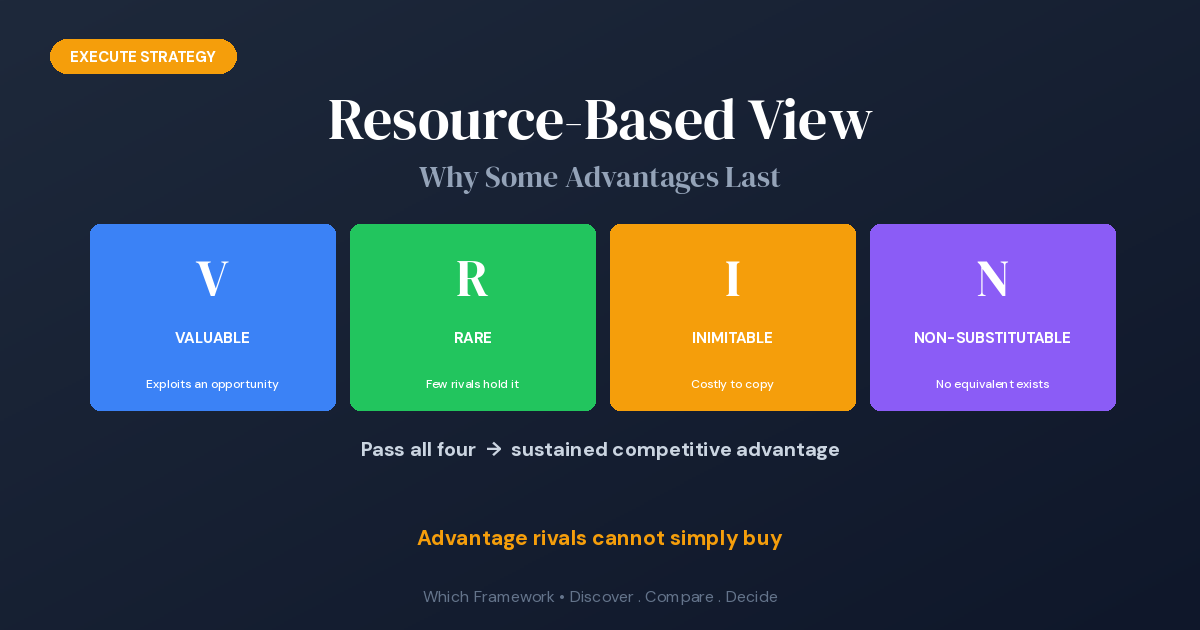
Resource-Based View: Why Some Advantages Last
The Resource-Based View (RBV) holds that a firm's sustained competitive advantage comes from the resources and capabilities it controls internally — specifically those that are valuable, rare, difficult to imitate and difficult to substitute — rather than from the industry position it occupies.
What Is It?
Through the 1980s, strategy was dominated by the question of where to compete. Choose an attractive industry, position defensibly within it, and profits follow. The Resource-Based View asked a different question: why do firms in the same industry, facing the same five forces, perform so differently for so long?
Its answer is that advantage is internal. Firms are not interchangeable units that happen to occupy positions; they are distinct bundles of resources, and those bundles are not freely tradable. If a resource could simply be bought, every competitor would buy it and the advantage would evaporate. What persists is what cannot be easily acquired, copied or replaced.
Birger Wernerfelt introduced the term in a 1984 paper, building on Edith Penrose's 1959 work on firm growth as a function of internal resources. Jay Barney's 1991 article Firm Resources and Sustained Competitive Advantage gave the theory its testable form and is the reference most people mean when they cite RBV.
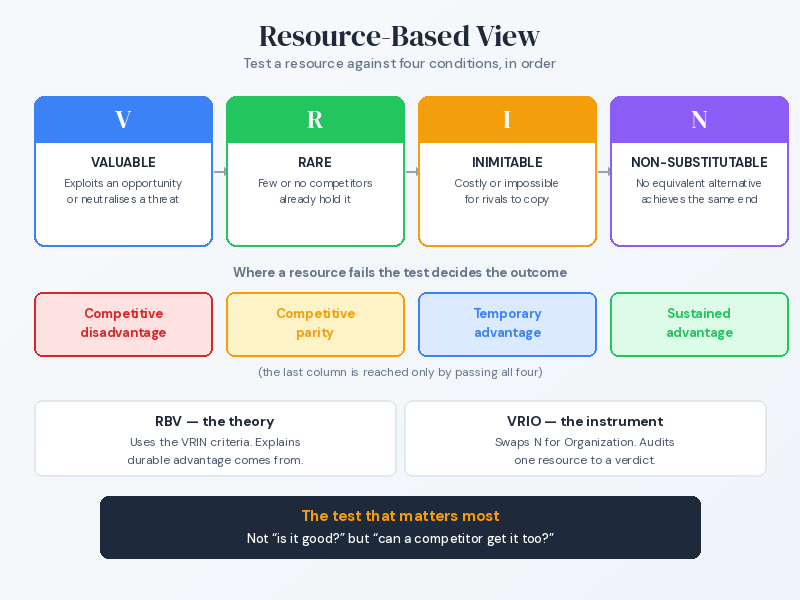
The VRIN Criteria
Barney argued that a resource generates sustained advantage only when it satisfies four conditions simultaneously:
- Valuable — it lets the firm exploit an opportunity or neutralise a threat. A resource that does not improve customer value or reduce cost is a cost center, however distinctive.
- Rare — few or no competitors possess it. A capability everyone has is table stakes; it prevents disadvantage rather than creating advantage.
- Inimitable — rivals cannot copy it at reasonable cost. Barney identified three sources of imitation difficulty: unique historical conditions, causal ambiguity where even the owning firm cannot fully explain why the resource works, and social complexity such as culture and relationships that no one deliberately designed.
- Non-substitutable — no strategically equivalent alternative exists that competitors can use to achieve the same result by different means.
Resources under RBV include tangible assets, but the criteria bite hardest on intangibles: reputation, accumulated know-how, culture, proprietary data, supplier relationships. Tangible assets tend to fail the imitability test, because anything purchasable is purchasable by rivals too.
RBV and VRIO: Theory and Instrument
These are constantly conflated, and the distinction is simple. RBV is the theory — an explanation of where advantage originates. VRIO is the instrument Barney later developed to apply it.
VRIO replaces the fourth VRIN criterion, Non-substitutability, with Organization: is the firm actually structured to capture the value of the resource? The change matters because it addresses a real and common failure — firms holding genuinely rare, inimitable resources that produce nothing, because reporting lines, incentives or processes prevent exploitation. A brilliant research group with no route to product is the standard example.
Practically: use RBV to understand why advantage persists and to frame strategic conversations about what to build versus buy. Use VRIO when you need to audit a specific resource and reach a verdict.
Before you start
Do you want the theory or the tool?
This is the most important thing to settle, and it is the reason most people arrive here by mistake. RBV is a theory, not a method. It explains why firms in the same industry earn different returns. It does not tell you what to do on Monday, and it never intended to.
If you came looking for something to run in a workshop, you want VRIO — Barney’s operationalisation of this theory into four testable questions. Read RBV to understand the reasoning; use VRIO to do the work.
| If you actually want to… | You want |
|---|---|
| Assess your resources in a session next week | VRIO — the instrument built from this theory Compare RBV and VRIO |
| Understand why the industry itself is profitable or not | Porter’s Five Forces — the opposing tradition, looking outward Compare RBV and Five Forces |
| Take a quick, broad view of position | SWOT — RBV is the theory underneath its internal half Not sure which? Compare |
| Decide where to grow, given what you have | Ansoff Matrix or Blue Ocean Strategy Not sure which? Compare |
| Cite the academic source in an essay or dissertation | RBV, and the papers in the evidence section below — Penrose 1959, Wernerfelt 1984, Barney 1991 |
| Understand why competitors in your industry perform differently | RBV — you are in the right place |
The distinction that matters
A theory earns its keep by explaining something. RBV’s claim is that differences in performance between firms in the same industry come from resources those firms hold and rivals cannot readily obtain. If your question is “why are we behind a competitor facing identical market conditions?”, this is the right lens. If your question is “what should we do about it?”, the lens alone will not answer you.
Worked example
The same firm, two lenses
An illustrative composite showing what RBV adds rather than how to run it. Two accountancy practices in the same mid-sized city. Same services, same client base, same regulation, same labor market. One earns roughly three times the profit per partner of the other.
Industry analysis cannot explain this, because every external condition is identical. That gap is precisely the problem RBV was written to address.
| Question | What industry analysis says | What RBV says |
|---|---|---|
| Why the gap? | It should not exist. Both face the same five forces, the same buyer power, the same entry conditions. | The firms hold different resources. Look inside, not outward. |
| What is different? | — | Twenty years of an internal training pipeline. Staff turnover roughly a third of the local norm, so client relationships persist across decades and juniors bill accurately far sooner. |
| Why can’t it be copied? | — | It took twenty years to build and cannot be bought. Even the firm itself cannot fully articulate which practices produce the retention — the causal link is genuinely ambiguous, which is what makes it safe. |
| Could a rival buy it? | — | Not on the open market. Individual accountants can be hired; the accumulated relationships and the culture producing them cannot be. |
| So what should we do? | — | RBV does not answer this. It has told you where the advantage lives and why it holds. Turning that into decisions is VRIO’s job, and acting on it is a change program. |
What the lens actually did
It relocated the question. Industry analysis had nothing to say, because industry conditions were identical — and a partner group that only knows Porter would have concluded the gap was down to luck, effort, or better selling.
Note the last row. RBV stops exactly where a practitioner most wants it to continue, and that is not a flaw in the theory but a fact about what theories do. Any page that presents RBV as a set of steps has quietly turned it into VRIO without saying so.
How to Apply It
- Inventory honestly. List resources and capabilities across categories — physical, financial, human, organizational, technological, reputational. Most teams list what they are proud of rather than what they actually hold.
- Test each against the criteria in order. Value first, because a resource failing that test needs no further analysis. Rarity next, then imitability. Most items drop out at rarity, which is itself the useful finding.
- Ask how long inimitability lasts. Imitation barriers erode. The strategic question is not whether a resource is currently hard to copy, but how many years of protection remains and what happens when it ends.
- Check organizational capture. For anything surviving the first three tests, confirm the firm is structured to exploit it. This is where RBV analysis most often reveals something actionable.
- Convert to decisions. Resources that pass all tests should shape where you invest and what you refuse to outsource. Resources that fail are candidates for outsourcing or divestment.
When to Use
- Deciding what to build in-house versus buy or outsource
- Diversification decisions — whether existing resources transfer to a new market
- Merger and acquisition rationale, where the case rests on acquiring capabilities rather than revenue
- Explaining sustained performance differences between similar competitors
- Prioritizing long-horizon capability investment
- Academic and MBA strategy analysis, where RBV is a core theoretical lens
When NOT to Use
- For industry attractiveness questions. RBV says nothing about whether a market is worth entering. Use Porter's Five Forces.
- In fast-moving environments. Where advantage periods are short, the dynamic capabilities extension is a better fit than classical RBV.
- For early-stage startups. A firm with few accumulated resources gains little from auditing them; Lean Canvas or Business Model Canvas address the actual question.
- When you need a verdict quickly. Use VRIO, which is the operational version.
In practice
How RBV gets misused
Nearly every misuse traces back to treating an explanatory theory as an analytical procedure.
| What you see | What it usually means | What to do |
|---|---|---|
| An RBV “analysis” with steps and a template | The theory has been silently converted into a method | Use VRIO and say so. It is the same lineage, designed for exactly this, and it will not embarrass you in front of anyone who knows the literature. |
| A long list of resources, all called strategic | Nothing was tested for rarity or imitability | Most resources are ordinary and should be. Keep only those a well-funded rival could not obtain within two years. |
| Resources named, but no account of why they hold | The isolating mechanism is missing | State it explicitly: path dependence, causal ambiguity, or social complexity. Without one, you have described an asset, not an advantage. |
| The argument starts from a firm that already won | Reasoning backwards from outcome to explanation | This is the tautology critique in miniature — see the evidence below. Specify what the resource lets you do before checking whether performance followed. |
| A resource audit in a fast-moving market | A static snapshot is being taken of a moving target | RBV explains advantage at a point in time. Where technology or regulation is shifting quickly, the dynamic capabilities literature is the better lens. |
| “Our people are our greatest resource” | A capability has been confused with an asset | People are hireable and therefore rarely rare. What may be rare is the routine that makes those people effective here and not elsewhere. |
Sourced
What the evidence says
The idea is Penrose’s, from 1959, and Wernerfelt said so.
Edith Penrose’s The Theory of the Growth of the Firm treated a firm as a bundle of resources whose growth is limited by its managerial capacity rather than by market conditions. Wernerfelt’s 1984 paper, which gave the resource-based view its name, credits her directly for the idea of looking at firms as a broader set of resources.
Penrose, E., The Theory of the Growth of the Firm, Oxford, 1959; Wernerfelt, B., “A Resource-based View of the Firm”, Strategic Management Journal 5(2), 1984, pp. 171–180.
Barney turned the theory into something testable.
Wernerfelt supplied the perspective; Barney’s 1991 paper supplied the criteria that made it usable, setting out valuable, rare, imperfectly imitable and non-substitutable. Those four became VRIN, and later VRIO. The division of labor is worth remembering: RBV is the argument, VRIO is the instrument.
Barney, J. B., “Firm Resources and Sustained Competitive Advantage”, Journal of Management 17(1), 1991, pp. 99–120.
Its central definition has been called circular for twenty-five years.
Priem and Butler argued in 2001 that if valuable resources are defined as those improving a firm’s efficiency and effectiveness, then the claim that valuable resources produce advantage reduces to a restatement. Barney replied in the same issue; they responded again. Both sides accepted one point of real practical consequence: whether a resource is valuable is settled outside the theory, in product markets, by customers and competitors.
Priem & Butler, Academy of Management Review 26(1), 2001, pp. 22–40 and 57–66; Barney, same issue, pp. 41–56.
The “too static” criticism produced a successor — and may misread the original.
Teece, Pisano and Shuen’s 1997 paper introduced dynamic capabilities in response to a real limitation: RBV explains why an advantage persists, but not how firms build or renew resources when markets shift. That successor literature is now larger than RBV itself. There is a wrinkle, though. Kor and Mahoney argue that Penrose had already dealt with the time dimension in 1959, stressing continuous renewal of capabilities and noting that no firm is immune from Schumpeterian competition — so the static reading may be an artefact of how the 1980s papers compressed her, not of the underlying idea.
Teece, Pisano & Shuen, “Dynamic Capabilities and Strategic Management”, Strategic Management Journal 18(7), 1997, pp. 509–533; Kor & Mahoney, “Edith Penrose’s (1959) Contributions to the Resource-based View”, Journal of Management Studies 41(1), 2004.
What that means for using it.
Use RBV as a lens, and be honest that it is one. It reframes a performance gap as a question about resources rather than effort or luck, which is genuinely valuable when industry analysis has run out of explanation. It will not rank your options, will not tell you what to build, and cannot by itself establish that a resource is valuable. Pair it with external analysis for the value question, with VRIO for assessment, and with the dynamic capabilities literature if your market is moving fast.
Key Strengths
- Explains persistence. Positioning theory struggles to explain why advantage lasts decades. RBV's imitation barriers do.
- Directs attention inward. Counterweights the tendency to explain performance entirely through market conditions.
- Values the intangible. Gives analytical standing to culture, reputation and know-how, which balance sheets ignore.
- Empirically productive. Among the most tested frameworks in strategy research, with substantial supporting literature.
- Sharpens make-or-buy reasoning. Provides a principled basis for what should never be outsourced.
Key Weaknesses
- The tautology critique. Richard Priem and John Butler argued in 2001 that RBV risks circularity: valuable and rare resources produce advantage, and we identify them as valuable and rare because advantage exists. This is the most serious objection and it has never been fully resolved.
- Hard to operationalise. Causal ambiguity is central to the theory — but if a firm cannot identify why its resource works, it cannot deliberately manage it.
- Largely static. RBV explains why current advantage persists, not how to build advantage from a weak position. Teece's dynamic capabilities work developed partly to address this.
- Underweights the external. A perfectly VRIN resource is worthless if demand disappears.
- Assessment is subjective. Judging rarity or imitability rarely has hard evidence behind it, and internal assessments skew favorable.
Quick Reference
How It Works
| 1 Primary Input | Internal capability inventory, performance history versus comparable competitors, cost and value drivers |
|---|---|
| 2 Data You Need | Resource and capability catalogue, competitor benchmarking, evidence of imitation attempts, organizational structure and incentive design |
| 3 Primary Output | A classified resource portfolio identifying which resources sustain advantage, which are at parity, and where capability investment should concentrate |
Comparison with Related Frameworks
RBV vs VRIO
VRIO is the applied instrument of this theory. RBV uses the VRIN criteria and explains where advantage comes from; VRIO swaps Non-substitutability for Organization and gives a decision procedure for a specific resource. Read RBV to understand the argument, run VRIO to reach a verdict.
RBV vs Porter's Five Forces
These are the two opposing schools of strategy. Five Forces locates advantage in industry structure and market position; RBV locates it in internal resources. Neither is complete alone — an attractive industry entered without distinctive resources yields no durable advantage, and exceptional resources in a structurally unprofitable industry yield little either.
RBV vs SWOT
SWOT's Strengths quadrant asks what you are good at. RBV asks the harder question of whether those strengths are rare and hard to copy — most listed strengths are neither. RBV is effectively a rigorous test applied to one quadrant of SWOT.
Sequencing
What to run before and after RBV
RBV is a way of framing a question, so it sits earlier than most things on this site — before the assessment, not instead of it.
Before
Establish what the market values
Both sides of the tautology debate agreed that value is determined outside the theory. Without a view of customers and competitors, “valuable” becomes whatever the room already believes.
During
Apply the instrument
This is where RBV hands over. VRIO turns the theory into four testable questions against named competitors, and produces a verdict rather than an explanation.
After
Decide what to do with what you found
Unexploited resources are an organizational problem; defensible ones are a growth question. If your market is moving fast enough that today’s resources may not matter in three years, the dynamic capabilities literature is the next stop.
Common questions
Resource-Based View: quick answers
What is the Resource-Based View in simple terms?
It is the argument that a company's lasting competitive advantage comes from what it owns and knows internally, rather than from the market it chose to compete in. Resources that are valuable, rare, hard to copy and hard to substitute produce advantage that persists, because competitors cannot simply acquire them.
What is the difference between RBV and VRIO?
RBV is the underlying theory and uses the VRIN criteria — Valuable, Rare, Inimitable, Non-substitutable. VRIO is the practical tool Barney derived from it, replacing Non-substitutability with Organization to test whether the firm is actually set up to exploit the resource. RBV explains, VRIO evaluates.
Who developed the Resource-Based View?
Birger Wernerfelt named it in a 1984 paper, drawing on Edith Penrose's 1959 work on firm growth. Jay Barney's 1991 article Firm Resources and Sustained Competitive Advantage established the VRIN criteria and is the most cited formulation.
What is the main criticism of RBV?
The tautology critique, argued most influentially by Priem and Butler in 2001. RBV states that valuable and rare resources create advantage, but in practice resources are often identified as valuable and rare because the firm already has an advantage — making the claim difficult to falsify.
How does RBV relate to dynamic capabilities?
Dynamic capabilities, developed by David Teece and colleagues in 1997, extends RBV to address its static character. Where RBV explains why an existing resource sustains advantage, dynamic capabilities examines how firms build, reconfigure and shed resources as conditions change — which matters more the faster the environment moves.
Is RBV useful for small companies or startups?
Less so in early stages, because the theory analyzes accumulated resources that a young firm has not yet built. It becomes relevant once a company has developed something distinctive and needs to decide what to protect, invest in, and refuse to outsource.
Is RBV a framework or a theory?
A theory. It explains why firms in the same industry earn different returns, and it makes no claim to tell you what to do next. VRIO is the instrument built from it and is what you want if you need something to run in a session.
What are the main criticisms of the resource-based view?
Two dominate. Priem and Butler argued in 2001 that the definition of a valuable resource makes the central claim circular. Separately, the theory is criticised as static — explaining why advantage persists but not how firms renew resources when markets shift — which prompted the dynamic capabilities literature from Teece, Pisano and Shuen in 1997.
Frameworks related to Resource-Based View (RBV)
- VRIO FrameworkCompetitive advantage analysis tool evaluating resources through Value, Rarity, Imitability,…
- Porter's Five ForcesRigorous industry analysis framework examining five competitive forces to determine industry…
- SWOT AnalysisClassic strategic framework assessing Strengths, Weaknesses, Opportunities, and Threats for…