Futures Thinking: The Methods, and How It Relates to Strategic Foresight
Futures thinking is the practice of treating the future as several possible futures rather than one, so that long-range decisions are tested against more than the outcome everyone already expects.
Before you start
Is futures thinking your framework?
Futures thinking is for questions where the thing you do not know is how the world will change around you, and where the answer matters years out rather than quarters out. It will not tell you what to build next month, and it does not produce a number. It also needs a decision waiting at the end. Without one it produces an interesting workshop that everybody enjoys and nobody acts on.
| If your real question is… | You probably want |
|---|---|
| What is changing outside us right now, and does it matter? | PESTEL Analysis — a checklist for looking outward, and the usual first step inside futures work rather than an alternative to it Compare Futures Thinking and PESTEL |
| We need a few concrete stories about how the world might go, to test a decision against | Scenario Planning — the best known method within futures thinking; if this is all you need, go straight there Compare Futures Thinking and Scenario Planning |
| How competitive is our industry, and where is the profit going? | Porter’s Five Forces — structural analysis of the industry you are in now |
| Which markets or products should we grow into? | Ansoff Matrix — a growth choice, made against the world as it is |
| We need to know how many units to make next year | That is forecasting, and it is a different discipline — explained below, because the two get confused constantly |
| Our plans assume the world stays roughly as it is, and we suspect that is wrong | Futures Thinking — you are in the right place |
The test that separates futures work from a nice day out
Name the decision this will feed, before you begin. A capital commitment, a hiring plan, a research budget, a choice about which capability to build. If nobody can name one, what you are running is a conversation, and it will be remembered as an away-day rather than as the moment a strategy changed.
The second test is discomfort. If everything produced feels familiar, the exercise has described the future everyone already expected — the one future you did not need three months to find.
What Is It?
Futures thinking is a way of working that assumes there is more than one plausible future, and treats that plurality as the point. The plural in “futures” is deliberate. It is there to block the reflex of asking what the future holds, because that question has only one answer and it is always a guess.
What the field offers instead is a set of methods for finding signs of change early, describing several different ways things could unfold, and then asking what each would mean for you. The value is rarely that one of the futures turns out to be right. It is that the organization has already thought about a situation it would otherwise have met cold.
This is also why it is judged unfairly. People measure futures work by whether it predicted correctly, which is like judging a fire drill by whether there was a fire. The honest measure is whether a decision was made differently, and whether the organization recognized a change earlier than it would have done.
Quick Reference
The canonical structure
The methods, one at a time
Futures thinking is not one procedure. It is a toolkit, and most projects use three or four of these in sequence. They are listed roughly in the order you would meet them: find the signals, sort the futures, tell the stories, then work back to what you must do now.
| Method | What it does | The test |
|---|---|---|
| Environmental scanning | Looking outside the organization, on purpose and repeatedly, for early signs of change. A weak signal is something happening at small scale now that would matter greatly at large scale. PESTEL is the usual net. The discipline is doing it continuously rather than once. | Has scanning ever surfaced something that made a senior person uncomfortable? |
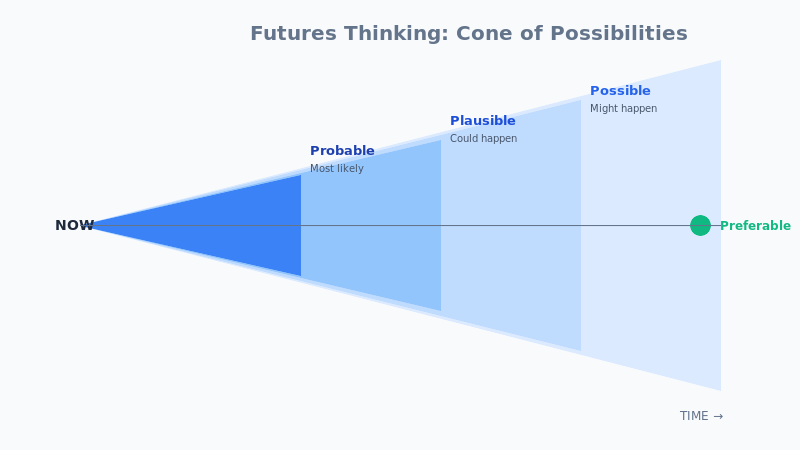
| The futures cone | A picture rather than a procedure. It sorts what people are talking about into four kinds of future: probable (what current trends suggest), plausible (what could reasonably happen), possible (what could happen if things we believe today turned out wrong) and preferable (what we actually want). Its job is to stop a conversation collapsing into the probable. | Can the group name a plausible future it would find unwelcome? |
| Scenario planning | Building a small number of internally consistent stories about how the world might go, then testing decisions against each. Usually three or four. The common mistake is best case, worst case and middle, which is really one scenario at three volumes rather than genuinely different worlds. | Would each scenario lead you to a different decision? If not, you have one scenario. |
| Backcasting | Start from a described future and work backwards, asking what must have happened for it to exist. Useful when the future in question is one you want rather than one you expect, which is why it is common in climate, energy and public infrastructure planning. | Does the path contain a step someone has to start this quarter? |
| Causal Layered Analysis | Sohail Inayatullah’s method for digging beneath an issue through four levels: the headline version, the systems producing it, the worldview making those systems seem natural, and the underlying metaphor. It stops a group solving at headline level, where solutions are always obvious and always shallow. | Has the group named the metaphor it has been operating under? |
| Three Horizons | A way of holding three things in view at once: the current system that is losing its fit with the world (H1), the viable future that is trying to emerge (H3), and the contested, messy transition between them (H2). Note that a completely different framework shares this name — see the evidence section below. | Can people name what they are personally invested in inside H1? |
The methods are not the hard part
Any of the six can be taught in an afternoon. What makes futures work difficult is that it asks senior people to take seriously a world in which their current strategy is wrong, and to do so in front of colleagues. The methods are mostly devices for making that conversation possible — the futures cone gives permission to discuss the implausible, Three Horizons gives permission to say the current business is dying. Which is why choosing the method matters less than most guides suggest, and why running the exercise without anyone senior present is close to pointless.
Reconciling terms
Futures thinking, foresight, forecasting
These words get used as though they were interchangeable, and two of them genuinely are close. One of them is a different activity altogether, and mistaking it for the others is the most common error in this whole field.
| Term | What it is | What it produces |
|---|---|---|
| Forecasting | Working out the single most likely outcome by extending what the data already shows. Aims at one answer and can be scored for accuracy. | A number, with a confidence range |
| Trend analysis | Tracking the direction and speed of a change that is already underway. Feeds everything else on this list. | A direction of travel |
| Futures thinking | The habit of mind: holding several possible futures open instead of one. Not tied to any particular exercise or team. | Better questions, and fewer surprises |
| Strategic foresight | The organized practice of applying futures thinking inside an organization, on a schedule, to inform strategy. This is futures thinking with a budget, a method and a deadline. | Strategy options and decisions |
| Scenario planning | One method used within strategic foresight, and by far the best known. Often mistaken for the whole discipline. | Three or four stories |
The short version, and the trap
Futures thinking is the mindset. Strategic foresight is the organized practice of doing it. Scenario planning is one of its methods. An organization with a foresight function does this on purpose and with resources. One that merely has people who think this way gets the mindset free and loses most of the value.
Forecasting is the one that does not belong. It aims at a single right answer, which means it can be graded, and the temptation is therefore to grade foresight the same way. Foresight that is judged on accuracy will quietly stop producing anything uncomfortable, because the safest way to be right is to describe the future everyone already expects.
Core Features
- Plural by design: several futures held open at once, never narrowed to one prediction
- Outward-looking: the material comes from outside the organization and outside the industry
- Long horizon: usually five to twenty years, well past normal planning cycles
- Participatory: value comes from the shared conversation, not from a report
- Preference is explicit: what you want is treated as a legitimate input, not smuggled in
- Continuous where it works: scanning runs all the time; the workshop is the visible part
Worked example
A regional water utility, and the scenario nobody wanted to write
An illustrative composite. A regional water utility in south-eastern Australia had to decide whether to commit to a treatment plant with a forty-year design life. The finance case assumed population growth and rainfall broadly like the last twenty years. The board was uneasy but could not say why.
| Stage | What it produced |
|---|---|
| Scanning | Six months of scanning across policy, climate, technology and demographics. Roughly ninety signals, of which eleven survived challenge. Two concerned household water recycling becoming cheap enough to install in a single home. |
| Futures cone | The sorting exercise did the real work. Nearly every assumption in the business case sat in the probable band, which made visible that the plant was justified against exactly one future — and that the group had been treating that future as the situation rather than as a choice. |
| Scenarios | Four stories at a twenty-five year horizon. Three were comfortable. The fourth combined a drier decade with cheap domestic recycling and a policy shift toward local self-supply, and demand for centralized treatment fell by a third. |
| The uncomfortable one | The fourth scenario was nearly cut twice, on the grounds that it was speculative and would alarm the board. It was kept because the chair asked what the exercise was for if the alarming one was removed. |
| Backcasting | Working backwards from the fourth scenario identified two things that would have to be true by 2032 for it to be under way. Both were observable now, cheaply, and neither was being tracked. |
| The decision | The plant was built, at reduced capacity, with land and connections left for a second stage. The saving against the original design was material, and the two indicators went into quarterly board reporting. |
What the exercise actually bought
It did not predict anything, and that was not the point. Nobody knows whether the fourth scenario will happen. What changed was that a forty-year commitment stopped being sized against a single assumed future, and became a smaller commitment with a deliberate option attached.
The pivotal moment was the one that looks least like analysis: keeping the scenario that made people uncomfortable. The three comfortable scenarios all pointed at the plant as originally specified, which is exactly what you would expect, because they were built from the assumptions that produced the specification. An exercise that had quietly dropped the fourth would have cost six months and confirmed the plan.
Two years on, the part still working is the least glamorous: two indicators in a quarterly pack. Scanning stopped when the consultants left and the scenario document is unread. The project succeeded — but what survived was the monitoring, not the thinking.
When to Use
- You are making a commitment whose consequences run well beyond the planning cycle
- Your industry is being reshaped by something outside it — regulation, climate, technology, demographics
- Every plan on the table assumes the world continues broadly as it is
- You have been surprised recently by something that was visible in advance to someone
- A capability will take years to build, so it has to be started before the need is certain
- Leadership disagrees about direction, and the disagreement is really about different assumed futures
When NOT to Use
- The decision is due this quarter — there is no time for this and it will not help
- You need a number, such as demand or headcount — that is forecasting
- Nobody senior will attend, so nothing produced can change a decision
- The organization is in a genuine crisis and needs to survive the year
- It is being commissioned to look innovative, with no decision waiting at the end
- The real problem is executing a strategy you already have — see OKRs or Strategy Map
In practice
How futures thinking goes wrong
The failures are unusually consistent, and most of them are versions of the same thing: the organization finds a way to do the exercise without letting it threaten anything.
| Failure mode | What it looks like | What to do instead |
|---|---|---|
| Only comfortable futures | Four scenarios that all point at the strategy you already have | Require at least one future in which the current strategy fails. If nobody is uneasy, the exercise has not started. |
| Judged on accuracy | Someone asks two years later which scenario was right, and the function quietly starts writing safer ones | Judge it on whether decisions changed and whether you saw change earlier. Say so before you begin. |
| The report nobody reads | A handsome hundred-page document; the value died with the workshop that produced it | The output is a changed decision and a short list of things to watch. Write the indicators down; skip the design work. |
| No decision attached | An excellent away-day, warmly reviewed, followed by business as usual | Name the decision before the first workshop. If there is not one, wait until there is. |
| Scanning stops | Six months of careful signal gathering that ends the day the project does | Assign scanning to a named role as a standing task. It is the only part that compounds. |
| Junior delegation | The team who attended cannot change anything; the people who can were not there | Senior attendance is a precondition, not a nice-to-have. Without it, do not run the project. |
Sourced
Evidence, and how to cite it
The futures cone is usually credited to the wrong person — by everyone except him.
The diagram is widely called Voros’s futures cone, after the Australian futurist Joseph Voros, whose early-2000s version is the one most people have seen. Voros himself says otherwise. By his account the cone was used to portray alternative futures by Trevor Hancock and Clement Bezold in 1994, built on a taxonomy set out by Norman Henchey in 1978 which named four classes of future: possible, plausible, probable and preferable. Voros also notes an earlier cone graphic in Charles Taylor’s 1990 “cone of plausibility”. Hancock and Bezold are rarely credited today.
Voros, J. (2017) ‘The Futures Cone, use and history’, The Voroscope; Hancock, T. & Bezold, C. (1994) ‘Possible futures, preferable futures’, Healthcare Forum Journal, 37(2), pp. 23–29; Henchey, N. (1978) ‘Making sense of futures studies’, Alternatives, 7(2), pp. 24–27.
“Three Horizons” names two unrelated frameworks, and most business readers know the other one.
Say Three Horizons in a corporate room and people will think of the growth-portfolio model from The Alchemy of Growth by Mehrdad Baghai, Stephen Coley and David White, published in 1999 and long promoted by McKinsey. There the horizons are classes of business investment: the profitable core, emerging growth, speculative options. The futures version is a different thing entirely, created by Anthony Hodgson, Andrew Curry, Graham Leicester, Bill Sharpe, Andrew Lyon and Ioan Fazey, and associated with the International Futures Forum. It describes a system in transition: H1 the dominant arrangement losing its fit, H3 the emerging future that fits better, H2 the contested space between. One allocates investment; the other reads a changing system.
Baghai, M., Coley, S. & White, D. (1999) The Alchemy of Growth. New York: Perseus; Sharpe, B. (2013) Three Horizons: The Patterning of Hope. Axminster: Triarchy Press.
The field defines itself against prediction, and the useful ideas are meant to sound unreasonable.
Jim Dator, who ran the Hawaii Research Center for Futures Studies for decades, is best known for the maxim that any useful statement about the future should at first appear ridiculous — because anything that sounds sensible today is already priced into everyone’s plans. His four generic images of the future — continued growth, collapse, discipline and transformation — are a standard way of checking whether a scenario set has real range, or whether all four stories are versions of continued growth.
Dator, J., Hawaii Research Center for Futures Studies; see also Inayatullah, S. (2008) ‘Six pillars: futures thinking for transforming’, Foresight, 10(1), pp. 4–21.
How to cite it.
For the futures cone, cite Hancock and Bezold (1994) for the model and Henchey (1978) for the taxonomy, with Voros (2017) for the history if you need the lineage in one place. For Causal Layered Analysis, cite Inayatullah, S. (2004) The Causal Layered Analysis Reader. Taipei: Tamkang University Press. For Three Horizons, cite Sharpe, B. (2013) Three Horizons: The Patterning of Hope — and never cite it as McKinsey’s, which is a different framework. For scenario planning, the practice traces to Herman Kahn at RAND and to Pierre Wack’s work at Shell in the early 1970s.
Key Strengths
- Surfaces assumptions: makes visible the single future a plan was quietly built on
- Cheap insurance on expensive decisions: months of work against commitments lasting decades
- Legitimizes awkward conversations: the methods give people cover to say the current model is failing
- Improves recognition speed: a change already discussed is noticed far sooner when it arrives
- Builds options rather than bets: tends to produce staged commitments instead of single large ones
Key Weaknesses
- Nothing to show: no number, no ranking, no deliverable that survives a budget review well
- Easy to neutralize: an organization can run the whole process without letting it threaten anything
- Slow: three to six months, against a strategy cycle that usually will not wait
- Depends on who is in the room: without seniority it cannot change a decision
- Hard to evaluate: the honest measures are indirect, which makes it vulnerable when budgets tighten
- Crowded vocabulary: foresight, futures, forecasting and scenarios are used loosely, and reputations suffer for it
Sequencing
What to run before and after
Futures thinking sits upstream of strategy. It is nearly useless without something downstream to receive it.
Before
Scan the outside world, and know your industry as it stands
Futures work needs raw material. A structured outward scan gives you the signals, and a clear picture of today’s industry structure gives you something to notice change against.
During
Turn the futures into stories a decision can be tested against
Scenario planning is where futures thinking becomes usable. The scenarios have to disagree about something that matters, or the test they provide is not a test.
After
Attach it to something people are measured on
The part that survives is whatever enters the regular reporting cycle. Put the indicators you will watch into the quarterly pack, and connect the direction to goals someone owns.
Common questions
Futures thinking: quick answers
What is futures thinking?
A way of working that treats the future as several possible futures rather than one. The plural is deliberate: it blocks the reflex of asking what the future holds, a question with only one answer that is always a guess. Instead you look for early signs of change, describe several ways things could unfold, and ask what each would mean for you. The aim is not to be right about which happens, but to be prepared for more of them.
What is the difference between futures thinking and strategic foresight?
Futures thinking is the mindset; strategic foresight is the organized practice of applying it. If people habitually consider several futures, that is futures thinking. If there is a function, a budget, a method and a schedule feeding results into strategy, that is strategic foresight. Scenario planning is one method used inside foresight, not a synonym for either.
Is futures thinking the same as forecasting?
No, and this is the most common confusion in the field. Forecasting extends what the data already shows to reach a single most likely answer, and can be scored for accuracy afterwards. Futures thinking holds several futures open and cannot be scored that way. Mixing them is dangerous in practice: foresight judged on accuracy quietly stops producing anything uncomfortable, because the safest way to be right is to describe the future everybody already expects.
What is the futures cone, and who created it?
A diagram sorting what people discuss into probable, plausible, possible and preferable futures, so a conversation does not collapse into the probable alone. It is usually credited to Joseph Voros, but he credits it himself to Trevor Hancock and Clement Bezold, who used it in 1994, building on a taxonomy Norman Henchey set out in 1978. Voros's version is the one most people have seen, which is why his name stuck.
Is Three Horizons the same as McKinsey's Three Horizons?
No. Two unrelated frameworks share the name. McKinsey's, from The Alchemy of Growth by Baghai, Coley and White in 1999, sorts business investment into the profitable core, emerging growth and speculative options. The futures one, created by Anthony Hodgson, Andrew Curry, Graham Leicester, Bill Sharpe, Andrew Lyon and Ioan Fazey, describes a system in transition: H1 the dominant arrangement losing its fit, H3 the emerging future, H2 the contested space between. Always say which you mean.
What is the futures triangle?
A quick method from Sohail Inayatullah positioning any situation between three forces: the pull of the future, meaning the visions drawing people forward; the push of the present, meaning the trends already in motion; and the weight of history, meaning the structures holding things in place. It runs in a single session and often opens a longer piece of futures work, because it surfaces disagreement about which force is strongest.
How do you know whether futures thinking worked?
Not by whether it predicted correctly, which is the wrong test and a damaging one. The honest measures are whether a decision was made differently, whether a change was recognized earlier than it otherwise would have been, and whether anything from the exercise is still watched a year later. In practice the part that survives is a short list of indicators in a regular reporting pack, not the scenario document.
How do I cite futures thinking methods?
For the futures cone, cite Hancock, T. and Bezold, C. (1994) 'Possible futures, preferable futures', Healthcare Forum Journal, 37(2), pp. 23-29, with Henchey, N. (1978) for the taxonomy. For Causal Layered Analysis and the futures triangle, cite Inayatullah, S. (2004) The Causal Layered Analysis Reader. Taipei: Tamkang University Press. For Three Horizons, cite Sharpe, B. (2013) Three Horizons: The Patterning of Hope. Axminster: Triarchy Press — never as McKinsey's.
Deep Resources
Frameworks related to Futures Thinking / Trend Analysis
- Scenario PlanningStrategic planning method that explores multiple plausible futures to prepare organizations…
- PESTEL AnalysisMacro-environmental scanning across Political, Economic, Social, Technological, Environmental,…
- Innovation Pipeline / Stage-Gate ProcessStructured process for managing innovation projects from ideation to commercialization.…