
PEST Analysis: Macro-Environmental Scanning
PEST Analysis is a macro-environmental scanning framework that analyzes Political, Economic, Social, and Technological factors affecting an organization.
What Is It?
PEST Analysis examines the external macro-environment to identify opportunities and threats. Originally introduced by Francis Aguilar at Harvard in 1967, it provides a systematic way to scan for factors outside your control that impact your business.
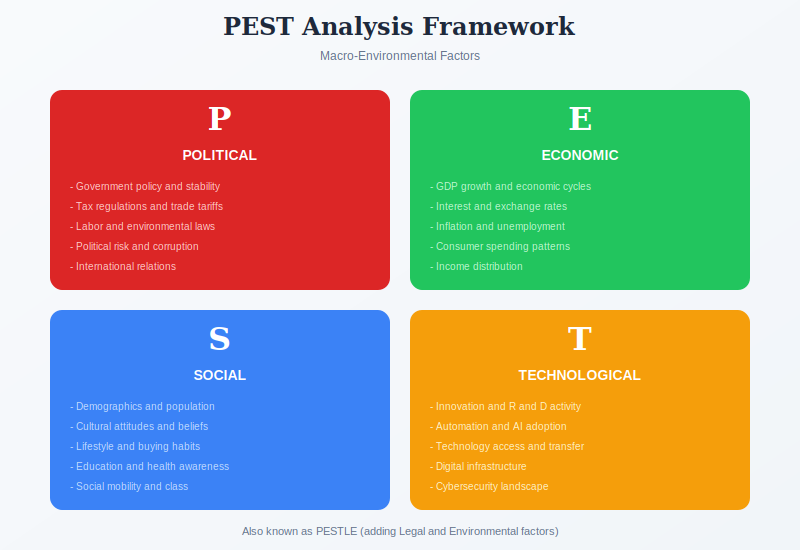
Political: Government policies, regulations, political stability, trade agreements. Economic: GDP growth, interest rates, inflation, unemployment, consumer spending. Social: Demographics, cultural trends, lifestyle changes, education levels. Technological: Innovation rate, automation, R&D activity, digital disruption.
PEST is often extended to PESTLE (adding Legal and Environmental) or STEEPLE (adding Ethical). The framework provides essential context for SWOT Analysis and complements Porter's Five Forces.
Quick Reference
When to Use
- Strategic planning and scenario development
- Market entry or expansion decisions
- Understanding external trends and disruptions
- Input to SWOT Analysis (O and T)
- Global business operations
When NOT to Use
- Need internal analysis (use SWOT)
- Need industry competitive analysis (use Five Forces)
- Quick tactical decisions
- Stable, predictable environments
Key Strengths
- Comprehensive: All major external factors
- Early Warning: Identifies emerging trends
- Universal: Applies to any industry
- Strategic Focus: Big picture thinking
Key Weaknesses
- Hard to predict accurately
- Can be overwhelming
- Many factors outside control
- Requires continuous monitoring
How It Works
| 1 Primary Input | Industry reports, economic data, regulatory updates, technology trends |
|---|---|
| 2 Data You Need | Government policies, economic indicators, demographic data, tech developments |
| 3 Primary Output | Macro-environmental assessment, strategic opportunities and threats |
Comparison with Related Frameworks
PEST vs SWOT
SWOT includes internal factors; PEST is external only. PEST provides input to SWOT's Opportunities and Threats. Use together for comprehensive analysis.