Blue Ocean Strategy: The Strategy Canvas and Four Actions
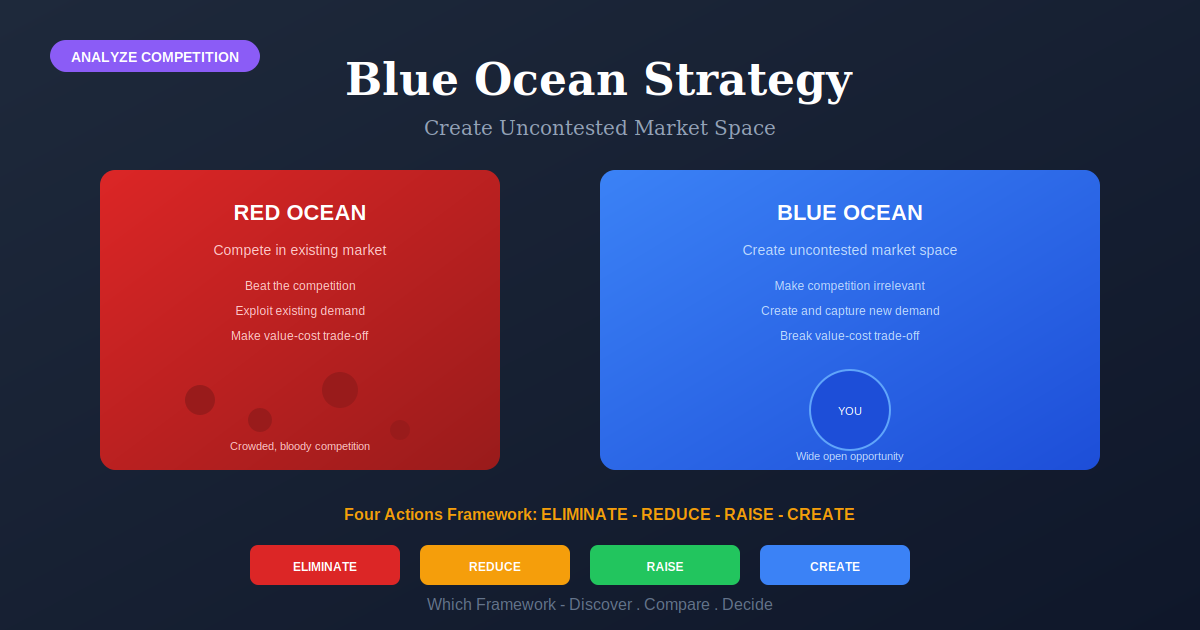
Blue Ocean Strategy is a market-creation framework built on value innovation — raising buyer value and lowering cost together — using a strategy canvas to map an industry’s competing factors and four actions: eliminate, reduce, raise and create.
Before you start
Is this your framework?
Blue Ocean Strategy is for one situation: an industry where everyone competes on the same factors, and competing harder on them has stopped paying. Its move is to change which factors are in play at all, which is a different act from doing the existing ones better.
That also sets its limit. The framework assumes you can afford to be wrong for a while and that somebody will fund a position no current customer is asking for. Where the pressure is quarterly, the honest answer is usually a sharper version of what you already do.
| If your real problem is… | You probably want |
|---|---|
| We need to choose a basis of competition inside the market we are in | Porter’s Generic Strategies — and note the two frameworks disagree on whether you must choose between cost and differentiation at all Compare Blue Ocean and Generic Strategies |
| We need to see who competes where before deciding anything | Competitive Positioning Map — two axes and the existing field, where a strategy canvas plots many factors at once Compare Blue Ocean and Positioning Map |
| We need to judge whether this industry can be profitable at all | Porter’s Five Forces — structure and where profit sits, which no canvas explains |
| We need to understand what customers are actually trying to get done | Jobs to Be Done — demand seen from the buyer’s side, and a good source of candidate factors |
| We need to decide where to grow: new products, new markets, or both | Ansoff Matrix — direction of growth rather than reconstruction of the market |
| We have a new business idea and need to test whether it holds together | Lean Canvas — a one-page model of the business, not of the industry |
| Everyone competes on the same things and competing harder has stopped working | Blue Ocean Strategy — you are in the right place |
What Is It?
W. Chan Kim and Renée Mauborgne, both professors at INSEAD, published Blue Ocean Strategy in 2005, drawing on a study of 150 strategic moves across 30 industries. Their metaphor gave the book its title. A red ocean is an existing market with known boundaries and known rivals, where growth means taking share from someone and margins narrow as everyone improves along the same lines. A blue ocean is market space that did not previously exist, where demand is created rather than divided.
The mechanism is value innovation, a term they had introduced in Harvard Business Review in 1997. It means lifting what buyers value and lowering cost simultaneously, which becomes possible when you stop taking the industry’s list of competing factors as given. Drop factors buyers do not actually value and cost falls; add factors the industry has never offered and value rises. Neither move works alone.
This is a direct contradiction of Porter, and worth stating plainly because the two frameworks are often taught in the same week. Porter argued in 1980 that a firm chasing both low cost and differentiation ends up with neither, a condition he called stuck in the middle. Value innovation is the claim that the trade-off is an artifact of competing on a fixed set of factors, and dissolves once the factors change. Porter’s reply was that such positions are temporary. Both arguments are set out in the evidence section, and Porter’s Generic Strategies covers the other side.
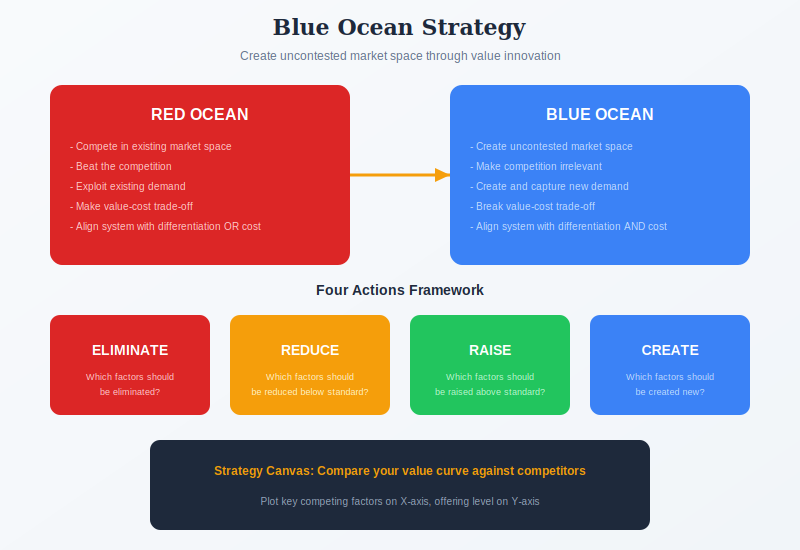
Two tools carry the method in practice. The strategy canvas draws the factors an industry competes on and how much of each every player offers. The four actions, often called the ERRC grid, are the operations that move a curve off the industry’s. Both are covered below.
Quick Reference
The method
The canvas and the four actions
The canvas comes first. List the factors the industry competes on, put them along the bottom, and plot how much of each factor every significant player offers. In most industries the curves come out nearly parallel, which is itself the finding: everyone is competing on the same things, differing only in how much they spend.
The four actions are then applied to that list of factors, not to your product. Two of them cut cost and two of them lift value, and Kim and Mauborgne’s argument is that running all four together is what makes value innovation possible. Use only the right-hand pair and you have an expensive premium product; use only the left-hand pair and you have a cheaper version of the same thing.
| Action | The question | Why it is difficult | Effect |
|---|---|---|---|
| Eliminate | Which factors that the industry has long competed on should be removed entirely? | The hardest of the four. It means dropping something every rival believes is essential, and the belief is usually shared inside your own company too. | Lowers cost |
| Reduce | Which factors have been over-served in the race to match rivals? | Requires admitting that some of your investment has gone into features buyers stopped noticing several product generations ago. | Lowers cost |
| Raise | Which factors should be lifted well above the industry standard? | Easy to agree, easy to under-do. Raising a factor slightly is invisible to buyers and simply adds cost. | Lifts value |
| Create | Which factors has the industry never offered at all? | Nobody can research demand for something that does not exist. This is where the exercise becomes a judgment call rather than an analysis. | Lifts value |
Where do candidate factors come from? Kim and Mauborgne supply two aids. The six paths look for opportunity across alternative industries, across strategic groups, along the chain of buyers, at complementary products and services, at the balance of functional and emotional appeal, and across time. The three tiers of noncustomers sort the people who are not buying into those on the edge of leaving, those who have refused the industry, and those who have never considered it — which keeps attention on demand that does not yet exist rather than on rivals’ customers.
The test a canvas has to pass
The curves must cross. A value curve that sits above the industry on every factor is not a blue ocean move; it is the same strategy with a larger budget, and it costs more to run. Divergence means being visibly lower on some factors, which is uncomfortable in a way that spending more is not.
Kim and Mauborgne set two further conditions. The curve should show focus, meaning effort concentrated on a few factors rather than spread across all of them, and the strategy should be expressible in one clear phrase. If it takes a paragraph to say what you are doing differently, the canvas has usually not been resolved.
Core Features
- Value innovation: buyer value up and cost down together, not traded off
- Red and blue oceans: competing for share versus creating new space
- Strategy canvas: every player’s offering across the industry’s competing factors
- Four actions: eliminate, reduce, raise, create, applied together
- Six paths: systematic places to look for factors nobody is using
- Noncustomers: demand sought outside the industry’s existing buyers
Worked example
A pathology lab chain, and the ocean that turned red
An illustrative composite. A diagnostic pathology chain in Pune, India, with eleven collection centers and about ₹40 crore in annual revenue. Test prices had fallen for four years running as national chains expanded, and every operator competed on the same handful of things. The canvas above is this market.
| Action | What they did |
|---|---|
| Eliminate | Referral commissions to prescribing doctors, an industry-wide practice and roughly 18% of revenue. Removing it freed the largest single cost and, unexpectedly, became something patients could be told about. |
| Reduce | Collection centers cut from eleven to four, and the test menu narrowed from 380 to about 140 by dropping rarely ordered panels that were sent out to third-party labs anyway. |
| Raise | Turnaround pushed from a typical 24 to 36 hours down to same-day for routine panels, and reporting moved to a phone-readable format with reference ranges explained in plain language. |
| Create | Home sample collection booked in a one-hour slot, which no local operator offered. This carried the whole move; nothing else on the canvas was new to the market. |
| The result | Volume rose 34% in eighteen months on a lower cost base. Margin recovered from about 6% to 14%, and the chain stopped losing price arguments because it was no longer selling the same thing. |
What happened next, and what the demand actually was
The ocean turned red in under two years. Two national chains launched home collection across the city with balance sheets the local operator could not match, and by the third year it was a standard feature rather than a differentiator. This is not a failure of execution; it is what Kim and Mauborgne themselves predicted in 1997, when they wrote that imitators arrive sooner or later. A blue ocean is a phase, and the strategic question is what you build during it.
The second finding is less comfortable. The chain had described its growth as reaching noncustomers. When it looked properly, most of the additional volume came from patients who had previously used a rival — existing demand, redirected. Genuine noncustomers, people who had been putting off tests entirely, were a small share. The three tiers of noncustomers exist precisely to force that check, and skipping it lets any share gain be reported as market creation.
When to Use
- Every competitor offers roughly the same things and price is the only lever left
- Margins have narrowed for several years despite everyone improving
- Industry conventions have gone unquestioned long enough to be invisible
- There is a large population who could buy and do not
- You can fund a position no existing customer has asked for
- Setting a direction for a new venture with no legacy to defend
When NOT to Use
- The immediate problem is operational, and the answer is to execute better
- Regulation or safety fixes the factors, so eliminating them is not available
- The horizon is a quarter, and the payoff here is measured in years
- The market is genuinely new already, so there is no red ocean to leave
- It would be used to justify a pivot somebody has already decided on
In practice
How Blue Ocean thinking goes wrong
The vocabulary is easy to adopt and the discipline is not, which produces a characteristic set of failures.
| Failure mode | What it looks like | What to do instead |
|---|---|---|
| Raise and create only | A curve above the industry on every factor, presented as a blue ocean, delivering a costlier product | Require eliminations. If nothing is being removed, no cost has been taken out and the trade-off is intact. |
| Any new idea called a blue ocean | The phrase used for a product launch, a new segment, or a rebrand | Test the canvas: do the curves cross? Divergence is the criterion, not novelty. |
| Factors nobody validated | A canvas built entirely in a workshop, with offering levels assigned by the team | Check the factor list and the levels with buyers and with people who refuse the industry. |
| Share gain reported as market creation | Growth attributed to noncustomers when it came from rivals’ customers switching | Ask new buyers what they did before. Redirected demand is fine, but call it what it is. |
| No plan for imitation | The move works, competitors copy it, and there is no second act | Decide during the blue phase what you build that imitation does not transfer: scale, brand, cost position. |
| Eliminating something buyers do value | A cost cut dressed as an elimination, and customers who quietly leave | Distinguish factors the industry believes matter from factors buyers behave as though matter. |
Sourced
Evidence, and how to cite it
The evidence was assembled backwards.
This is the substantial criticism and it is difficult to answer. The authors identified strategic moves that had already succeeded and worked out the pattern afterwards, which means the firms that attempted something equally unconventional and failed are absent from the sample by construction. A pattern derived only from survivors cannot tell you how often the same moves lead nowhere, so the framework describes successes convincingly while saying little about the odds of repeating them.
Critique widely made in the strategy literature and in reviews of the book; see for example the discussion of retrospective case selection in Burke et al. (2009, 2010).
Blue oceans turn red, including the book’s own showcase.
Kim and Mauborgne wrote in 1997 that competitors eventually imitate a new value curve, and the record bears it out. Cirque du Soleil, the case that opens the book, spent decades defending its position against entrants in experiential entertainment, took on debt to expand, and filed for bankruptcy protection in June 2020. That does not make the original move wrong. It does mean a blue ocean should be treated as a phase with an expiry date rather than as a permanent position.
Kim & Mauborgne (1997); Cirque du Soleil Entertainment Group, bankruptcy protection filing, June 2020.
Porter and value innovation genuinely disagree.
Porter’s position in 1980 was that pursuing low cost and differentiation together usually delivers neither. Value innovation holds that the trade-off exists only while the set of competing factors is taken as fixed. Porter answered that hybrid positions are typically temporary, resting on rivals’ inefficiency rather than on a defensible choice, and restated the underlying argument in 1996 by separating operational effectiveness from strategy. Neither side has settled it, and the disagreement is a better thing to understand than to resolve.
Porter, M.E. (1980) Competitive Strategy. New York: Free Press; Porter, M.E. (1996) ‘What Is Strategy?’, Harvard Business Review, November–December.
How to cite it.
Value innovation was introduced in Harvard Business Review in 1997; the book followed in 2005, drawing on 150 strategic moves across 30 industries, with an expanded edition in 2015 and a successor volume in 2017.
Harvard: Kim, W.C. and Mauborgne, R. (2005) Blue Ocean Strategy: How to Create Uncontested Market Space and Make the Competition Irrelevant. Boston: Harvard Business School Press.
APA: Kim, W. C., & Mauborgne, R. (2005). Blue ocean strategy: How to create uncontested market space and make the competition irrelevant. Harvard Business School Press.
For value innovation, cite Kim and Mauborgne (1997). For the successor, cite Blue Ocean Shift (2017).
Key Strengths
- Questions the factor list: the one move most competitive analysis skips
- Cost and value together: forces eliminations rather than additions alone
- The canvas travels: one picture a board and a product team both read
- Looks outside the industry: six paths and noncustomers widen the search
- Sets a clear test: curves that cross, focus, and one sentence
Key Weaknesses
- Built from survivors: the failures are absent from the evidence by construction
- Better backwards than forwards: explains past moves more readily than it finds new ones
- Temporary by nature: imitation arrives, and the framework says little about the second act
- Unfalsifiable in use: almost any success can be narrated as a blue ocean afterwards
- Demands patience and money: both scarce in the markets where it is most needed
Sequencing
What to run before and after
A canvas is only as good as the factor list behind it, and a divergent curve is only worth drawing if something can be built while the space stays open.
Before
Establish what the industry competes on, and why
You cannot change a factor list you have not written down. Map the current field and understand the structure holding it in place, or you will eliminate something that is load-bearing.
During
Find candidate factors from outside the industry
The factors worth creating rarely appear on a whiteboard. They come from watching what buyers are actually trying to accomplish, and from the people who have refused the industry altogether.
After
Test the model, then build what imitation cannot copy
A divergent curve still has to work as a business. Then decide what you accumulate while the space is open, because the space will not stay open.
Common questions
Blue Ocean Strategy: quick answers
What is blue ocean strategy?
An approach to strategy that seeks uncontested market space rather than a larger share of a contested one. Kim and Mauborgne called existing crowded markets red oceans and newly created space blue oceans. The mechanism they proposed is value innovation: raising what buyers value while lowering cost, instead of trading one against the other.
What is the difference between a red ocean and a blue ocean?
A red ocean is an existing market with settled boundaries and known rivals, where growth comes from taking share and margins tend to erode. A blue ocean is market space that does not yet exist, where demand is created rather than fought over. The book's argument is that the second is reached by changing the factors an industry competes on.
What is a strategy canvas?
A chart with the factors an industry competes on along the bottom and the level of each offering up the side. Drawing your value curve alongside the industry average shows whether you are genuinely different or simply spending more on the same things. Kim and Mauborgne said a good curve shows focus, diverges from the industry, and can be summed up in one clear phrase.
What is the Four Actions Framework, or ERRC grid?
Four questions applied to the factors an industry competes on. Which factors should be eliminated? Which reduced well below industry standard? Which raised well above it? Which created that the industry has never offered? Eliminate and reduce lower cost; raise and create lift buyer value. The point is that all four run together, which is what makes value innovation possible.
How does blue ocean strategy differ from Porter's generic strategies?
They disagree on whether you must choose. Porter argued in 1980 that a firm pursuing both low cost and differentiation usually achieves neither and ends up stuck in the middle. Value innovation is the claim that the trade-off can be broken by changing which factors you compete on at all. Porter's reply is that such positions are usually temporary, resting on rivals' inefficiency rather than a defensible choice.
What are the six paths and the three tiers of noncustomers?
Two tools for finding candidate factors. The six paths look for opportunity across alternative industries, strategic groups, buyer chains, complementary offerings, functional and emotional appeal, and time. The three tiers of noncustomers sort the people not buying into soon-to-be, refusing and unexplored noncustomers, which keeps attention on demand that does not exist yet rather than on rivals' customers.
What are the main criticisms of blue ocean strategy?
That the evidence was assembled backwards. Kim and Mauborgne studied moves that had already succeeded and worked out the pattern afterwards, so the firms that attempted the same thing and failed never appear. Critics also note that blue oceans turn red as imitators arrive, something the authors themselves wrote in 1997. Cirque du Soleil, the book's showcase example, filed for bankruptcy protection in 2020.
How do I cite blue ocean strategy?
Harvard style: Kim, W.C. and Mauborgne, R. (2005) Blue Ocean Strategy: How to Create Uncontested Market Space and Make the Competition Irrelevant. Boston: Harvard Business School Press. APA style: Kim, W. C., & Mauborgne, R. (2005). Blue ocean strategy. Harvard Business School Press. For value innovation, cite Kim and Mauborgne (1997) in Harvard Business Review. For the successor, cite Blue Ocean Shift (2017).
Deep Resources
Frameworks related to Blue Ocean Strategy
- Porter's Generic StrategiesCost leadership, differentiation and focus, and the argument that you must choose…
- Competitive Positioning MapTwo axes showing where competitors sit, and which regions of a market are unoccupied…
- Porter's Five ForcesIndustry structure across five forces, explaining where profit actually sits…