Innovation Pipeline: What It Is and How to Manage One
Innovation Pipeline is the managed flow of ideas from first suggestion to commercial launch, structured as stages of work separated by decision gates, in which most ideas are deliberately removed before they reach the market.
Before you start
Is this your framework?
A pipeline exists to answer one question repeatedly: which of these ideas should still be alive next quarter? It is a killing mechanism as much as a development one, and organizations that cannot bring themselves to kill things get no value from installing it.
That also marks its limit. A pipeline improves the throughput and discipline of ideas you already have. It does not generate them, and it will not tell you whether the ideas are any good in the first place.
| If your real problem is… | You probably want |
|---|---|
| We do not have enough ideas to fill a pipeline in the first place | Brainstorming or SCAMPER — generation, which a pipeline consumes but never produces Compare Innovation Pipeline and Brainstorming |
| We do not know whether we are solving a problem anyone has | Design Thinking — establishing what is worth building, which belongs before the first gate Compare Innovation Pipeline and Design Thinking |
| We need to rank a set of features we have already committed to build | RICE Score or Value vs Effort — ordering work, not deciding what survives |
| We need to test whether a new business idea holds together at all | Lean Canvas — one page on the model behind a single idea |
| The question is which businesses to fund across a corporate portfolio | BCG Growth-Share Matrix — existing units and cash, not ideas in development |
| We need to look further out than any current project reaches | Futures Thinking or Scenario Planning — direction rather than throughput |
| Ideas enter, nothing ships, and nobody can say what happened to them | Innovation Pipeline — you are in the right place |
What Is It?
An innovation pipeline is the route ideas travel from first suggestion to commercial launch, and the set of decisions that removes most of them on the way. The metaphor is borrowed from sales and from drug development, and the borrowed word is doing real work. What distinguishes a pipeline from a process is attrition. A process describes how work moves. A pipeline says that most of what enters is meant not to arrive.
That is worth dwelling on, because it is where the concept is most often misunderstood. Projects being killed is not the pipeline failing. It is the pipeline working, and a pipeline where almost everything that enters also launches is not a well-run one — it is one with insufficiently ambitious ideas, or gates that have stopped functioning.
The term is used two ways. Loosely it means the current stock of ideas and projects in flight, as in a thin pipeline. More precisely it means the managed sequence those ideas move through, which is what this page describes.
A note on names. Innovation pipeline and Stage-Gate are frequently treated as the same thing, and they are not. The pipeline is the general idea, and nobody owns it. Stage-Gate is a specific process for running one, developed by Robert Cooper from research beginning in the 1980s, and it is the best known but not the only method. Stage-Gate is a registered trademark of its owners. This page covers both, and the next section sets out Cooper's structure.
Related pages: Design Thinking for the discovery work that precedes gate one, and Brainstorming for filling the front of the funnel.
Quick Reference
The structure
The stages and the gates
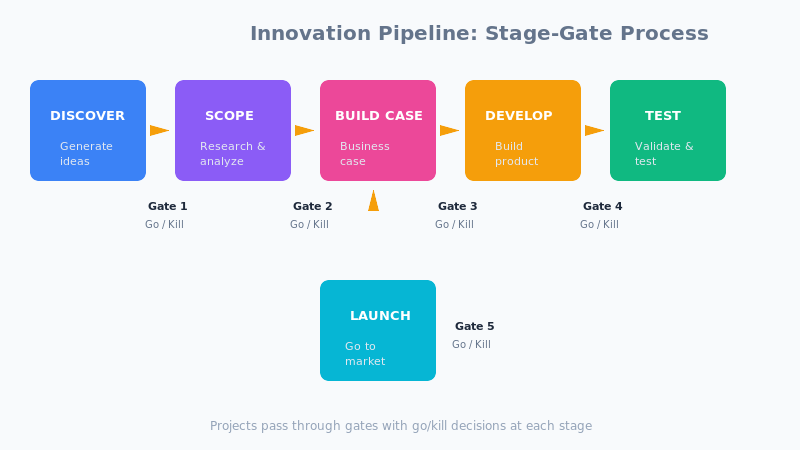
Cooper’s structure alternates two different things. Stages are where work happens and money is spent. Gates are meetings where a project is judged and one of four decisions is taken: go, kill, hold, or recycle for rework. The alternation matters more than the specific number of stages, which organizations vary freely.
| Stage | The work | The gate after it asks |
|---|---|---|
| Discovery | Generating and capturing ideas, from staff, customers, research and the market. Cheap, and the only stage where volume is the objective. | Is this worth an hour of anyone’s time? |
| Scoping | A quick, inexpensive assessment: rough market size, obvious technical obstacles, whether anyone already does it. | Is there plausibly a market and a way to build it? |
| Build the business case | The heavy analysis: defined product, validated need, technical feasibility, financial case. The most commonly skipped stage, and the last cheap place to stop. | Do we believe the numbers enough to fund development? |
| Development | Building the product, alongside marketing, operations and launch planning. Where the great majority of the money goes. | Does what we built match what we justified? |
| Testing and validation | Trials in the market, with customers and in production. The last point at which evidence can still change the decision. | Will this work outside the building? |
| Launch | Full commercialization, with the post-launch review that closes the loop and improves the gate criteria. | What did we learn about our own judgment? |
Why gates fail
A gate is only a gate if projects die at it. In many organizations they become status reviews: the team presents, everyone nods, the project continues. The tell is the kill rate. If nothing has been stopped in a year, the gates are not functioning, whatever the process documentation says.
Two conditions make them work. The criteria must be written down before the project is judged, so the discussion is about evidence rather than advocacy. And the people at the gate must control the resources, because a group that cannot reallocate money cannot really say no — it can only say not yet, which is how projects become undead and consume budget for years without ever launching or stopping.
In operation
Managing the pipeline
Running a pipeline is three jobs at once, and organizations that struggle usually do the first well and the other two badly.
| Job | What it involves | The number to watch |
|---|---|---|
| Fill it | Keep enough entering the front. Because attrition compounds, output at the far end is set years earlier by volume at the near end. Starving the front is invisible for two years and then obvious. | New ideas entering per quarter, and where they come from |
| Judge it | Apply the gate criteria and act on them. This is the job most often performed as theatre, because killing a project means telling people their work has stopped. | Kill rate per gate. A gate that never kills is a meeting |
| Balance it | Keep the mix deliberate across incremental improvements, adjacent moves and genuinely new bets. Left alone, a pipeline drifts toward safe near-term work, because that is what passes gates most easily. | Share of spend by ambition, against a stated target |
The drift toward safety
Gate criteria reward projects that can show a market, a number and a route to launch. Incremental work can always show those things; genuinely novel work usually cannot, because the evidence does not exist yet. So a well-run gate process, applied uniformly, systematically eliminates exactly the projects that would matter most.
The common remedy is to stop applying one set of criteria to everything. Ambitious projects are judged on what they have learned and what the next cheap experiment would cost, rather than on a business case they cannot yet produce, and they are funded from a protected allocation so they do not compete head-on with safe work for the same money.
Core Features
- Attrition by design: most of what enters is meant not to arrive
- Stages and gates: work alternating with decisions, not a continuous flow
- Four gate outcomes: go, kill, hold, or recycle for rework
- Written criteria: agreed before the project is judged, not during
- Portfolio view: the mix across ambition levels, managed deliberately
- Post-launch review: the loop that improves the gate criteria over time
Worked example
A dairy processor, and the gate that never killed anything
An illustrative composite. A dairy processor in the Waikato, New Zealand, with about NZ$300 million in revenue, running a formal stage-gate process across roughly forty active projects. The board’s complaint was that innovation spending had risen for four years while the share of revenue from products launched in the last three years had fallen.
| Where they looked | What they found |
|---|---|
| The front | Healthy. Around 200 ideas a year entered, mostly from technical staff and key accounts, and the volume had been stable. |
| The gates | Eleven projects killed in four years, against 340 that entered. Gate meetings ran to schedule and produced minutes, but the standing outcome was hold rather than kill, because holding avoided the conversation. |
| The consequence | Twenty-six of the forty active projects had not moved a gate in over eighteen months. They were consuming roughly a third of the innovation budget while producing nothing, and crowding out capacity for anything new. |
| The mix | Thirty-six of forty projects were line extensions: new flavors, new pack sizes, new formats. Everything further out had been screened away at gate two for lacking a defensible market forecast. |
| What changed | Hold was removed as a gate outcome, leaving go, kill and recycle. Nineteen projects were closed within two quarters. A separate small allocation was created for early-stage work, judged on learning rather than on forecasts. |
The problem was the middle, and it looked like the front
Rising spend with falling output almost always reads as an idea shortage, and almost never is. The front of this pipeline was working. What had failed was the willingness to stop things, and the accumulated cost of not stopping them was a third of the budget tied up in projects nobody expected to launch. Removing hold as an option was a small procedural change that forced a decision the organization had been avoiding for four years.
The second finding was harder to fix and is not yet resolved. A uniform gate that demands a market forecast will always favor a new pack size over a new category, because only one of them can produce the forecast. The protected allocation is a partial answer. It is also a small one, and whether it survives the next budget round is a fair question — ring-fenced innovation money is usually the first thing reallocated when the core business has a difficult year.
When to Use
- Ideas enter and disappear, and nobody can say what became of them
- Development capacity is spread thin across too many live projects
- Spending on innovation is rising while launches are not
- Decisions about what to continue are made informally or by seniority
- Regulated or capital-intensive development where staged commitment is necessary
- The organization is large enough that visibility has genuinely been lost
When NOT to Use
- The shortage is ideas, not discipline
- The team is small enough to hold every project in one conversation
- Learning cycles are days rather than months, where staged gates add drag
- Nobody at the gates controls a budget, so no decision can be enforced
- The purpose would be to document activity rather than to stop it
In practice
How innovation pipelines go wrong
Almost every failure here is a failure to stop something, wearing a different hat.
| Failure mode | What it looks like | What to do instead |
|---|---|---|
| Gates that never kill | Reviews that run on time, produce minutes, and continue every project | Track the kill rate per gate. If it is near zero, the gates are status meetings. |
| Hold as the default | Projects neither funded nor closed, consuming budget and capacity for years | Remove hold, or time-limit it. An undead project costs more than a dead one. |
| One set of criteria for everything | Novel work screened out at an early gate for lacking a forecast it cannot yet have | Judge ambitious projects on learning and next-experiment cost, from separate funds. |
| Too many stages | Seven gates and a template pack, so a small product change takes eleven months | Scale the process to the size of the bet. Small changes need a shorter route. |
| Starving the front | Idea generation quietly stops; the effect appears two years later as an empty pipeline | Measure new ideas entering per quarter as its own metric, not just projects in flight. |
| No post-launch review | Nobody checks whether the projects passed at gates actually succeeded | Review launches against their business cases. It is the only way the criteria improve. |
Sourced
Evidence, and how to cite it
Roughly 3,000 raw ideas stand behind one commercial success.
Greg Stevens and James Burley published success curves for industrial innovation in 1997, drawing on project records, patent data and venture capital returns, and found similar shapes in all three. Their cascade runs from 3,000 raw ideas to 300 acted on, 125 small projects, nine significant developments, four major ones, 1.7 launches and one commercial success. That is a survival rate of about 0.03%. It is an average across industries rather than a rule, and the figure is much harsher in pharmaceuticals.
Stevens, G.A. & Burley, J. (1997) ‘3,000 raw ideas = 1 commercial success!’, Research-Technology Management, 40(3), pp. 16–27.
The pipeline and Stage-Gate are not the same thing.
An innovation pipeline is a general description of ideas flowing through with attrition, and it has no author. Stage-Gate is a particular process for managing one, developed by Robert Cooper from studies of new product development beginning in the 1980s and set out in Winning at New Products in 1986. Steven Wheelwright and Kim Clark described a related development funnel in 1992. Cooper has since published adaptations that fold in agile practice for faster cycles. Treating pipeline and Stage-Gate as synonyms obscures the fact that other ways of running a pipeline exist.
Cooper, R.G. (1986) Winning at New Products. Reading, MA: Addison-Wesley; Wheelwright, S.C. & Clark, K.B. (1992) Revolutionizing Product Development. New York: Free Press.
Uniform gate criteria push a pipeline toward incremental work.
Gates reward evidence, and evidence favors the familiar. A line extension can produce a market size, a margin and a launch date; a genuinely new proposition usually cannot, because the market it addresses does not yet exist to be measured. Applied uniformly, the same criteria that impose useful discipline also filter out the projects with the widest range of outcomes. This is a structural property of the method rather than a mistake in running it, which is why the usual remedy is a separate route and a separate budget rather than better criteria.
A recurring theme in the new product development literature; see Cooper’s own later writing on adapting gates for higher-risk projects.
How to cite it.
Harvard: Cooper, R.G. (1986) Winning at New Products. Reading, MA: Addison-Wesley.
APA: Cooper, R. G. (1986). Winning at new products. Addison-Wesley.
For the attrition figures, cite Stevens and Burley (1997). For the development funnel, cite Wheelwright and Clark (1992). Stage-Gate is a registered trademark of its owners and is normally written with the mark on first use in commercial documents.
Key Strengths
- Makes the invisible visible: what is in flight, and where it is stuck
- Staged commitment: spending rises only as uncertainty falls
- Decisions on criteria: evidence rather than seniority or enthusiasm
- Frees capacity: killing early is what funds the projects that matter
- Improvable: post-launch reviews sharpen the criteria over time
Key Weaknesses
- Biased toward the incremental: gates reward evidence the novel cannot supply
- Slow if over-built: too many stages turn small changes into projects
- Only as good as the gates: a process that never kills anything is overhead
- Assumes a knowable plan: awkward where learning cycles are days
- Administrative weight: templates and packs can outgrow the decisions they serve
Sequencing
What to run before and after
A pipeline processes ideas. Something has to make them, and something has to decide the order of what survives.
Before
Fill the front, and find out what is worth solving
A pipeline consumes ideas and produces none. Generation methods keep the front full, and discovery work establishes which problems are worth entering in the first place.
During
Give the gates something to judge with
Gate decisions need comparable evidence. Scoring methods make the ranking explicit, and customer research supplies the demand side that a business case rests on.
After
Turn survivors into commitments, and check the judgment
Projects that pass the last gate need owners, targets and a launch. Then review what actually happened against the business case, because that is the only thing that improves the criteria.
Common questions
Innovation pipeline: quick answers
What is an innovation pipeline?
The flow of ideas through an organization from first suggestion to commercial launch, together with the decisions that remove most of them along the way. The word pipeline is doing real work: what distinguishes it from a process is attrition. Many ideas enter, a few reach development, and a smaller number reach the market.
What does innovation pipeline mean?
It means two things in practice. Loosely, it is the current stock of ideas and projects an organization has in flight, as in a healthy pipeline or a thin pipeline. More precisely, it is the managed sequence of stages and decision points those ideas pass through. The second sense is what the frameworks on this page describe.
Is the innovation pipeline the same as Stage-Gate?
No. An innovation pipeline is the general idea of ideas flowing through with attrition, and no one owns it. Stage-Gate is a specific process for running one, developed by Robert Cooper from research in the 1980s, with named stages separated by gates where projects are continued or killed. Stage-Gate is one way to manage a pipeline, and it is the best known, but it is not the only one.
What are the stages of an innovation pipeline?
In Cooper's formulation: discovery, scoping, building the business case, development, testing and validation, and launch. A gate sits before each stage, where a project is judged against defined criteria and continued, killed, held or recycled. Organizations vary the number of stages, but the alternation of work and decision is the constant.
How do you manage an innovation pipeline?
Three jobs run at once. Fill it, since attrition means volume at the front determines output at the back. Judge it, which means applying real criteria at gates and actually killing projects. And balance it, so the portfolio is not entirely safe incremental work with nothing further out. Most pipelines fail on the second and third, not the first.
How many ideas does it take to get one success?
Stevens and Burley's 1997 study put it at roughly 3,000 raw ideas for one commercial success, with about 300 acted on, 125 becoming small projects, nine significant developments, four major ones and 1.7 launches. They found similar curves in project records, patent data and venture capital returns. It is an average across industries, and the odds are considerably worse in pharmaceuticals.
What is a healthy innovation pipeline?
One where the mix matches the strategy and the numbers at the front support the output expected at the back. A pipeline made entirely of near-term incremental projects will hit its targets for three years and leave nothing afterwards. A pipeline of only transformational bets will miss most years. The balance is a deliberate choice, not an outcome.
How do I cite the innovation pipeline or Stage-Gate?
For Stage-Gate, Harvard style: Cooper, R.G. (1986) Winning at New Products. Reading, MA: Addison-Wesley. APA style: Cooper, R. G. (1986). Winning at new products. Addison-Wesley. For the attrition figures cite Stevens, G.A. and Burley, J. (1997) '3,000 raw ideas = 1 commercial success!', Research-Technology Management, 40(3), pp. 16-27. For the development funnel cite Wheelwright and Clark (1992).
Deep Resources
Frameworks related to Innovation Pipeline
- Design ThinkingEstablishing what is worth building, which belongs before the first gate…
- Brainstorming / IdeationStructured idea generation, which keeps the front of the funnel full…
- RICE ScoreScoring that makes gate comparisons explicit rather than a matter of advocacy…