Brainstorming: The Four Rules, and Why Groups Should Write Before They Talk
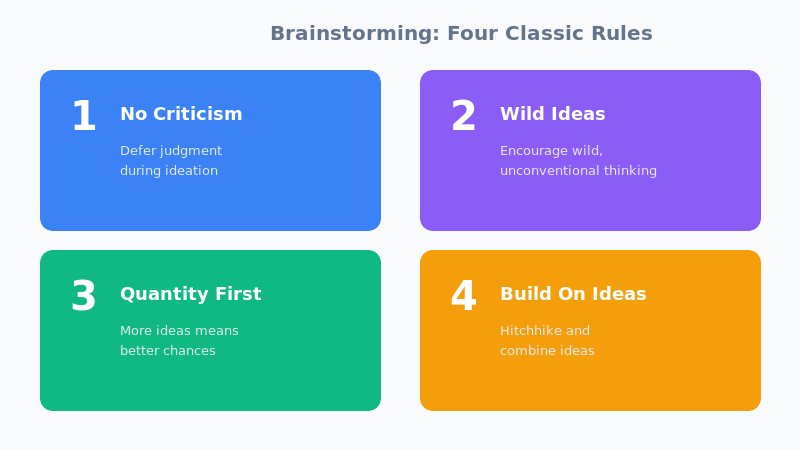
Brainstorming is a group idea-generation technique governed by four rules: defer judgment, welcome wild ideas, pursue quantity, and build on the contributions of others.
Before you start
Is this your framework?
Brainstorming answers one question: how do we produce a lot of candidate ideas quickly. Quantity is the goal, and everything in the method is arranged to protect it.
It is a generation technique and nothing else. It will not tell you which idea is any good, whether customers want it, or how to build it. The table below says what does.
| If your real problem is… | You probably want |
|---|---|
| We have plenty of ideas and need to know which to build | RICE — scoring and ranking a list you already trust Compare Brainstorming and RICE |
| We need to know which ideas customers would actually value | Kano Model — researched with customers rather than generated in a room Compare Brainstorming and Kano |
| We do not know what problem we are solving yet | Design Thinking — framing the problem before generating solutions to it |
| We need to understand what customers are trying to achieve | Jobs to Be Done — motivation, which no amount of ideation supplies |
| We want to escape the competitive assumptions of our industry | Blue Ocean Strategy — a structured challenge to what everyone assumes |
| Ideas get generated and never turn into anything | Innovation Pipeline — the stages between an idea and a product |
| We need many candidate ideas on a defined question, this afternoon | Brainstorming — you are in the right place |
What Is It?
Put a group in a room, pose a question, and collect ideas without judging them. Encourage volume, allow anything, and build on what others say. Osborn's contribution was to notice that criticism arrives too early in ordinary discussion and to separate generation from evaluation.
That separation is genuinely useful and it survives. What has not survived is the claim underneath it. Osborn argued that a group working this way would produce roughly twice as many ideas as the same people working alone, and that assertion has been tested since 1958 and consistently fails.
The same people generate more ideas, and more good ideas, working separately and pooling the results. Researchers call the comparison group a nominal group: individuals who never interact, whose output is combined afterwards with duplicates removed. Nominal groups beat interacting groups, and the gap widens as the group gets larger.
The main reason is mechanical rather than motivational. Only one person can speak at a time, so everyone else is holding an idea instead of forming a new one, and holding it also stops them listening properly. By the time the floor is free the idea has been forgotten, or now seems irrelevant. This is called production blocking, and experiments that isolate it find it accounts for most of the loss.
The practical consequence is not to abandon the method. It is to reorder it: generate in silence, then converge in the room. Every technique on this page that outperforms classic brainstorming does that one thing, and the four rules apply perfectly well to the written phase.
Quick Reference
The rules
The four rules, and how each has held up
Osborn set out four rules in 1953. Three have held up. The fourth is fine as an instruction and rests on an assumption that did not.
| Rule | What it is for | How it has held up |
|---|---|---|
| Defer judgment | Separating generation from evaluation, so ideas are not killed before they are finished. | Broadly supported as a separation of phases. Some later work finds structured debate can raise output further, so treat it as a rule for the generation phase rather than a ban on thinking critically. |
| Welcome wild ideas | Widening the range before narrowing it, on the view that it is easier to tame an idea than invent one. | Reasonable and low-cost. The risk is a session that produces entertaining ideas and nothing usable, which is a facilitation problem rather than a flaw in the rule. |
| Go for quantity | Volume, on the argument that the good ideas are found among the many rather than aimed at directly. | Well supported. The number of ideas generated correlates strongly with the number of good ideas available to choose from. |
| Build on others' ideas | Combination and improvement, which is what a group can do that individuals cannot. | The instruction is sound. The assumption that a talking group is the best setting for it is what failed testing, since building on an idea requires hearing it while not holding one of your own. |
The rules are fine. The room is the problem
It is worth being precise about what the evidence undermines. It is not the four rules, which are sensible and cost nothing to follow. It is the format in which Osborn assumed they would be applied — people speaking in turn in a room — and specifically the claim that this beats the same people working alone.
There is a second finding that makes this harder to notice. Participants consistently believe the group session went better than individual work, even when measurement shows the opposite. The effect has a name, the illusion of group effectivity. A team's confidence that brainstorming worked is not evidence that it did, which is why this particular failure has survived seventy years of contrary results.
What to run instead
The variants that outperform it
Every variant below fixes the same thing: it removes the requirement to wait for the floor. They differ in how much structure they add on top.
| Technique | How it runs | What it is good for |
|---|---|---|
| Brainwriting | Everyone writes ideas silently, then sheets are passed on and built upon. | The default replacement for classic brainstorming. Removes production blocking and most evaluation apprehension at no cost. |
| 6-3-5 | Six people, three ideas each, passed every five minutes, six rounds. 108 ideas in half an hour. | When you want guaranteed volume and equal contribution. The timer does the facilitation for you. |
| Nominal group technique | Silent generation, then round-robin sharing one idea at a time, then discussion, then a vote. | When the group must also choose, not only generate. The vote at the end is the point. |
| Round robin | Each person contributes in a fixed order, with no interruption and no skipping. | Groups with a dominant voice or a steep seniority gradient. Turn-taking is enforced rather than hoped for. |
| Question storming | Generate questions about the problem rather than answers to it. | When the problem itself is not yet well framed, and jumping to solutions would lock in the wrong one. |
The cheapest change is the order of the session
None of this requires new tooling, a facilitator qualification or a budget. Give everyone ten silent minutes and paper before anyone speaks, then run the discussion on what was written. That single reordering captures most of the difference the research describes, and it fits inside the meeting you were already going to hold.
The reason it works is worth stating plainly, because it also tells you when it will not. Silent generation helps because waiting to speak is the constraint. In a group of two, waiting costs little and the effect is small. In a group of eight, seven people are holding ideas at any moment, and that is where the ordering matters most.
Core Features
- A defined question: narrow enough to answer, open enough to have many answers
- Generation separated from evaluation: the durable part of Osborn's method
- Silent generation first: written, before anybody speaks
- Quantity as the target: counted, because the count predicts the good ideas
- Equal contribution: enforced by structure rather than left to the room
- A separate selection step: with its own criteria, run later
Worked example
Ten silent minutes against ninety of discussion
An illustrative composite. A consumer lending business in Buenos Aires, Argentina, running monthly ideation workshops to reduce loan application abandonment. Eight people, ninety minutes, for eleven months. Nobody could point to anything that had shipped from them.
| What was examined | What it showed |
|---|---|
| Who was talking | Transcripts of three sessions were timed. Two of the eight participants accounted for 61% of the speaking time, and two others spoke for under four minutes across ninety. The four rules were being followed correctly throughout. |
| How many ideas | An average of 34 distinct ideas per ninety-minute session, about four per person per session. |
| The comparison | One month the same eight people were given ten silent minutes and paper before any discussion. The written round alone produced 71 ideas, more than double a full session, and the two quietest participants contributed 19 of them. |
| What the group thought | Asked afterwards which format had felt more productive, six of eight said the discussion sessions. The written round had felt slow and awkward. |
| What changed | Sessions restructured: ten minutes silent writing, sheets passed once, then thirty minutes of discussion on what was written, then scoring in a separate meeting a week later. Two changes from the following four sessions shipped, including one from a participant who had barely spoken in eleven months. |
Ten silent minutes beat ninety minutes of discussion
71 ideas from a written round against 34 from a full session, with the same people in the same room on the same problem. The two participants who had contributed almost nothing for eleven months produced 19 ideas in ten minutes. Nothing about their ability had changed; the format had simply never given them the floor, and no facilitation technique was going to manufacture 90 minutes of speaking time for eight people.
The uncomfortable part is the last row but one. Six of eight preferred the format that produced half as much. The discussion sessions felt collaborative and energetic; the silent round felt like an exam. That is the illusion of group effectivity behaving exactly as described, and it is why asking a team whether a workshop went well is not a measurement.
When to Use
- You need many candidate ideas on a question that is already framed
- The problem has many plausible answers rather than one correct one
- People with different knowledge can contribute to the same question
- Early in a process, where the cost of a bad idea is a discarded sticky note
- You can separate generation from selection into different sessions
- Silent written generation can be run before any discussion
When NOT to Use
- The problem is not yet framed, so ideas would answer the wrong question
- What is needed is evidence about customers, not more options
- There is one correct answer to be worked out rather than invented
- The group has a steep seniority gradient and no structure to counter it
- Ideas have been generated repeatedly and nothing is ever selected
- Only a discussion format is available and the group is large
What to run instead
How brainstorming goes wrong
The first two are the ones the research is about. The rest are ordinary facilitation failures that make an already weak format weaker.
| Failure mode | What it looks like | What to do instead |
|---|---|---|
| Talking first | Ninety minutes of discussion producing fewer ideas than ten minutes of writing would | Silent written generation before anyone speaks. Cheapest change available and the best supported. |
| Judging by how it felt | The session felt energetic, so it is assumed to have worked. Nobody counts anything. | Count the distinct ideas. Participant confidence and output are known to come apart. |
| Two people talking | A handful dominate, the quietest contribute almost nothing across months of sessions | Enforce turn-taking or write instead. Do not rely on inviting quieter people to speak up. |
| A vague question | "How might we improve the product" produces ideas about everything and nothing | Narrow until the answers would be comparable to each other. Frame the problem first. |
| Generation and selection in one session | Ideas evaluated as they arrive, so the later ones never get proposed | Separate the meetings. Selection needs criteria that generation deliberately suspends. |
| No owner afterwards | Photographs of sticky notes, and eleven months of sessions with nothing shipped | End with named owners and dates for a shortlist, or do not hold the session. |
| Groups that are too large | Twelve people in a room, so eleven are waiting at any moment | Split into groups of four or fewer, or write. Blocking gets worse with size. |
Sourced
Evidence, and how to cite it
The method and its four rules come from an advertising executive in 1953.
Alex Faickney Osborn was a partner at the agency BBDO, where he is the O. He had been running group idea sessions since the late 1930s, published a first account in How to Think Up in 1942, and set out the method fully in Applied Imagination in 1953, which is the standard citation. The four rules and the term brainstorm session both come from that work, as does the specific claim that the average person generates about twice as many ideas in a group as alone.
Osborn, A.F. (1953) Applied Imagination: Principles and Procedures of Creative Thinking. New York: Scribner.
The central claim failed the first serious test, in 1958.
Taylor, Berry and Block had twelve groups of four and forty-eight individuals follow the four rules on the same three problems. The individuals were afterwards combined at random into twelve nominal groups of four and scored as though they had worked together. The real groups were markedly inferior on mean total ideas, on mean unique ideas, and on three separate quality-weighted measures. The result has been replicated repeatedly since, and a 1991 meta-analysis found the pattern consistent across the literature. The deficit grows as groups get larger.
Taylor, D.W., Berry, P.C. and Block, C.H. (1958) ‘Does group participation when using brainstorming facilitate or inhibit creative thinking?’, Administrative Science Quarterly, 3(1), pp. 23–47.
The cause is production blocking, not laziness or shyness.
Diehl and Stroebe ran four experiments separating the candidate explanations: free riding, evaluation apprehension, and production blocking. Removing the temptation to free ride did not close the gap. Evaluation apprehension had an effect but did not interact with session type in the way the explanation requires. The fourth experiment found that production blocking accounted for most of the loss. Only one person can contribute at a time, and while waiting, participants forget ideas, discard them as no longer relevant, or fail to listen because they are holding one. This matters practically: it means the fix is structural, and encouraging people to speak up does not address it.
Diehl, M. and Stroebe, W. (1987) ‘Productivity loss in brainstorming groups: toward the solution of a riddle’, Journal of Personality and Social Psychology, 53(3), pp. 497–509.
Participants cannot tell, which is why the belief persists.
People who have just taken part in a group session typically judge it more productive than working alone, including in studies where the measured output shows the reverse. The effect is documented well enough to have a name, the illusion of group effectivity. Its practical implication is uncomfortable and specific: a team's satisfaction with a workshop carries no information about whether it produced more ideas. If you want to know, count them, and compare against a silent round on a comparable question.
Stroebe, W., Diehl, M. and Abakoumkin, G. (1992) and Paulus et al. (1993), on the illusion of group effectivity.
How to cite it.
Harvard: Osborn, A.F. (1953) Applied Imagination. New York: Scribner.
APA: Osborn, A. F. (1953). Applied imagination. Scribner.
If you cite the effectiveness claim, cite Taylor, Berry and Block (1958) alongside it. For the mechanism, cite Diehl and Stroebe (1987), Journal of Personality and Social Psychology, 53(3).
Key Strengths
- Separates generation from evaluation: the durable part of the method
- Fast and free: no tooling, no training, no preparation beyond a question
- Quantity is the right target: the count does predict the good ideas
- Everyone understands it: no explanation needed to start
- Fixable cheaply: the main defect is corrected by reordering the session
Key Weaknesses
- Groups underproduce individuals: tested since 1958 and consistently replicated
- Only one person can speak: so most of the room is waiting, not thinking
- Gets worse with size: the deficit widens as the group grows
- Feels better than it is: participant confidence is not a measurement
- Generates nothing but options: selection is a separate problem entirely
Sequencing
What to run before and after
Ideas are cheap and only useful either side of something. What comes before decides whether they answer the right question; what comes after decides whether any of them happen.
Before
Frame the problem, and find out what customers actually need
A session answers the question it is given. Ideas generated against a vague or wrong question are efficiently produced and useless, and no facilitation fixes that.
During
Write before you talk, and count what comes out
Silent generation removes the constraint the research identifies. Counting the ideas is the only way to know whether a change to the format helped, since how it felt will not tell you.
After
Select deliberately, then give the survivors owners
Selection needs the criteria that generation suspended, and it needs its own meeting. A shortlist without named owners and dates is a photograph of sticky notes.
Common questions
Brainstorming: quick answers
Who invented brainstorming?
Alex Faickney Osborn, an advertising executive and the O in the agency BBDO. He had been running the sessions since the late 1930s, described the method in How to Think Up in 1942, and set it out fully in Applied Imagination in 1953. That book is the standard citation and the source of the four rules.
What are Osborn's four rules?
Defer judgment: no criticism during the session. Welcome wild ideas. Go for quantity, on the argument that volume produces quality. And build on other people's ideas rather than only offering your own. Three of the four have held up reasonably well. The one that has not is the assumption underneath them, that a group does this better than individuals.
Does group brainstorming actually work?
It works less well than the same people working alone and pooling their ideas afterwards, a comparison group researchers call a nominal group. This has been tested since 1958 and replicated consistently: interacting groups produce fewer ideas and fewer good ideas. The method is not useless, but Osborn's specific claim that groups outproduce individuals is the part that failed.
Why do groups produce fewer ideas?
Mainly production blocking. Only one person can speak at a time, so everyone else is holding an idea rather than generating a new one, and while holding it they cannot listen properly either. Ideas get forgotten or discarded as no longer relevant. Evaluation apprehension and free riding contribute, but the experiments point at blocking as the main cause.
What is brainwriting?
The same exercise with the talking removed. Everyone writes ideas silently for a set period, the sheets are passed on, and each person builds on what they receive. It removes production blocking because nobody has to wait for the floor, and it removes most evaluation apprehension because contributions are not performed in front of the room.
What is the 6-3-5 method?
A structured form of brainwriting: six participants, three ideas each, passed on every five minutes. Six rounds produce 108 ideas in half an hour. The numbers matter less than the structure, which enforces silent generation, guarantees every participant contributes equally, and makes building on others' ideas a rule rather than a hope.
What is the difference between brainstorming and ideation?
Ideation is the whole activity of generating and developing ideas; brainstorming is one technique for doing it, and a fairly specific one with named rules and an author. Treating them as synonyms is common and mostly harmless, except that it hides the existence of the other techniques, several of which perform better.
How do you cite brainstorming research?
For the method, cite Osborn, A.F. (1953) Applied Imagination. New York: Scribner. For the finding that groups underperform, cite Taylor, D.W., Berry, P.C. and Block, C.H. (1958) in Administrative Science Quarterly. For the cause, cite Diehl, M. and Stroebe, W. (1987) in the Journal of Personality and Social Psychology, 53(3).
Deep Resources
Frameworks related to Brainstorming
- Design ThinkingFraming the problem before generating solutions, which decides whether the ideas matter…
- SCAMPERPrompted idea generation, for when an open question produces nothing…
- RICE ScoreChoosing between the ideas, which brainstorming deliberately refuses to do…