Design Thinking Framework: The Five Stages, Explained
Design Thinking is a human-centered problem-solving framework built on five stages — Empathize, Define, Ideate, Prototype and Test — that invests in understanding users and reframing the problem before generating solutions.
Before you start
Is design thinking your framework?
Design thinking earns its cost in one situation: nobody can agree what the problem is, and the people affected by it are reachable. Both halves matter. If the problem is settled and the argument is only about which solution to build, then Empathize and Define — the two stages that exist to establish the problem — are ceremony. And if users cannot be observed, Empathize becomes a workshop about users, which is a much weaker activity.
One further test separates it from user research. Will you change what you build because of what you find? If the roadmap is already signed, Empathize produces a deck that confirms the decision. Design thinking costs what it costs because the research stages are permitted to overturn the building stages.
| If your real problem is… | You probably want |
|---|---|
| We need to know what customers are trying to get done, not what they think of our product | Jobs to Be Done — a theory of demand rather than a process, and often the sharper lens to bring to the Define stage Compare Design Thinking and Jobs to Be Done |
| We need one segment’s thoughts, feelings, words and actions on a single page | Empathy Mapping — a synthesis tool that lives inside the Empathize stage, not an alternative to it |
| We need to see a whole experience across touchpoints and find where it breaks | Customer Journey Mapping — one existing journey in detail; design thinking asks whether it should exist Compare Design Thinking and Journey Mapping |
| We need ideas, and we need them this afternoon | Brainstorming — the Ideate stage on its own, without the research that gives it something to aim at |
| We know what to build and need to decide the order | RICE Score or Value vs Effort — ranking, not discovery |
| We have a validated concept and need to ship it in increments | Scrum — design thinking stops at a tested prototype and hands over here |
| Nobody agrees what problem we are solving, and real users are reachable | Design Thinking — you are in the right place |
What Is It?
Most methods assume you know what to solve and help you solve it well. Design thinking assumes the opposite. It spends the front half of the effort establishing what is worth solving, and treats the reframing of the problem as the output likeliest to justify the exercise. The characteristic result of a good project is that the team stops working on the thing it started on.
The name carries two different things, which causes most of the confusion around it. There is a research tradition from the 1960s: design as a distinct way of reasoning, suited to problems with no correct answer. And there is a five-step method taught to non-designers, which is what almost everyone now means by the phrase.
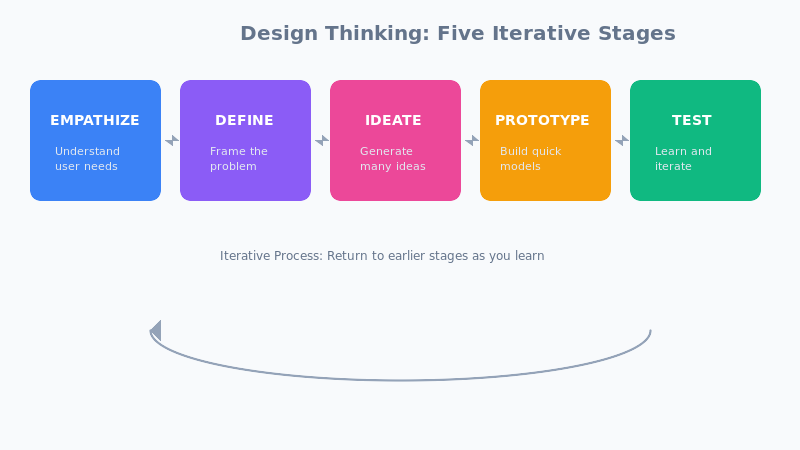
Those five are Empathize, Define, Ideate, Prototype and Test — two rounds of going wide and then narrowing. They are modes rather than a sequence; a failed test usually sends you back to define, not to prototype.
One point of order. The five stages are the Stanford d.school’s — the Hasso Plattner Institute of Design at Stanford University — and IDEO publishes a different model with three phases. The two are routinely merged, including in much teaching material; the whose model is it section sorts out who published what. The stages draw on tools covered separately here: Empathy Mapping and User Personas for synthesis, Customer Journey Mapping for an experience end to end, and Jobs to Be Done for framing what people are trying to achieve.
Quick Reference
The canonical structure
The five stages, and IDEO’s three
The first column is the d.school’s five modes; the last shows where each falls in IDEO’s three phases, so material in either vocabulary can be read against the other. The middle column matters most: each stage has a test distinguishing having done it from having held a meeting about it.
| Stage | What it actually requires | The test | IDEO’s three phases |
|---|---|---|---|
| 1. Empathize | Observe people in the situation, not in a conference room. What you want is the workaround and the abandoned attempt. Reported and observed behavior diverge exactly where the problem is — which is why a survey is a poor substitute. | Did you watch anyone fail at the task? | Inspiration |
| 2. Define | Converge on one problem statement: a person, a need, a reason. This carries the value and is skipped most often, because it means discarding most of what was collected. A statement writable before the research is a sign nothing changed. | Does it contradict what you believed a month ago? | Inspiration (its converging end) |
| 3. Ideate | Generate far more options than you need, then narrow on stated criteria. Obvious answers arrive first and clear the way. Separate generating from judging, or the room settles on the safest idea in ten minutes. | Did anything survive that nobody would have proposed on day one? | Ideation |
| 4. Prototype | Build the cheapest artifact that answers one question — a paper screen, a script, a room rearranged for an afternoon. A prototype is a question, not a small version of the answer. Polish it until nobody feels free to reject it and the test becomes a demonstration. | Could you throw it away on Friday without argument? | Ideation |
| 5. Test | Put it in front of real users and let them use it badly. Record what happens, not what they say; ask what they would do next, not whether they like it. This is the second empathize stage. | What did the test change? | Ideation, then Implementation |
Why the last column is lopsided
The split is not arbitrary. The d.school separates empathize from define because beginners collapse them — they research, then state the problem they already had. Naming convergence as its own mode makes it visible. IDEO writes for practitioners who do not need telling, so it compresses the front end and gives implementation a phase of its own. The five-stage model ends at a tested prototype and says nothing about shipping — which is what teams run into when they wonder why the workshop produced nothing.
Attribution
Whose model is it? Stanford, IDEO and the Double Diamond
Four things circulate under one name, published by four bodies at four different times. They are not versions of each other, and citing the wrong one is the commonest error in student work here.
| Model | Phases | Published by | Written for |
|---|---|---|---|
| The five modes | Empathize, Define, Ideate, Prototype, Test | Stanford d.school, in the Bootcamp Bootleg (2010), reissued as the Design Thinking Bootleg (2018) | Teaching. A deck of method cards under a Creative Commons license, explicitly a work in progress rather than a standard. |
| The three phases | Inspiration, Ideation, Implementation | IDEO.org, in The Field Guide to Human-Centered Design (2015). Its predecessor, the Human-Centered Design Toolkit, used Hear, Create, Deliver. | Field practice, originally social-sector work. Carries implementation as a full phase. |
| The Double Diamond | Discover, Define, Develop, Deliver | UK Design Council, shared from 2004, absorbed into its Framework for Innovation in 2019 | Explaining design process to those who commission it — policymakers, executives, engineers. |
| The term itself | No phases. Not a method. | Herbert Simon (1969), Robert McKim (1973), Peter Rowe (1987), Rolf Faste at Stanford, Richard Buchanan (1992) | A research literature on how designers reason. Predates every diagram above by decades. |
Why everyone attributes the five stages to IDEO
Because the two institutions share a founder. David Kelley founded IDEO in 1991 and led the creation of the d.school in 2004, and Tim Brown’s 2008 Harvard Business Review article attached IDEO’s name to the idea for good. The firm most associated with design thinking is not the body that published the five stages. The mistake is reasonable, and still a mistake: if you are citing empathize–define–ideate–prototype–test, cite the d.school.
The Double Diamond has the same murky parentage, and unusually its publisher says so. The Design Council’s history records that the diamond shape came from an IDEO engineer in the late 1990s, and that Gary Hamel was already using a “Double Diamond” at Whirlpool with different phase names. The team, in their own words, codified, renamed and popularized — which is more than the five-stage version usually admits.
Core Features
- Problem-finding before problem-solving: Empathize and Define exist to change the question
- Paired divergence and convergence: go wide twice, narrow twice, never both at once
- Prototypes as questions: built to be rejected cheaply, not to demonstrate progress
- Observation over report: what people do, gathered where they do it
- Mixed disciplines in one room: team composition is part of the method
- Iteration by default: stages are modes to move between, not gates to pass
Worked example
A community college, and the form that was not the problem
An illustrative composite. A community college in Ohio with around 11,000 students had a number nobody could move. Each year, 34% of the students selected for federal financial aid verification never finished it, and lost aid they qualified for. The team was asked to simplify the verification form.
| Stage | What it produced |
|---|---|
| Empathize | The team interviewed twenty-two students and sat beside six more as they tried to complete the process. Most had never opened the form. The college announced each selection through a student portal that students logged into about twice a semester. Half of them did not know a deadline had started until their aid failed to arrive. |
| Define | The team rewrote the brief. The original one said the form was too hard. The new one said something different: students who qualify for aid are losing it without ever learning that anything was required of them. That single sentence was the finding, and it overturned the assumption behind the original brief. |
| Ideate | The team generated around forty ideas and narrowed them to four. Simplifying the form made the shortlist, but came third. It would only have helped students who had already reached the form, and those were not the students who were failing. |
| Prototype | A two-week pilot with 120 students, using no new software. Each student got a text message when the college selected them, then two reminders. They also got a one-page checklist written in plain language. The only costs were staff time and a bulk SMS account. |
| Test | Completion among those 120 students rose from 66% to 84%. In follow-up interviews, few of them mentioned the checklist. Almost all of them pointed to the first text message. |
What the exercise actually bought, and what it did not
The reframe was the whole value. The form redesign that everyone was ready to fund would barely have moved the completion rate, because the students who were failing never reached the form in the first place. Three weeks of watching people attempt the task told the college more than eighteen months of complaints had. The complaints came from students who had got far enough into the process to have something to complain about.
But look at where the gain landed. Among the students the college had flagged as highest-need, completion rose only from 61% to 68%. The fix worked best for students who had reliable phone service and a stable address, and those students were already the closest to succeeding. This is what critics mean when they call design thinking conservative. Design thinking improves the system as it stands, and it helps most the people who are almost inside that system already.
When to Use
- The problem statement is contested, or has never been written down at all
- Repeated fixes have not improved the outcome, which suggests the wrong thing is being fixed
- You are designing a service or experience rather than optimizing a known process
- The people affected can be observed doing the actual task, not just surveyed
- The team is cross-functional and the decision-maker will attend the research
When NOT to Use
- The problem is well defined and the work is engineering, not framing
- The decision is due this week — the front half cannot be usefully compressed
- Users cannot be reached, leaving you designing from assumptions with extra steps
- The solution is already chosen and the exercise is really about validating it
- Nobody has authority to act on a reframed problem, so a better question changes nothing
In practice
How design thinking goes wrong
Its failures are unusually visible, because they leave photogenic artifacts — walls of notes, workshop decks — that look exactly like the successful version.
| Failure mode | What it looks like | What to do instead |
|---|---|---|
| Sticky-note theater | Two energizing days, a photographed wall, no decision a month later | Agree in advance what the workshop may change, and who signs it. |
| Empathize without users | The team imagines the user because scheduling real ones was hard | If you cannot reach users, pick a different method rather than simulating one. |
| The prototype that is really a specification | Six weeks of polish, and then a test that cannot fail because too much has already been spent | Cap the build cost before you start. A prototype you cannot throw away is a commitment. |
| Skipping define | Research Tuesday, ideation Wednesday, the original problem statement intact | Make convergence a separate session with a written output someone defends. |
| No implementation path | A validated concept, an enthusiastic team, no owner or delivery route | Name the receiving team before the first workshop and involve them in testing. |
Sourced
Evidence, and how to cite it
The five stages are the d.school’s; IDEO’s own model has three phases.
The Bootcamp Bootleg appeared in 2010 and was reissued in 2018 as the Design Thinking Bootleg, a free deck of method cards under a Creative Commons license. It names five modes and calls itself an evolving set of tools, which makes the source document less prescriptive than almost every summary written about it. IDEO.org’s Field Guide (2015) sets out Inspiration, Ideation and Implementation instead; the earlier Human-Centered Design Toolkit used Hear, Create and Deliver. Neither is the five-step sequence attributed to IDEO.
Hasso Plattner Institute of Design at Stanford (2018) Design Thinking Bootleg. Stanford, CA: Stanford d.school; IDEO.org (2015) The Field Guide to Human-Centered Design. San Francisco: IDEO.org.
The term is decades older than either institution’s diagram.
Herbert Simon treated design as a mode of thinking in The Sciences of the Artificial (1969). Robert McKim taught visual thinking at Stanford from 1973; Rolf Faste later taught design thinking there. Peter Rowe published a book titled Design Thinking in 1987, on architecture. Tim Brown’s 2008 HBR article is the entry point into business, not the origin.
Simon, H.A. (1969) The Sciences of the Artificial. Cambridge, MA: MIT Press; Rowe, P.G. (1987) Design Thinking. Cambridge, MA: MIT Press; Brown, T. (2008) ‘Design Thinking’, Harvard Business Review, June.
The most serious criticism comes from designers, not from skeptics of design.
Natasha Jen of Pentagram argued in 2017 that reducing a messy craft to five tidy steps removes the peer criticism that makes design work at all. Lee Vinsel called the movement a commercialization exercise in 2018. Natasha Iskander argued in Harvard Business Review that year that it preserves the status quo, privileging the designer over the people served. Bruce Nussbaum, who helped popularize it at BusinessWeek, had already called it a failed experiment in 2011.
Iskander, N. (2018) ‘Design Thinking Is Fundamentally Conservative and Preserves the Status Quo’, Harvard Business Review, September; Jen, N. (2017), 99U conference; Vinsel, L. (2018) ‘The Design Thinking Movement Is Absurd’.
How to cite it.
Harvard: Hasso Plattner Institute of Design at Stanford (2018) Design Thinking Bootleg. Stanford, CA: Stanford d.school.
APA: Hasso Plattner Institute of Design at Stanford. (2018). Design thinking bootleg. Stanford d.school.
For IDEO’s three phases, IDEO.org (2015) The Field Guide to Human-Centered Design. For the business case, Brown, T. (2009) Change by Design. New York: HarperBusiness. For the Double Diamond, Design Council (2019). For the term itself, Rowe (1987).
Key Strengths
- Catches the wrong question early: the new problem statement is usually worth more than the solution
- Cheap to be wrong: disposable prototypes make failure cheap early, when it still costs little
- Evidence a room accepts: watching one user struggle settles arguments that data cannot
- Transfers across domains: works on services, policy and internal process, not only products
- Builds shared understanding: a team that did the research together stops relitigating it
Key Weaknesses
- Stops short of delivery: the five-stage version has no implementation phase
- Easy to perform, hard to do: the artifacts are producible without the substance
- Conservative in effect: it improves the existing system, and helps most those already close to succeeding in it
- Depends on facilitation: quality varies more with the facilitator than with the method
- Weak evidence base: widely taught, thinly evaluated against alternatives
Sequencing
What to run before and after
Design thinking is a container. Several frameworks here are tools inside one of its stages rather than competitors to it.
Before
Confirm the answer is allowed to change
Establish who can act on a reframed problem and what they will abandon. If the honest answer is nothing, run a lighter listening method instead.
During
Use the specialist tools inside the stages
Empathy maps and personas synthesize research; journey maps show where an experience breaks; structured ideation stops the room converging in ten minutes.
After
Supply the implementation phase the model lacks
A tested prototype is not a shipped thing. Slice it, rank what to build first, hand it to a team with a delivery cadence — this is where most design thinking projects quietly end.
Common questions
Design thinking: quick answers
What are the five stages of design thinking?
Empathize, Define, Ideate, Prototype and Test. Empathize is field research. Define converges it into one problem statement. Ideate opens back out into candidate solutions. Prototype builds the cheapest artifact that answers a question. Test puts it in front of real users. They are modes rather than steps, and teams loop back constantly.
Did IDEO create the empathize–define–ideate–prototype–test process?
No. Those five are the Stanford d.school's, published in its Bootcamp Bootleg in 2010 and reissued as the Design Thinking Bootleg in 2018. IDEO publishes a three-phase model instead. The confusion is reasonable: David Kelley founded IDEO in 1991 and led the creation of the d.school in 2004. If you are citing the five stages, cite the d.school.
What is IDEO's design thinking process, and is it the same as human-centered design?
IDEO's published process has three phases — Inspiration, Ideation and Implementation — set out in The Field Guide to Human-Centered Design, released by IDEO.org in 2015. The earlier Human-Centered Design Toolkit used Hear, Create and Deliver. In IDEO's own usage, human-centered design is the practice and design thinking is what it is called when taught to non-designers.
What is the official source for the five stages?
The Design Thinking Bootleg, published by the Hasso Plattner Institute of Design at Stanford and free to download under a Creative Commons license. It is a deck of method cards rather than a textbook. There is no ISO standard and no certifying body, so a consultancy's summary is not an official version of anything.
What is the Double Diamond, and how does it relate to design thinking?
A four-phase model — Discover, Define, Develop, Deliver — shared by the UK Design Council from 2004 and folded into its Framework for Innovation in 2019. It describes the same rhythm of widening and narrowing twice. The Council's own history says the diamond shape came from IDEO in the late 1990s, and that the team codified and renamed rather than invented.
Who invented design thinking?
Nobody, in the sense the question expects. Herbert Simon treated design as a way of thinking in 1969. Robert McKim and later Rolf Faste taught it at Stanford from the 1970s. Peter Rowe published a book called Design Thinking in 1987, about architecture. Tim Brown's 2008 Harvard Business Review article carried it into business.
What are the main criticisms of design thinking?
The sharpest come from inside design. Natasha Jen of Pentagram argued in 2017 that packaging a messy craft as five tidy steps strips out the peer criticism that makes design work. Lee Vinsel called the movement a commercialization exercise in 2018. Natasha Iskander argued in Harvard Business Review that year that it preserves the status quo by privileging the designer.
How do I cite design thinking?
Harvard style, for the five stages: Hasso Plattner Institute of Design at Stanford (2018) Design Thinking Bootleg. Stanford, CA: Stanford d.school. APA style: Hasso Plattner Institute of Design at Stanford. (2018). Design thinking bootleg. Stanford d.school. For the three phases cite IDEO.org (2015). For the business case cite Brown, T. (2009) Change by Design.
Deep Resources
Frameworks related to Design Thinking
- Brainstorming / IdeationStructured technique for generating creative ideas through group participation. Foundation for…
- SCAMPER TechniqueChecklist-based innovation method (Substitute, Combine, Adapt, Modify, Put to another use,…
- Empathy MappingA visual tool that captures what users think, feel, say, and do to build shared understanding…