SCAMPER Technique: What Each Letter Asks, and How to Run It on a Real Product
SCAMPER is a checklist of seven prompts — substitute, combine, adapt, modify, put to another use, eliminate and reverse — applied in turn to something that already exists.
Before you start
Is this your framework?
SCAMPER answers one question: what else could we do to the thing we already have. Seven prompts, applied one at a time to an existing product, process or service, each forcing a change nobody would have proposed unprompted.
It needs something to operate on. Pointed at a blank page it produces nothing, because every prompt is a transformation of an existing object. It also has no opinion on whether any of the ideas are worth doing. If either of those is your problem, the table below says where to go.
| If your real problem is… | You probably want |
|---|---|
| We have no idea and nothing to start from | Brainstorming — open generation, which does not require an existing object to transform Compare SCAMPER and Brainstorming |
| We do not know what customers actually need | Jobs to be Done — the job the product is hired for, which no amount of reshuffling features will reveal Compare SCAMPER and Jobs to be Done |
| We have too many ideas and cannot choose | ICE Scoring or RICE — SCAMPER generates and never ranks |
| We need a whole product development process | Design Thinking — research, definition and testing around the ideation step this technique occupies |
| We are looking for an uncontested market rather than a better product | Blue Ocean Strategy — strategic repositioning, not feature variation |
| Ideas keep appearing and none of them ever ship | Innovation Pipeline — the stages and gates between an idea and a product |
| We have a product and need more options for changing it | SCAMPER — you are in the right place |
What Is It?
Take something that exists. Ask seven questions about it in turn. What could be substituted? What could be combined with it? What could be adapted from elsewhere? What could be modified, made bigger or smaller? What else could it be put to use for? What could be eliminated? What could be reversed or rearranged?
The mechanism is constraint. Asked to improve a product, people generate a handful of ideas along the lines they already think in. Asked specifically what could be removed, they have to answer that question, and the answer is usually somewhere they were not looking.
It is a checklist, not a method. There is no research step, no prioritization, no test, and no view on whether any output is a good idea. What it reliably produces is volume and variety, which is worth something at the start of an hour and worth nothing at the end of one if nothing follows.
Quick Reference
The seven prompts
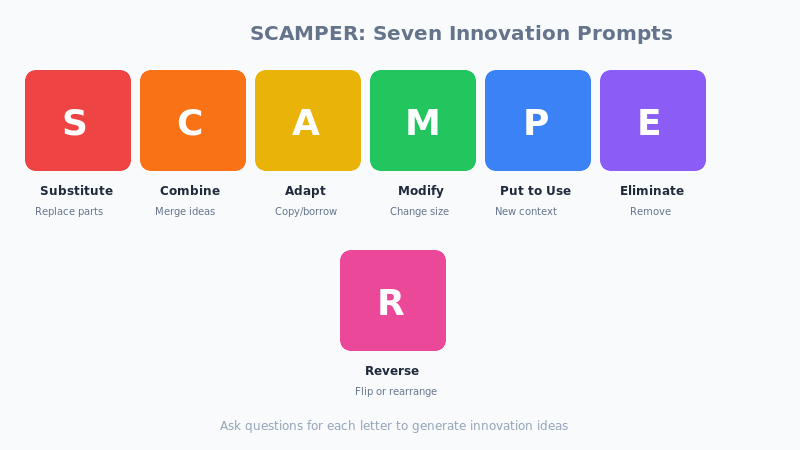
What each letter actually asks
Each letter is a different kind of transformation. The value is in answering all seven, not stopping at the two that come easily — almost always substitute and combine.
| Letter | The question | What it tends to surface |
|---|---|---|
| S — Substitute | What could be swapped out? A material, component, step or rule? | Cost and supply alternatives. The easiest prompt, and the first exhausted |
| C — Combine | What could be merged with this? Another product, step or audience? | Bundles and integrations. The other prompt teams stop at |
| A — Adapt | What works elsewhere that could be borrowed? What does this resemble in another industry? | Cross-domain ideas, usually the most original output the technique gives |
| M — Modify | What could be bigger, smaller, stronger, a different shape? Sometimes split into magnify and minify | Scale and format variations. Reliable, rarely surprising |
| P — Put to another use | Who else could use this? What could it do that it was not built for? | New segments and repurposing. Often the best prompt for a mature product |
| E — Eliminate | What could be removed entirely? What if half of it were gone? | The prompt people skip and the one that pays. Teams add by instinct; they have to be forced to subtract |
| R — Reverse | What if the order ran backwards, or roles swapped? Sometimes given as rearrange | Process and sequence changes, and the occasional business model inversion |
The acronym is not stable
Published versions differ. A is adapt or adjust. M is modify, sometimes magnify or minify as separate prompts. P is put to another use, or purpose. R is reverse, or rearrange, or both. The checklist was compressed from a longer list of questions and the compression was never standardized.
Run all the readings rather than picking one. Magnify and minify produce different ideas, and so do reverse and rearrange. Treating them as alternatives loses prompts for nothing.
Disambiguation
SCAMPER, brainstorming and design thinking
These are named together constantly and operate at different sizes. The question that separates them is how much of the problem each covers.
| Approach | Scope | Needs |
|---|---|---|
| SCAMPER this page | One step: generating variations on a thing that exists | An existing object. Produces nothing from nothing |
| Brainstorming | One step: generating ideas without a starting object | A question. Broader than SCAMPER and much less directed |
| Design Thinking | A whole process: empathize, define, ideate, prototype, test | Time and access to users. SCAMPER sits inside its ideate step |
| Innovation pipeline | What happens after ideas exist: stages, gates, funding | Governance. This is where SCAMPER output goes to be killed or funded |
The common mistake is treating it as a process
SCAMPER occupies about twenty minutes of a product development cycle. Presented as a methodology it disappoints, because there is no research in front of it and no filter behind it, and a session that ends with forty unranked ideas has produced work rather than progress.
Its correct place is inside something larger. Design thinking supplies the user research that tells you which of the forty matter; an innovation pipeline supplies the gates that stop all forty being started.
Core Features
- Seven prompts, applied in turn: substitute, combine, adapt, modify, put to another use, eliminate, reverse
- Requires an existing object: every prompt is a transformation of something
- Generation only: no research, no ranking, no test
- Forced coverage: the value is in the prompts nobody would have reached for
- Unstable acronym: several published expansions, none canonical
- Minutes to learn: no training, no facilitator, no materials
Worked example
A bicycle component maker in Taichung, and the prompt that paid
An illustrative composite. A Taiwanese manufacturer of bicycle hub gears ran a two-hour session on a mid-range hub that had been in the catalog nine years with falling margin. Six people, all seven prompts, thirty-one ideas.
| Prompt | What came out |
|---|---|
| Substitute and Combine | Nineteen of the thirty-one ideas, almost all cost-down material swaps the engineering team had already considered. Two easy prompts absorbed two thirds of the session. |
| Adapt | A sealing approach borrowed from the company's own agricultural gearbox line. Went into testing and shortened the warranty claim rate. |
| Eliminate | Someone asked what would remain if the internal shifting mechanism were removed entirely. The answer was a single-speed hub with the same shell and bearings, sharing most of the tooling. It shipped as a separate product into the urban commuter market at roughly TWD 40 million in first-year revenue. |
| Put to another use | Three ideas about e-bike conversions, all already covered by another team. No loss, but no gain. |
| Reverse | One idea about assembling the hub from the drive side inward. Rejected on tooling cost, but it surfaced an assembly step that was later removed anyway. |
One prompt out of seven carried the session
The single idea worth anything came from Eliminate, and nobody in that room would have got to it unprompted, because the entire product line was built on the shifting mechanism being the thing you sell. That is the case for running all seven prompts even when the first two feel productive.
Note also what the technique did not do. Thirty-one ideas came out unranked and undifferentiated, and deciding between them took a separate meeting with cost and volume data that no part of SCAMPER supplies.
When to Use
- An existing product, service or process needs options for change
- A team keeps producing variations on the same two ideas
- A mature product with falling margin, where the obvious moves are exhausted
- As the ideation step inside a larger design or improvement process
- Working alone, where there is no group to brainstorm with
- Teaching structured creativity, which is what it was built for
When NOT to Use
- From a blank page, since every prompt transforms an existing thing
- To choose between ideas, which the technique has no mechanism for
- Where the real problem is not knowing what customers need
- For genuinely new categories, since the output is bounded by the starting object
- As a substitute for a product process, which it occupies twenty minutes of
- Where the constraint is delivery rather than ideas, which is the more common case
In practice
How sessions go wrong
The technique is almost too easy to run, and the failures come from what surrounds the session rather than from the prompts.
| Failure mode | What it looks like | What to do instead |
|---|---|---|
| Stopping at S and C | Two thirds of the ideas come from the first two prompts and the session runs out of time | Time-box each prompt equally. Ten minutes each, whether or not the ideas are flowing. |
| Nothing after the session | Forty ideas on a wall, no owner, no ranking, no next meeting | Book the selection meeting before the session, and decide in advance what data it will need. |
| Applied to nothing in particular | Run against a vague theme like our onboarding, producing vague ideas | Point it at one concrete artifact. A specific screen, a specific part, a specific step. |
| Evaluating while generating | Each idea debated as it appears, and the quiet people stop contributing | Separate the two passes. Generate everything, then judge, as a distinct activity. |
| One acronym reading only | Modify used, magnify and minify never asked | Run the variants. They are different questions and cost nothing extra. |
| Sold as innovation strategy | A checklist presented to leadership as the answer to a growth problem | Describe it as what it is: twenty minutes of idea generation inside a longer process. |
Sourced
Evidence, and how to cite it
The questions are Osborn's; the acronym is Eberle's.
Alex Osborn's Applied Imagination set out a long checklist of idea-spurring questions alongside the brainstorming rules he is better known for. Bob Eberle, an educational administrator in Edwardsville, Illinois, selected from that list, drew also on Frank Williams's work on creative expression, and arranged the result into a mnemonic.
Osborn, A.F. (1953) Applied Imagination. New York: Scribner; Eberle, R.F. (1971) SCAMPER: Games for Imagination Development. Buffalo: D.O.K. Publishers.
It was written for children, not for product teams.
Eberle's book is a 42-page classroom resource of guided imagination games, with a description for the teacher against each activity and cues on when to wait and how to extend the exercise. He followed it with Scamper On and co-wrote a creative problem-solving resource for children. Nothing about the technique is unsuited to adults, but a corporate innovation methodology is not what was being written.
Eberle, R.F. (1971), collation record: 42 pages; and Eberle, R.F. (1972) ‘Developing imagination through SCAMPER’, The Journal of Creative Behavior, 6(3), pp. 199–203.
There is no controlled evidence that it beats the alternatives.
No trial compares idea quality from a SCAMPER session with idea quality from unstructured generation on the same problem. The general finding that prompts increase the number and range of ideas is well supported; that a specific set of seven outperforms another set is not. Treat the choice of checklist as a matter of convenience.
No comparative outcome studies of the SCAMPER checklist are available in the creativity literature as of 2026.
The expansion of the acronym varies by source.
A is given as adapt or adjust; M as modify, magnify or minify; P as put to another use or purpose; R as reverse or rearrange. The variation traces to the compression of a longer question list into seven letters, and no single reading is authoritative. Anyone quoting one version as the correct one is choosing.
Compare Eberle (1971) with the expansions in Serrat, O. (2017) ‘The SCAMPER Technique’, in Knowledge Solutions. Singapore: Springer, pp. 311–314.
How to cite it.
Harvard: Eberle, R.F. (1971) SCAMPER: Games for Imagination Development. Buffalo, NY: D.O.K. Publishers.
APA: Eberle, R. F. (1971). SCAMPER: Games for imagination development. D.O.K. Publishers.
For a peer-reviewed source, cite Eberle (1972) in The Journal of Creative Behavior. For the underlying questions, cite Osborn (1953).
Key Strengths
- Forces coverage: the prompts nobody would reach for are where the value is
- Works alone: one of the few ideation techniques that does not need a group
- Learned in minutes: no training, no facilitator, no materials
- Beats a blank instruction: asked to innovate, people stall; asked what to remove, they answer
- Produces volume fast: thirty ideas in two hours is ordinary
Key Weaknesses
- Incremental by construction: output is bounded by the object you started from
- No selection mechanism: it ends with an unranked list
- Front-loaded: substitute and combine absorb the session unless time-boxed
- No evidence of superiority: prompts help, but not demonstrably these prompts
- Unstable acronym: different sources teach different prompts
- Oversold: routinely presented as an innovation strategy rather than an exercise
Sequencing
What to run before and after
SCAMPER is a middle step. It needs something to point at, and it hands back a list somebody else has to judge.
Before
Decide what to point it at, and why
The technique transforms one concrete object. Pointed at a theme rather than an artifact it produces themes. Knowing what customers are actually struggling with also decides which prompt is worth the most time.
During
Keep generation separate from judgment
Debating each idea as it appears halves the output and silences the quieter half of the room. The same rule that governs a brainstorming session applies here.
After
Rank the list, then gate it
A session ends with an undifferentiated pile. Scoring turns it into an order, and a pipeline decides which of them get funded rather than merely started.
Common questions
SCAMPER: quick answers
What is the SCAMPER technique?
A checklist of seven prompts applied in turn to something that already exists, to generate variations on it. The prompts are substitute, combine, adapt, modify, put to another use, eliminate and reverse. It generates ideas and does nothing else: there is no research step and no way to rank the output.
What does SCAMPER stand for?
Substitute, Combine, Adapt, Modify, Put to another use, Eliminate, Reverse. Several letters have alternative readings in published sources: A is sometimes adjust, M is sometimes split into magnify and minify, P is sometimes purpose, and R is sometimes rearrange. None is authoritative, and running the variants costs nothing and produces different ideas.
Who created the SCAMPER technique?
Bob Eberle, an educational administrator, in his 1971 book SCAMPER: Games for Imagination Development. The underlying questions are Alex Osborn's, from Applied Imagination in 1953; Eberle selected from that list and arranged the result into a mnemonic. He wrote it as a classroom resource for developing children's imagination, not as a business tool.
What is an example of SCAMPER?
Applied to a bicycle hub gear: substitute the shell material; combine it with the brake; adapt a seal from a different product line; modify the size range; put it to another use on cargo bikes; eliminate the shifting mechanism entirely and sell a single-speed version on the same tooling; reverse the assembly order. The eliminate prompt is usually where the non-obvious answer sits.
What is the difference between SCAMPER and brainstorming?
Direction and starting point. Brainstorming generates ideas from a question and needs no existing object. SCAMPER transforms a specific thing you already have, using prompts that force coverage of angles a group would skip. SCAMPER works for one person alone; brainstorming is usually a group activity.
How is SCAMPER used in design thinking?
As one tool inside the ideate stage. Design thinking is a full process running from user research through definition, ideation, prototyping and testing. SCAMPER covers about twenty minutes of the ideation step, and depends on the earlier stages having identified something concrete worth transforming.
How long does a SCAMPER session take?
One to two hours for a single object with a small group. Time-box each prompt equally, around ten minutes, because substitute and combine will otherwise absorb most of the session and the later prompts, which produce the less obvious ideas, get squeezed.
Does SCAMPER work for radical innovation?
Not really, and this is structural rather than a matter of technique. Every prompt is a transformation of an existing object, so the output is bounded by what you started from. It is good at finding options inside a product line and poor at finding a reason to leave one. For that, the question is a strategic one rather than an ideation one.
Deep Resources
Frameworks related to the SCAMPER Technique
- BrainstormingOpen generation for when there is no existing object to transform…
- Design ThinkingThe full process this technique occupies one step of…
- Innovation PipelineWhere an unranked pile of ideas goes to be funded or killed…