McKinsey 7S Framework: Organizational Alignment Model
McKinsey 7S Framework is an organizational effectiveness model that examines seven interdependent elements—Strategy, Structure, Systems, Skills, Style, Staff, and Shared Values—to diagnose alignment and guide organizational change.
Before you start
Is 7S actually your framework?
7S is one of the most widely recognized models in management, which is exactly why it gets picked for problems it does not solve. It is the framework most people remember from business school, and familiarity is a poor selection criterion.
7S diagnoses incoherence — the situation where every part of the organization looks defensible on its own, yet the whole thing does not work. If you can already name the one broken thing, you do not have a 7S problem, and a seven-element audit will bury the answer you already have.
| If your real problem is… | You probably want |
|---|---|
| Nobody agrees what we are trying to achieve | OKR or Balanced Scorecard Not sure which? Compare |
| We know what to do, not in what order | RICE, Value vs Effort or MoSCoW Not sure which? Compare |
| The change keeps failing to stick | Kotter’s 8-Step or ADKAR Not sure which? Compare |
| We are not sure the strategy itself is right | Porter’s Five Forces or SWOT Not sure which? Compare |
| Ownership is unclear and things fall through | RACI Matrix |
| Work is invisible, delivery is unpredictable | Kanban |
| Everything is individually fine and collectively broken | 7S — you are in the right place |
The distinction that matters
7S is a diagnostic, not a change method. It tells you where an organization contradicts itself. It has no mechanism for doing anything about that, and treating it as a change program is the most common way it disappoints.
What Is It?
The McKinsey 7S Framework was developed by Tom Peters and Robert Waterman at McKinsey & Company in 1980, later popularized in their 1982 bestseller "In Search of Excellence." It revolutionized thinking about organizational effectiveness by showing that strategy alone isn't enough—seven interconnected elements must align for success.
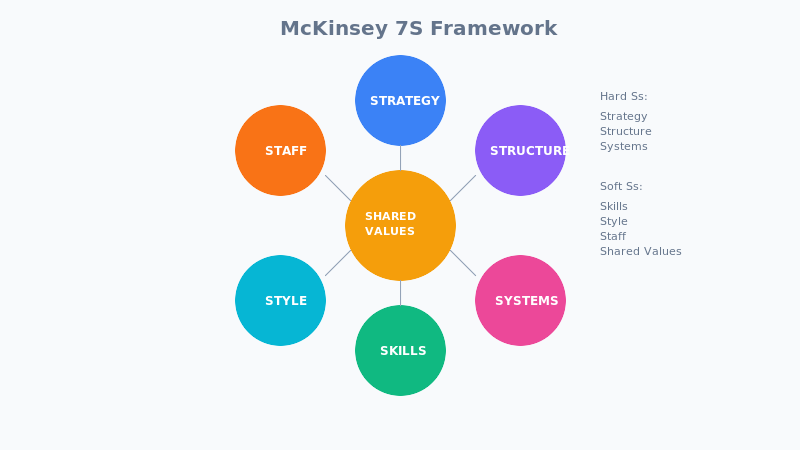
The framework divides into Hard S's (tangible, easier to change): Strategy (plan for competitive advantage), Structure (how the organization is organized), and Systems (processes, IT, procedures). And Soft S's (intangible, harder to change): Skills (organizational capabilities), Style (leadership approach and culture), Staff (people and talent), and Shared Values (core beliefs and purpose).
Shared Values sits at the center, connecting and influencing all other elements. This placement emphasizes that organizational identity and purpose are foundational—change Shared Values and every other element must realign. The interconnected model shows why changing one element often requires adjusting others.
The 7S Framework complements Balanced Scorecard for performance measurement, Kotter's 8-Step Model for change management, and VRIO Framework for capability assessment.
Quick Reference
Core Features
- Strategy: Plan to build and sustain competitive advantage
- Structure: Organizational design, reporting, division of work
- Systems: Processes, IT systems, workflows, procedures
- Skills: Core capabilities and competencies
- Style: Leadership style and organizational culture
- Staff: People, talent management, HR practices
- Shared Values: Core beliefs, identity, purpose (central element)
Worked example
A 7S that found the real problem
An illustrative composite, built from a pattern common enough to be worth walking through. A 220-person B2B software company moved its strategy upmarket, from small-business customers to enterprise accounts. Eighteen months later, enterprise revenue had barely moved. The obvious diagnosis was a sales-capability gap. The 7S found something else.
The middle column is what the leadership team said in the room. The right column is what turned out to be true once somebody checked.
| Element | What they said | What was actually true |
|---|---|---|
| Strategy | “Move upmarket to enterprise” | Genuinely agreed and genuinely communicated. Not the problem. |
| Structure | “Reorganised into enterprise pods” | Pods existed. Each rep still owned the entire cycle alone, exactly as in the old model. |
| Systems | “Standard CRM and quota” | Commission paid on deals closed per quarter, not on contract value. A nine-month enterprise deal paid less than three quick small ones. |
| Skills | “We need enterprise training” | A real gap — security reviews, procurement, multi-stakeholder selling. But not the binding constraint. |
| Style | “Fast-moving, results-driven” | The weekly all-hands celebrated deals closed. Nobody was ever applauded for a deal still in progress. |
| Staff | “Strong commercial team” | Hired and promoted on velocity. The people best suited to the new motion scored worst on the old metrics. |
| Shared Values | “Win the week” | Said aloud, printed on the wall, and sincerely meant. Structurally incompatible with a nine-month sales cycle. |
What the diagnosis showed
Strategy, Structure and Skills were all broadly fine. The contradiction sat between Systems and Shared Values on one side and Strategy on the other. The company had asked people to pursue long deals while paying and applauding short ones. The reps were behaving rationally.
Note what this rules out. More enterprise sales training — the intuitive fix, and the one already budgeted — would have changed nothing, because capability was never the constraint. That is the specific value 7S adds: it stops you solving the visible problem instead of the real one.
When to Use
- Major organizational change initiatives
- Post-merger integration planning
- Strategy implementation assessment
- Organizational restructuring
- Performance improvement diagnosis
- Culture transformation programs
- Leadership team alignment workshops
When NOT to Use
- Quick strategic decisions (too comprehensive)
- External market analysis (internal focus only)
- Small teams or early-stage startups
- Tactical or operational issues
- When resources for deep analysis unavailable
In the room
How 7S sessions actually fail
The framework is rarely what breaks. The workshop is. These are the recurring patterns, and what to do when you see one.
| What you see | What it usually means | What to do |
|---|---|---|
| Every element is rated “needs improvement” | The team is describing an aspiration, not a baseline | Force a comparison. Rate each S against a named competitor, or against your own organization two years ago. |
| The session produces seven workstreams | 7S was used to generate a to-do list rather than a diagnosis | Discard anything that is not a contradiction between two elements. Those are the only findings 7S is qualified to produce. |
| Hard elements get specifics, soft ones get slogans | Nobody has evidence for Style or Shared Values | Ask what you would observe on an ordinary Tuesday that proves it. If nobody can answer, the element is unmeasured, not healthy. |
| Leadership rates Style far higher than everyone else | Culture is being described from the top of the organization | Collect Style, Staff and Shared Values separately from at least two levels, then compare. The gap is itself the finding. |
| Shared Values match the values poster exactly | Stated values have been recorded instead of enacted ones | Ask what behavior actually gets someone promoted here. That answer is your real Shared Values. |
| Three months on, nothing has changed | 7S diagnosed, then nothing owned the result | Expected — 7S has no execution mechanism. Hand the findings to Kotter’s 8-Step or OKR with named owners. |
Sourced
What the evidence says
It was built to explain why good strategies fail in execution.
McKinsey managing director Ron Daniel commissioned an organizational effectiveness project after observing that sophisticated strategies kept failing when implemented. The seven-element structure was settled over a two-day session in San Francisco; the alliteration was suggested by Anthony Athos and Richard Pascale, and the seventh element was originally “superordinate goals” before becoming Shared Values.
Waterman, Peters & Phillips, “Structure Is Not Organization”, Business Horizons 23(3), June 1980, pp. 14–26. Original paper (PDF)
Its most famous application went badly, and publicly.
Peters and Waterman used the framework to select 43 “excellent” American companies for In Search of Excellence (1982). BusinessWeek ran a cover story on 5 November 1984 reporting that close to a third of them had run into serious financial trouble within roughly two years of publication.
“Oops! Who’s Excellent Now?”, BusinessWeek, 5 November 1984.
But that critique is weaker than it is usually made to sound.
Later academic work argues the BusinessWeek finding is time-sensitive — it measures a two-year window — and is contradicted by longer-horizon analyzes of the same companies. The more durable criticisms of the excellence research are methodological, concerning how the sample was assembled, rather than the share of firms that later stumbled.
Discussed in “Who’s excellent now? The unspeakable nature of business excellence”, Culture and Organization, 2023. Paper
What that means for using it.
The honest reading is narrower than either its promoters or its critics suggest. 7S has never been validated as a predictive model — alignment across seven elements does not forecast performance, and the largest attempt to use it that way is the cautionary tale above. What it reliably does is give a leadership team a shared vocabulary for naming contradictions everyone can sense but nobody had articulated. Judge a 7S session by whether it surfaced a contradiction somebody was avoiding, not by whether it produced a score.
Key Strengths
- Holistic View: Examines organization comprehensively
- Interconnections: Shows dependencies between elements
- Soft Elements: Recognizes culture and people matter
- Diagnostic Power: Identifies misalignments clearly
- Change Guidance: Shows what else must change
Key Weaknesses
- Complex and time-intensive to apply fully
- Internal focus—ignores external environment
- Soft elements are subjective and hard to measure
- Doesn't prioritize which S matters most
- Can lead to analysis paralysis
How It Works
| 1 Primary Input | Organizational data, employee surveys, leadership interviews, process documentation |
|---|---|
| 2 Data You Need | Strategy documents, org charts, process maps, capability assessments, culture surveys |
| 3 Primary Output | Alignment assessment, gap analysis, change roadmap, priority actions per element |
Sequencing
What to run before and after 7S
7S assumes your strategy is already decided, and it does nothing to execute the change it identifies. It is a middle step, and most disappointment with it comes from running it on its own.
Before
Check the strategy is sound
7S takes Strategy as an input and never questions it. If the strategy is wrong, 7S will faithfully align you to the wrong thing.
During
Diagnose the contradictions
The 7S itself. Two to four weeks, with evidence gathered from more than one level. The output is a short list of contradictions, not a scorecard.
After
Give the findings an owner
The step most often skipped, and the reason 7S gets remembered as a workshop that changed nothing. Diagnosis without an execution mechanism decays within a quarter.
Common questions
McKinsey 7S: quick answers
What are the 7 S's in the McKinsey 7S Framework?
Strategy, Structure and Systems are the hard elements. Skills, Style, Staff and Shared Values are the soft ones. Shared Values sits at the center because a change there forces every other element to realign.
Is the McKinsey 7S Framework right for my problem?
7S diagnoses incoherence — when every part looks defensible alone but the whole does not work. If you can already name the one broken thing, something more targeted will serve you better: OKR for unclear goals, RICE for prioritization, Kotter’s 8-Step for change that will not stick, RACI for unclear ownership.
Why do McKinsey 7S workshops often fail?
The usual causes are using it to generate a to-do list instead of finding contradictions between elements, answering the soft elements with slogans rather than evidence, collecting culture data only from leadership, and having no execution mechanism afterwards. 7S is a diagnostic; it has no built-in way to deliver change.
How long does a McKinsey 7S assessment take?
Two to four weeks for a team of five to fifteen. The time goes into gathering evidence from more than one level of the organization, not into the workshop itself. A single-session 7S usually records opinion rather than diagnosis.
Who created the McKinsey 7S Framework?
Robert Waterman, Tom Peters and Julien Phillips at McKinsey & Company, published in Business Horizons in June 1980. Anthony Athos and Richard Pascale suggested organising the findings as alliterative S-words.
Comparison with Related Frameworks
7S Framework vs Balanced Scorecard
Balanced Scorecard measures performance across perspectives. 7S diagnoses organizational alignment. Use 7S to identify issues, Balanced Scorecard to track improvement.
7S Framework vs VRIO
VRIO Framework assesses competitive advantage of resources. 7S examines broader organizational alignment. VRIO is resource-focused; 7S is organization-wide.
Deep Resources
Frameworks related to McKinsey 7S Framework
- Balanced ScorecardStrategic management framework that translates strategy into measurable objectives across…
- VRIO FrameworkCompetitive advantage analysis tool evaluating resources through Value, Rarity, Imitability,…
- Strategy MapVisual representation of strategy showing how objectives connect through cause-and-effect…