VRIO Framework: Competitive Advantage Analysis
VRIO Framework is a strategic analysis tool that evaluates resources and capabilities through four questions—Value, Rarity, Imitability, and Organization—to determine whether they provide sustained competitive advantage.
Before you start
Is VRIO actually your framework?
VRIO answers one narrow question: of the things we already have, is any of them capable of sustaining an advantage? It is an internal audit with a strict test, and it is deliberately unimpressed by most of what a company is proud of.
It also has a limitation its own literature is explicit about, and which almost every practical guide omits: VRIO cannot tell you whether something is valuable. Value is set by customers and competitors, outside the firm. Run VRIO without external analysis and the V becomes a room full of people agreeing that their work matters.
| If your real problem is… | You probably want |
|---|---|
| We do not know what customers actually value | Jobs to Be Done or Voice of the Customer Not sure which? Compare |
| We do not have a picture of the competitive landscape | Porter’s Five Forces or PESTEL Not sure which? Compare |
| We want a broad strengths and weaknesses picture, quickly | SWOT — VRIO is the rigorous version of its internal half Compare VRIO and SWOT |
| We know our advantage and must decide where to grow | Ansoff Matrix or Blue Ocean Strategy Not sure which? Compare |
| We have good people and assets but nothing comes of them | McKinsey 7S — that is an organizational coherence problem |
| Deciding whether and how to expand into a new market | The market expansion playbook, where VRIO is stage 3 of 6 |
| We need to know whether an advantage is actually defensible | VRIO — you are in the right place |
The distinction that matters
VRIO is a test, not a survey. Its purpose is to disqualify. A VRIO analysis that concludes you hold several sustained advantages has almost certainly been graded generously — the framework is built to find the small number of things that survive scrutiny, and the usual honest answer is one, or none.
What Is It?
The VRIO Framework, developed by Jay Barney in 1991, is a cornerstone of the Resource-Based View (RBV) of strategy. Unlike frameworks that focus on external market positioning (like Porter's Five Forces), VRIO looks inward to identify which internal resources and capabilities can provide sustainable competitive advantage.
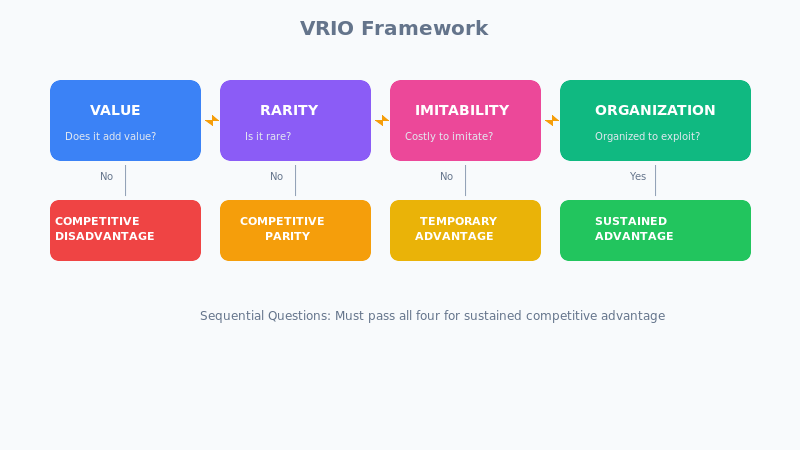
The framework asks four sequential questions about each resource: Value—Does it enable the firm to respond to threats or opportunities? Rarity—Do few competitors possess it? Imitability—Is it costly for others to obtain or develop? Organization—Is the firm organized to capture value from this resource?
Resources must pass all four tests for sustained competitive advantage. If a resource is valuable but not rare, it provides competitive parity. If valuable and rare but easy to imitate, it offers temporary advantage. Only when all criteria are met—and the organization can exploit the resource—does sustained advantage emerge.
VRIO complements SWOT Analysis for capability assessment, McKinsey 7S for organizational alignment, and Porter's Five Forces for external analysis.
Quick Reference
Core Features
- Value: Does the resource enable response to opportunities/threats?
- Rarity: Is it controlled by few firms in the competitive landscape?
- Imitability: Do firms without it face cost disadvantage obtaining it?
- Organization: Are policies and procedures organized to exploit it?
- Sequential Logic: Questions must be answered in order
- Competitive Implications: Clear outcomes from disadvantage to sustained advantage
Worked example
Four resources, four different verdicts
An illustrative composite. A forty-year-old specialty food manufacturer, roughly $60m turnover, ran VRIO across the four things its leadership named when asked what made the company hard to beat. Each landed on a different rung, which is what a properly graded VRIO looks like.
Each question is only asked if the previous one was answered yes. A single no fixes the verdict and ends the row.
| Resource | V | R | I | O | Verdict |
|---|---|---|---|---|---|
| Certified, audited production plant | Yes | No | — | — | Competitive parity. Necessary to compete, worth nothing as an advantage. Every serious rival has one. |
| National chilled distribution network | Yes | Yes | No | — | Temporary advantage. Genuinely rare today, but a competitor can buy the same capability within about eighteen months. |
| Four decades of undocumented process know-how | Yes | Yes | Yes | No | Unexploited advantage. Impossible to copy — and held entirely in the heads of nine people, five of whom retire within three years. |
| Long-term exclusive contracts with heritage growers | Yes | Yes | Yes | Yes | Sustained advantage. Contracted, documented, and actively used in how the product is sold. |
What the diagnosis showed
The third row is the reason to run VRIO at all. That know-how was the company’s strongest asset by the first three tests and was earning nothing, because nothing had been built to hold it. It was not a strategy problem; it was an organization problem, and it had a three-year clock on it.
Note that the plant — the thing the board was proudest of, and the largest line on the balance sheet — scored parity. VRIO is useful precisely because it separates what is expensive from what is defensible.
When to Use
- Strategic planning and competitive strategy development
- M&A due diligence and target assessment
- Identifying core competencies to invest in
- Deciding which capabilities to build vs. outsource
- Evaluating sustainability of competitive position
- Resource allocation prioritization
- Strategic review and portfolio assessment
When NOT to Use
- External market or industry analysis (use Five Forces)
- Rapidly disrupting industries where resources become obsolete
- Quick tactical decisions
- Early-stage startups with limited resources to analyze
- When competitive advantage comes from market positioning alone
In practice
How VRIO goes wrong
VRIO is four questions, which makes it feel easy. Nearly every failure comes from answering one of them too kindly.
| What you see | What it usually means | What to do |
|---|---|---|
| Everything is rated valuable | Value was judged inside the room, when it is set outside the firm | Tie each V to external evidence — something a customer paid for, or a threat it demonstrably neutralised. If neither exists, it is unproven, not valuable. |
| The analysis produces several sustained advantages | Grading was generous throughout | Expect one, or none. Re-run the rare and inimitable tests against your three nearest competitors by name, not against an average rival. |
| “Costly to imitate” was answered “it would be hard” | The question was treated as difficulty rather than cost and time | Put a number and a duration on it. If a competitor could replicate it for a sum they could raise, in under two years, the answer is no. |
| The O column is all yes | Organization was assumed rather than tested | Ask who is accountable for exploiting the resource and what would visibly stop if they left. The O is where most genuine findings live. |
| The resource list is entirely assets | Only balance-sheet items were considered | Capabilities, routines and relationships pass VRIO far more often than assets do, precisely because they are harder to buy. |
| Run once, filed, never revisited | Treated as a verdict rather than a reading | Rarity and imitability decay. Re-test whenever a competitor moves or a key person leaves. |
Sourced
What the evidence says
It started as VRIN in 1991, and became VRIO in 1995.
Jay Barney’s 1991 paper set out four attributes a resource needed in order to sustain advantage: valuable, rare, imperfectly imitable and non-substitutable. Four years later he replaced non-substitutability with organization — whether the firm is actually arranged to exploit what it holds. That single substitution is the whole practical point of the model: it moved the question from what a company owns to whether it can use it.
Barney, J. B., “Firm Resources and Sustained Competitive Advantage”, Journal of Management 17(1), 1991, pp. 99–120; “Looking Inside for Competitive Advantage”, Academy of Management Executive 9(4), Nov 1995, pp. 49–61.
It was designed to fill the weaker half of SWOT.
Barney’s 1995 paper opens by observing that tools for analyzing external opportunities and threats had developed far faster than tools for analyzing internal strengths and weaknesses. VRIO was written to close that gap. This is the accurate answer to “VRIO or SWOT?”: they are not competitors. VRIO is what the S and W of a SWOT look like when someone insists on evidence.
Barney, 1995, as above.
Academics have argued for twenty-five years that the logic is circular.
Priem and Butler argued in 2001 that the resource-based view is tautological: if valuable resources are defined as those that improve a firm’s efficiency and effectiveness, then saying valuable resources produce advantage reduces to saying that resources which produce advantage produce advantage. Barney replied in the same issue, defending the 1991 article while conceding requirements the research had not met; Priem and Butler responded again, reaffirming the charge.
Priem & Butler, Academy of Management Review 26(1), 2001, pp. 22–40 and 57–66; Barney, same issue, pp. 41–56.
Both sides agreed on the point that matters most in practice.
Critic and author alike accepted that the value of a resource is determined outside the resource-based view — by product markets, customers and competitors. That concession is the single most useful thing to take from the debate, because it tells you what VRIO cannot do. The V is an input, not an output. Any VRIO run without external market analysis has quietly assumed away its own hardest question, which is why a workshop can produce a confident answer and still be worthless.
Key Strengths
- Rigorous: Systematic evaluation of competitive advantage
- Actionable: Clear implications for each outcome
- Resource-Focused: Identifies what truly differentiates
- Strategic: Guides investment and development priorities
- Theoretically Grounded: Based on robust academic research
Key Weaknesses
- Subjective assessments of rarity and imitability
- Requires detailed knowledge of competitor capabilities
- Internal focus—doesn't address market dynamics
- Static analysis in dynamic competitive environments
- Organization criterion often underemphasized
How It Works
| 1 Primary Input | Resource inventory, capability assessment, competitor intelligence |
|---|---|
| 2 Data You Need | Internal capabilities, competitor resources, industry benchmarks, organizational processes |
| 3 Primary Output | Competitive advantage assessment, priority resources to develop/protect, strategic focus areas |
Sequencing
What to run before and after VRIO
VRIO looks inward, and its first question can only be answered by looking outward. That is not a criticism of the model — it is stated in its own literature — but it does mean running it in isolation produces confident nonsense.
Before
Establish what the market values
The V in VRIO is set by customers and competitors, not by you. This step is not optional preparation; it supplies the input without which the first question cannot honestly be answered.
During
Test each resource in turn
One to three weeks. Grade against three named competitors rather than a hypothetical average one. The output is a short, uncomfortable list, not a catalogue of strengths.
After
Fix the O, then build on what passed
Unexploited advantages are the most common finding and the most actionable, because the fix is organizational rather than competitive. Only then decide where to point the advantages that survived.
Part of a playbook: How to Expand into a New Market. VRIO is stage 3 of 6, after Five Forces and before the Ansoff Matrix.
Common questions
VRIO: quick answers
What does VRIO stand for?
Valuable, Rare, Inimitable and Organized. The four are asked in order, and a single no fixes the verdict: not valuable means competitive disadvantage; valuable but not rare means parity; valuable and rare but imitable means temporary advantage; all three but not organised means an unexploited advantage; all four means sustained competitive advantage.
Who created the VRIO framework?
Jay B. Barney. He published the original four criteria — valuable, rare, imperfectly imitable and non-substitutable, known as VRIN — in the Journal of Management in 1991. He replaced non-substitutability with organization in “Looking Inside for Competitive Advantage”, Academy of Management Executive, in 1995, producing VRIO.
What is the difference between VRIN and VRIO?
VRIN (1991) tested whether a resource was non-substitutable. VRIO (1995) replaced that test with organization: whether the firm is actually arranged to exploit the resource. The change moved the model from what a company owns to whether it can use what it owns, which is where most real findings turn out to be.
VRIO or SWOT — which should I use?
They are not alternatives. Barney wrote VRIO because tools for analyzing external opportunities and threats had outpaced tools for analyzing internal strengths and weaknesses. VRIO is what the S and W halves of a SWOT look like when evidence is required. Use SWOT for a fast, broad picture and VRIO when you need to know whether a strength is genuinely defensible.
What are the main criticisms of VRIO?
The most serious is that the underlying resource-based view is tautological: if valuable resources are defined as ones that improve efficiency and effectiveness, then claiming valuable resources create advantage is circular. Priem and Butler made this argument in the Academy of Management Review in 2001 and Barney replied in the same issue. Both sides agreed that a resource’s value is determined outside the framework, by markets and customers — which is why VRIO must be paired with external analysis.
Comparison with Related Frameworks
VRIO vs SWOT Analysis
SWOT Analysis provides broad strategic overview including external factors. VRIO focuses specifically on internal resources and competitive advantage. Use SWOT for overall assessment, VRIO for deeper capability analysis.
VRIO vs Porter's Five Forces
Porter's Five Forces analyzes external industry structure. VRIO examines internal resources. They're complementary—Five Forces for industry, VRIO for firm-specific advantage.
Deep Resources
Frameworks related to VRIO Framework
- SWOT AnalysisClassic strategic framework assessing Strengths, Weaknesses, Opportunities, and Threats for…
- McKinsey 7S FrameworkOrganizational alignment model examining Strategy, Structure, Systems, Skills, Style, Staff,…
- Porter's Five ForcesRigorous industry analysis framework examining five competitive forces to determine industry…