
STP Framework: Segmentation, Targeting, Positioning
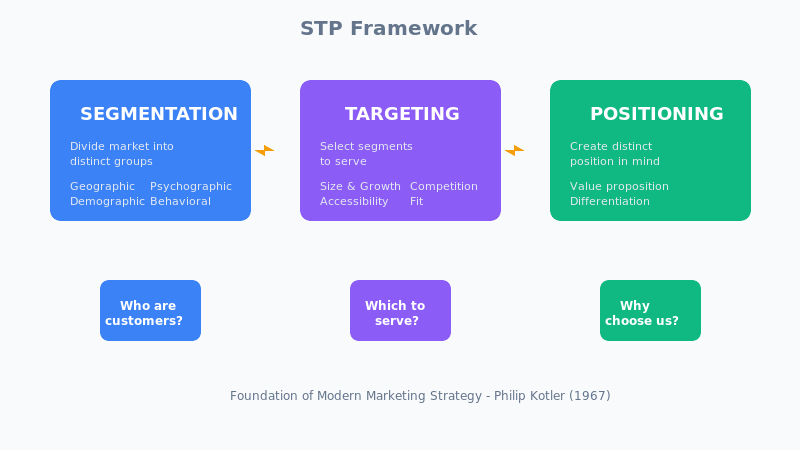
STP Framework is the foundational marketing strategy model consisting of Segmentation (dividing markets into groups), Targeting (selecting segments to serve), and Positioning (creating differentiated value perception in customers' minds).
Before you start
Is STP actually your framework?
STP answers one question: given a market containing different kinds of buyer, which kinds should we serve and what should we mean to them? It assumes those differences already exist, that you can detect them, and that you have the discipline to deliberately not serve some of them.
That last assumption is where most STP work quietly fails. A segmentation that concludes “all of these look attractive” has not been done. Targeting is a decision about who you are not for, and a framework cannot make that decision on your behalf.
| If your real problem is… | You probably want |
|---|---|
| We do not understand why people buy at all | Jobs to Be Done or Voice of the Customer Not sure which? Compare |
| We need our customers to feel like real people to the team | User Personas |
| Customers leave partway through and we cannot see where | Customer Journey Mapping |
| We cannot articulate why anyone picks us over a rival | Competitive Positioning Map or Porter’s Generic Strategies Not sure which? Compare |
| We are choosing which markets or products to grow into | Ansoff Matrix or Blue Ocean Strategy Not sure which? Compare |
| We have almost no customers yet | Nothing here. Segmenting a market you have not entered produces fiction. Find product-market fit first. |
| Distinct groups want different things and we cannot serve them all | STP — you are in the right place |
The distinction that matters
Segmentation is research. Targeting is a commercial decision. Positioning is a claim you have to keep. They are three different kinds of work, and teams routinely run the first, skip the second, and write the third as a slogan.
What Is It?
The STP Framework, formalized by Philip Kotler in "Marketing Management" (1967), is the foundation of modern marketing strategy. It provides a systematic approach to understanding markets and crafting differentiated offerings that resonate with specific customer groups.
Segmentation divides the total market into distinct groups with different needs, characteristics, or behaviors. Common bases include geographic, demographic, psychographic, and behavioral factors. Targeting evaluates segment attractiveness and selects which segments to serve—undifferentiated (mass), differentiated (multiple segments), concentrated (niche), or micro (individual). Positioning develops a distinctive place in customers' minds relative to competitors.
The framework shifts marketing from mass communication to targeted strategy. Rather than trying to be everything to everyone, STP helps organizations focus resources on customers they can serve best, with messages and offerings tailored to those specific needs.
STP connects to Customer Journey Mapping for experience design, User Personas for segment characterization, Voice of Customer for needs understanding, and Competitive Positioning Map for visualization.
Quick Reference
Core Features
- Segmentation: Divide market by geographic, demographic, psychographic, behavioral criteria
- Targeting: Evaluate and select segments based on attractiveness and fit
- Positioning: Develop differentiated value proposition for chosen segments
- Customer Focus: Built around customer needs, not product features
- Competitive Differentiation: Creates distinct position vs. competitors
- Resource Efficiency: Focuses marketing spend on winnable segments
Worked example
An STP that survived contact with the market
An illustrative composite, drawn from a pattern common enough to be worth walking through. An online course business selling data-analysis training had flat conversion despite heavy traffic. Its existing segments were demographic: age band, country, job seniority. The rebuild changed what the segments were made of.
The middle column is the first attempt. The right column is what replaced it after the team tested whether the segments behaved differently.
| Stage | First attempt | What actually worked |
|---|---|---|
| Segmentation | Age, country, seniority | Motivation for enrolling: career-changers, people topping up a skill for their current job, and people who needed a credential for a visa or promotion. Demographically these three were indistinguishable. |
| Segment sizes | “25–34 is our biggest group” | Career-changers were smallest but paid most and finished courses. Credential-seekers were largest, cheapest, and mostly never opened the material. |
| Targeting | All three, with the same funnel | Career-changers primary, skill-toppers secondary, credential-seekers explicitly deprioritized despite being the largest group by headcount. |
| Positioning | “Learn data analysis online, flexibly” | “The course you finish when your next job depends on it.” Aimed only at career-changers, and deliberately unappealing to the other two. |
| What changed | — | Completion-focused features that credential-seekers actively disliked. Higher price. Fewer, better-fitting enrolments. |
What the diagnosis showed
The original segments were demographic because demographic data is what the analytics tool reported. They were tidy, and they were useless: all three motivations were spread evenly across every age band and country, so the segments never behaved differently from one another.
The test that exposed it is worth stealing. Do your segments respond differently to the same offer? If they do not, they are descriptive categories, not segments — and no amount of targeting or positioning built on top of them will work.
When to Use
- New product or service launch planning
- Marketing strategy development
- Market entry or expansion decisions
- Brand repositioning initiatives
- Customer base analysis and prioritization
- Competitive response planning
- Annual marketing planning cycles
When NOT to Use
- Commoditized markets with no differentiation possible
- Monopoly or near-monopoly situations
- Very small markets that can't be meaningfully segmented
- When market research budget is insufficient
- Crisis situations requiring immediate tactical response
In practice
How STP goes wrong
STP rarely fails as a concept. It fails at the joints between its three stages, because each stage is a different kind of work and teams tend to be good at only one of them.
| What you see | What it usually means | What to do |
|---|---|---|
| Segments are age, region and company size | You segmented by the data you already had, not by what drives buying | Test whether the segments respond differently to an identical offer. If they do not, they are demographics wearing a segment costume. |
| Every segment is rated attractive | No targeting decision has been made | Force a ranked list and write an explicit “not us” line. If nothing was declined, targeting did not happen. |
| The positioning statement lists features | It describes the product rather than a position relative to alternatives | Name who you are beating and on what dimension. A position is comparative or it is not a position. |
| Positioning appeals to everyone in the room | It has been sanded down until it excludes nobody | Ask which customers it should actively repel. A statement nobody rejects will not be remembered by anyone either. |
| The segmentation deck is two years old | STP was run as a project rather than as a standing view | Re-run segmentation on a fixed cycle, or at least revisit it whenever acquisition cost moves sharply. |
| Sales and marketing describe the target differently | Positioning was agreed in a document, not adopted in behavior | Check what the sales team actually says on calls. That is your real position, whatever the deck says. |
Sourced
What the evidence says
Kotler is credited with STP, but he wrote none of its three parts.
Segmentation and positioning were developed separately, by different people, sixteen years apart and in different fields — one in academic marketing, the other in advertising. Kotler’s contribution was assembling them into a single sequence and teaching it to several generations through Marketing Management. That is a real contribution, but it is editorial rather than originating, and it matters for how you use the model: STP is three separate ideas in a trench coat, which is exactly why it tends to fail at the joins between them.
Segmentation: Wendell R. Smith, 1956.
Smith defined market segmentation as viewing a heterogeneous market as a number of smaller homogeneous markets, arising from differing preferences among buyers. He framed it explicitly as an alternative to product differentiation — a strategic choice between adapting the offer to the market or adapting perception of the offer.
Smith, W. R., “Product Differentiation and Market Segmentation as Alternative Marketing Strategies”, Journal of Marketing 21(1), July 1956, pp. 3–8.
Positioning: Trout in 1969, then Ries and Trout in 1972.
Jack Trout introduced positioning in a 1969 article in Industrial Marketing. He and Al Ries then made it famous with a three-part series, “The Positioning Era Cometh”, in Advertising Age in April and May 1972, followed by the 1981 book. Their central claim was that positioning is not something you do to a product but something you do to the mind of the prospect — which is why a positioning statement full of product features is a category error, not merely weak writing.
Ries, A. & Trout, J., “The Positioning Era Cometh”, Advertising Age, April–May 1972; Positioning: The Battle for Your Mind, McGraw-Hill, 1981.
What that means for using it.
Treat the three stages as three different disciplines rather than three steps in one method. Segmentation is empirical and can be got wrong in ways data will reveal. Targeting is a commercial judgement that no analysis will make for you. Positioning is a communications claim that only counts if it survives contact with customers who could have chosen someone else. Most disappointing STP work is strong on the first, silent on the second, and decorative on the third.
Key Strengths
- Customer-Centric: Built around customer needs
- Efficient: Focuses resources on best opportunities
- Differentiated: Creates competitive distinction
- Actionable: Guides messaging, product, and channel decisions
- Universal: Applies across industries and contexts
Key Weaknesses
- Requires quality market research data
- Segmentation can be arbitrary or oversimplified
- Positions can be imitated by competitors
- May miss emerging segments or changing needs
- Static model in dynamic markets
How It Works
| 1 Primary Input | Market research, customer data, competitive intelligence |
|---|---|
| 2 Data You Need | Customer demographics, behaviors, preferences, competitor positioning, market size |
| 3 Primary Output | Target segment profiles, positioning statement, marketing strategy direction |
Sequencing
What to run before and after STP
STP assumes you already know why people buy, and it stops before anything is built or shipped. It sits in the middle of a longer chain, and running it alone is the usual reason it produces a deck rather than a decision.
Before
Find out why people buy
Segments built on motivation outperform segments built on demography, but you cannot segment by motivation until you have gone and asked. This is the step that determines whether your segmentation is real.
During
Segment, target, position
Two to six weeks depending on whether you need new research. Output is a ranked segment list, an explicit “not us” decision, and one positioning statement that some customers should dislike.
After
Make the position true
A position is a promise about what the product does and who it is for. If nothing downstream changes — the roadmap, the pricing, the onboarding — the positioning is advertising copy rather than strategy.
Common questions
STP: quick answers
What does STP stand for in marketing?
Segmentation, Targeting and Positioning. Divide the market into groups that behave differently, decide which of those groups you will serve, then establish what you want to mean to them relative to the alternatives they could choose instead.
Is STP actually your framework?
STP fits when distinct groups want different things and you cannot serve them all well. If you do not yet know why people buy, run Jobs to Be Done or Voice of the Customer first. If you have almost no customers, segmenting produces fiction — find product-market fit before segmenting.
Who actually created the STP framework?
No single person did. Wendell R. Smith introduced market segmentation in the Journal of Marketing in 1956. Jack Trout introduced positioning in 1969, developed with Al Ries in Advertising Age in 1972. Philip Kotler assembled the pieces into the STP sequence and popularised it through Marketing Management, which is why it is usually attributed to him.
Why do STP exercises fail?
Most often because segments are built from demographic data that does not predict buying behavior, because no group is genuinely declined at the targeting stage, or because the positioning statement describes product features instead of staking a position against a named alternative.
How do I know if my segments are real?
Test whether they respond differently to the same offer. If two segments behave identically when given the same price, message and product, they are descriptive categories rather than segments, and anything built on top of them will underperform.
Comparison with Related Frameworks
STP vs Customer Journey Mapping
Customer Journey Mapping details the experience within a segment. STP identifies which segments to target. Use STP first to select targets, then Journey Mapping to optimize their experience.
STP vs Jobs to Be Done
Jobs to Be Done segments by customer goals rather than demographics. JTBD can enhance STP by revealing underlying motivations that cut across traditional segments.
Deep Resources
Frameworks related to STP Framework
- Customer Journey MappingVisual representation of all customer interactions across channels and touchpoints, revealing…
- User PersonasDetailed, research-based archetypal user profiles that guide product decisions by creating…
- Voice of the CustomerSystematic approach to gathering, analyzing, and prioritizing customer feedback to guide…
- Competitive Positioning MapVisual 2-axis framework mapping competitor positions to identify market gaps and strategic…