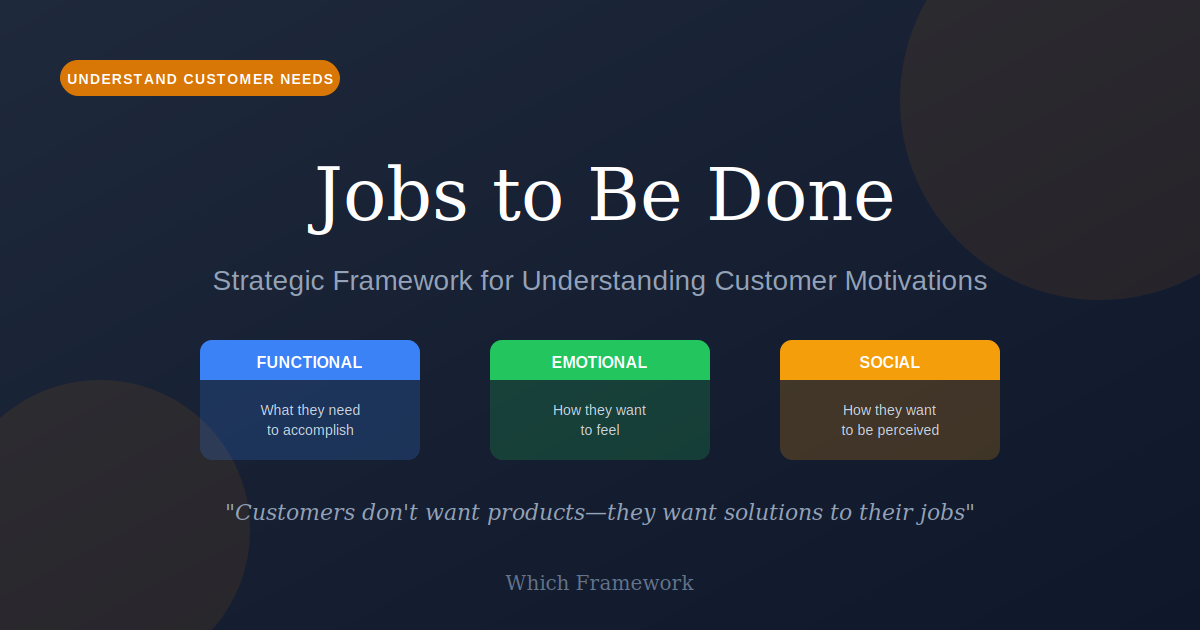
Jobs to Be Done: Customer Motivation Framework
Jobs to Be Done is a framework that helps teams understand what customers are trying to accomplish by analyzing the underlying motivations, context, and competing solutions in customers' lives, rather than focusing on traditional demographic segments.
Before you start
Is JTBD your framework?
Jobs to Be Done answers one question: what progress is this person trying to make, and what did they hire to make it? It is a theory of demand. It explains why people switch, and it tends to reveal competitors you had not counted.
It is at its most useful when you are surprised — when usage does not match who you thought your customer was, or when people churn for reasons your segmentation cannot explain.
| If your real problem is… | You probably want |
|---|---|
| We need our customers to feel like real people to the team | User Personas — a communication device. JTBD replaces the explanatory use of personas, not the empathy-building one. Compare JTBD and Personas |
| We know the job and need to decide which features to build | Kano Model — feature-level satisfaction, once the job is settled Not sure which? Compare |
| We need to see where customers drop out of our process | Customer Journey Mapping — your process, not their progress Not sure which? Compare |
| We must choose which segment to serve and how to position | STP — run JTBD first, then segment by job rather than demography Not sure which? Compare |
| We are testing whether a business exists at all | Lean Canvas — and use JTBD to fill its Problem block |
| A backlog nobody can rank | The feature prioritization playbook, where Jobs to Be Done is stage 1 of 5 |
| Testing whether a business idea is worth pursuing | The idea validation playbook, where Jobs to Be Done is stage 2 of 5 |
| People are behaving in ways our segmentation cannot explain | JTBD — you are in the right place |
The distinction that matters
Personas describe who the customer is. JTBD describes what situation they are in. The same person hires different things in different circumstances, which is why demographic segments so often fail to predict behavior — and why a 40-year-old buying a milkshake at 8am is a different customer from the same person buying one at 4pm.
What Is It?
The Jobs to Be Done framework, popularized by Clayton Christensen, shifts product development thinking from "who is the customer?" to "what job is the customer trying to accomplish?" Rather than building products for predefined customer segments, this framework helps teams discover the functional, emotional, and social "jobs" that drive customer behavior.
When a customer "hires" a product or service, they're doing so to make progress on something they're trying to accomplish. Understanding these jobs—rather than static demographic profiles—reveals why customers make choices and what would make them switch to alternatives.
The framework recognizes that customers don't want products; they want solutions to problems they're trying to solve. A person might hire a drill to complete a home renovation, but the real job is "creating a comfortable living space." Understanding the true job reveals better solutions and reveals why customers behave the way they do.
Quick Reference
The core structure
Functional, emotional and social jobs
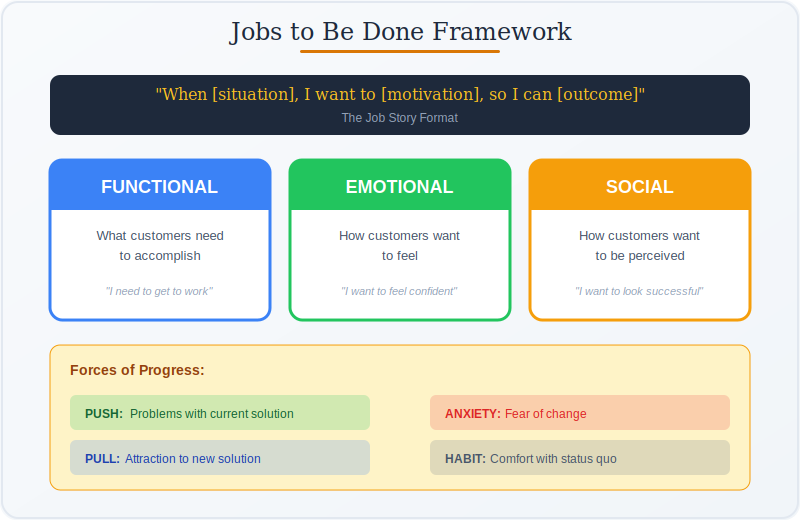
Every job has three dimensions. Capturing only the functional one is the single most common way JTBD research fails, because the functional dimension is the easiest to ask about and the least likely to explain a switch.
| Dimension | What it captures | Example | How to surface it |
|---|---|---|---|
| Functional | The practical task being accomplished | “Get from home to the office.” | Just ask. People answer this one readily, which is why it dominates weak research. |
| Emotional | How the person wants to feel, or to stop feeling | “Not feel anxious about being late.” | Ask what they were worried about, and what would have happened if it had gone wrong. |
| Social | How they want to be seen by others | “Be seen as someone who has it together.” | Ask who else knew about the decision and what they said. Almost nobody volunteers this dimension unprompted. |
Why the third one matters commercially
Every car performs the same functional job. What separates them is emotional and social — and those dimensions are where pricing power lives. If your JTBD research produced only functional statements, you have described a category, not a reason anyone would pay you more than the alternative.
First, disambiguate
The three schools of Jobs to Be Done
JTBD is not one method. There are three established schools with different research procedures and structurally different outputs, and their proponents have publicly disagreed — about what counts as a job, about whether emotional and social dimensions belong at all, and about who originated the ideas.
Most confusion about “how to do JTBD” is really an unrecognized collision between these. Two guides can both be correct and give you incompatible instructions.
| Christensen — jobs as progress | Moesta — the switch interview | Ulwick — Outcome-Driven Innovation | |
|---|---|---|---|
| What a job is | The progress a person seeks in a circumstance | The same, examined at the moment of switching | A functional process the customer is executing |
| Method | Narrative and observation; the milkshake study | Interviews reconstructing the timeline of a switch, using push, pull, anxiety and habit | Decompose the job into steps, generate desired outcome statements, survey and score them |
| Output | A story explaining why people hire what they hire | The four forces acting on a specific switch | Ranked, measurable outcomes with opportunity scores |
| Nature | Qualitative, a lens | Qualitative, a procedure | Quantitative, a system |
| Use it when | You do not yet know what job you are solving | You need to understand switching, for positioning or messaging | You know the job and must decide which outcomes to target next |
The practical resolution
The schism generated a great deal of heat and is mostly a distraction for practitioners. The workable synthesis: use the narrative and switch-interview tools when you are still discovering the job, and outcome scoring once you know the job and need to rank where to invest. They answer different questions at different stages. Pick one deliberately rather than blending their vocabularies, because their outputs do not combine cleanly.
Core Features
- Functional Jobs: What does the customer need to accomplish? (tangible, measurable outcomes)
- Emotional Jobs: How does the customer want to feel? (aspirations, avoiding negative feelings)
- Social Jobs: How does the customer want to be perceived? (status, identity, relationships)
- Context Matters: Jobs exist within specific circumstances, not universal to all customers
- Progress-Focused: Focuses on what customers are trying to get done, not who they are
- Competing Solutions: Identifies what customers currently use to make progress, including non-obvious competitors
- Motivations & Barriers: Uncovers push (problems with status quo) and pull (attraction to solutions)
Worked example
A job statement that changed the product
An illustrative composite. A Chicago company selling online continuing-education courses to licensed accountants. Churn was high, demographics explained nothing, and the team had built three personas that all behaved identically in the data.
Eleven switch interviews. The right column is what the interviews produced, in the standard format: when [situation], I want to [motivation], so I can [outcome].
| What the team assumed | What the interviews found | |
|---|---|---|
| The job | “Learn new accounting skills” | “When my license renewal is 6 weeks away and I have not started, I want to clear my required hours without losing a weekend, so I can stop thinking about it.” |
| Functional | Acquire knowledge | Complete a required hour count and get it recorded with the board. |
| Emotional | Not considered | Remove a nagging obligation. Several described relief, not learning, as the point. |
| Social | Not considered | Avoid being the person at the firm who let their license lapse. |
| The real competitor | Other course providers | A weekend in-person seminar, and procrastinating until a cheaper cram option appeared. |
| What changed | More course topics | Automatic board reporting, a visible hours counter, and a “finish in one sitting” track. Catalog growth stopped. |
What the research actually decided
It stopped the roadmap. The team had been adding courses because their assumed job was “learn skills” and more catalog looks like more value. Once the job was stated as clearing a deadline without losing a weekend, catalog size became irrelevant and completion speed became the product.
Note the emotional row. “Relief, not learning” is the kind of finding that only appears when you ask what someone was worried about. A functional-only interview would have returned “I need CPE credits” and confirmed everything the team already believed.
When to Use
- You're entering a new market or launching a new product
- Customer needs are not well understood
- Demographic segmentation isn't driving successful products (unlike User Personas which work when segments are clear)
- You want to understand why customers choose competitors
- You're trying to innovate beyond incremental improvements
- You need to justify product investments to stakeholders
- You want to predict how customers will respond to new features
When NOT to Use
- You need quick decisions (use Empathy Mapping for faster alignment)
- You have only a few potential customers to interview
- Your market has extremely low complexity
- Customers can't articulate their motivations
- You lack resources for in-depth customer research
- You're optimizing existing products with tight deadlines (use Voice of the Customer instead)
In practice
How JTBD research goes wrong
The theory is easy to agree with and hard to execute. Nearly every failure is an interview problem rather than a framework problem.
| What you see | What it usually means | What to do |
|---|---|---|
| All the job statements are functional | You asked what people do, not what they feared or how they wanted to be seen | Ask what they were worried about, and who else knew. The social dimension is almost never volunteered. |
| The job statement contains your product category | The job was written backwards from the solution | A job must be solution-agnostic. If a competitor could not also be hired for it, you have described your product, not a job. |
| Interviews asked what people want | Stated preference, which is famously unreliable | Reconstruct a specific past switch: what happened the day they decided, what they tried first, what nearly stopped them. |
| Competitors listed are all in your category | The job was framed too narrowly | The real competition is anything hired for the same progress — including doing nothing, a spreadsheet, or an in-person alternative. |
| The job statement keeps changing | Either too abstract to be useful or too specific to be a job | Test it against three criteria: solution-agnostic, stable over time, and something a customer would recognize as their own. |
| Two guides gave contradictory instructions | You are mixing schools — see above | Choose one deliberately for the stage you are at. Narrative for discovery, outcome scoring for prioritization. |
Sourced
What the evidence says
The founding quote is misattributed, twice over.
Almost every JTBD article opens with Theodore Levitt on drills and holes. Levitt never claimed it. In The Marketing Mode and again in later books he explicitly credited Leo McGivena, an advertising man, whose line about people wanting quarter-inch holes
rather than quarter-inch drills appears in print in Percy Whiting’s The Five Great Rules of Selling in 1947. Christensen then quoted Levitt, and the industry has quoted Christensen quoting Levitt ever since — writing the original author out in two steps.
Whiting, P. H., The Five Great Rules of Selling, McGraw-Hill, 1947, p. 39; Levitt, T., The Marketing Mode, 1969, and Marketing for Business Growth, 1974.
Ulwick was doing this before the word “jobs” was attached to it.
Christensen is universally credited as JTBD’s originator, and he did more than anyone to spread it — through The Innovator’s Solution in 2003 and Competing Against Luck in 2016. But Tony Ulwick developed Outcome-Driven Innovation in the early 1990s and presented it to Christensen at Harvard Business School in 1999, before the “jobs” vocabulary was in common use. Christensen later credited Ulwick with bringing predictability to innovation. The popular history compresses two separate lineages into one.
The milkshake study is the canonical demonstration, and it is about circumstance.
The finding that made JTBD famous was that a large share of milkshakes were bought before 9am by lone commuters, hiring them for a long boring drive — a job for which the real competitors were bananas, bagels and doughnuts rather than other milkshakes. The lesson is not about milkshakes. It is that the unit of analysis is the circumstance, not the person, which is precisely why demographic segmentation kept failing to explain the sales.
What that means for using it.
Treat JTBD as a lens with three competing toolkits attached rather than as a single method, and be explicit about which one you are using. Its durable contribution is the reframing: people do not buy products, they hire something to make progress in a situation, and your competition is whatever else could be hired. That insight predates Christensen, survives the schism, and remains useful regardless of which school’s interview guide you pick up.
Key Strengths
- Reveals True Motivations: Uncovers why customers actually make decisions, not why they say they do
- Reduces Product Failure Risk: Understanding jobs significantly improves product-market fit
- Competitive Advantage: Identifies opportunities competitors haven't discovered
- Guides Innovation: Sparks ideas for entirely new solutions to customer jobs
- Stakeholder Alignment: Gives clear language for communicating customer needs across organizations
Key Weaknesses
- Time-intensive research process (2-4 weeks vs hours for Empathy Mapping)
- Requires skill in conducting customer interviews
- No guaranteed accuracy—customers may not articulate jobs clearly
- Research interpretation requires subjective analysis
- Implementation gap—understanding jobs is only the first step
How It Works
| 1 Primary Input | Specific customer behavior or choice (why did they buy this product?) |
|---|---|
| 2 Data You Need | In-depth customer interviews (30-60 min each), context about their situation, alternatives considered |
| 3 Primary Output | Clear job statement (functional, emotional, social), success criteria, barriers and motivations |
Comparison with Related Frameworks
Jobs to Be Done is a strategic research framework. Here's how it compares to other customer understanding methods:
Jobs to Be Done vs User Personas
User Personas focus on who customers are, while Jobs reveals what they're trying to accomplish. Personas describe demographics and behaviors; Jobs uncover underlying motivations. Use Jobs for innovation, Personas for execution.
Jobs to Be Done vs Empathy Mapping
Empathy Mapping captures what users think, feel, say, and do at a moment in time. Jobs reveals the deeper "why" behind their progress. Use Empathy Mapping for quick alignment, Jobs for strategic direction.
Jobs to Be Done vs Voice of the Customer
Voice of the Customer systematically collects stated needs and requirements. Jobs interprets hidden motivations. Use VOC for continuous improvement, Jobs for discovering unarticulated needs.
Jobs to Be Done vs Customer Journey Mapping
Customer Journey Mapping shows the "what" and "where" of experience; Jobs reveals the "why." Use both: Jobs to understand needs, Journey mapping to optimize experience delivery.
Sequencing
What to run before and after
JTBD sits very early. It tells you what to build toward, which means most other customer frameworks are more useful after it than before.
Before
Find people who recently switched
The single biggest determinant of quality. Recent switchers remember the circumstance; long-term users have rationalized it. Aim for eight to twelve interviews before looking for patterns.
During
Interview, then write the statement
Reconstruct specific switches rather than asking about preferences. Write the job statement only once a pattern converges, and test it for being solution-agnostic and stable.
After
Turn the job into decisions
A job statement is an input. Segment by job rather than demography, decide which features serve it, and check whether your positioning names the progress the customer actually wanted.
Part of a playbook: How to Prioritize Product Features. Jobs to Be Done is stage 1 of 5, before the Kano Model.
Part of a playbook: How to Validate a Business Idea. Jobs to Be Done is stage 2 of 5, after Voice of the Customer and before the Lean Canvas.
Common questions
Jobs to Be Done: quick answers
What are functional, emotional and social jobs?
The three dimensions of any job. The functional job is the practical task — “get from A to B”. The emotional job is how the person wants to feel, or stop feeling — “not be anxious about being late”. The social job is how they want to be perceived — “be seen as someone who has it together”. Capturing only the functional dimension is the most common way JTBD research fails, because emotional and social are where differentiation and pricing power live.
Who created the Jobs to Be Done framework?
There is no single originator, despite the standard account. Clayton Christensen popularized it through The Innovator's Solution (2003) and Competing Against Luck (2016), and the Christensen Institute remains its best-known source. But Tony Ulwick developed Outcome-Driven Innovation in the early 1990s and presented it to Christensen at Harvard Business School in 1999, before “jobs” language was common. Bob Moesta developed the switch interview method separately.
What is the difference between JTBD and personas?
Personas describe who the customer is; JTBD describes what situation they are in. The same person hires different things in different circumstances, which is why demographic segments often fail to predict behavior. JTBD replaces the explanatory use of personas — it does not replace their value as a communication device for keeping teams focused on real people.
What are the three schools of Jobs to Be Done?
Christensen's jobs-as-progress, which is a qualitative lens; Bob Moesta's switch interview, which reconstructs the moment of switching using push, pull, anxiety and habit; and Tony Ulwick's Outcome-Driven Innovation, which decomposes a job into steps and produces ranked, measurable outcome statements. They disagree publicly about what counts as a job. Use the narrative schools for discovery and outcome scoring for prioritization.
Did Theodore Levitt say people want a quarter-inch hole, not a drill?
He quoted it, but credited someone else. Levitt attributed the line to Leo McGivena, an advertising man, and it appears in print in Percy Whiting's The Five Great Rules of Selling in 1947. Christensen later quoted Levitt, and the industry has quoted Christensen ever since — so the original author disappeared through two rounds of citation.
How do you write a Jobs to Be Done statement?
The standard format is: when [situation], I want to [motivation], so I can [outcome]. Three tests before you keep it — it must be solution-agnostic (a competitor could also be hired for it), stable over time, and recognizable to the customer as their own. If your product category appears in the statement, it was written backwards from the solution.
Deep Resources
Frameworks related to Jobs to Be Done
- User PersonasDetailed, research-based archetypal user profiles that guide product decisions by creating…
- Empathy MappingA visual tool that captures what users think, feel, say, and do to build shared understanding…
- Voice of the CustomerSystematic approach to gathering, analyzing, and prioritizing customer feedback to guide…