Lean Canvas: One-Page Startup Business Plan
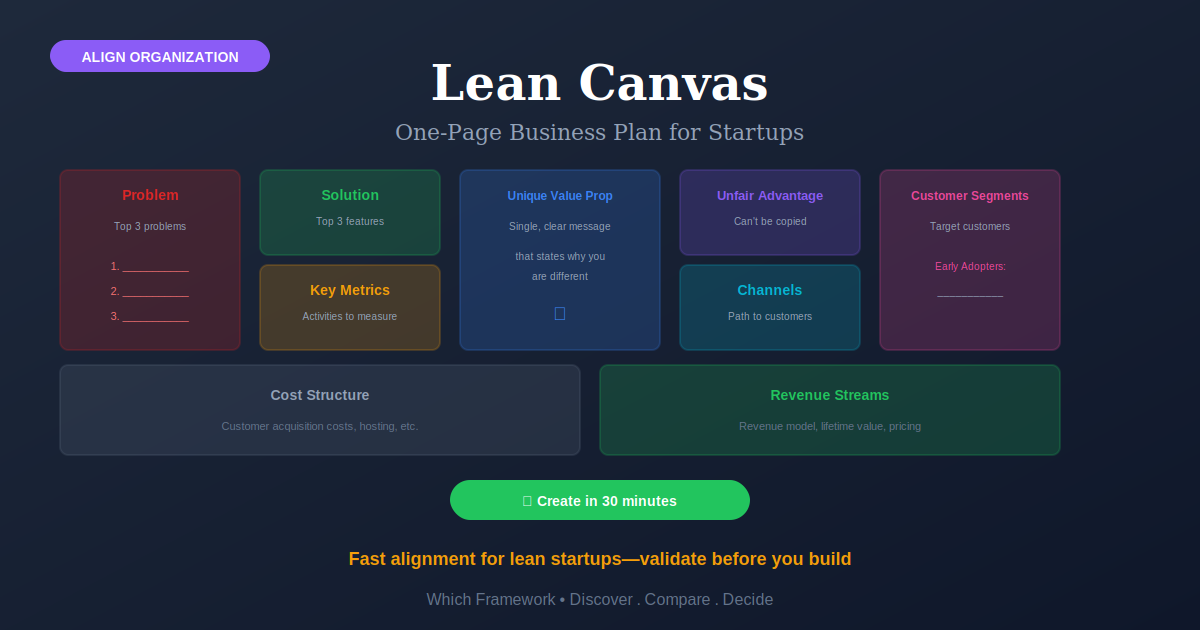
Lean Canvas is a one-page business model template optimized for startups, focusing on Problem, Solution, Key Metrics, and Unfair Advantage to enable rapid iteration and validation.
Before you start
Is Lean Canvas your framework?
Lean Canvas is for a business that does not exist yet. Its whole design assumes the central question is not “how will this operate?” but “is there a business here at all?”
It is a hypothesis log, not a plan. Each block holds an assumption you intend to test, and the canvas earns its keep by making the riskiest ones visible and rankable.
| If your real problem is… | You probably want |
|---|---|
| We have a working business and need to map how it operates | Business Model Canvas — the original, built for established companies Compare Lean Canvas and BMC |
| We do not understand why customers would buy | Jobs to Be Done or Voice of the Customer Not sure which? Compare |
| We know the market and must pick which segment to serve | STP — segmentation, targeting, positioning Not sure which? Compare |
| We need to decide which features matter to customers | Kano Model |
| We are choosing which market or product to grow into | Ansoff Matrix |
| Testing whether a business idea is worth pursuing | The idea validation playbook, where the Lean Canvas is stage 3 of 5 |
| We have an idea and no evidence anyone wants it | Lean Canvas — you are in the right place |
Lean Canvas or Business Model Canvas?
Same nine-box shape, four different boxes, opposite purposes. The Business Model Canvas asks about partners, activities, resources and customer relationships — things an operating company actually has. Ash Maurya watched founders skip or invent those boxes before launch, and swapped them for the four questions that actually kill early startups. BMC documents a model that works. Lean Canvas tests whether one exists. Most startups begin lean and graduate to the full canvas once the model stops changing every week.
What Is It?
Lean Canvas, created by Ash Maurya and introduced in his book "Running Lean" (2012), is an adaptation of the Business Model Canvas specifically designed for startups operating under conditions of extreme uncertainty.
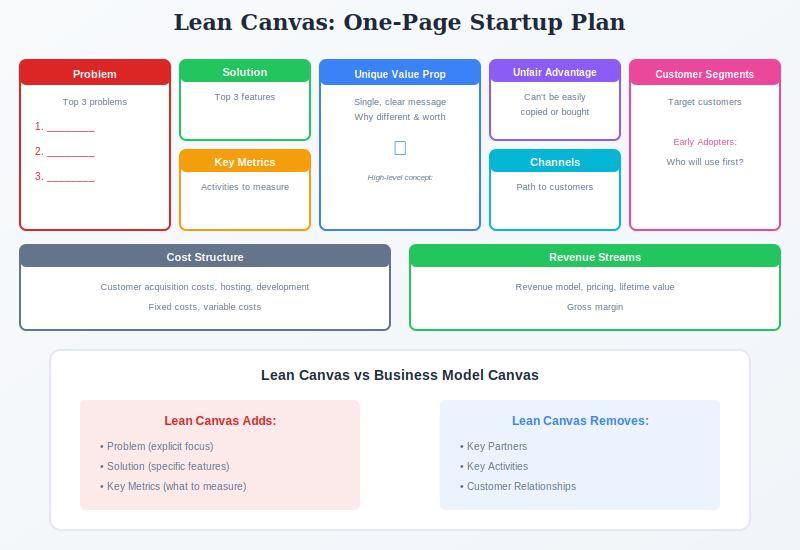
While Business Model Canvas is comprehensive, Lean Canvas is lean. It replaces Key Partners, Key Activities, and Customer Relationships with startup-critical elements: Problem (what customer pain are you solving?), Solution (your proposed answer), Key Metrics (how you'll measure progress), and Unfair Advantage (what can't be easily copied).
The canvas is designed to be created in 20-30 minutes—speed is a feature, not a bug. This forces entrepreneurs to focus on essentials and creates a document that's easy to update as you learn from customer interviews and experiments.
Lean Canvas works seamlessly with lean startup methodology and OKR for execution alignment. It's the starting point for many successful startups' strategic planning.
Quick Reference
The canonical structure
The nine blocks, in Ash Maurya’s fill order
The canvas is not filled left to right. Maurya gives a specific order, and it matters: each block constrains the next, and starting in the wrong place is how founders end up describing a solution nobody needs.
There is also a deliberate split down the middle. Blocks on the right concern the market; blocks on the left concern the product. If your canvas is dense on the left and thin on the right, you have documented an idea rather than a business.
| # | Block | What goes in it | Done when… |
|---|---|---|---|
| 1 | Problem | The top three problems your customer has, plus how they solve them today | You can name the existing alternative. “Nothing” is almost never the honest answer — a spreadsheet counts. |
| 2 | Customer Segments | Who has that problem, specifically. Separate the user from the buyer if they differ. | The segment is narrow enough that you could list twenty real names. “Small businesses” is not a segment. |
| 3 | Unique Value Proposition | A single clear sentence stating why you are different and worth attention | It would not be true of a competitor if they wrote it about themselves. |
| 4 | Solution | The smallest thing that could address each problem. One line per problem. | It is deliberately thin. This block comes fourth for a reason. |
| 5 | Channels | The path to customers — inbound, outbound, partners, marketplaces | You have named a channel you can actually access now, not one you would need funding to build. |
| 6 | Revenue Streams | Model, price point, gross margin, lifetime value | There is a number. “Freemium, monetize later” defers the hardest assumption. |
| 7 | Cost Structure | Customer acquisition cost, distribution, hosting, people, burn rate | You can compare it against block 6 and say whether the arithmetic works. |
| 8 | Key Metrics | The few numbers that tell you the business is working | Each one could go down. Metrics that only go up are vanity metrics. |
| 9 | Unfair Advantage | Something that cannot be easily copied or bought | Honestly, often blank at the start — and Maurya says that is normal. Passion, work ethic and being first are not unfair advantages. |
On the Unfair Advantage block
This is the block people fake, and faking it is worse than leaving it empty. Real unfair advantages look like proprietary data, insider domain knowledge, an existing audience, exclusive access, or network effects that grow with use. If nothing on your canvas genuinely cannot be copied or bought, leave the box blank and revisit it. An honest gap is information; an invented moat is a decision you will regret later.
Core Features
- Problem: Top 3 problems your target customers face
- Solution: Top 3 features that solve those problems
- Unique Value Proposition: Single, clear message stating why you're different
- Unfair Advantage: Something that cannot be easily copied or bought
- Customer Segments: Target customers and early adopters
- Key Metrics: Key activities you measure
- Channels: Path to customers
- Cost Structure: Customer acquisition costs, hosting, etc.
- Revenue Streams: Revenue model, pricing, lifetime value
Worked example
A Lean Canvas, filled in order
An illustrative composite. Two founders in Denver building scheduling software for independent physical therapy clinics. The left column is their first draft; the right is what survived four customer interviews.
Note that the changes cluster in blocks 1, 2 and 9 — problem, segment and moat. That is the usual pattern.
| Block | First draft | After four interviews |
|---|---|---|
| 1. Problem | “Scheduling is inefficient” | “No-shows run 18–22% and staff spend 6–8 hours a week on reminder calls.” Current alternative: a front-desk person and a paper log. |
| 2. Customer Segments | “Healthcare providers” | Independent PT clinics with 2–6 therapists and no dedicated IT. Buyer is the owner-operator, user is the front desk. |
| 3. UVP | “Smart scheduling for clinics” | “Cut no-shows without hiring anyone.” |
| 4. Solution | Full practice management suite | Automated reminders plus a waitlist that auto-fills canceled slots. Two features. |
| 5. Channels | “Digital marketing” | State PT association conferences and the two billing companies these clinics already pay. |
| 6. Revenue Streams | “SaaS subscription” | $180/month per clinic. A recovered no-show is worth roughly $110, so the product pays for itself at two per month. |
| 7. Cost Structure | “Development and hosting” | ~$40/clinic/month in SMS and hosting. Acquisition cost unknown — flagged as the second-riskiest assumption. |
| 8. Key Metrics | “Number of users” | No-show rate before and after, and waitlist fill rate. Both can go down, which is the point. |
| 9. Unfair Advantage | “Our team is passionate about healthcare” | Blank. Deliberately. One founder’s clinic relationships may become one, but not yet. |
What the canvas actually did
It killed the practice management suite. Once the problem was stated as a measurable number — 18–22% no-shows, 6–8 hours of calls — the case for building a full suite collapsed, because two features addressed the whole thing.
And notice block 9. Replacing “we are passionate” with an honest blank is the single most valuable edit on the canvas. It tells the founders they currently have no moat, which is a fact worth knowing before raising money on the assumption that they do.
When to Use
- Early-stage startup validating problem-solution fit
- Rapid iteration on business model hypotheses
- Pitching to investors or advisors quickly
- Team alignment on startup fundamentals
- Before writing detailed business plans
- Complementing OKR for execution focus
When NOT to Use
- Established businesses (use Business Model Canvas)
- Complex multi-product organizations
- When detailed operational planning is needed
- Enterprise or government contexts
- Strategic positioning analysis (use Wardley Mapping)
In practice
How Lean Canvases go wrong
The canvas takes twenty minutes. Keeping it honest is the hard part, and it fails in a small number of recognizable ways.
| What you see | What it usually means | What to do |
|---|---|---|
| The Solution block is the longest | You started at block 4 instead of block 1 | Fill in Maurya’s order. Solution comes fourth precisely so it is constrained by a stated problem and a named segment. |
| “Existing alternatives” says none | The problem is being solved somehow today, and you have not found out how | Spreadsheets, an intern, or doing without all count. If there is genuinely no alternative, the problem may not be painful enough to pay for. |
| Customer Segment is a category | “Small businesses” or “millennials” — too wide to test | Narrow it until you could write down twenty real names. You need to be able to go and talk to them this week. |
| Unfair Advantage lists passion or first-mover status | The block was filled because it was empty | Both are copyable and neither is an advantage. Leave it blank. Maurya explicitly expects it to be empty early on. |
| Key Metrics are totals that only rise | Vanity metrics | Pick numbers that can fall — activation rate, retention, no-show rate. A metric that cannot deliver bad news cannot inform a decision. |
| Filled in once, then never opened | Treated as a document rather than a hypothesis log | Date it and revise after every batch of customer conversations. The value is in the diff between versions, not in the canvas itself. |
Sourced
What the evidence says
Ash Maurya created it in 2010, adapting Osterwalder’s canvas.
Maurya introduced the Lean Canvas in a 2010 post and developed it in Running Lean. It is an adaptation of the Business Model Canvas published by Alexander Osterwalder and Yves Pigneur in Business Model Generation, and Maurya has always presented it as such rather than as an independent invention. The canvas is released under a Creative Commons Attribution-ShareAlike license, which is why it appears freely on so many tools and templates.
Maurya, A., Running Lean: Iterate from Plan A to a Plan That Works, O’Reilly; Osterwalder, A. & Pigneur, Y., Business Model Generation, Wiley, 2010.
He replaced exactly four blocks, and the reason is the whole point.
Out went Key Partners, Key Activities, Key Resources and Customer Relationships. In came Problem, Solution, Key Metrics and Unfair Advantage. Five blocks are unchanged: Customer Segments, Unique Value Proposition, Channels, Revenue Streams and Cost Structure. Maurya’s observation was that founders before product-market fit do not have partners, activities or resources in any meaningful sense — so they either skipped those boxes or invented answers, while the questions that actually sink early startups had nowhere to go.
The Unfair Advantage block is supposed to be empty at first.
This is the most commonly misused block and the guidance is unambiguous: if nothing you have genuinely cannot be copied or bought, leave it blank and come back to it. That is normal early on. Passion, work ethic and being first to market all fail the test, because all three are available to anyone who shows up. Real candidates are proprietary data, insider knowledge, an existing community, exclusive access or network effects. A canvas with an honest blank is more useful than one with an invented moat.
What that means for using it.
Treat the canvas as a hypothesis log rather than a plan, and treat the fill order as part of the method rather than a suggestion. Its practical value is that it makes nine assumptions visible on one page so you can rank them by risk and go test the riskiest first. A canvas that never changes is not being used. The artifact worth keeping is the sequence of versions, because that record is the actual evidence of what you learned and when.
Key Strengths
- Speed: Create in 20-30 minutes
- Focus: Forces attention on problem and solution
- Iteration: Easy to update as you learn
- Startup-Optimized: Designed for uncertainty and validation
- Communication: One page tells the whole story
Key Weaknesses
- Less comprehensive than Business Model Canvas
- May miss important considerations for larger orgs
- Requires discipline to keep lean
- Not suitable for detailed planning
- Unfair Advantage is often hard to identify early
How It Works
| 1 Primary Input | Customer problem hypothesis, solution ideas, target segment |
|---|---|
| 2 Data You Need | Customer interviews, problem validation, early metrics |
| 3 Primary Output | One-page business model for validation and iteration |
Comparison with Related Frameworks
Lean Canvas vs Business Model Canvas
Business Model Canvas is more comprehensive with Key Partners and Activities. Lean Canvas is faster and startup-focused with Problem and Solution. Use Lean Canvas for early-stage; BMC for established businesses.
Lean Canvas vs OKR
OKR focuses on execution and goal-setting. Lean Canvas defines the business model. Use Lean Canvas to define what you're building; OKR to execute on it.
Sequencing
What to run before and after
The canvas captures assumptions. It does not generate them and it does not test them, so it sits between two activities that matter more than the grid.
Before
Go find the problem
A canvas filled from a whiteboard records what the founders already believe. The Problem and Customer Segment blocks should come from conversations, not from the room.
During
Fill in order, then rank by risk
Twenty minutes to fill, longer to argue about. The output that matters is not the canvas but a ranked list of assumptions, riskiest first.
After
Test the riskiest assumption
One experiment at a time, aimed at whichever block would sink the business fastest if wrong. Then revise the canvas and date the new version.
Part of a playbook: How to Validate a Business Idea. The Lean Canvas is stage 3 of 5, after Jobs to Be Done and before a cheap test of the riskiest assumption.
Common questions
Lean Canvas: quick answers
What are the 9 blocks of the Lean Canvas?
Problem, Customer Segments, Unique Value Proposition, Solution, Channels, Revenue Streams, Cost Structure, Key Metrics, and Unfair Advantage. Ash Maurya fills them in that numbered order rather than left to right, because each block constrains the next. The canvas also splits down the middle: the right-hand blocks concern the market, the left-hand blocks concern the product.
Who created the Lean Canvas?
Ash Maurya, in 2010, developed further in his book Running Lean. He adapted it from the Business Model Canvas published by Alexander Osterwalder and Yves Pigneur in Business Model Generation, and has always presented it as an adaptation. It is released under a Creative Commons Attribution-ShareAlike license.
What is the difference between the Lean Canvas and the Business Model Canvas?
Same nine-box format, four different boxes, opposite purposes. Maurya removed Key Partners, Key Activities, Key Resources and Customer Relationships — things only an operating company has — and replaced them with Problem, Solution, Key Metrics and Unfair Advantage. The Business Model Canvas documents a model that works; the Lean Canvas tests whether one exists. Startups usually begin lean and graduate once the model stops changing weekly.
What order should you fill in a Lean Canvas?
Not left to right. Maurya's order is: 1 Problem, 2 Customer Segments, 3 Unique Value Proposition, 4 Solution, 5 Channels, 6 Revenue Streams, 7 Cost Structure, 8 Key Metrics, 9 Unfair Advantage. Solution comes fourth deliberately, so that it is constrained by a stated problem and a named segment rather than driving them.
What counts as an Unfair Advantage?
Something that cannot be easily copied or bought: proprietary data, insider domain knowledge, an existing audience or community, exclusive access, or network effects. Passion, work ethic and being first to market do not count, because all three are available to anyone. If you do not have one yet, leave the block blank — Maurya expects it to be empty early on, and an honest gap is more useful than an invented moat.
Is the Lean Canvas a business plan?
No. A business plan asserts what will happen; the Lean Canvas records what you currently believe and intend to test. Each block holds an assumption, and the point is to rank them by risk and check the riskiest first. A canvas that has not changed after customer conversations is not being used as intended.
Deep Resources
Frameworks related to Lean Canvas
- Business Model CanvasA one-page visual framework for designing and analyzing business models across nine key…
- OKR (Objectives & Key Results)Goal-setting methodology that defines ambitious Objectives and measurable Key Results to…