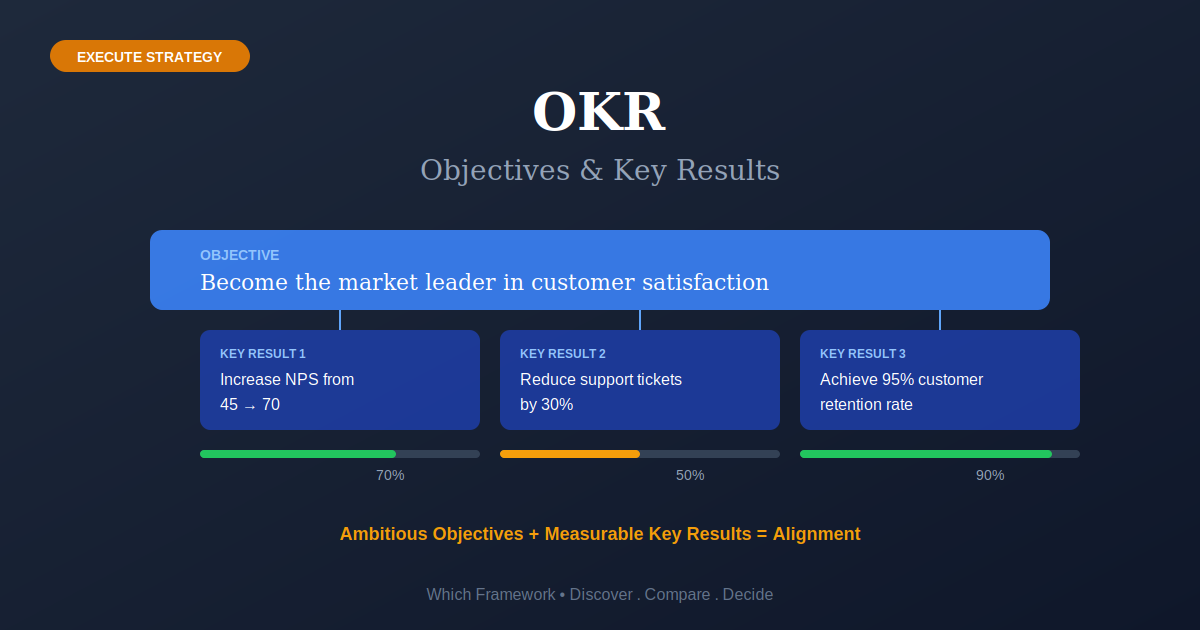
OKR: Objectives & Key Results
OKR (Objectives & Key Results) is a goal-setting methodology that defines ambitious Objectives and measurable Key Results to create organizational alignment, focus, and transparency around what matters most.
Before you start
Is OKR your framework?
OKR is a goal-setting framework for change over a fixed period — normally a quarter. It asks what should be different by the end of it, and how you will know. That is a narrower job than it is usually given.
It is not a way to track the ongoing health of a business, not a plan, and not a system for allocating work. Most OKR disappointment comes from asking it to be one of those three.
| If your real problem is… | You probably want |
|---|---|
| We need to watch steady-state business health, not drive change | Balanced Scorecard — those are KPIs, and KPIs do not belong in OKRs Compare OKR and Balanced Scorecard |
| Nobody can explain how our strategy is supposed to work | Strategy Map — OKRs assume the strategy already exists and is agreed Compare OKR and Strategy Map |
| We need annual policy deployed coherently top to bottom | Hoshin Kanri — built for exactly the vertical alignment OKRs handle badly Compare OKR and Hoshin Kanri |
| We have goals but nobody knows who owns what | RACI — an unowned Key Result is not an OKR problem Compare OKR and RACI |
| Work arrives continuously and the issue is flow, not focus | Kanban — quarterly targets do not help a queue |
| We do not yet know what we should be aiming at | Lean Canvas — OKRs will faithfully accelerate you toward the wrong thing |
| Your team has grown and you have become the bottleneck | The delegation playbook, where OKRs is stage 5 of 6 |
| Turning a chosen strategy into what teams actually do | The strategy execution playbook, where OKRs is stage 5 of 5 |
| We need focus on a few measurable outcomes this quarter | OKR — you are in the right place |
The test that separates OKRs from a renamed task list
If you could complete every Key Result by working through a checklist, they are tasks. A Key Result you fully control is a task with a number stapled to it. Real Key Results describe a state of the world that you influence but do not command — which is why they can be missed by a team that did everything it planned.
What Is It?
OKR — Objectives and Key Results — is a goal-setting framework built on one pairing. An Objective states what you want to be different and is written in plain language. Two to five Key Results state how you will know it happened, and each carries a number with a start value and a target.
The discipline sits entirely in the second half. Objectives are easy and cheap; almost any team can write an inspiring one in ten minutes. Key Results are where OKRs either work or quietly become a status report, because a Key Result forces you to commit in advance to a measurement you cannot argue with later.
The framework is normally run quarterly, with a small number of OKRs per team, scored at the end of the cycle rather than tracked as a to-do list. Its purpose is subtraction: choosing three things means declining the other twenty, and organizations adopt OKRs when they have too many priorities rather than too few.
It is practitioner lore rather than research, developed inside Intel and popularized through Google. That matters for how much weight to put on any particular rule you read about it, including the famous ones.
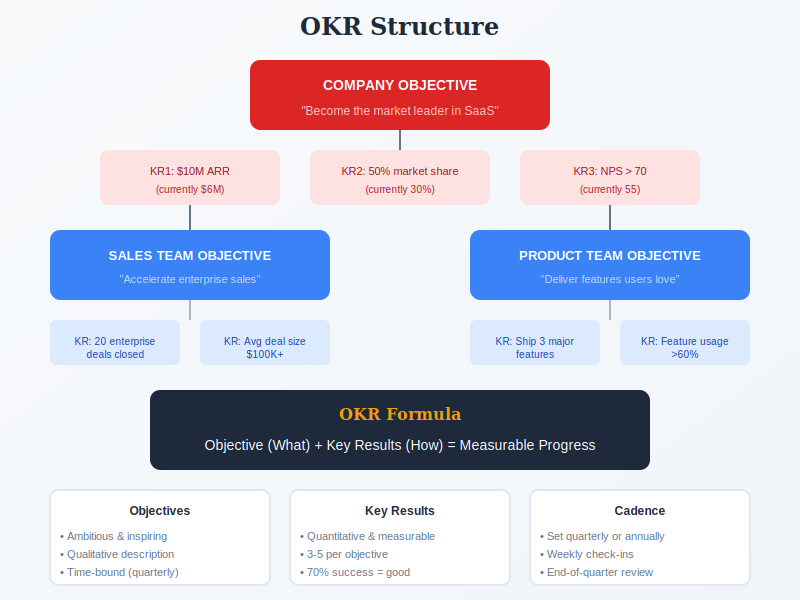
Quick Reference
The canonical structure
What counts as a Key Result
Andy Grove’s formulation at Intel was a single sentence with two blanks: I will ______ as measured by ______. The first blank is the Objective, the second is the Key Result. Nearly every failure of OKR writing is a failure to fill in the second blank honestly.
| Element | What it must be | What gets written instead |
|---|---|---|
| Objective | Qualitative, memorable, and about a change. One sentence a new joiner could repeat. | A department name with a verb on the front: “Improve marketing.” |
| Key Result | A number with a baseline and a target, describing an outcome you influence but do not control. | A deliverable: “Launch the new portal.” That is a task, and you will complete it whether or not anything improves. |
| Count | Three to five Objectives per team, two to five Key Results each. | Twelve Objectives, which is the same list of everything with new headings. |
| Committed OKR | Expected to reach 1.0. Missing one is a failure that needs explaining. | Graded on the same curve as aspirational, so nobody knows which promises were real. |
| Aspirational OKR | Deliberately set beyond reach; landing near 0.7 is the designed outcome. | The 0.7 rule applied to everything, including commitments that should have hit 1.0. |
| Health metrics | Watched, not targeted — uptime, churn, margin. Kept beside the OKRs. | Promoted into Key Results, which turns the framework into a KPI dashboard. |
On the two types
The committed and aspirational distinction is the part most often dropped, and dropping it is what makes the famous 0.7 target incoherent. A committed OKR scoring 0.7 is a broken promise. An aspirational OKR scoring 1.0 means the target was too easy. One number cannot mean both.
Label each OKR as one or the other before the quarter starts, not after the score is known. Deciding afterwards is how a missed commitment becomes a “stretch goal” in the review.
A common confusion
Who actually invented OKRs?
Three names get the credit, in different places, and the honest answer involves all three in sequence. It is worth getting right, because the usual shorthand — that OKRs replaced Management by Objectives — has the relationship backwards.
| Who | When | What they actually contributed |
|---|---|---|
| Peter Drucker | 1954, The Practice of Management | Management by Objectives. The idea that people should agree measurable objectives with their manager rather than receive instructions. OKR is a descendant of MBO, not a replacement for it. |
| Andy Grove | Intel, 1970s; written up in High Output Management, 1983 | The operating system. Grove adapted MBO into what Intel called iMBOs — short cycles, small numbers of objectives, and the insistence that each objective carry measurable key results. The label “OKR” came later; Grove built the method, not the acronym. |
| John Doerr | Learned it at Intel from 1975; presented it to Google in 1999 | Transmission and naming. Doerr carried the practice to Google when it had around thirty employees, and three decades later wrote it up for a general audience in Measure What Matters. |
The short answer
If you need one name, it is Andy Grove at Intel — Doerr himself credits Grove as the originator. If you need one sentence: Drucker supplied the principle, Grove turned it into a working system at Intel, and Doerr named it, carried it to Google, and made it famous.
So yes, OKRs were created at Intel. But they were not created from nothing, and a page that presents them as a modern alternative to MBO is describing a thing as the opposite of its own parent.
Core Features
- Objective plus Key Results: one qualitative statement, two to five measured outcomes
- Quarterly cycle: short enough to correct, long enough for something to change
- Deliberately few: three to five per team, because the point is subtraction
- Graded 0.0 to 1.0: scored at the end rather than ticked off along the way
- Committed and aspirational are different instruments: one should hit 1.0, one should land near 0.7
- Transparent by default: visible across the company, which is most of how alignment happens
- Separated from compensation: the moment they are scored for pay, targets become negotiable
Worked example
A first OKR cycle, before and after
An illustrative composite. A 240-person compliance software company in Raleigh, North Carolina, writing OKRs for the first time. Mid-market deals were stalling in procurement and nobody could say why. The left column is the first draft; the right is after the checklist test was applied to every line.
Every item in the left column could be completed by working through a list. That is the diagnosis.
| First draft | After rewriting | |
|---|---|---|
| Objective | “Become the leader in mid-market compliance” | “Make onboarding fast enough that mid-market buyers stop stalling in procurement” |
| KR 1 | Ship the new onboarding flow | Median time-to-first-value from 34 days to 12 |
| KR 2 | Launch the partner portal | New accounts completing setup with no CS call from 18% to 50% |
| KR 3 | Hire three more customer success reps | Onboarding support tickets per new account from 4.1 to 1.5 |
| KR 4 | Reduce churn | Removed — churn is a health metric, watched beside the OKRs rather than targeted in them |
| Type | Not stated | Committed on KR 1, aspirational on KR 2 and 3, labeled before the quarter began |
What the rewrite actually did
The highlighted row was the one with consequences. “Hire three more CS reps” is a plan, and it had already been costed into the quarterly budget. Restating it as the outcome it was meant to produce — fewer onboarding tickets per account — separated the goal from the single solution that had been assumed.
Two weeks in, a setup wizard and three template fixes had moved tickets per account from 4.1 to 2.6. The hiring request was withdrawn. Nobody had argued against the headcount; the OKR simply stopped presupposing it.
When to Use
- When there are too many priorities and something has to be declined out loud
- Quarterly planning in a company large enough that teams cannot see each other’s work
- When strategy is agreed but nothing measurable has been attached to it
- After a pivot or reorganization, to re-point teams at a small number of shared outcomes
- When output is high and outcomes are flat — the classic sign of goals written as deliverables
- In growth-stage companies, where informal alignment stops working somewhere past a hundred people
- Alongside a Strategy Map or Balanced Scorecard, where OKRs carry the change and the scorecard carries the health metrics
When NOT to Use
- As an input to performance reviews or bonuses — the fastest reliable way to destroy them
- For steady-state operational metrics, which are KPIs; use Balanced Scorecard
- In pre-product-market-fit startups, where the right target changes faster than the cycle; use Lean Canvas
- For continuous or reactive work with no quarterly shape; use Kanban
- When the strategy itself is unresolved — OKRs will encode the disagreement rather than settle it
- As a task tracker, which is what happens whenever Key Results are written as deliverables
In practice
How OKRs go wrong
OKRs fail in a small number of recognizable ways, and most organizations manage several at once in their first year.
| What you see | What it usually means | What to do |
|---|---|---|
| Key Results are things the team will ship | They are tasks, and the framework has become a roadmap with scores | Apply the checklist test to every line. If completing it is fully within the team’s control, restate it as the outcome it is supposed to cause. |
| OKRs feed the performance review or the bonus | HR owns the rollout | Separate them explicitly and say so out loud. People asked to stake their pay on a target will negotiate an easy one, which removes the only reason to set ambitious goals. |
| Everything is graded against 0.7 | The committed and aspirational distinction was never made | Label each OKR before the quarter starts. A committed OKR at 0.7 is a missed promise, not a good stretch. |
| Twelve OKRs per team | Nothing was declined; the old list got new headings | Cap at three to five and make the cut visible. If leadership will not choose, the framework has nothing to work with. |
| Written in January, reopened in December | Treated as an annual planning artifact | Score and rewrite quarterly. OKRs that survive a full year unchanged were either too easy or are being ignored. |
| Cascaded strictly top-down | Alignment confused with instruction | Let a meaningful share come from teams. Purely cascaded OKRs arrive as assignments, and teams write to what they were handed rather than to what they can see. |
| Uptime, churn and margin are Key Results | Health metrics have been promoted into targets | Move them to a watch list beside the OKRs. They matter continuously, which is exactly why they are not quarterly change goals. |
Sourced
Evidence, and how to cite it
Grove wrote the method down, and the formulation is one sentence.
High Output Management sets out Intel’s objectives-and-key-results practice, including the sentence template “I will ______ as measured by ______” and the argument for short cycles and few objectives. Anyone teaching OKRs is teaching from this book, whether or not they have read it.
Grove, A.S. (1983) High Output Management. New York: Random House.
The 0.7 target applies to one of the two types, and is routinely applied to both.
Google’s published guidance distinguishes committed OKRs, which are expected to reach 1.0, from aspirational OKRs, where averaging around 0.7 is the intended result. Applying a single expectation to both is a category error, and it is the most common one in practice: it makes commitments soft and stretch goals punitive at the same time.
Google re:Work, ‘Set goals with OKRs’.
OKR has almost no independent evidence base.
This is worth stating plainly, because it separates OKR from frameworks with research behind them. What exists is practitioner testimony from two companies, a widely read trade book, and a large consulting industry. There is no body of peer-reviewed work establishing that OKRs improve performance, and the closest relevant research — goal-setting theory — supports specific difficult goals in general rather than this implementation of them. Treat confident numeric claims about OKR outcomes with suspicion; most trace back to vendors.
Tying OKRs to compensation is warned against by the people who popularized them, and done anyway.
Both Doerr and Google’s own guidance separate OKRs from performance ratings and pay. The reasoning is mechanical rather than cultural: a target that determines someone’s bonus becomes a target they negotiate, and ambitious goals stop being safe to set. Rollouts owned by HR nearly always couple the two, which is why so many OKR programs produce conservative goals that are all met.
Doerr, J. (2018) Measure What Matters. New York: Portfolio/Penguin.
How to cite it.
Harvard: Doerr, J. (2018) Measure What Matters: How Google, Bono, and the Gates Foundation Rock the World with OKRs. New York: Portfolio/Penguin.
APA: Doerr, J. (2018). Measure what matters: How Google, Bono, and the Gates Foundation rock the world with OKRs. Portfolio/Penguin.
For the method itself, cite Grove, A.S. (1983) High Output Management. New York: Random House. For the underlying principle, cite Drucker, P.F. (1954) The Practice of Management. New York: Harper & Row.
Key Strengths
- Forces subtraction: choosing three outcomes means declining the rest, in public
- Separates outcome from output: a team can ship everything and still miss, which is the useful signal
- Transparency does the alignment: visible goals let teams coordinate without a coordination layer
- Short cycle: a quarter is long enough to move something and short enough to correct
- Cheap to run: a spreadsheet is genuinely sufficient; the cost is the arguing, not the tooling
Key Weaknesses
- Degrades into a task list unless Key Results are policed as outcomes
- Almost no independent research base — it is practitioner lore from two companies
- Poor fit for continuous or reactive work with no quarterly shape
- Corrupted immediately by any link to pay or performance ratings
- The committed and aspirational distinction is widely dropped, which makes scoring meaningless
- Encodes strategic disagreement rather than resolving it — ambiguity upstream survives the process intact
How It Works
| 1 Primary Input | Company strategy, team priorities, and measurable baseline metrics |
|---|---|
| 2 Data You Need | Current performance baselines, strategic priorities, team capacity |
| 3 Primary Output | Aligned objectives and measurable key results across the organization |
Comparison with Related Frameworks
OKR is one of several strategy execution frameworks. Here's how it compares:
OKR vs Balanced Scorecard
Balanced Scorecard is more comprehensive, covering four perspectives (financial, customer, process, learning). OKRs are simpler and more focused on goals and outcomes. Use Balanced Scorecard for holistic strategy management; OKRs for goal-setting and alignment.
OKR vs Strategy Map
Strategy Map visualizes cause-and-effect relationships in strategy. OKRs are more action-oriented with specific metrics. Strategy Maps show "why"; OKRs show "what and how much." Often used together—Strategy Map for visualization, OKRs for execution.
OKR vs Hoshin Kanri
Hoshin Kanri is the Japanese approach with similar cascading goals but more emphasis on process and catchball (two-way alignment). Hoshin is more rigorous but slower; OKRs are simpler and more agile. Use Hoshin for manufacturing/process-heavy organizations.
OKR vs Lean Strategy
Lean Strategy emphasizes experimentation and rapid iteration. OKRs are better for established goals with clear metrics. Use Lean Strategy when you're still validating direction; OKRs when direction is clear and you need execution alignment.
Sequencing
What to run before and after
OKR converts an agreed strategy into a small number of measured outcomes. It needs the strategy to exist beforehand and needs ownership and delivery afterwards, and it supplies neither.
Before
Settle the strategy and find the baselines
A Key Result needs a current number as well as a target. Teams that cannot state the baseline usually discover the metric does not exist yet, which is the real first task.
During
Write few, label the type, check weekly
Three to five per team, each marked committed or aspirational before the quarter starts. A short weekly confidence check catches the OKR that quietly became a task list.
After
Score, then rewrite rather than roll over
Grade 0.0 to 1.0 against the type you declared, keep the scores away from pay, and write the next set fresh. An OKR that rolls over unchanged for three quarters is a KPI in the wrong place.
Part of a playbook: How to Delegate as Your Team Grows. OKRs is stage 5 of 6, after psychological safety and before succession planning.
Part of a playbook: How to Execute a Business Strategy. OKRs is stage 5 of 5, after Hoshin Kanri.
Common questions
OKR: quick answers
Who invented OKRs?
Andy Grove, at Intel in the 1970s, is the person who built the method, and John Doerr credits him as its originator. The principle underneath it is older: Peter Drucker set out Management by Objectives in 1954, and Grove adapted it into what Intel called iMBOs, adding short cycles, a small number of objectives, and the requirement that each one carry measurable key results. Doerr learned the practice at Intel from 1975, presented it to Google in 1999, and named and popularized it for a general audience in Measure What Matters in 2018.
Were OKRs created at Intel?
Yes. The working method was developed at Intel under Andy Grove and written up in his 1983 book High Output Management. Two caveats are worth keeping. Intel did not call them OKRs, the internal name was iMBOs, and the acronym came into general use later through John Doerr. And they were not created from nothing: Grove was adapting Peter Drucker’s Management by Objectives, so describing OKRs as a modern replacement for MBO gets the relationship backwards.
What is the difference between an Objective and a Key Result?
The Objective is qualitative and states what should be different, in one memorable sentence. Key Results are quantitative and state how you will know it happened, each with a starting value and a target. Grove’s formulation was a single sentence with two blanks: I will blank as measured by blank. The usual mistake is writing deliverables as Key Results. If you could complete a Key Result by working through a checklist, it is a task, because a real Key Result describes something you influence but do not fully control.
Is 70% a good OKR score?
Only for aspirational OKRs. Google’s guidance separates committed OKRs, which are expected to reach 1.0 and where a miss needs explaining, from aspirational OKRs that are deliberately set beyond reach and are designed to land around 0.7. Applying one number to both is the most common scoring error: it makes real commitments look soft and makes stretch goals feel punitive. Label each OKR as committed or aspirational before the quarter begins, not after you see the score.
How many OKRs should a team have?
Three to five Objectives, with two to five Key Results each, per team per quarter. The number is the point rather than a convention: OKRs exist to force subtraction, and a team carrying twelve Objectives has simply relabeled its existing workload. If leadership is unwilling to declare which things will not happen this quarter, the framework has nothing to operate on and will produce a status report instead.
What is the difference between OKRs and KPIs?
KPIs measure the ongoing health of something that runs continuously, such as uptime, churn or gross margin. OKRs describe a change you intend to produce within a fixed period. The two get confused because both involve numbers, and the usual symptom is a Key Result like maintain 99.9% uptime, which is a health metric wearing a target. Keep health metrics on a watch list beside the OKRs, and use a Balanced Scorecard if the health picture is what you actually need.
Should OKRs be linked to performance reviews or bonuses?
No, and both Doerr and Google’s own guidance say so explicitly. The reason is mechanical rather than cultural: a target that determines someone’s pay becomes a target they negotiate, so ambitious goals stop being safe to set and everyone lands on comfortable ones that are all met. Rollouts owned by HR tend to couple the two by default, which is why so many OKR programs produce a full set of achieved goals and no visible change in results.
How do I cite OKRs?
Harvard style: Doerr, J. (2018) Measure What Matters: How Google, Bono, and the Gates Foundation Rock the World with OKRs. New York: Portfolio/Penguin. APA style: Doerr, J. (2018). Measure what matters: How Google, Bono, and the Gates Foundation rock the world with OKRs. Portfolio/Penguin. For the method as originally developed, cite Grove, A.S. (1983) High Output Management, and for the underlying principle cite Drucker, P.F. (1954) The Practice of Management.
Deep Resources
Frameworks related to OKR (Objectives & Key Results)
- Balanced ScorecardStrategic management framework that translates strategy into measurable objectives across…
- Strategy MapVisual representation of strategy showing how objectives connect through cause-and-effect…