Playbook
How to Delegate as Your Team Grows
Six questions, asked in order, for the leader who has become the bottleneck.
A delegation playbook is a six-stage sequence of management tools that moves a growing team from depending on one leader's decisions to clear owners, delegated outcomes and ready successors.
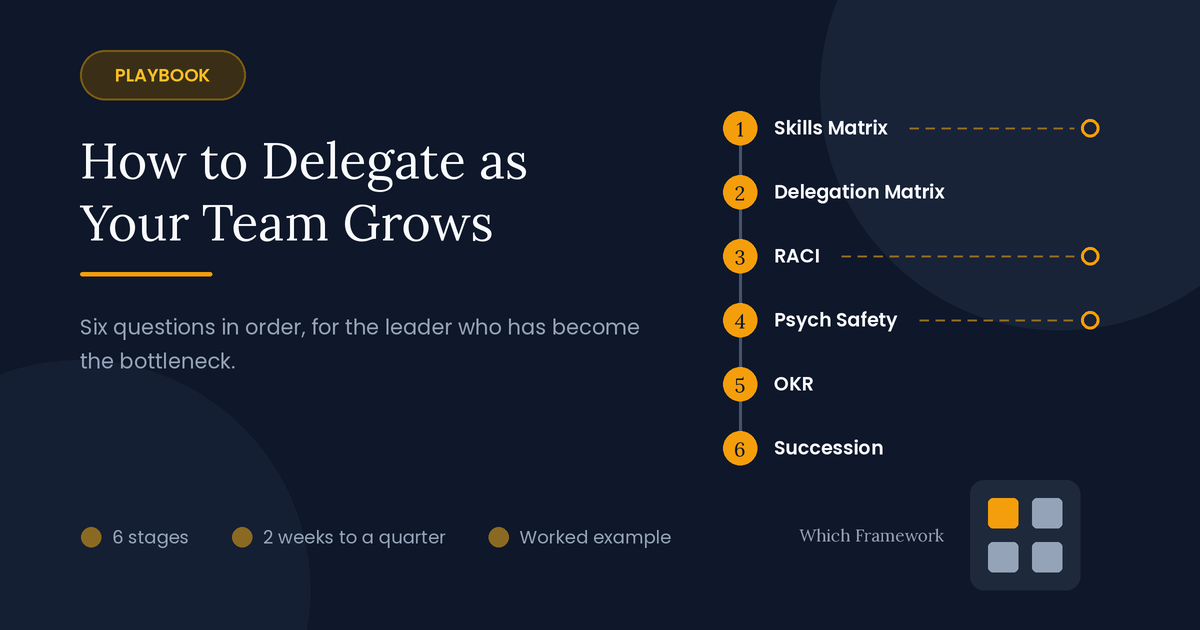
The route
Six questions, in order
Each stage asks one question and uses one proven tool to answer it. What comes out of each stage goes into the next. Three points on the route can send you back or make you pause.
Only need to settle who decides what on one project? Start at stage 3.
-
Who can do what today?Stage 1 · Skills Matrix
Passes on: who can do what, and which skills only the leader has
Nobody has the skill?Train someone alongside you before handing it over.
-
What should you hand off?Stage 2 · Delegation Matrix
Passes on: each task's new owner and how much authority goes with it
-
Who decides what?Stage 3 · RACI Matrix
Passes on: one accountable owner for every decision
Two owners for one decision?Settle it before going on.
-
Will people raise problems early?Stage 4 · Psychological Safety
Passes on: habits that bring bad news forward
Problems still hidden?Pause here. Don't set outcome goals yet.
-
What should people deliver?Stage 5 · OKR
Passes on: outcomes each owner is judged on
-
Who steps up next?Stage 6 · Succession Planning
Passes on: named successors for the roles you can't afford to lose
- How do you keep it working?Then · A 90-day review
The example
One agency, followed all the way through
This playbook follows one company from start to finish. It is an illustrative composite, and the details are simplified.
A software agency in Cluj-Napoca, Romania, building web and mobile apps for clients in Western Europe. Two years ago it had 12 people. It now has 40. The founder still writes every estimate, signs off every release and takes every call from an unhappy client. Work waits in her inbox, and two senior developers left last year saying they had no room to grow.
Each stage below ends with what the agency produced at that step, so you can watch one stage's output become the next stage's input.
Stage 1 of 6
Who can do what today?
Tool: Skills Matrix · Time: 1 to 2 days
Before handing anything over, find out who could take it. A skills matrix lists the skills the work needs down one side and the people across the top, and rates each person on each skill. The scale matters less than honesty. People rate themselves more candidly when they are told, in writing, that the grid will not feed pay reviews.
Rate the leader too. The point is to find the skills only the leader has, because those are the tasks stuck in the leader's inbox.
What goes inThe skills the work needs, and the people on the team.
What comes outA grid of who can do what, with the skills only one person has marked.
Skip it if: you already have a current, honest skills matrix. Few teams do.
| Skill | Founder | Tech lead | Senior dev | Delivery mgr | Account mgr |
|---|---|---|---|---|---|
| Client estimates | 4 | 2 | 1 | 3 | 1 |
| Release sign-off | 4 | 3 | 2 | 1 | 0 |
| Architecture calls | 4 | 3 | 3 | 0 | 0 |
| Client escalations | 4 | 1 | 0 | 2 | 3 |
| Hiring interviews | 4 | 1 | 1 | 1 | 0 |
0 none · 1 aware · 2 can do it unaided · 3 does it well · 4 can teach it
Handed to stage 2: estimates, release sign-off and escalations each have someone rated 3 besides the founder. Hiring interviews have nobody. That skill has to be built before it can be handed over.
Decision point
If nobody has the skill, don't hand the task over yet. Have someone sit in on the next few, then hand it over. Delegating a task nobody can do sets that person up to fail, and teaches the team that delegation means blame.
Stage 2 of 6
What should you hand off, to whom, and with how much oversight?
Tool: Delegation Matrix · Time: an afternoon
List everything the leader does in a normal fortnight. Then sort each task on two things: how important it is, and how skilled the best available person is. Stage 1 already answered the second question, so this stage is quick.
Each quadrant has its own answer. Important work with a skilled person: delegate fully. Important work with nobody skilled: keep it for now and train someone. Less important work with a skilled person: delegate with check-ins. Less important work with nobody skilled: stop doing it.
Then do the step most leaders skip. For each task you hand over, say how much authority goes with it: decide and tell me, decide after asking me, or bring me a recommendation. A handover without that sentence gets checked back up the line.
What goes inThe leader's task list, and the skills grid from stage 1.
What comes outEach task with a new owner, a quadrant and a stated level of authority.
Skip it if: you only have one or two tasks to hand over. Just hand them over.
Handed to stage 3: release sign-off, estimates and escalations go to named owners with full authority. Status reports go over with spot checks, hiring stays for now, and one task disappears.
Stage 3 of 6
Who decides what, now that the work is spread out?
Tool: RACI Matrix · Time: half a day
Stage 2 decided who takes each task. Once work is spread across more people, the harder question is who decides. A RACI matrix lists each decision down the side and each role across the top, and puts one of four letters in each cell. Every decision gets exactly one A.
Read the draft row by row, looking for two things. Two A's in one row means two people each think the other has decided, so the decision sits. A row full of C's means a decision so many people must approve that it slows everything down.
What goes inThe handovers and authority levels from stage 2.
What comes outEvery decision with one accountable owner, and a short list of who is asked or told.
Skip it if: the team is small enough that everyone hears every decision anyway.
- RResponsible
- Does the work
- AAccountable
- Owns the decision and answers for it
- CConsulted
- Asked for a view before the decision
- IInformed
- Told after it is made
| Decision | Founder | Tech lead | Delivery mgr | Account mgr |
|---|---|---|---|---|
| Release sign-off | I | A | C | I |
| Estimates under EUR 20k | A | C | A | I |
| Client escalations | C | C | I | A |
| Scope changes mid-sprint | I | C | A | C |
| Hiring decisions | A | R | I | – |
Where the accountable person also does the work, only A is shown.
Handed to stage 4: estimates now have one owner, the delivery manager. The founder had kept an A on them just in case, and that row explained why estimates still waited for her.
Decision point
If any decision has two owners, settle it before going on. Every later stage assumes one owner per decision. With two, each is judged on a call the other one made.
Stage 4 of 6
Will people raise problems early, or hide them?
Tool: Psychological Safety · Time: 4 to 6 weeks after the handovers
Delegation fails quietly when people hide problems. A new owner who fears blame will sit on a slipping deadline until the client calls. Psychological safety is a team's shared belief that it is safe to speak up, ask questions and admit mistakes.
It is measured, not assumed. A short survey helps, but behavior tells you more. Watch how bad news arrives, and what the leader does with a decision someone else made. Check it now, before stage 5 starts judging people on results.
What goes inThe new owners, a few weeks into their new responsibilities.
What comes outAgreed habits that bring problems forward early.
Skip it if: never, once you have handed over anything that matters.
| Warning sign | What it looked like | What changed |
|---|---|---|
| Bad news arrives late | The founder heard about a slipped deadline from the client | Any risk to a date is raised the day it is seen, with no blame for raising it |
| Decisions reversed | The founder rewrote two estimates the delivery manager had sent | The founder no longer overrules an owner without talking to them first |
| Questions skip the owner | Developers still asked the founder about releases | The founder answers with: ask the tech lead |
Handed to stage 5: problems now reach the owner early, and the founder has stopped taking decisions back. That makes it fair to judge owners on results.
Decision point
If problems are still hidden, pause here. Don't hand over more, and don't set outcome goals yet. People who fear blame choose goals they know they will hit, and delegating more into a team that hides trouble multiplies the trouble.
Stage 5 of 6
What should people deliver, rather than what should they do?
Tool: OKR · Time: 1 to 2 weeks, in one planning cycle
A task handed over as a task comes back as questions. An outcome handed over comes back as a result. OKR stands for objectives and key results. The objective is a short, plain statement of what should change. The key results, usually two to four, are numbers that show whether it did.
The test for each key result is simple. Could someone complete it by working through a checklist? If yes, it is a task, not a result. Rewrite it as the change the task is meant to cause.
What goes inThe owners and decisions from stages 2 and 3, and a team that raises problems early.
What comes outOutcomes each owner is judged on, instead of task lists.
Skip it if: the handed-over work is routine and has no outcome worth measuring.
Example: the delivery manager's OKR for the quarter
ObjectiveEstimates stop waiting on the founder
- Key result 19 in 10 estimates under EUR 20k sent within three working days
- Key result 2No estimate under EUR 20k needs the founder's sign-off
- Key result 3Finished projects land within 15% of their estimated hours
| Owner | First draft (a task) | Rewritten (an outcome) |
|---|---|---|
| Tech lead | Review every release | No release rolled back for a missed review this quarter |
| Delivery manager | Send estimates on time | 9 in 10 estimates under EUR 20k sent within three working days, without the founder |
| Account manager | Handle escalations | Escalations settled within 48 hours; none reach the founder unless the client asks |
Handed to stage 6: each new owner has results to aim at. The highlighted one changed the founder's week: estimates were a fifth of her hours.
Stage 6 of 6
Who steps up next?
Tool: Succession Planning · Time: 2 to 3 days, then yearly
Delegation creates new key roles. If the tech lead leaves, release sign-off lands back on the founder's desk overnight. Succession planning names the roles the business can't afford to lose, and finds who could step into each.
Be honest about readiness. Ready now, ready in a year or two, and no one yet are all useful answers. The third is the one that tells you whom to hire or develop next.
What goes inThe key roles created in stages 2 and 3, the results from stage 5, and the skills grid from stage 1.
What comes outNamed successors, how ready each is, and the gaps to close.
Skip it if: the team is small and every role has a clear backup already.
| Key role | Ready now | Ready in 1 to 2 years | Gap |
|---|---|---|---|
| Tech lead | – | Senior developer | Needs a year of architecture calls |
| Delivery manager | – | – | Nobody. The next hire is a second delivery manager |
| Hiring lead (the founder today) | – | Tech lead | Sitting in on interviews since stage 1 |
Handed on: a hiring plan with a reason behind it: the delivery manager role had no successor at all.
Pace
Fast track or thorough
The same six stages can take two weeks or a full quarter. The fast track frees the leader's time quickly. The thorough run makes the change hold as the team keeps growing.
| Stage | Fast track (about two weeks) | Thorough (one quarter) |
|---|---|---|
| 1. Skills Matrix | The leader rates the team alone | Everyone rates themselves, then compares |
| 2. Delegation Matrix | Top ten tasks only | Two weeks of tasks, logged as they happen |
| 3. RACI | Only decisions that have stalled | Every recurring decision |
| 4. Psychological Safety | Watch for the three warning signs | A short survey, repeated after a quarter |
| 5. OKR | One outcome per new owner | A full cycle, reviewed at the end |
| 6. Succession Planning | The two riskiest roles | Every key role, with a development plan |
Failure modes
How delegation goes wrong
| What happens | What it looks like | The fix |
|---|---|---|
| Dumping, not delegating | The dull tasks go; the important ones stay | Sort by importance and skill, not by what you dislike |
| No stated authority | Every handed-over task comes back as a question | Say how much authority goes with each task |
| Taking decisions back | The leader quietly redoes delegated work | Talk to the owner before overruling them |
| Tasks, not outcomes | Owners finish the list and nothing improves | Rewrite each task as the result it should cause |
| One new bottleneck | All the work moves to one strong deputy | Spread handovers, and plan a successor for every key role |
After the playbook
Keeping it working
Book a review 90 days out. Check three things: has the leader's time actually changed, are decisions landing with the owners in the RACI, and are the OKRs being met. If any of the three has drifted, go back to the stage that produced it.
Repeat the playbook each time the team grows by about half again. The tasks that were right to keep at 40 people are often the ones to hand over at 60. For a team that is still forming, Tuckman explains why the same handover can work in one quarter and fail in the next.
Common questions
Delegation: quick answers
How do I start delegating when my team grows?
Start by finding out who can do what, not by handing things over. A skills matrix shows which tasks only you can do today. Then sort your tasks by importance and by the skill of the best available person, and for each task you hand over, say how much authority goes with it.
What should a manager not delegate?
Important work that nobody on the team can do yet. Keep it for now and train someone alongside you. Also keep decisions about people's pay and performance, and anything that only makes sense coming from you, such as setting the team's direction.
Why does delegation fail?
Usually for one of three reasons. The leader hands over tasks without saying how much authority goes with them, so everything comes back as a question. The leader quietly takes decisions back. Or people hide problems, so trouble surfaces late and the leader stops trusting the handover.
What is the difference between a RACI matrix and a delegation matrix?
The delegation matrix decides which tasks you hand over and how closely you oversee them. RACI comes after it and settles who owns each decision once the work is spread across several people. The first is about your task list; the second is about the team's decisions.
How long does it take to delegate properly?
About two weeks to free the leader's time on the fast track, and one quarter for the change to hold. The slow part is not the handover. It is the weeks after, while new owners gain confidence and the leader learns not to step back in.
Is this only for founders?
No. It works for any leader who has become the bottleneck: a newly promoted manager, a department head whose team has doubled, or a project lead who is still doing the work of the people they now lead.
Frameworks in this playbook
- Skills MatrixStage 1: Who can do what today?
- Delegation MatrixStage 2: What should you hand off, to whom, and with how much oversight?
- RACI MatrixStage 3: Who decides what, now that the work is spread out?
- Psychological SafetyStage 4: Will people raise problems early, or hide them?
- OKRStage 5: What should people deliver, rather than what should they do?
- Succession PlanningStage 6: Who steps up next?
- Tuckman's StagesAfter: why the same handover works one quarter and fails the next