Delegation Matrix: Empowering Your Team
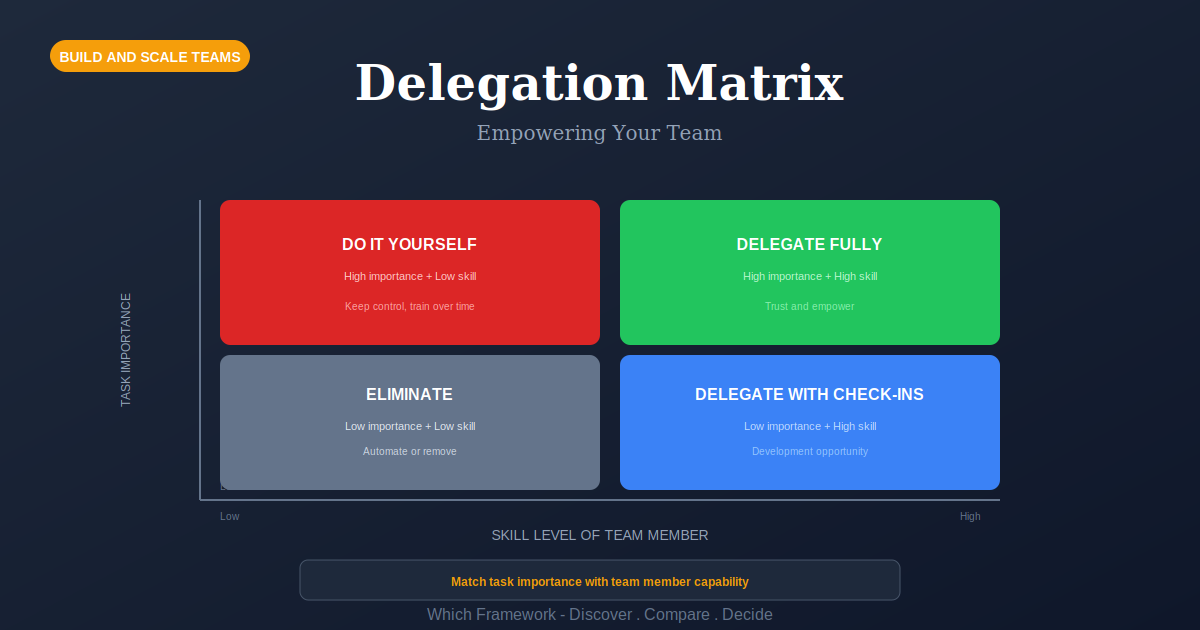
Delegation Matrix is a simple 2x2 framework that helps leaders determine what tasks to delegate, to whom, and what level of oversight is appropriate based on task importance and team member skill.
What Is It?
The Delegation Matrix plots task importance against team member skill level to guide delegation decisions. It's a practical tool for leaders who struggle with letting go or who delegate poorly.
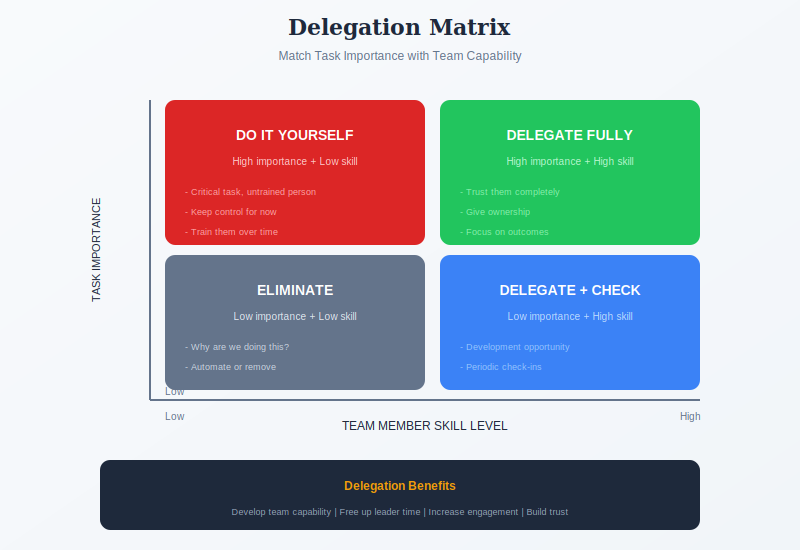
The four quadrants: Do It Yourself (high importance, low skill—keep control, train over time), Delegate Fully (high importance, high skill—trust and empower), Delegate with Check-ins (low importance, high skill—development opportunity), Eliminate (low importance, low skill—why do this at all?).
This framework connects to Skills Matrix for understanding capability, RACI Matrix for role clarity, and Tuckman's Stages for adjusting delegation to team maturity.
Quick Reference
First, disambiguate
Which delegation matrix do you mean?
“Delegation matrix” is not one tool. At least four different things go by the name, and they answer genuinely different questions. Most confusion about delegation frameworks is really confusion between these.
| If your question is… | The tool you want | What it gives you |
|---|---|---|
| Which tasks should I hand over, and to whom? | The delegation matrix on this page | A 2×2 of task importance against the person’s skill. Sorts your task list into keep, delegate, coach or drop. |
| How much authority comes with this decision? | The seven levels of delegation — Tell, Sell, Consult, Agree, Advise, Inquire, Delegate | Not which tasks, but how far autonomy extends on each one. Delegation is a dial, not a switch. |
| Who can approve spend of this size? | A delegation of authority matrix | A governance document mapping decision types to approval thresholds and signatories. Same words, completely different artefact — and not covered here. |
| Who does the work, and who answers for it? | RACI Matrix | Roles per task rather than delegation decisions. Frequently used alongside this one. Compare with RACI |
| Your team has grown and you have become the bottleneck | The delegation playbook | A route through several frameworks, where the delegation matrix is stage 2 of 6. |
The distinction that matters
The first two are complementary, not competing. This matrix decides what to delegate; the seven levels decide how far. Most delegation that fails does so because the first question was answered and the second was never asked — the task was handed over without anyone saying whether the person could decide, had to consult, or merely had to report.
Worked example
A manager’s task list, sorted
An illustrative composite. A newly promoted head of operations, six direct reports, working sixty-hour weeks and convinced none of it could be handed over. The exercise took forty minutes.
The last column is the step most people skip: having decided to delegate, saying how much authority goes with it.
| Task | Importance | Their skill | Quadrant | Level of authority |
|---|---|---|---|---|
| Approving supplier contracts over $50k | High | Low | Do it yourself — for now | Consult: bring me the shortlist and your recommendation. |
| Weekly capacity planning | High | High | Delegate fully | Delegate: decide and tell me afterwards. This was eight hours a week the manager had never questioned. |
| Onboarding new starters | Low | High | Delegate with check-ins | Advise: you decide, ask me if you want a view. |
| Compiling the monthly board pack | Low | Low | Eliminate | Nobody reads it. Replaced with a five-line summary. |
| Handling escalated customer complaints | High | Medium | Delegate with check-ins | Agree: draft the response, we send it together, for the next month only. |
What actually changed
Two quadrants did the work. Delegate fully released eight hours a week that had never been examined, because the task was important and the manager had assumed importance meant keeping it. Importance is not the test — the pairing of importance with capability is.
Eliminate is the quadrant people are most reluctant to use and the one that most often applies. A task that is neither important nor well-suited to anyone is usually a habit rather than a requirement. Ask who would notice if it stopped, and for how long.
When to Use
- Feeling overwhelmed with tasks
- Team members ready for more responsibility
- New manager transition
- Scaling a team
- Workload redistribution
- Leadership development
When NOT to Use
- Crisis situations requiring immediate action
- Confidential or sensitive matters
- Tasks requiring unique authority
- As excuse for dumping unwanted work
In practice
How delegation matrices go wrong
The grid is easy. Everything that makes delegation actually work happens in the handover, which the grid does not cover.
| What you see | What it usually means | What to do |
|---|---|---|
| The task comes back within two weeks | The task was delegated; the authority was not | State the level explicitly. Can they decide alone, must they consult, or are they just doing the work? Unstated authority defaults to none. |
| Everything lands in “do it yourself” | Skill was rated against your own standard rather than the standard the task requires | Ask what would actually go wrong at their current level, and how bad that would be. “Not as well as I would” is not a risk. |
| Only low-importance work gets delegated | Delegation is being used to offload rather than to develop | The high-importance, high-skill quadrant is where the manager’s time is actually recovered. If nothing sits there, you have redistributed chores. |
| The eliminate quadrant is empty | Nobody was willing to say a task is pointless | It is rarely genuinely empty. Ask who would notice if each low-importance task stopped, and how long it would take them. |
| The person delegated to did not agree to it | The matrix was filled in alone | Delegation is an agreement, not an instruction. Run the grid, then have the conversation, and expect their view of their own skill to differ from yours. |
| Something goes wrong and the manager is blamed anyway | Accountability was assumed to transfer with the task | It does not. You can delegate the work and the decision rights; you remain answerable for the outcome. See the RACI Matrix on responsible versus accountable. |
Sourced
Where it came from
The 2×2 has no identifiable author.
The importance-against-skill grid is a folk tool. It appears in management training materials, leadership courses and countless blog posts, and none of them cite an origin, because there does not appear to be one to cite. Our own framework data records it as emerging from general management practice around 1970, which is a placeholder rather than a finding. It is genuinely useful and genuinely unattributable, and it is worth saying so rather than inventing a lineage.
The delegation levels tradition does have a documented lineage.
Tannenbaum and Schmidt described delegation as a continuum of leadership behaviors rather than a binary, in Harvard Business Review in 1958 and again in 1973. Hersey and Blanchard’s situational leadership work condensed this into four modes — tell, sell, participate, delegate — matched to the readiness of the person being delegated to.
Tannenbaum, R. & Schmidt, W. H., “How to Choose a Leadership Pattern”, Harvard Business Review, 1958; revisited 1973.
Appelo extended it to seven levels, and said why.
Jurgen Appelo’s seven levels — Tell, Sell, Consult, Agree, Advise, Inquire, Delegate — were built explicitly on the Hersey-Blanchard model. His objection was that the four-mode version treats delegation as one-directional, flowing from superior to subordinate, where a modern team needs something more symmetrical and more granular. The associated practices, Delegation Poker and the Delegation Board, exist to make the level an explicit negotiation rather than an assumption.
Appelo, J., Management 3.0 and Management 3.0 #Workout.
Authority delegates. Accountability does not.
This is the point every delegation tradition converges on and most delegation training skips. You can hand over the task, the decision, and the authority to spend. You cannot hand over having to answer for the result — the Management 3.0 material calls this the accountability trap. It is the same distinction that makes the RACI A and R different letters, and it is why a manager who delegates badly is still the one asked what happened.
Key Strengths
- Simple: Easy to understand and apply
- Empowering: Develops team capability
- Efficient: Frees leader time
- Systematic: Removes guesswork
Key Weaknesses
- Oversimplifies complex situations
- Skill assessment can be subjective
- Doesn't address motivation
- May miss context factors
How It Works
| 1 Primary Input | Task list, team member skills, task importance ratings |
|---|---|
| 2 Data You Need | Current workload, skill assessments, strategic priorities |
| 3 Primary Output | Delegation plan, task assignments, check-in schedule |
Frameworks related to Delegation Matrix
- Tuckman's Stages of Group DevelopmentFramework describing 4 stages of team development: Forming, Storming, Norming, and Performing.…
- Skills Matrix / Competency MappingFramework for identifying, assessing, and developing team member capabilities. Maps skills…
- RACI MatrixResponsibility matrix clarifying who is Responsible, Accountable, Consulted, and Informed for…
Sequencing
What to run before and after
The grid takes under an hour. What surrounds it decides whether the delegation holds.
Before
Know what people can actually do
The skill axis is the one people get wrong, usually by rating against their own ability rather than the task’s requirement. A capability view built with the team beats a manager’s impression.
During
Sort, then set the level
Place each task in a quadrant, then state how much authority goes with the ones you are handing over. The second step is what makes the first stick, and it is the one usually left unsaid.
After
Make it visible and revisit it
Skill changes, which means the grid changes. A delegation decision made once and never revisited becomes either a bottleneck or an abdication within a couple of quarters.
Part of a playbook: How to Delegate as Your Team Grows. The delegation matrix is stage 2 of 6, after the skills matrix and before RACI.
Common questions
Delegation matrix: quick answers
What is a delegation matrix?
A 2×2 grid that sorts tasks by how important they are against how skilled the person is who might take them on. The four quadrants give four decisions: keep it for now, delegate fully, delegate with check-ins, or stop doing it. It answers which tasks to hand over — not how much authority goes with them.
What are the four quadrants of the delegation matrix?
High importance with low skill: do it yourself for now, and train. High importance with high skill: delegate fully — this is where a manager’s time is actually recovered. Low importance with high skill: delegate with check-ins, as a development opportunity. Low importance with low skill: eliminate, because the task is usually a habit rather than a requirement.
What are the seven levels of delegation?
Tell, Sell, Consult, Agree, Advise, Inquire and Delegate — Jurgen Appelo’s extension of Hersey and Blanchard’s situational leadership model, used in Management 3.0 through Delegation Poker and Delegation Boards. They answer a different question from the matrix: not which tasks to hand over, but how far autonomy extends on each one.
Is a delegation matrix the same as a delegation of authority matrix?
No, despite the near-identical name. A delegation of authority matrix is a governance document mapping decision types to approval thresholds and signatories — who can approve what level of spend, who signs which contracts. It is a control artefact, usually owned by finance or legal. The delegation matrix here is a management tool for deciding which tasks to hand to which person.
Can you delegate accountability?
No. You can delegate the task, the decision and the spending authority, but you remain the one required to answer for the outcome. Every delegation tradition converges on this, and it is the same distinction that separates the A from the R in a RACI matrix. A manager who delegates badly is still the one asked what happened.
Who invented the delegation matrix?
Nobody identifiable. The importance-against-skill grid is a folk tool that appears widely in management training without any cited origin. The related tradition of delegation levels is properly documented — Tannenbaum and Schmidt described delegation as a continuum in Harvard Business Review in 1958, Hersey and Blanchard condensed it into four modes, and Jurgen Appelo extended it to seven.