Succession Planning: Building a Bench, and What Naming a Successor Costs
Succession Planning is a repeating process that identifies critical roles, assesses internal candidates against the capabilities those roles demand, and develops the candidates over time toward readiness.
Before you start
Is this your framework?
This process answers one question: if the people holding your critical roles left, who could do the job, and what would it take to get them there. The horizon is years, and the output is development activity rather than a list of names.
It is slow and it is expensive, and it does not tell you who to appoint. It also does nothing about the role nobody has ever been trained to cover, which is usually a specialist rather than an executive. If your problem is nearer than that, the table below points elsewhere.
| If your real problem is… | You probably want |
|---|---|
| We do not know what capabilities we have or where the gaps are | Skills Matrix — current capability mapped against what the work needs, which this process assumes you already have Compare Succession Planning and Skills Matrix |
| One person is the only one who can do something, and they are leaving in a month | That is key-person risk, not succession. Log it in a Risk Management Framework and buy cover now |
| People are not growing because nothing real is ever handed to them | Delegation Matrix — authority attached to actual decisions, which is what develops a successor rather than a course Compare Succession Planning and Delegation Matrix |
| The transition itself is going badly and people are unsettled | Bridges’ Transition Model — the psychological side of a handover, which a plan does not address |
| Nobody will say honestly whether a candidate is ready | Psychological Safety — readiness ratings are only as candid as the room they are produced in |
| The org is restructuring and roles themselves are changing | McKinsey 7S — succeeding into a role that will not exist is wasted development |
| Your team has grown and you have become the bottleneck | The delegation playbook, where succession planning is stage 6 of 6 |
| Critical roles will turn over in the next few years and we have no bench | Succession Planning — you are in the right place |
What Is It?
Succession planning is a repeating cycle, not a document. Decide which roles would hurt most to lose. Work out what those roles actually demand. Look at who inside could get there. Then give those people work that closes the distance, and check again next year.
The step that gets skipped is the last one. A plan with no development attached is a list of names, and a list of names ages badly: people leave, roles change, and the chart becomes a record of who worked here two years ago.
The second thing worth knowing early is that this process is built on a judgment nobody can make reliably. Assessing whether someone could do a job they have never done is a prediction, and predictions about people are weak. That does not make the process worthless, but it does change what you should expect from it: a wider bench and better development, rather than a correct answer about who is next.
Quick Reference
The cycle
The four steps, and which one carries the weight
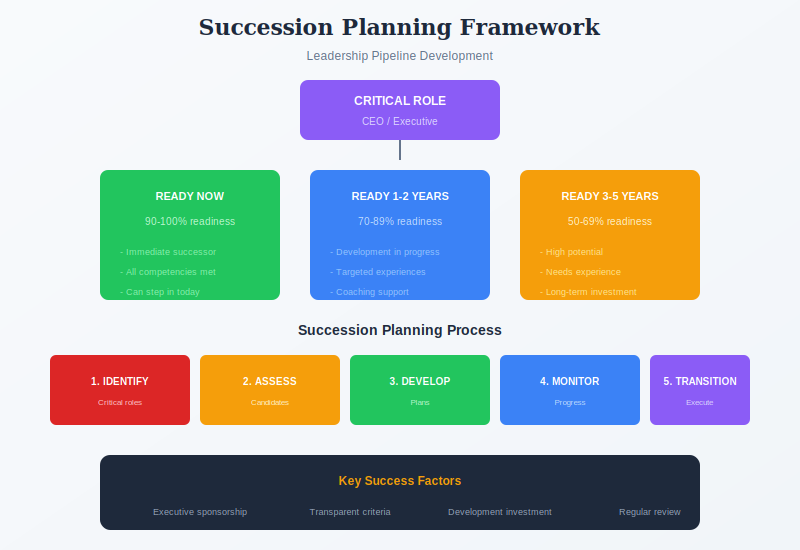
Every version of this process runs the same four steps. Three of them are administrative and get done. The fourth is the one that makes any difference, and it is the one that gets postponed.
| Step | What it produces | Where it fails |
|---|---|---|
| 1. Name the critical roles | A short list of positions whose loss would do real damage | Only the top two layers get listed. The role that actually cannot be covered is often a specialist several levels down. |
| 2. Say what each role demands | The capabilities, decisions and relationships the job actually turns on | Copied from the job description, which describes the last person rather than the work. |
| 3. Assess candidates | A read on who could get there, and how far away they are | Potential gets rated from current performance, which measures the job someone already holds rather than the one being filled. |
| 4. Develop and re-assess | Stretch assignments, real decisions, and a rating that moves | Skipped. The chart is filed, nobody's work changes, and next year the same names are a year older. |
Readiness bands are judgments wearing numbers
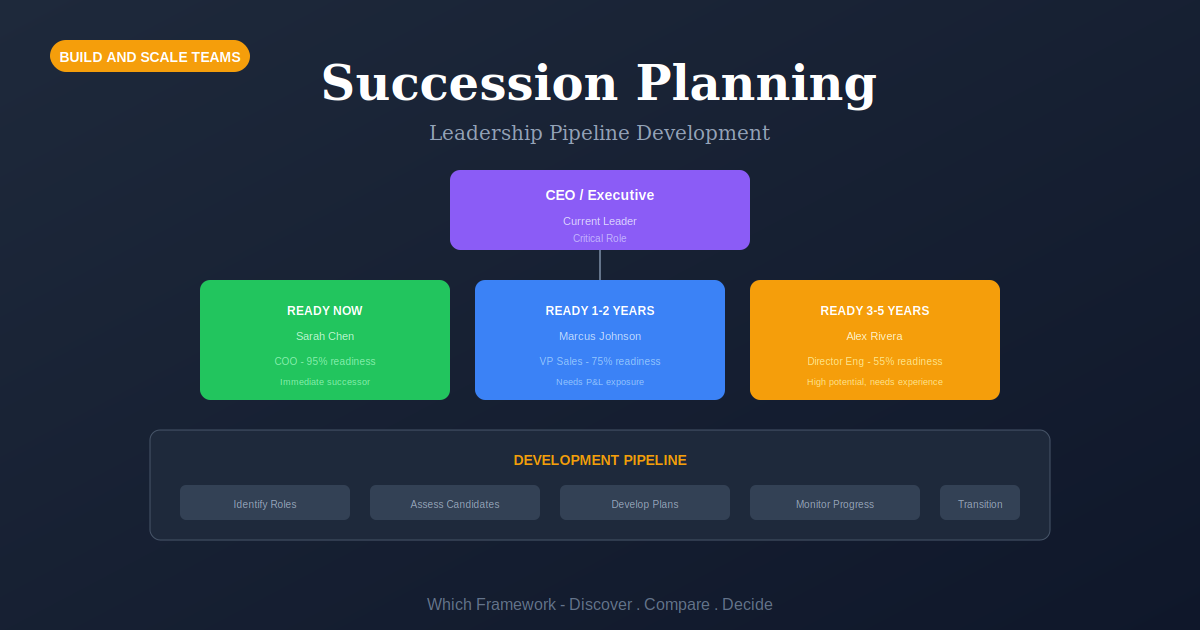
Most plans sort candidates into ready now, ready in a year or two, and ready in several. The bands are useful shorthand. The percentages sometimes attached to them are not measurements of anything, and quoting one to two decimal places lends a prediction a precision it does not have.
Treat a band as a statement about what development is owed, not about probability. Ready in two years means we know the three things this person has never done and here is when they will do them. If it does not mean that, it means nothing.
Disambiguation
Succession, replacement, and emergency cover
Three different exercises share the name, and most organizations believe they are doing the third when they are doing the first. The distinguishing question is what happens after the document is produced.
| Exercise | Horizon | What it produces |
|---|---|---|
| Emergency cover | Tomorrow morning | A named person who can sign, decide and hold the room if someone does not come in. No development implied |
| Replacement planning | This year | A chart mapping each critical post to one or two internal names. A risk artifact. Ages fast and is rarely refreshed |
| Succession Planning this page | Two to five years | A pool of people being deliberately developed toward roles they cannot yet do. Development is the output; the chart is a by-product |
The common substitution
A replacement chart is cheap and takes an afternoon, so it is what gets produced when a board asks whether there is a succession plan. It answers a fair question about risk, and it is worth having. It is simply not the same thing, and calling it one means the development never gets budgeted.
The tell is whether anybody's work changed as a result. If the document exists and no assignment, no reporting line and no budget moved because of it, you have a chart.
Core Features
- Roles first, people second: the unit is a critical position, not a promising individual
- Internal by design: the whole point is a bench you already employ
- Multi-year horizon: a cycle that repeats annually, not a project with an end
- Prediction at its center: assessment of a job nobody has yet done
- Development is the output: assignments and decisions, not a document
- Pools rather than slots: several candidates for several roles beats one heir per post
Worked example
A finance director in Santiago, and the candidate who left anyway
An illustrative composite. A Chilean industrial distributor of around 700 staff knew its finance director would retire in eighteen months. Two internal candidates: a controller of nine years, and a younger commercial finance manager.
| Stage | What happened |
|---|---|
| The first attempt | A chart naming the controller as successor and the commercial manager as backup. Two hours' work. Nobody's job changed and neither candidate was told. |
| What the chart missed | The role turned on two things neither candidate had done: negotiating the annual banking facility, and defending numbers to a board. The job description mentioned neither, because it described the outgoing director rather than the job. |
| The second attempt | Both candidates ran a real piece of the work. The controller led the facility renewal with the outgoing director present and silent. The commercial manager presented to the board twice. |
| What it cost to name someone | When the controller was confirmed, the commercial manager resigned within four months. Replacing the role externally cost roughly CLP 34 million in fees and five months of reduced output. |
| What the handover looked like | The incoming director had already renegotiated the facility once and sat in front of the board twice. The transition passed without an external hire and without a gap. |
The bench was the point, and the bench is what it cost
Naming a successor is not free, and the price is paid by whoever was not named. This is the ordinary result, not bad luck: a strong runner-up who learns they are second reads that as a ceiling, and the better they are the more options they have. Any calculation of what succession planning is worth has to net this off.
Note which step produced the result. Not the chart, which existed for months and changed nothing. What worked was handing two people a piece of the real job while somebody who could catch them was still there.
When to Use
- Several critical roles will turn over within a few years and no obvious internal candidate exists
- Leadership is concentrated in a small group approaching retirement at similar times
- The organization is growing faster than it can hire senior people externally
- A board or regulator expects a documented view of leadership continuity
- Specialist roles exist that take years to learn and are held by one person each
- Retention of strong people is the actual problem, and visible career paths are part of the answer
When NOT to Use
- As a response to a departure already announced, where the horizon is too short to develop anyone
- In organizations small enough that everybody already knows who would step in
- Where roles are being redesigned, since developing people toward a job that will not exist wastes both
- Without an executive who will actually release people into stretch work
- As a retention promise, because an unfulfilled implication of promotion is worse than saying nothing
- Where the honest answer is that the role should be filled externally for capabilities you do not have
In practice
How succession plans fail
Nearly every failure below comes from the same substitution: producing the artifact, which is easy, in place of doing the development, which is not.
| Failure mode | What it looks like | What to do instead |
|---|---|---|
| A chart with no development | Names against posts, reviewed annually, nobody's work different | Attach one named assignment per candidate with a date. If nothing is assigned, do not call it a plan. |
| Potential inferred from performance | The best controller assumed to be the next finance director | Assess against what the target role demands, which usually includes things the current job never tests. |
| The runner-up walks | A strong second candidate resigns within months of the announcement | Plan for it before naming anyone. Pools across several roles leave more than one person with somewhere to go. |
| Only the executive layer covered | Three vice presidents have successors; the one engineer who understands the settlement system does not | Rank roles by damage on loss, not by seniority. |
| Kept secret from the candidates | People are on a plan they have never been told about, so no development conversation happens | Talk about development explicitly without promising a post. The two are separable and should be separated. |
| Never refreshed | A plan naming people who left, for roles that have changed | Rerun it annually against the current org, and treat any senior departure as a trigger. |
Sourced
Evidence, and how to cite it
The practice was formalized at General Electric.
Walter Mahler built the executive continuity work at GE that became its Session C talent review, and set it out with William Wrightnour in 1973. Richard Vancil later named the pattern of grooming a designated successor relay succession. William Rothwell's 1994 handbook is the standard practitioner reference, and the leadership pipeline idea comes from Charan, Drotter and Noel in 2001.
Mahler, W.R. and Wrightnour, W.F. (1973) Executive Continuity. Homewood: Dow Jones-Irwin; Vancil, R. (1987) Passing the Baton. Boston: Harvard Business School Press.
Groomed succession outperforms the alternatives.
Zhang and Rajagopalan examined 204 CEO successions in US manufacturing firms and compared relay succession, where an heir apparent is designated and developed, with other inside appointments and outside hires. Relay successions produced better post-succession performance, and the advantage was largest where the firm had been performing poorly beforehand. Note the finding is about the process, not about insiders: whether insiders beat outsiders in general remains contested.
Zhang, Y. and Rajagopalan, N. (2004) ‘When the known devil is better than an unknown god’, Academy of Management Journal, 47(4), pp. 483–500.
Naming a successor costs you the runners-up.
Cannella and Shen studied what becomes of heirs apparent and found exit is a routine outcome rather than a rare one. The same 2004 study found boards were less likely to run a relay succession when they had more internal candidates — a deep bench makes naming one person more expensive, because it tells everyone else where they stand.
Cannella, A.A. and Shen, W. (2001) ‘So close and yet so far: promotion versus exit for CEO heirs apparent’, Academy of Management Journal, 44(2), pp. 252–270.
The assessment step has weak predictive validity.
The nine-box grid and its relatives rest on a potential rating, and potential is a prediction rather than an observation. A practitioner benchmark of large US companies put the accuracy of high-potential identification at around half, and found most firms were using current performance as their main predictor. There is no validated instrument behind the grid itself.
New Talent Management Network benchmark (2015), reported in Chief Learning Officer; Church, A.H. et al. (2015) Consulting Psychology Journal, 67(1).
How to cite it.
Harvard: Zhang, Y. and Rajagopalan, N. (2004) ‘When the known devil is better than an unknown god’, Academy of Management Journal, 47(4), pp. 483–500.
For the practice itself, cite Mahler and Wrightnour (1973) or Rothwell (1994). For the leadership pipeline, cite Charan, Drotter and Noel (2001). There is no single originator of succession planning as a whole.
Key Strengths
- Reduces the worst case: a critical departure becomes a handover rather than a crisis
- Forces the role question: naming what a job demands is useful even if nobody succeeds into it
- Develops people through real work: stretch assignments beat training budgets
- Evidence behind the groomed handover: designated and developed successors do outperform the alternatives
- Makes career paths visible: which is part of why people stay
Key Weaknesses
- Rests on a weak prediction: potential ratings are close to a coin toss
- Naming an heir loses the others: the cost lands on your second-best person
- Slow and expensive: years of senior attention before anything is returned
- Degrades into a chart: the artifact is easy and the development is not
- Reproduces the current leadership: raters tend to see potential in people like themselves
- Blind to roles being redesigned: it plans for the organization you have today
Sequencing
What to run before and after
The cycle assumes you already know what your roles demand, and it stops at the point where the handover actually happens.
Before
Establish what capability you actually have
Assessing a candidate against a role means comparing two things you have written down. Without a current picture of capability, step three collapses into an opinion about who is impressive.
During
Hand over real decisions, not courses
What closes the distance to a senior role is doing part of it while somebody who can catch you is still there. That needs authority attached at a stated level, or it is shadowing.
After
Run the transition as a transition
The appointment is the start of the difficult part. People who were peers are now reporting, the runner-up is deciding whether to stay, and the incoming leader is being read for signals.
Part of a playbook: How to Delegate as Your Team Grows. Succession planning is stage 6 of 6, after OKRs.
Common questions
Succession Planning: quick answers
What is succession planning?
A repeating cycle that identifies the roles an organization would most suffer to lose, works out what those roles actually demand, assesses who internally could get there, and then develops those people toward readiness. The output is development activity over several years, not a document naming replacements.
What is the difference between succession planning and replacement planning?
Replacement planning maps each critical post to one or two internal names so that the organization knows who would step in. It is a risk artifact, takes an afternoon, and implies no development. Succession planning develops a pool of people toward roles they cannot yet do, over two to five years. Most organizations that believe they are doing the second are doing the first.
Who should be included in a succession plan?
Roles first. Rank positions by how much damage their loss would do, not by seniority, which usually surfaces a specialist several levels down whose knowledge nobody else holds. Then identify candidates for each. Pools covering several roles work better than one designated heir per post.
Should you tell people they are in the succession plan?
Talk about development explicitly, and avoid promising a post. The two are separable. Keeping the whole thing secret means no development conversation happens and the plan does nothing; promising a role you may not be able to give creates a worse problem when someone else gets it.
What is the nine-box grid, and does it work?
A three-by-three grid plotting current performance against assessed potential, used to sort people in a talent review. The performance axis is observable. The potential axis is a prediction, usually made from manager opinion, and it carries no validated instrument behind it. A benchmark of large companies put the accuracy of high-potential identification at around half. Useful for structuring a conversation, unreliable as a measurement.
Does succession planning actually improve performance?
The strongest evidence is for relay succession specifically. Across 204 CEO successions, firms that designated and developed an heir apparent outperformed those making other inside appointments or hiring outside, and the advantage was largest where the firm had been performing poorly. Note this is evidence for the grooming process, not for insiders being better than outsiders generally, which remains contested.
What is relay succession?
A handover in which a successor is named in advance, given a period working alongside the incumbent, and then takes over. The term comes from Richard Vancil. It is the version of succession with the best evidence behind it, and also the version that carries the highest cost in departures among the candidates who were not chosen.
How long does succession planning take?
Two to five years to develop a candidate into a senior role, with the cycle itself rerun annually. Anything shorter is replacement planning or emergency cover. If a departure has already been announced and the horizon is months, there is no time to develop anyone and the honest options are an interim appointment or an external hire.
Deep Resources
Frameworks related to Succession Planning
- Skills Matrix / Competency MappingThe current capability picture this process assumes you already have…
- Delegation MatrixAuthority attached to real decisions, which is what actually develops a successor…
- Bridges' Transition ModelThe psychological side of the handover, which begins where the plan stops…