Psychological Safety Framework: Edmondson’s Model and How to Measure It
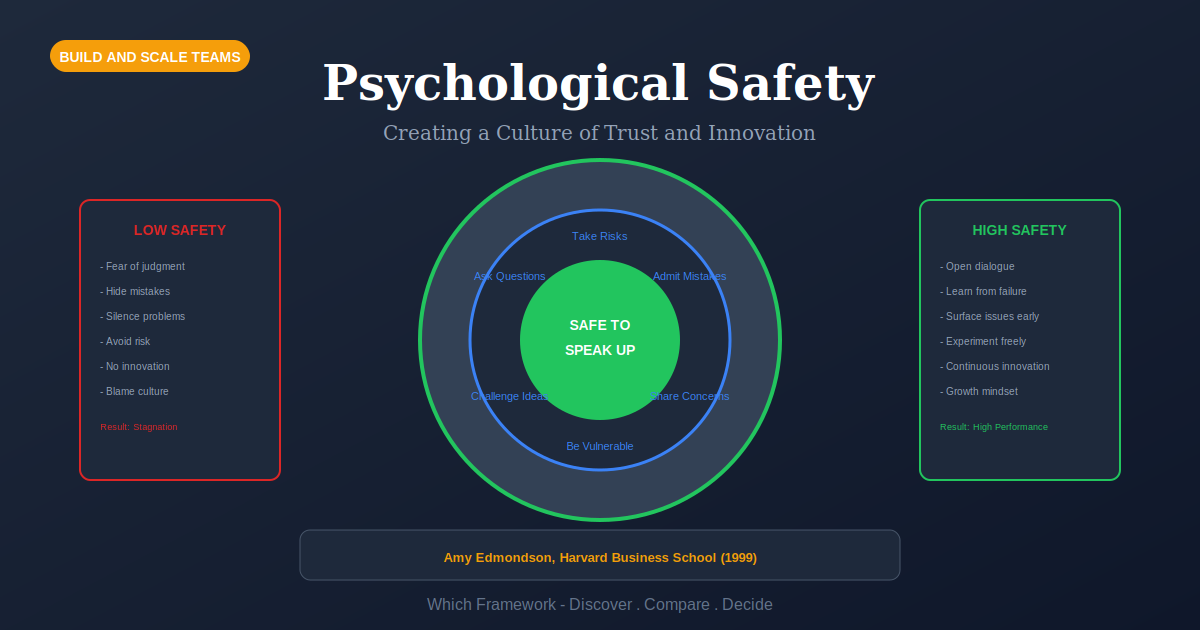
Psychological Safety is a shared belief that the team is safe for interpersonal risk-taking—speaking up, asking questions, admitting mistakes, and challenging ideas without fear of punishment or humiliation.
Before you start
Is psychological safety your framework?
Psychological safety is a diagnosis, not an intervention. It describes a condition — whether people on a team believe they can take an interpersonal risk without being punished for it — and it can be measured. What it does not do is tell you how to run a meeting, structure a team, or manage a change program.
That distinction decides whether this page is useful to you. If people are visibly holding back and you want to know whether that is real and how bad it is, this is the right instrument. If you already know the answer and want a method, you want something else.
| If your real problem is… | You probably want |
|---|---|
| The team is new and storming, and we are reading that as a safety problem | Tuckman’s Stages — conflict in a forming team is developmental, not a safety failure Compare the two |
| Nobody has agreed how this team works together | Team Charter — explicit norms are a cause of safety, not a substitute for measuring it Compare the two |
| People are struggling with a change that has already happened | Bridges’ Transition Model or ADKAR — that is transition, not safety Compare the two |
| Decisions stall because nobody knows who decides | RACI — silence caused by unclear authority looks identical to silence caused by fear |
| People will not take on work without checking first | Delegation Matrix — the issue is stated authority, not felt safety |
| We know safety is low and need a change program | Kotter’s 8-Step — this framework diagnoses; it does not deliver Compare change frameworks |
| We need to know whether people are holding back, and how much | Psychological Safety — you are in the right place |
The test that separates a real reading from a comfortable one
Ask what the last three mistakes were, and who reported them. On a psychologically safe team the answer is specific, recent and volunteered by the person who made the error. On an unsafe team you get a pause, then a generic answer, then a mistake that was discovered rather than reported. Edmondson’s original finding turned on exactly this: her better-performing teams recorded more errors, not fewer.
What Is It?
Psychological safety is the shared belief that a team is safe for interpersonal risk-taking — that speaking up, asking a question, admitting an error or challenging a decision will not be met with punishment or humiliation. Amy Edmondson defined and measured it at team level in a 1999 study, and it is her operational definition that nearly all subsequent work builds on.
Two things about it are consistently misunderstood. The first is that it is a property of a team, not of an individual or an organization. Two teams inside the same company, under the same policies, routinely score very differently, because the immediate manager and the local norms do most of the work.
The second is that it is not the same as comfort, trust, or being nice. Edmondson pairs it with accountability precisely because high safety on its own produces pleasant teams that do not achieve much. Safety lowers the cost of speaking; it does not supply anything worth saying.
It is also measurable, which distinguishes it from most culture concepts. The 1999 paper included a seven-item survey that is still the standard instrument, and it can be run in a few minutes per team.
Quick Reference
The canonical structure
Which psychological safety framework do you mean?
Three distinct things get called “the psychological safety framework,” and they have different authors, different purposes and different evidential status. Most confusion about the topic comes from mixing them.
| What it is | Who, and when | What it gives you |
|---|---|---|
| The construct and its measure — a single team-level belief, captured by a seven-item survey | Amy C. Edmondson, 1999, Administrative Science Quarterly | A number you can compare across teams and track over time. This is the academic core, and the only part with peer-reviewed measurement behind it. |
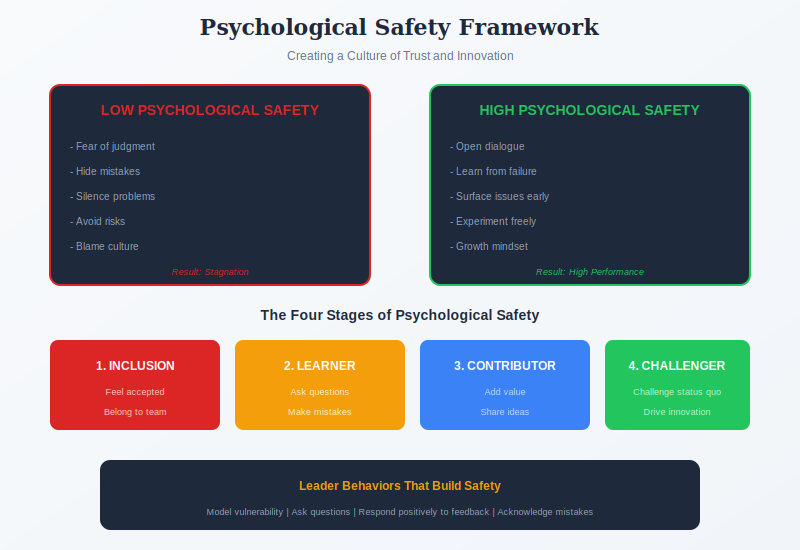
| The four stages — Inclusion Safety, Learner Safety, Contributor Safety, Challenger Safety | Timothy R. Clark, 2020 — not Edmondson | A developmental ladder for leaders, widely taught and widely misattributed. Useful as a sequence of leader behaviors; it is not what Edmondson measured. |
| Project Aristotle — the finding that safety was the strongest of five team dynamics | Google, published via re:Work, 2015–16 | The reason executives take the topic seriously. Internal, correlational and not peer-reviewed — persuasive, but not the evidence base. |
On the four stages
If you have seen psychological safety presented as four stages, you have seen Timothy Clark’s 2020 model, not Amy Edmondson’s. The misattribution is extremely common, including in corporate training material and in the earlier version of this page.
It matters practically, not just pedantically. Clark’s stages are a prescriptive ladder for leaders to climb. Edmondson’s construct is a single measurable state with a validated instrument. If you cite Edmondson and then run a four-stages workshop, you are claiming research support that the workshop does not have.
The part most often dropped
Safety without accountability
Edmondson does not treat psychological safety as a good in itself. In The Fearless Organization she sets it against performance standards on a second axis, and the resulting four zones are the clearest correction to the “safety means being nice” reading.
| Low accountability | High accountability | |
|---|---|---|
| High safety | Comfort zone. Pleasant, collegial, and not going anywhere. People speak freely because nothing much depends on what they say. | Learning zone. The target. High standards, and the candour to meet them. |
| Low safety | Apathy zone. People are present and disengaged. Neither the standards nor the conversation is real. | Anxiety zone. High demands, no candour. This is where errors get concealed rather than reported, and it is the most dangerous of the four. |
Which zone the effort usually lands in
Organizations that set out to raise psychological safety and do nothing about standards move from the anxiety zone to the comfort zone, not the learning zone. Everyone reports the intervention went well, and nothing improves.
The corollary is more useful still: if standards are already high and results are poor, the anxiety zone is the most likely diagnosis, and raising safety is the highest-leverage move available. If standards are vague, fix those first — safety will not compensate for them.
Core Features
- A team-level property: measured per team, not per person and not per company
- Measurable: Edmondson’s seven-item survey is the standard instrument and takes minutes to run
- About interpersonal risk, not comfort: the question is what happens when you speak, not how pleasant the room is
- Paired with accountability: the useful quadrant is high safety and high standards
- Driven mostly by the immediate manager: which is why scores vary so widely inside one organization
- Asymmetric to build and destroy: months to raise, one public humiliation to undo
- Visible in error reporting: safer teams surface more problems, not fewer
Worked example
Two teams, one company, opposite readings
An illustrative composite. A medical device manufacturer in Minneapolis ran Edmondson’s seven-item survey across engineering. Two teams reporting to the same director came back at opposite ends, which is the normal result and the reason team-level measurement matters.
Same company, same policies, same director. The difference is what happens in the room.
| Signal | Team A — firmware | Team B — test engineering |
|---|---|---|
| Seven-item survey mean (1–7) | 5.8 | 3.1 |
| Defects logged per release | 44 | 9 |
| Defects found by the customer after release | 2 | 17 |
| How the director read it before the survey | “Team A is sloppy — look at the defect count.” | “Team B is our clean team.” |
| Who raised the last three problems | Two engineers and a contractor, unprompted, in stand-up | All three surfaced in a post-release review, none before |
| Accountability for standards | High — learning zone | High — anxiety zone |
What the survey actually did
It inverted the director’s reading of both teams. Team B was not producing fewer defects; it was reporting fewer and shipping them instead, at eight times Team A’s escape rate. The internal defect count had been read as a quality metric when it was functioning as a safety metric.
Note that both teams had high accountability. The intervention for Team B was therefore not “raise standards” and not “be nicer” — it was to change what happened in the ten seconds after somebody reported a problem. That is a narrower and far more actionable conclusion than a culture program.
When to Use
- When quality or safety incidents are being discovered late rather than reported early
- When one team consistently underperforms another and no structural cause explains it
- Before a change program, to establish whether people will tell you the truth about it
- After a public failure, layoff or leadership change, when candour is most at risk
- In regulated, clinical or safety-critical work, where concealed errors carry real cost
- As a baseline you can re-run — the trend across quarters matters more than the absolute number
- In leadership development, where it gives managers a measurable target rather than an attitude
When NOT to Use
- As a substitute for performance standards — safety without accountability produces the comfort zone
- As an explanation for underperformance that has a structural cause: unclear ownership (RACI) or missing skills (Skills Matrix)
- Measured at company level, where team-to-team variation averages away the signal
- Anonymously surveyed with no intention of acting — asking and ignoring lowers safety further
- As the deliverable of a change program — it diagnoses; use Kotter’s 8-Step or ADKAR to deliver
- In a forming team, where friction is developmental — see Tuckman’s Stages
In practice
How psychological safety work goes wrong
The concept is easy to endorse and hard to act on, which produces a characteristic set of failures — most of them versions of treating a measurable condition as a mood.
| What you see | What it usually means | What to do |
|---|---|---|
| It is being treated as niceness | The accountability axis was dropped | Put standards back in the conversation explicitly. The target is the learning zone, not the comfort zone, and the difference is whether anything is expected of anyone. |
| Measured once at company level | The unit of analysis is wrong | Measure per team. Two teams under one director routinely differ by two points on a seven-point scale, and the company average conceals exactly the teams you need to find. |
| Low defect or incident counts read as good news | Reporting rate is being read as occurrence rate | Compare internally-found against externally-found problems. A team finding few and shipping many is the anxiety-zone signature. |
| Survey run, results filed, nothing changes | Asking without acting | This actively lowers safety, because it demonstrates that speaking up has no consequence. Do not run the survey unless something will visibly follow it. |
| A workshop on the four stages, cited to Edmondson | Two different bodies of work have been merged | Cite Clark for the stages and Edmondson for the construct and the measure. Decide which one the session is actually about. |
| Leaders ask for candour and then argue with it | The stated invitation is contradicted by the response | What happens in the ten seconds after someone speaks sets the norm. The invitation is worth nothing next to the reaction. |
| Score improves, behavior does not | People have learned what the survey wants | Pair the survey with a behavioral measure — who raised the last three problems, and when. Self-report alone drifts once the instrument becomes familiar. |
Sourced
Origins, and how to cite it
The term predates Edmondson by three decades.
Edgar Schein and Warren Bennis used “psychological safety” in 1965, in the context of organizational change and group methods, arguing that people need to feel secure before they will change behavior. Edmondson’s contribution was not the phrase but the operationalization — defining it at team level and building an instrument that measures it.
Schein, E.H. & Bennis, W.G. (1965) Personal and Organizational Change Through Group Methods. New York: Wiley.
The founding finding looked, at first, like the opposite of the result.
Edmondson set out to test whether better hospital teams made fewer errors. The data showed the better teams recording more — which turned out to reflect willingness to report rather than rate of occurrence. That reversal is the whole idea in miniature, and it is why an unusually clean incident log deserves suspicion rather than congratulation.
Edmondson, A.C. (1999) ‘Psychological Safety and Learning Behavior in Work Teams’, Administrative Science Quarterly, 44(2), pp. 350–383.
The four stages are Clark’s, and Project Aristotle is not peer-reviewed.
Two of the most-cited elements of the popular account are not part of the academic core. The four-stage ladder is Timothy R. Clark’s 2020 model, routinely attributed to Edmondson. Google’s Project Aristotle was internal, correlational and published through a company website rather than a journal — genuinely useful for persuading executives, and not the evidence base it is usually presented as. The peer-reviewed core is Edmondson’s own line of work and the studies that followed it.
Clark, T.R. (2020) The 4 Stages of Psychological Safety. Oakland: Berrett-Koehler.
Safety works through learning behavior, not directly on performance.
Edmondson’s model is mediated: psychological safety enables learning behavior — asking questions, seeking feedback, discussing errors — and it is the learning behavior that improves performance. This is why raising safety on a team with no standards and nothing to learn produces no result, and why the effect is strongest in interdependent, uncertain work rather than in routine independent tasks.
How to cite it.
Harvard: Edmondson, A.C. (1999) ‘Psychological Safety and Learning Behavior in Work Teams’, Administrative Science Quarterly, 44(2), pp. 350–383.
APA: Edmondson, A. (1999). Psychological safety and learning behavior in work teams. Administrative Science Quarterly, 44(2), 350–383.
For the practitioner treatment including the safety-accountability matrix, cite Edmondson, A.C. (2018) The Fearless Organization. Hoboken, NJ: John Wiley & Sons. For the four stages, cite Clark, not Edmondson.
Key Strengths
- Measurable: a validated seven-item instrument, which is rare for a culture concept
- Diagnostic precision: locates the problem at a specific team rather than in “the culture”
- Strong evidence base: peer-reviewed and replicated across healthcare, manufacturing and software
- Actionable at the right level: the lever is a manager’s behavior, not a company program
- Explains counterintuitive data: gives you a reason to distrust an unusually clean incident log
Key Weaknesses
- Self-reported, so scores drift once teams learn what the survey rewards
- Easily misread as comfort, which produces pleasant teams that achieve nothing
- Slow to build and fast to destroy — the asymmetry makes progress fragile
- Popular account is entangled with a different author’s model and a non-peer-reviewed study
- Diagnoses without prescribing: it tells you the state, not the remedy
- Weak effect in routine independent work, where there is little to learn and little interdependence
How It Works
| 1 Primary Input | Team survey data, behavioral observations, incident patterns |
|---|---|
| 2 Data You Need | Edmondson's 7-item survey, meeting dynamics, error reporting |
| 3 Primary Output | Safety assessment, leader behaviors, team agreements |
Comparison with Related Frameworks
Psychological Safety vs Tuckman’s Stages
Tuckman’s Stages describes how a team changes over time; psychological safety describes a condition at a point in time. They are frequently confused because a storming team looks unsafe. It usually is not — friction during forming and storming is developmental and resolves. Persistent silence in a performing team is the genuine warning sign, and Tuckman has nothing to say about it.
Psychological Safety vs Team Charter
A Team Charter states the norms a team intends to hold; psychological safety measures whether people actually behave as though those norms are real. A charter is an input, the survey is an outcome, and the gap between them is the interesting number. Writing a charter that says “we welcome challenge” changes nothing on its own.
Psychological Safety vs RACI
Both are diagnosed from the same symptom — people not speaking or not acting — and the remedies are opposite. RACI fixes silence caused by not knowing who decides. Psychological safety addresses silence caused by knowing exactly who decides and being unwilling to contradict them. Running a culture program against a structural ownership problem wastes a quarter, and so does the reverse.
Sequencing
What to run before and after
Psychological safety is a measurement. It needs something before it to rule out structural causes, and something after it to act on what it found — on its own it produces a number and a feeling of having addressed the problem.
Before
Rule out the structural explanations
Silence has cheaper causes than fear. Unclear decision rights and missing skills produce the same symptom and are far quicker to fix.
During
Measure per team, and pair it with a behavioral check
Run the seven-item survey at team level, then ask who raised the last three problems and when. The self-report and the behavior should agree; when they do not, trust the behavior.
After
Change something visible, then re-measure
Asking and not acting lowers safety. Pick one observable change in how reports are received, and re-run the survey a quarter later so the trend rather than the number does the work.
Part of a playbook: How to Delegate as Your Team Grows. Psychological safety is stage 4 of 6, after RACI and before OKRs.
Common questions
Psychological safety: quick answers
What is the psychological safety framework?
Psychological safety is the shared belief that a team is safe for interpersonal risk-taking: that speaking up, asking a question, admitting a mistake or challenging a decision will not lead to punishment or humiliation. Amy Edmondson defined and measured it at team level in a 1999 study in Administrative Science Quarterly, and that operational definition, together with her seven-item survey, is what most later work builds on. It is a property of a team rather than of a person or a company.
What are the four stages of psychological safety?
Inclusion Safety, Learner Safety, Contributor Safety and Challenger Safety. These come from Timothy R. Clark’s 2020 book The 4 Stages of Psychological Safety, not from Amy Edmondson, and the misattribution is very common. Clark’s stages are a developmental ladder of leader behaviors. Edmondson’s construct is a single measurable team-level belief with a validated survey behind it. If you are citing research support, cite Edmondson for the construct and Clark for the stages.
Who created the psychological safety framework, and how do I cite it?
Edgar Schein and Warren Bennis used the term in 1965, but Amy C. Edmondson defined it at team level and built the instrument that measures it. Harvard style: Edmondson, A.C. (1999) ‘Psychological Safety and Learning Behavior in Work Teams’, Administrative Science Quarterly, 44(2), pp. 350-383. APA style: Edmondson, A. (1999). Psychological safety and learning behavior in work teams. Administrative Science Quarterly, 44(2), 350-383. For the practitioner treatment including the safety and accountability matrix, cite The Fearless Organization (2018).
How do you measure psychological safety?
With Edmondson’s seven-item survey from the 1999 paper, administered per team rather than per company. It takes a few minutes and produces a mean score you can compare across teams and track over quarters. Measure it alongside a behavioral check, because self-report drifts once people learn what the instrument rewards: ask what the last three problems were, who raised them, and whether they surfaced before or after they caused damage.
Is psychological safety the same as being nice?
No, and this is the most consequential misreading. Edmondson sets psychological safety against accountability for performance standards on a second axis. High safety with low accountability produces the comfort zone: a pleasant team that achieves little. The target is the learning zone, high on both. Organizations that raise safety without touching standards generally move from anxiety to comfort, report that the intervention went well, and see no change in results.
Why did Google’s Project Aristotle matter?
Google’s internal study of team effectiveness found psychological safety to be the strongest of five team dynamics, and publishing that through re:Work in 2015 and 2016 is largely why executives take the topic seriously. It is worth being precise about its status: the study was internal, correlational and not peer-reviewed. It is persuasive evidence that the idea has practical purchase, not the academic foundation. That foundation is Edmondson’s own line of research.
Does psychological safety mean fewer mistakes?
No: safer teams typically report more. Edmondson’s original study set out to test whether better hospital teams made fewer errors and found that the better-performing ones recorded more, because they were willing to report them. Occurrence rate and reporting rate are different things. A team with an unusually clean internal defect or incident log, and problems being found by customers instead, shows the signature of low safety rather than high quality.
How long does it take to build psychological safety?
Months to raise and moments to undo, which is the asymmetry that makes it difficult. The lever is mostly the immediate manager: what happens in the ten seconds after someone reports a problem sets the norm far more than any stated invitation to speak up. That is also why two teams in the same company under the same director routinely score two points apart on a seven-point scale, and why measuring at company level hides exactly the teams you need to find.
Deep Resources
Frameworks related to Psychological Safety Framework
- Tuckman's Stages of Group DevelopmentFramework describing 4 stages of team development: Forming, Storming, Norming, and Performing.…
- Team Charter / NormingFramework for establishing team agreements, norms, and working conventions. Creates clarity on…
- Bridges' Transition ModelPeople-centered framework managing emotional and psychological aspects of organizational…