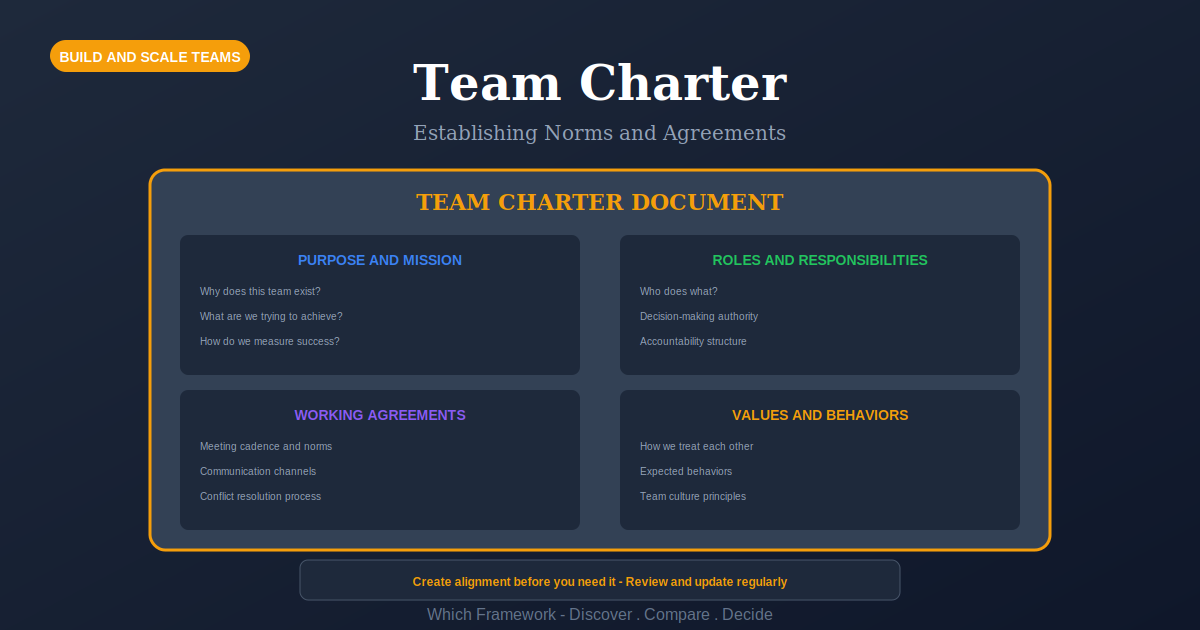
Team Charter: What Goes In One, and How It Differs From Working Agreements
Team Charter is a short document written by a team about itself, setting out four things — its purpose, its roles, its decision rights and its expected conduct — before the work begins.
Before you start
Is this your framework?
A charter answers one question: how will this particular group work together. Purpose, roles, decision rights and conduct, settled in advance and written down where anyone can check them.
It authorizes nothing and it funds nothing. It carries no budget, no mandate and no escalation path, so a group with no agreed purpose will produce a charter full of pleasant sentences and change nothing. If your problem is upstream of how we work together, the table below says where to go.
| If your real problem is… | You probably want |
|---|---|
| The project itself has not been approved or funded | A project charter, which is a governance document signed by a sponsor — a different artifact, compared in the table below |
| Two people both think they own the same decision | RACI Matrix — responsibility resolved decision by decision, at a granularity a charter does not reach Compare Team Charter and RACI |
| People will not raise problems in front of each other | Psychological Safety — a written agreement to speak up does not make it safe to speak up Compare Team Charter and Psychological Safety |
| The team is arguing and nobody knows whether that is normal | Tuckman’s Stages — the pattern a new group tends to follow, which a charter shortens but does not remove |
| We do not agree on what success looks like | OKR — measurable objectives, which a charter's purpose section gestures at and never quantifies |
| How much authority does each person actually have | Delegation Matrix — levels of authority per decision, rather than a general statement of trust |
| A new or merged group needs to settle how it operates | Team Charter — you are in the right place |
What Is It?
A charter is a short document a team writes about itself, before the work gets going. It states why the group exists, who does what, how decisions get made, and what the members have agreed to expect from each other.
The interesting property is who it is for. It is written by the team, for the team, and it has no external audience. Nothing in it is approved by anyone. That is also why it can fail so quietly: a document with no reader outside the room is easy to file and never open again.
What it does, when it does anything, is convert assumptions into commitments. Everyone joins a team with a private model of how it will run, and those models differ in ways nobody discovers until the models collide. A charter forces the collision into a room where it costs an afternoon instead of a quarter.
Quick Reference
The document
What goes in it, and what makes it bite
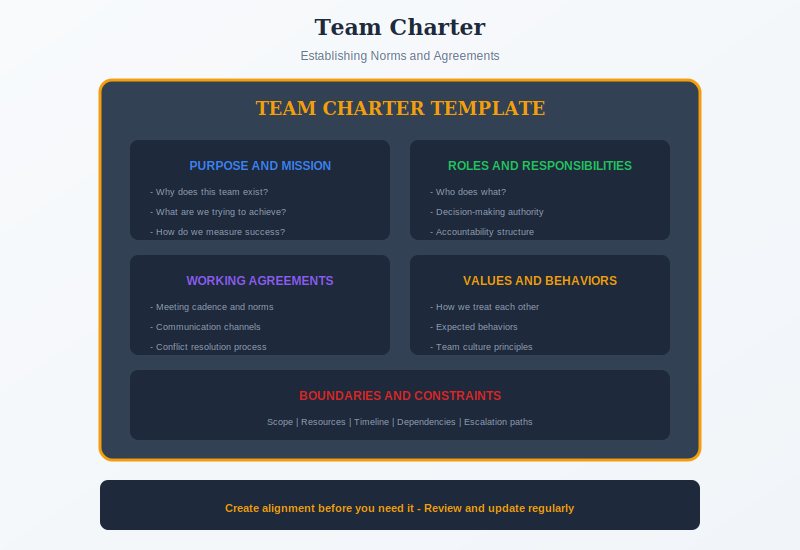
Four blocks appear in almost every version. The blocks are not the difficult part. What decides whether the document does anything is whether each answer is specific enough that somebody could be found to have broken it.
| Block | Dead version | Live version |
|---|---|---|
| Purpose why this group exists | We deliver excellence for our customers | We own onboarding from signature to first successful login. Anything after first login is not ours. |
| Roles who does what | A list of job titles copied from the org chart | Named person against each recurring decision and each thing that breaks at 2am |
| Decision rights how calls get made | We decide together, by consensus | Reversible calls: whoever is closest, no meeting. Irreversible calls: named person, after written input. Deadlock breaks to the lead within two days. |
| Conduct what we expect of each other | We respect each other and communicate openly | Disagreement goes in the thread, not in a private message. No decision is taken in a channel half the team cannot read. |
The test for every line
Ask of each entry: could somebody violate this, and would we notice? We respect each other fails both halves. No decision in a channel half the team cannot read passes both, which is why it is worth the ink.
The corollary is that a short charter beats a thorough one. Four specific commitments get used; twenty general ones become a document nobody can hold in their head, and an agreement nobody remembers is not an agreement.
Disambiguation
Charter, working agreements, or RACI
Three artifacts overlap here and teams routinely build one while believing they have built another. The reliable way to tell them apart is to ask who the audience is.
| Artifact | What it settles | Who reads it |
|---|---|---|
| Team Charter this page | Purpose, roles, decision rights and conduct for one group | The team itself. Nobody approves it |
| Project charter PMBOK sense | That the project exists, what it is for, and that the manager may spend resources on it | The sponsor and senior leadership. It authorizes; a team charter does not |
| Working agreements agile practice | Day-to-day operating conventions: standup time, definition of done, pull-request etiquette | The team. Narrower than a charter and revised far more often |
| RACI responsibility matrix | Who is responsible, accountable, consulted and informed, per activity | The team and anyone who needs to know whom to chase |
Where teams get caught
The common error is writing a project charter, getting it signed, and assuming the team question is now handled. It is not. One authorizes the work; the other settles how the people will do it, and a signed project charter says nothing about who breaks a deadlock.
Working agreements are the part of a charter that changes. A sensible split is to keep purpose, roles and decision rights in a charter revisited a few times a year, and let the operating conventions live somewhere the team edits freely.
Core Features
- Written by the team, not for a sponsor: no external approval, no external audience
- Four standard blocks: purpose, roles, decision rights, conduct
- Written before the work: the point is settling questions while they are still cheap
- No authority of its own: it commits nothing and funds nothing
- Specific enough to break: the only property that separates a useful charter from a poster
- Revisited, not archived: a date to review it is part of the document
Worked example
A cross-functional launch team in Singapore, and the clause that saved it
An illustrative composite. A payments company assembled nine people from engineering, risk, marketing and support for a four-month product launch. None had worked together. A half-day chartering session was held in week one, largely because the program lead had been burned by a previous launch.
| What the charter said | What happened |
|---|---|
| Scope boundary | The charter stated the team owned the launch up to first transaction and not merchant onboarding. Three separate requests to absorb onboarding work were declined in weeks five, seven and nine, each in under ten minutes. |
| Deadlock clause | Reversible decisions were left to whoever was closest. For irreversible ones a named person decided after written input, within two days. It was used twice, both times on risk-versus-launch-date questions that had sunk the previous launch for six weeks. |
| Disagreement in the open | Objections went in the shared thread. Compliance later said this was the reason a control gap was caught in week six rather than in the pre-launch audit. |
| What the charter did not cover | Nothing was written about handover at the end. The team adjourned with no owner for the runbook, and support absorbed roughly SGD 60,000 of unplanned effort in the first quarter after launch. |
One clause did most of the work
The value was concentrated almost entirely in the deadlock rule. Purpose and conduct sections read well and were rarely consulted. The two-day escalation was invoked twice and both times converted a standoff into a decision inside a week.
The gap is as instructive. Chartering sessions are held at the start, when nobody is thinking about the end, so handover is the block that goes missing most often. It cost more here than every conduct clause saved.
When to Use
- A new team is forming, especially across functions that do not usually work together
- Two groups have been merged and each arrives with its own conventions
- A team is distributed across time zones, where implicit norms never form
- The same argument keeps recurring and nobody can point to what was agreed
- A short-lived team with a hard deadline, where there is no time to settle things slowly
- Onboarding is frequent, and each new joiner re-derives how things work
When NOT to Use
- Without the whole team present, since a charter written by a manager is a memo
- As a substitute for deciding what the team is actually for
- Where the real problem is authority, which a peer agreement cannot grant
- For a group that meets twice, where the overhead exceeds the benefit
- To fix a specific conflict already underway, which needs mediation rather than a document
- As a compliance artifact produced because a template requires one
In practice
How charters die
A charter fails quietly. Nothing announces that it has stopped mattering, which is why the failure modes below are worth knowing in advance.
| Failure mode | What it looks like | What to do instead |
|---|---|---|
| Unbreakable clauses | Respect, transparency, open communication — sentences nobody could be found to have violated | Apply the test: could somebody break this, and would we notice? Delete anything that fails. |
| Written once, never opened | A document from the kickoff that nobody has referenced in four months | Put a review date in the charter itself, and reference it the first time a disagreement fits one of its clauses. |
| Written by one person | The lead drafts it and circulates for comment; two people reply with looks good | Run the session with everyone in the room. The argument during drafting is most of the value. |
| Consensus written into it | We decide together, which means nothing is decided when two people disagree | Write the deadlock rule. Name who breaks a tie and by when. |
| Silent on the ending | No handover, no owner for what the team leaves behind | Add one block on what happens when the team disbands, written while people still care. |
| Not updated after membership changes | Half the signatories have left; the document still names them | Treat any joiner or leaver as a trigger to reread it together, which takes ten minutes. |
Sourced
Evidence, and how to cite it
There is no single originator, and the practice has two parents.
Chartering arrived at the team level from two directions. Project management contributed the charter itself: a document formally authorizing work, defined in PMI's body of knowledge and aimed at a sponsor. Team effectiveness research contributed the content, particularly the argument that a group needs an agreed direction and an enabling structure before it can work. No individual is credited with combining them.
Project Management Institute, A Guide to the Project Management Body of Knowledge; Hackman, J.R. (2002) Leading Teams. Boston: Harvard Business School Press.
Charter quality only pays off alongside task planning.
Mathieu and Rapp tracked thirty-two teams through a business strategy simulation and rated both their charters and their performance strategies. The finding was an interaction: sustained high performance came from teams that were strong on both. The charter alone did not carry it.
Mathieu, J.E. and Rapp, T.L. (2009) ‘Laying the foundation for successful team performance trajectories’, Journal of Applied Psychology, 94(1), pp. 90–103.
Charter quality on its own showed no significant effect.
The same study is often cited as proof that charters work, and it does not say that. Independent of goal setting, charter quality had no significant influence on performance over time. Anyone claiming a charter alone lifts results is citing a paper that reports the opposite.
Mathieu and Rapp (2009); characterization of the null main effect as summarized in Courtright et al. (2017).
Charters matter most where a team would not self-regulate.
Courtright and colleagues studied 239 self-managing student project teams from a control theory position. Charter quality improved performance for teams low in conscientiousness, and made little difference to teams already high on it. The document substitutes for what a diligent group would have done unprompted, which is a useful thing to know before spending a day on one.
Courtright, S.H., McCormick, B.W., Mistry, S. and Wang, J. (2017) ‘Quality charters or quality members?’, Journal of Applied Psychology, 102(10), pp. 1462–1470.
How to cite it.
Harvard: Mathieu, J.E. and Rapp, T.L. (2009) ‘Laying the foundation for successful team performance trajectories: the roles of team charters and performance strategies’, Journal of Applied Psychology, 94(1), pp. 90–103.
APA: Mathieu, J. E., & Rapp, T. L. (2009). Laying the foundation for successful team performance trajectories. Journal of Applied Psychology, 94(1), 90–103.
There is no origin citation for the practice itself. Cite the project charter to PMI and the team-level content to Hackman (2002).
Key Strengths
- Cheap: half a day, no tooling, no training, no facilitator required
- Surfaces disagreement early: the argument happens while it still costs an afternoon
- Gives new joiners a document: conventions that would otherwise take months to absorb
- Something to point at: a recurring dispute has a written prior answer
- Written by the people bound by it: which is most of why it gets honored
Key Weaknesses
- No authority: it grants nothing and cannot overrule anyone outside the room
- Dies silently: nothing signals that it has stopped being used
- Tends toward the unfalsifiable: left alone, it fills with sentences nobody can break
- Weak effect on its own: the evidence shows it paying off alongside task planning, not instead of it
- Least useful where teams are already disciplined: the gain is largest for groups that would not self-organize
Sequencing
What to run before and after
A charter settles how a group will work. It cannot settle what the group is for, and it cannot make the agreements safe to invoke.
Before
Fix what the team is actually for
A purpose block written by a team with no agreed objective produces a sentence about excellence. The objective has to arrive from outside the chartering session.
During
Get responsibility down to the decision
A roles block names people against areas. Recurring disputes are usually about a specific decision, which needs a finer grain than a charter naturally reaches.
After
Make the conduct clauses usable
An agreement to disagree in the open is worth nothing if people expect a cost for using it. What decides whether a charter is invoked is whether invoking it is safe.
Common questions
Team Charter: quick answers
What is a team charter?
A short document a team writes about itself before starting work, setting out why the group exists, who does what, how decisions are made, and what members expect of each other. It is written by the team for the team, and unlike a project charter it authorizes nothing.
What is the difference between a team charter and working agreements?
Scope and lifespan. A charter covers purpose, roles, decision rights and conduct, and is revisited a few times a year. Working agreements are narrower operating conventions such as standup time, the definition of done, or review etiquette, and a team edits them freely as it learns. Working agreements are usually a section of a charter that has outgrown it.
What is the difference between a team charter and a project charter?
The audience and the authority. A project charter is a governance document read by a sponsor and senior leadership; it authorizes the project and lets the manager commit resources. A team charter has no external reader and authorizes nothing. Signing a project charter does not settle who breaks a deadlock, which is the question a team charter exists to answer.
What should a team charter include?
Four blocks cover almost every version: purpose, meaning what this group owns and what it does not; roles, naming people against recurring decisions rather than listing job titles; decision rights, including what happens in a deadlock and by when; and conduct, meaning specific expectations rather than values. A handover block, covering what happens when the team disbands, is the one most often missing.
How long should a team charter be?
One page is plenty, and shorter is usually better. Four specific commitments get remembered and used. Twenty general ones produce a document nobody can hold in their head, and an agreement nobody remembers is not functioning as an agreement.
Do team charters actually improve performance?
The evidence is more qualified than the practice suggests. In the main study, charter quality on its own had no significant effect on performance; the gain came from teams that had both a good charter and a good task plan. Later work found charters help most for teams that would not otherwise self-regulate, and make little difference to already disciplined ones.
Who should write the team charter?
The whole team, in one session, together. A charter drafted by the lead and circulated for comment is a memo. Most of the value is in the argument that happens while writing it, which is precisely what circulating a draft avoids.
How often should a team charter be reviewed?
Put a date in the document, and treat any joiner or leaver as a trigger. Rereading it takes ten minutes. The common failure is not a bad charter but a charter written at kickoff and never opened again, by which point half the people it names have moved on.
Deep Resources
Frameworks related to the Team Charter
- RACI MatrixResponsibility per decision, at a grain a charter's roles block does not reach…
- Psychological Safety FrameworkWhat decides whether anyone actually invokes the conduct clauses they signed…
- Tuckman's Stages of Group DevelopmentThe pattern a new group follows anyway, which a charter shortens rather than removes…