Tuckman's Stages: What to Do at Forming, Storming, Norming and Performing
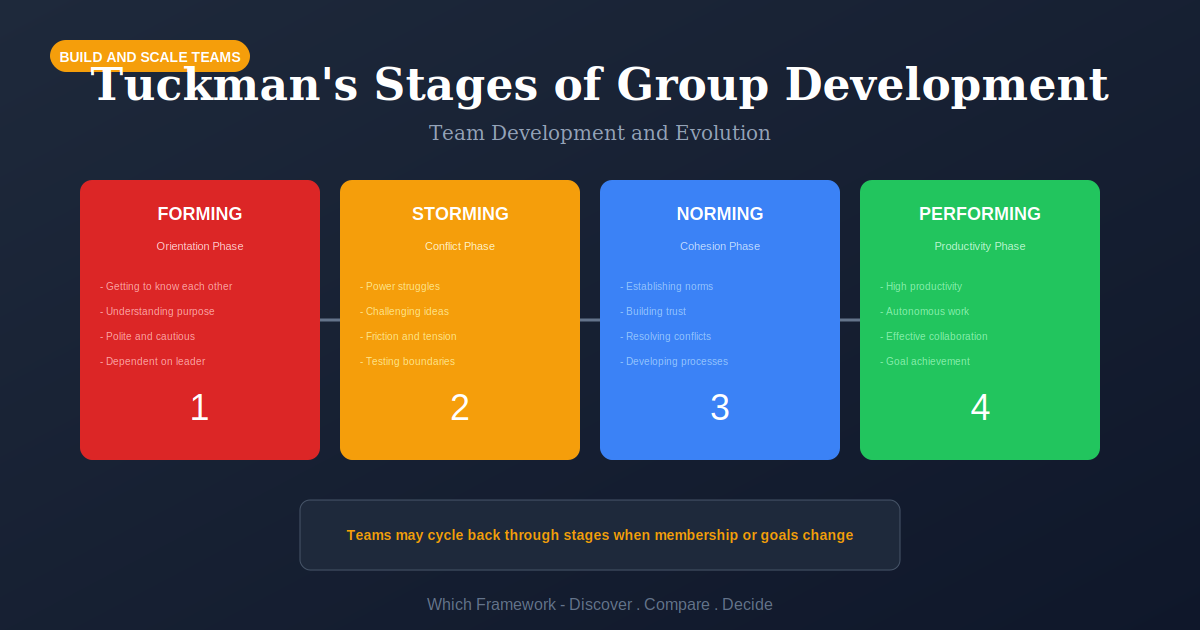
Tuckman's Stages is a descriptive model of small-group development that proposes one fixed sequence of phases — forming, storming, norming, performing and adjourning — running through both a group's structure and its task activity.
Before you start
Is this your framework?
This model answers one question: is what my team is doing right now normal for a team at this point. It is a description of a pattern, offered so that a rough patch reads as a phase rather than as a hiring mistake.
It is not a diagnostic instrument and it is not a schedule. It carries no test for which stage you are in, no estimate of how long any stage lasts, and no trigger that moves a group from one to the next. If you came looking for something that tells you what to change, the table below points at tools that do.
| If your real problem is… | You probably want |
|---|---|
| Nobody knows who decides what, or how we work together | Team Charter — the agreements this model calls norming, written down instead of waited for Compare Tuckman's Stages and Team Charter |
| People will not disagree in front of each other | Psychological Safety — the condition that decides whether storming is productive or merely quiet resentment Compare Tuckman's Stages and Psychological Safety |
| Two people both think they own the same decision | RACI Matrix — explicit responsibility per decision, which no stage model supplies |
| The team has the wrong mix of skills for the work | Skills Matrix — capability mapped against what the work needs |
| A deadline is approaching and the team has not really started | Gersick's punctuated equilibrium, described in the comparison below — a rival account built on deadlines rather than phases |
| The team is fine and the organization around it is changing | Bridges’ Transition Model — individual psychological transition, which is a different subject from group formation |
| A new team is arguing and I want to know whether to worry | Tuckman's Stages — you are in the right place |
What Is It?
Bruce Tuckman read fifty published studies of small groups and argued that a single sequence ran through all of them. Groups come together, fight, settle, and then get work done. He gave the four phases rhyming names, and the names are most of the reason anyone still knows the model.
Each phase has two faces. There is what the group is doing about its structure, meaning how members relate to one another, and what it is doing about its task. Storming is the clearest case: interpersonally it is conflict, but on the task side it is the group finally arguing about what the work actually is.
The model is descriptive. It says here is a pattern people have observed, not here is what to do. Nothing in it measures which stage a group occupies, times how long a stage runs, or names what pushes a group forward. Read as a schedule it will mislead you; read as vocabulary it is genuinely useful, because it gives a team a way to call a bad week a phase rather than a verdict.
Quick Reference
The sequence
What each stage looks like from inside
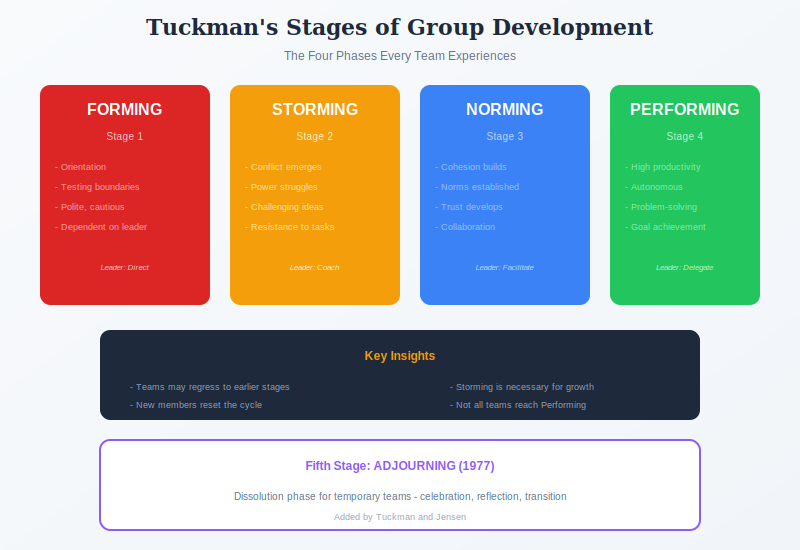
The names describe how a group feels, which is why they stick. What follows is what tends to be visible, and what helps.
| Stage | What you see | What actually helps |
|---|---|---|
| Forming orientation | Politeness, deference, questions aimed at the leader rather than at each other. Little disagreement, little commitment. | Direction. The one stage where telling people the answer is efficient, because nobody yet has the context. |
| Storming conflict | Arguments about scope, method and who decides. Sometimes loud, more often silent: missed meetings, private channels, work redone. | Surfacing it. The danger is not the conflict but its suppression, which yields a calm team that agrees to nothing. |
| Norming cohesion | Conventions appear without anyone announcing them, people cover for each other, and disagreement stops feeling risky. | Writing the conventions down while they are still visible. Unwritten norms are invisible to the next joiner. |
| Performing functional roles | Work moves without routing through the leader. Roles flex by task rather than title, and problems get solved where they occur. | Getting out of the way, and resisting the reorganization that resets everything. |
| Adjourning termination, added 1977 | Output drops near the end, and people are already half-attached to whatever comes next. | Naming the ending. Skipping it costs the next team these people join. |
The stage you are in is not the useful question
Teams do not sit in one stage. A group can be performing on familiar work and forming on anything new, and one new member sends it back through the sequence on everything that person touches. Membership change is the trigger the model does not name, and it fires most often of all.
So the diagnostic use is weak and the vocabulary use is strong. Asking which stage are we in starts an argument. Saying this is storming, it is supposed to be uncomfortable, and it is not evidence we hired wrong does something worth doing.
Disambiguation
When a team does not follow the sequence
Stage models are not the only account of group development, and the main rival was built by watching real project teams. A team that looks nothing like the sequence above is not necessarily broken.
| The model | What drives change | What it predicts |
|---|---|---|
| Tuckman's Stages this page | Internal group process, over time | The same ordered sequence in every group, with no timing attached |
| Punctuated equilibrium Gersick | The calendar. Awareness of the deadline | Inertia, one sharp transition at the halfway point of the available time, then a sprint. No storming phase at all |
| Integrated model Wheelan | Group maturity, measured not asserted | A similar sequence, but with a validated questionnaire attached so the stage can be scored |
Why the difference matters in practice
The two point at opposite interventions. If group process drives development, you invest in the group: facilitation, agreements, time together. If the calendar drives it, you change the calendar, and a twelve-month project with six milestones gets six midpoints.
A team can show both. The practical read is that a quiet team six weeks from a deadline is not necessarily norming. It may be in Gersick's first phase, which looks like agreement and is actually nobody having started.
Core Features
- Four stages, five since 1977: forming, storming, norming, performing, adjourning
- Two tracks per stage: what the group does about relationships and what it does about the work
- Descriptive, not prescriptive: a reported pattern, with no instruction attached
- No timing: nothing states how long a stage runs or what ends it
- No measurement: the stage is asserted by whoever is looking, not scored
- Built from a literature review: fifty published studies, no new observation of its own
Worked example
A merged team in Aarhus, and the storm nobody could see
An illustrative composite. A Danish logistics software company merged two support groups into one team of eleven after an acquisition. Six weeks in, the manager reported the transition as going well: no complaints, no arguments, everyone agreeable.
| What was observed | What it turned out to be |
|---|---|
| No visible conflict | Read at the time as norming arriving early. Six weeks is fast for eleven people who had been competitors, and fast was taken as good news. |
| Duplicate work | Both original groups kept their own ticket triage rules and ran them privately. Roughly 18% of tickets were touched twice. The disagreement was real; it had simply gone underground. |
| Two escalation paths | Each half still escalated to its former manager. Neither had said so, because saying so would have meant an argument. |
| What was done | A facilitated session with one question on the table: where do our two ways of working actually conflict? It produced four hours of genuine argument and a written set of triage rules that neither original group had used. |
| What followed | Duplicate handling fell to under 3% over the next quarter, worth roughly DKK 340,000 a year in recovered support time. The team also got noticeably louder in meetings, which the manager had to be persuaded was an improvement. |
Absence of conflict was the finding
The team had not skipped storming. It had suppressed it, and the suppression cost more than the argument would have. Two sets of rules ran in parallel for six weeks because surfacing the difference required someone to say out loud that the other half was doing it wrong.
Note what the model contributed and what it did not. It supplied the idea that a merged team ought to be arguing and was not, which is what prompted anyone to look. It supplied nothing about triage rules, and the fix was a written agreement, not a stage.
When to Use
- A new team is arguing and people are treating that as a bad sign
- Membership has changed and the team is behaving like a new one
- You need shared language for a rough patch that does not blame anyone
- Coaching a first-time manager through what a team will do to them
- A retrospective where the question is how we are working, not what we shipped
- A team that is suspiciously agreeable and you want a reason to check
When NOT to Use
- As a schedule, since nothing in the model says when anything happens
- To score or grade a team, because there is no measure attached
- To justify tolerating behavior that would be unacceptable at any stage
- For groups that meet twice and disband, where the sequence has no room
- As the explanation for a performance problem that is really about skills or resources
- Where a deadline rather than group process is plainly driving behavior
In practice
How the model gets misused
Almost every misuse comes from the same move: treating a description of what groups tend to do as an instruction about what yours should be doing by now.
| Failure mode | What it looks like | What to do instead |
|---|---|---|
| Read as a timetable | We are three months in, we should be performing by now | Drop the schedule. The model never had one. Ask what specifically is not working instead. |
| Storming as an excuse | Rudeness, exclusion or undermining waved through as a normal phase | Separate disagreement from conduct. Conflict about the work is the stage; conduct is not, at any stage. |
| Stages applied to people | One person labeled as the one who is still storming | The unit is the group. A stage describes a pattern of interaction, not an individual's character. |
| Quiet mistaken for norming | A calm team assumed to be past conflict when it has gone private | Look at the work, not the mood. Duplicate effort and parallel processes are the tell. |
| Membership change ignored | A team reorganized every quarter, expected to keep performing | Treat each change as a partial restart, and budget for it rather than being surprised by it. |
| Used in place of a decision | A stage diagnosis delivered as though it were an intervention | Name what changes tomorrow. The model has no lever in it; the lever is elsewhere. |
Sourced
Evidence, and how to cite it
The model is a literature review, not an observation.
Tuckman was a research psychologist at the Naval Medical Research Institute in Bethesda. His supervisor, Irwin Altman, had been collecting papers on group development and handed him the file. Tuckman sorted the fifty articles by setting and by whether they described interpersonal or task activity, and proposed the four stages as a fit to what was already reported. He collected no data of his own.
Tuckman, B.W. (1965) ‘Developmental sequence in small groups’, Psychological Bulletin, 63(6), pp. 384–399.
The source studies were mostly not work teams.
Of the fifty articles, roughly half were studies of therapy groups, with most of the rest drawn from human-relations training groups. Only a minority were natural or laboratory task groups. A model of how project teams behave was assembled largely from groups convened to talk about themselves, which is a different activity with different dynamics.
Tuckman (1965), Table 1, and Tuckman's own 2001 note on the origin of the paper in Group Facilitation.
The authors said themselves that it had barely been tested.
Twelve years on, Tuckman and Mary Ann Jensen went looking for empirical tests of the hypothesis. They found twenty-two relevant studies, of which exactly one had set out to test the model directly. They added adjourning on the strength of the termination stage several studies reported, called for statistical evidence, and described the testing of stage models as a virtually untapped field.
Tuckman, B.W. and Jensen, M.A.C. (1977) ‘Stages of small-group development revisited’, Group and Organization Studies, 2(4), pp. 419–427.
A study of real teams found a different pattern entirely.
Connie Gersick followed eight naturally occurring project teams across their whole lifespans. They did not progress through a universal sequence. Each set an approach in its first meeting, held it through a period of inertia, then changed sharply at the midpoint of its available time — teams working for an hour and teams working for six months both turned at their own halfway mark. What moved them was awareness of the deadline.
Gersick, C.J.G. (1988) ‘Time and transition in work teams’, Academy of Management Journal, 31(1), pp. 9–41.
How to cite it.
Harvard: Tuckman, B.W. (1965) ‘Developmental sequence in small groups’, Psychological Bulletin, 63(6), pp. 384–399.
APA: Tuckman, B. W. (1965). Developmental sequence in small groups. Psychological Bulletin, 63(6), 384–399.
For the five-stage version, cite Tuckman and Jensen (1977), not Tuckman (1965), because adjourning is not in the original. For the counter-case, cite Gersick (1988).
Key Strengths
- Normalizes conflict: gives a team a way to read a bad patch as a phase rather than a failure
- Memorable: four rhyming words that people retain and reuse without a handout
- Costs nothing: no instrument, no license, no facilitator required
- Sets expectations early: useful to a first-time manager before anything goes wrong
- Widely known: shared vocabulary across organizations, which is most of its practical value
Key Weaknesses
- No timing and no triggers: nothing says how long a stage lasts or what ends it
- Nothing to measure with: the stage is whatever the observer says it is
- Drawn from therapy groups: the evidence base is not work teams
- Barely tested, then and since: adoption ran well ahead of validation
- Silent on membership change: the most common real disruption is not in the model
- Descriptive only: knowing the stage tells you nothing about what to change
Sequencing
What to run before and after
The model names a pattern and supplies no lever. Everything that changes a team's trajectory comes from somewhere else.
Before
Agree what the team is for
A group with no shared purpose does not storm productively; it argues about scope forever. The disagreement needs something to be a disagreement about.
During
Make it safe to have the argument out loud
Storming that cannot surface goes private and becomes duplicate work and parallel processes. Whether conflict is productive turns on whether people expect a cost for raising it.
After
Write down what the team worked out
Norms arrived at implicitly are invisible to the next joiner, and the sequence restarts for them. Capturing the conventions is what stops each new arrival re-running the whole thing.
Common questions
Tuckman's Stages: quick answers
What are Tuckman's stages of group development?
Four stages proposed in 1965: forming, where a group orients itself and leans on the leader; storming, where conflict surfaces over roles, method and scope; norming, where conventions and cohesion settle; and performing, where work moves without routing through anyone. A fifth, adjourning, was added in 1977 for groups that end.
What is the storming stage?
The phase where a group argues, openly or otherwise, about who decides what and how the work should be done. It is often quiet rather than loud: missed meetings, private channels, work redone without comment. The stage is a normal part of a group settling, and its absence in a newly merged team is usually suppression rather than progress.
What is the fifth stage of Tuckman's model?
Adjourning, sometimes called mourning. Tuckman and Mary Ann Jensen added it in 1977 after several studies reported a distinct termination phase: output drops near the end, people become ambivalent, and attention shifts to whatever comes next. It was not part of the original 1965 paper.
Do teams always go through the stages in order?
No, and the model was never presented as a law. Groups skip stages, loop back, and run different stages on different pieces of work at the same time. Any change in membership sends a team back through the sequence for whatever the new person touches, which the model does not mention.
How long does each stage last?
The model does not say, and this is its largest practical gap. There is no stated duration for any stage and no trigger that moves a group from one to the next. Anyone giving you week counts is adding them. Treat any timetable built on these stages as invention.
Is Tuckman's model supported by evidence?
Weakly. It was a review of fifty published studies rather than new research, and about half of those studied therapy groups. When Tuckman and Jensen looked for tests in 1977 they found twenty-two relevant studies of which one had set out to test the model. Later work on real project teams found a different pattern. It is best treated as useful vocabulary rather than a validated instrument.
What is the difference between Tuckman's stages and punctuated equilibrium?
Tuckman says internal group process drives development through a fixed sequence. Gersick's punctuated equilibrium says the calendar does: teams set an approach in the first meeting, sit in inertia, then change sharply at the halfway point of their available time. The two point at different interventions. One says invest in the group, the other says change the deadlines.
Does a team restart at forming when someone new joins?
Partly, and this is the most useful thing to take from the model. A new member has none of the unwritten conventions the group settled on, so the sequence re-runs for everything that person is involved in while the rest of the work carries on as before. Writing the conventions down is what shortens it.
Deep Resources
Frameworks related to Tuckman's Stages
- Team CharterThe agreements this model calls norming, written down rather than waited for…
- Psychological Safety FrameworkWhat decides whether storming surfaces or goes private and expensive…
- Delegation MatrixHow much authority moves as a team matures, which the sequence assumes and never states…