Skills Matrix: Capability Assessment and Development
Skills Matrix (or Competency Mapping) is a framework for identifying, assessing, and developing team member capabilities, helping organizations visualize skills gaps and prioritize training investments.
What Is It?
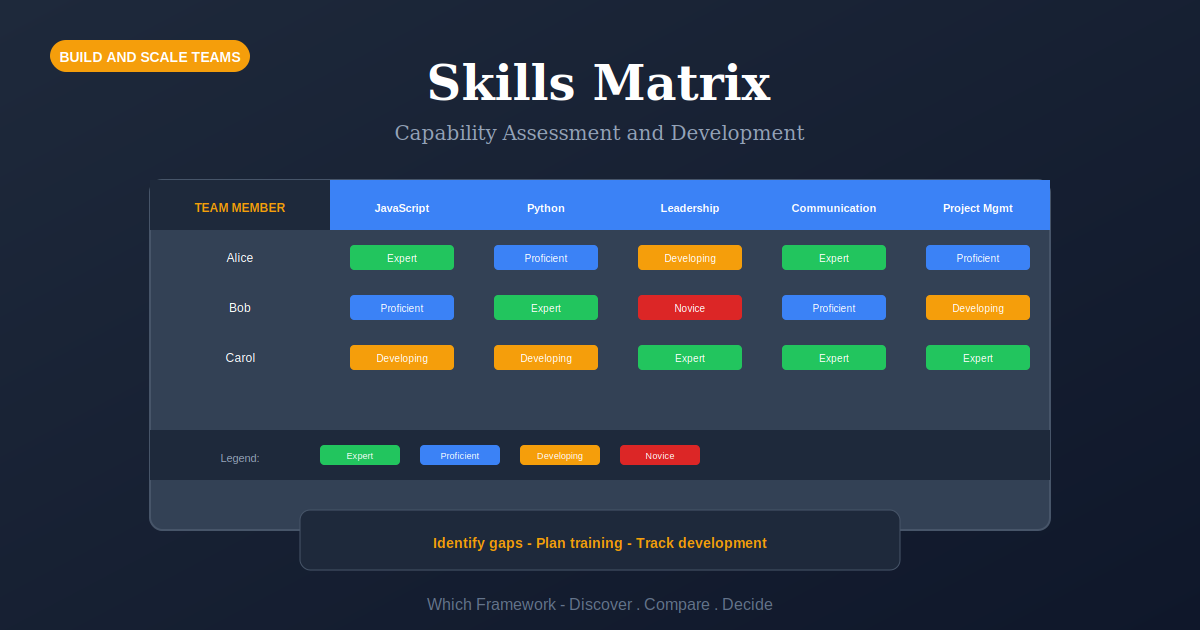
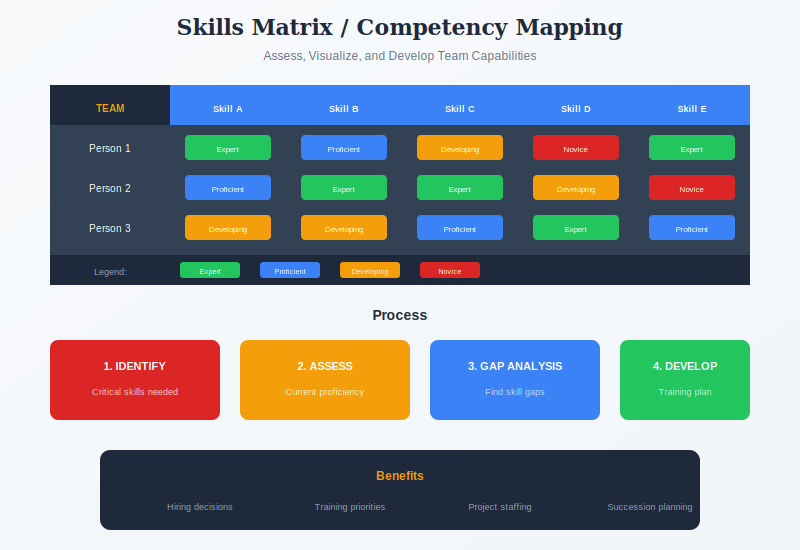
A Skills Matrix creates visibility into team capabilities. It's a grid with team members on one axis and required skills on the other, with proficiency levels indicated at each intersection. This simple visualization reveals gaps, redundancies, and development opportunities.
The framework typically uses a 4-level proficiency scale: Novice (learning), Developing (needs supervision), Proficient (independent), Expert (can teach others). Skills are identified based on role requirements, team objectives, and future needs.
Skills matrices connect directly to Succession Planning for leadership development, Delegation Matrix for task assignment, and training program design.
Quick Reference
First, disambiguate
Skills matrix, competency matrix or capability matrix?
These three are used interchangeably in most workplaces and they are not the same thing. The distinction is not pedantry: it determines what you can put in a cell, who fills it in, and what decision the grid can support.
The short version: a skill is something you can do, a competency is how you apply it to a standard, and a capability is what the organization can deliver. Each sits at a different altitude.
| Skills matrix | Competency matrix | Capability matrix | |
|---|---|---|---|
| Unit of measure | A specific, demonstrable ability — “can write SQL queries” | Skill plus knowledge plus behavior, applied to a standard — “analyzes data to inform decisions” | What the organization can reliably deliver — “can run a data migration unaided” |
| Altitude | Individual, granular | Individual, role-level | Team or organization |
| Who assesses | Manager or peer, often self-assessed first | Trained assessor against defined behavioral indicators | Leadership, usually against strategic goals |
| Answers the question | Who can do what, and where are we thin? | Is this person performing the role to standard? | Can we take this on at all? |
| Effort to build | Days. A team can do it in a workshop. | Months. Requires a competency framework with defined levels and indicators first. | Weeks, and mostly a leadership conversation rather than an assessment. |
| Fails when | Used for pay or promotion decisions it was never designed to support | Built without assessor training, so ratings mean different things to different managers | Confused with a headcount plan |
The distinction that matters
Most teams asking for a “competency matrix” want a skills matrix — they want to see who can do what and where the gaps are, this month, without commissioning a competency framework first. If nobody has written behavioral indicators and trained assessors against them, what you are building is a skills matrix regardless of what the document is called. That is fine. It is just worth knowing, because a skills matrix cannot carry promotion or pay decisions.
Before you start
Is a skills matrix your framework?
A skills matrix answers who on this team can do what, and how exposed are we. It is a visibility tool, and it is at its best when the answer is uncomfortable — one name in a column, or a critical skill held by someone about to leave.
| If your real problem is… | You probably want |
|---|---|
| We need to decide who owns what on a project | RACI Matrix — roles per task, not abilities per person Compare with RACI |
| I cannot decide what to hand over to whom | Delegation Matrix — takes skill as an input and pairs it with task importance Compare with Delegation Matrix |
| The team is new and not yet performing | Tuckman’s Stages — a maturity problem, not a skills gap Not sure which? Compare |
| We need formal assessment for pay or promotion | A competency framework with defined levels, behavioral indicators and trained assessors. A skills matrix will not survive that use. |
| We need to agree how the team works together | Team Charter |
| Your team has grown and you have become the bottleneck | The delegation playbook, where the skills matrix is stage 1 of 6 |
| We need to see who can do what, and where we are thin | Skills matrix — you are in the right place |
The distinction that matters
A skills matrix is a map, not a scorecard. The moment people believe their rating affects their pay, the ratings stop describing reality — and a matrix whose numbers are managed is worse than none, because it will be trusted. Say plainly what it will and will not be used for, before anyone fills in a cell.
Worked example
A skills matrix, and what it exposed
An illustrative composite. A seven-person data team, six skills that matter, assessed on a five-point scale. Ratings are the honest ones, reached after the manager promised in writing that the grid would not feed appraisals.
0 none · 1 aware, needs supervision · 2 can do it unaided · 3 can do it well and troubleshoot · 4 can teach it and set the standard
| Skill | Ana | Ben | Cai | Dee | Eli | Fay | Gus | Read |
|---|---|---|---|---|---|---|---|---|
| SQL / querying | 4 | 3 | 3 | 2 | 3 | 2 | 2 | Healthy. Deep bench, no risk. |
| Dashboard build | 2 | 4 | 3 | 3 | 1 | 2 | 0 | Fine. Ben is strongest but three others cope. |
| Billing data model | 0 | 0 | 4 | 0 | 0 | 1 | 0 | Single point of failure. Only Cai. Nobody else above 1. Cai is on a six-month notice period. |
| Pipeline / orchestration | 1 | 2 | 3 | 3 | 2 | 0 | 1 | Adequate, thin at the top. |
| Stakeholder comms | 3 | 1 | 2 | 4 | 2 | 3 | 2 | Healthy. |
| Statistical methods | 2 | 1 | 1 | 1 | 4 | 1 | 0 | Thin, but rarely needed. Accepted risk. |
What the grid actually decided
One row justified the whole exercise. The billing data model had exactly one person at any real level, and that person was leaving — a fact everyone half-knew and nobody had made visible. Two engineers were paired onto billing work within two weeks, which would not have happened without a grid making the gap undeniable.
Note the last row. Statistical methods is equally thin, and the team decided to accept that risk, because the skill is rarely needed and contractable. A skills matrix is not a to-do list of every gap — it is a way of choosing which gaps to live with.
When to Use
- Building a new team
- Planning training programs
- Making hiring decisions
- Staffing projects
- Succession planning
- Performance reviews
When NOT to Use
- As the sole basis for promotions
- Without clear proficiency definitions
- For highly creative or innovative work
- When skills change too rapidly to track
In practice
How skills matrices go wrong
Building one takes an afternoon. Keeping it honest and keeping it alive are the hard parts, and both fail in predictable ways.
| What you see | What it usually means | What to do |
|---|---|---|
| Almost everyone rates themselves a 3 | People suspect the grid will affect their standing | State the use in writing before assessment, and keep to it. One appraisal that cites the matrix will poison every future round. |
| The skill list runs to forty rows | Every task was listed instead of the skills that carry risk | Cap it at eight to twelve. Ask which skills would hurt if the person holding them left tomorrow — that is the list. |
| Levels are named but not defined | “Intermediate” means whatever each manager thinks | Define each level by what the person can do unsupervised. “Can do it unaided” is testable; “intermediate” is not. |
| The grid is full and nothing changed | It was treated as an inventory rather than a decision input | Every column with one name above level 2 is a risk needing a named response — pair, document, or consciously accept it. |
| Self-assessment only, never checked | The Dunning-Kruger problem, in a spreadsheet | Have people self-assess, then calibrate in pairs or with a manager. Gaps between the two ratings are useful in themselves. |
| Built once, eighteen months ago | Treated as a document rather than a live view | Refresh when someone joins or leaves, or quarterly. A stale matrix is worse than none because it looks authoritative. |
Sourced
What the evidence says
The skills matrix itself has no identifiable author.
The grid of people against abilities is a folk tool, widespread in manufacturing and training practice long before anyone wrote it up. Our own framework data records it as emerging from the HR and training community around 1980, which is a placeholder rather than a finding. What does have a documented history is the competency movement it is constantly confused with — and that history is worth knowing, because it explains why the two are different animals.
Competency assessment began with a 1973 paper about diplomats.
David McClelland’s “Testing for Competence Rather Than for Intelligence” argued that intelligence and aptitude tests were poor predictors of job performance, and that what should be measured instead are the behaviors distinguishing high performers from average ones. The work grew from a US State Department problem: academically outstanding candidates were failing in the field while others thrived. Richard Boyatzis developed it into a working model in The Competent Manager in 1982, defining a competency as an underlying characteristic of a person causally related to superior performance.
McClelland, D. C., “Testing for Competence Rather Than for Intelligence”, American Psychologist 28(1), 1973; Boyatzis, R. E., The Competent Manager, Wiley, 1982.
Its central claim was challenged in the same journal, and the challenge stands.
In 1991 Barrett and Depinet reviewed the evidence behind McClelland’s five main assertions in American Psychologist and concluded that, despite the theory’s wide acceptance, the available evidence did not show competency testing outperforming cognitive ability testing at predicting occupational behavior. Boyatzis had himself noted that his validation work did not provide enough information to build a selection or promotion system on. An entire industry of competency frameworks rests on a foundation that has been contested for more than thirty years.
Barrett, G. V. & Depinet, R. L., “A Reconsideration of Testing for Competence Rather Than for Intelligence”, American Psychologist 46(10), 1991, pp. 1012–1024.
What that means for using it.
It argues for using the lighter tool honestly rather than the heavier one badly. A skills matrix makes no claim to predict performance — it records who can currently do what, which is checkable and hard to argue with. A competency framework makes a stronger claim, requires trained assessors and defined behavioral indicators to mean anything, and rests on contested foundations even when built well. If you need visibility of gaps and cover, build the skills matrix and be clear that is what it is. Reach for competencies only when you genuinely need role-level assessment and are prepared to resource it properly.
Key Strengths
- Visibility: See team capabilities at a glance
- Gap Analysis: Identify training needs
- Planning: Inform hiring and development
- Objective: Data-driven decisions
Key Weaknesses
- Time-consuming to maintain
- Self-assessment bias
- May miss soft skills
- Can feel like surveillance
How It Works
| 1 Primary Input | Role requirements, team members, proficiency assessments |
|---|---|
| 2 Data You Need | Skill definitions, proficiency criteria, self and manager ratings |
| 3 Primary Output | Skills matrix, gap analysis, development plans |
Frameworks related to Skills Matrix / Competency Mapping
- Succession Planning FrameworkFramework for identifying, developing, and preparing successor candidates for critical…
- Delegation MatrixFramework for determining what tasks to delegate, to whom, and when. Helps leaders empower…
Sequencing
What to run before and after
A skills matrix produces visibility. On its own it changes nothing, and it is upstream of several decisions people usually try to make without it.
Before
Decide which skills actually matter
The commonest failure is a forty-row grid nobody maintains. Work backwards from what the team must deliver, and from what would hurt if a specific person left.
During
Assess, then calibrate
Self-assessment first, then a conversation. The disagreements are the useful part — a gap between how someone rates themselves and how their manager rates them is a finding, not an error.
After
Act on the thin columns
Every skill held by one person is either a risk to close or a risk to accept, and both need a name against them. This is also the natural input to deciding what can be handed over.
Part of a playbook: How to Delegate as Your Team Grows. The skills matrix is stage 1 of 6, before the delegation matrix.
Common questions
Skills matrix: quick answers
What is a skills matrix?
A grid of people against skills, with a rating in each cell showing what each person can currently do. Its purpose is visibility: who can do what, where the team is thin, and which abilities rest on a single person. It is a map of current ability, not an assessment of performance or potential.
What is the difference between a skills matrix and a competency matrix?
A skill is a specific demonstrable ability — “can write SQL queries”. A competency bundles skill, knowledge and behavior applied to a defined standard — “analyzes data to inform decisions”. A skills matrix can be built by a team in a workshop; a competency matrix requires a competency framework with behavioral indicators and trained assessors behind it, which takes months. Most teams asking for a competency matrix want a skills matrix.
What is a capability matrix, and how is it different?
Capability usually sits at team or organizational level: what the group can reliably deliver, combining people, process and tooling — “we can run a data migration unaided”. A skills matrix looks at individuals and their abilities; a capability matrix looks at the unit and its outcomes. The terms are often used interchangeably, but the altitude differs and so does the decision each supports.
What levels should a skills matrix use?
Four or five, each defined by what the person can do without supervision rather than by an adjective. A workable scale: 0 none, 1 aware but needs supervision, 2 can do it unaided, 3 can do it well and troubleshoot, 4 can teach it and set the standard. “Intermediate” and “advanced” are not testable; “can do it unaided” is.
Can a skills matrix be used for pay or promotion decisions?
It should not be. The moment people believe their rating affects their standing, the ratings describe what is safe to say rather than what is true — and a matrix whose numbers are managed is worse than none, because it will still be trusted. State the intended use in writing before anyone fills in a cell. Formal assessment needs a competency framework with trained assessors.
Who invented the skills matrix?
Nobody identifiable. The grid of people against abilities is a folk tool that appears widely in manufacturing and training practice without a cited origin. The related competency movement does have a documented history, beginning with David McClelland’s 1973 paper “Testing for Competence Rather Than for Intelligence” and developed by Richard Boyatzis in 1982.