Bridges' Transition Model: The Three Phases, and Why Change and Transition Are Not the Same
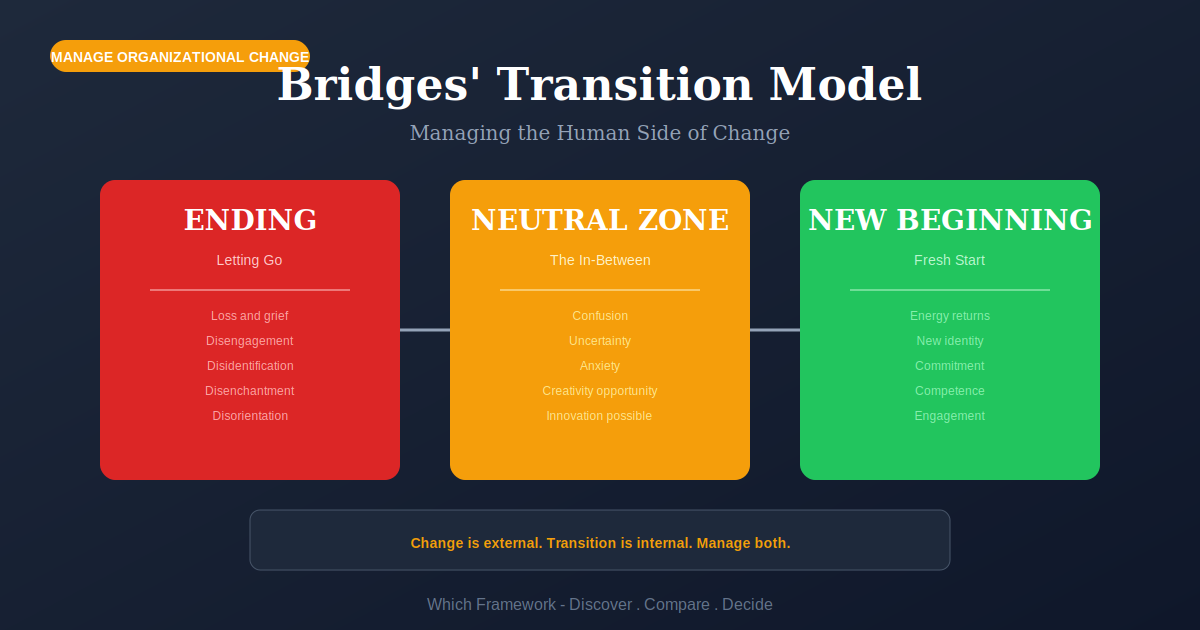
Bridges' Transition Model is a three-phase account of the psychological adjustment people make to a change — an ending, a neutral zone and a new beginning — each running on its own timetable.
Before you start
Is this your framework?
This model answers one question: why has the change happened and the people not moved. It separates the external event from the internal adjustment people make to it, and argues the second is slower, starts with a loss, and runs on its own clock.
It will not sequence your rollout, assign anybody anything, or tell you whether the change is a good idea. It is a lens on how people are doing, not a plan. If you need the plan, the table below says where to look.
| If your real problem is… | You probably want |
|---|---|
| We need an ordered program to run a large change | Kotter’s 8-Step Model — a sequence of organizational moves, where this model supplies no steps at all Compare Bridges and Kotter's 8-Step |
| We need to know which individuals are stuck and why | ADKAR Model — five named conditions per person, each with a diagnosis and a corrective action Compare Bridges and ADKAR |
| Somebody is actively opposing the change | Resistance Management — opposition is often a substantive objection rather than a phase to be waited out |
| We do not know who needs to be brought along at all | Stakeholder Analysis — who matters and how much attention each one gets |
| We want the simplest possible frame for a change | Lewin’s Change Model — unfreeze, change, refreeze, which is about the organization rather than the person |
| The change keeps sliding back after we stop pushing | Kaizen or an operating cadence — sustaining a change is a systems problem, not a psychological one |
| The change has landed and people are visibly not with it | Bridges' Transition Model — you are in the right place |
What Is It?
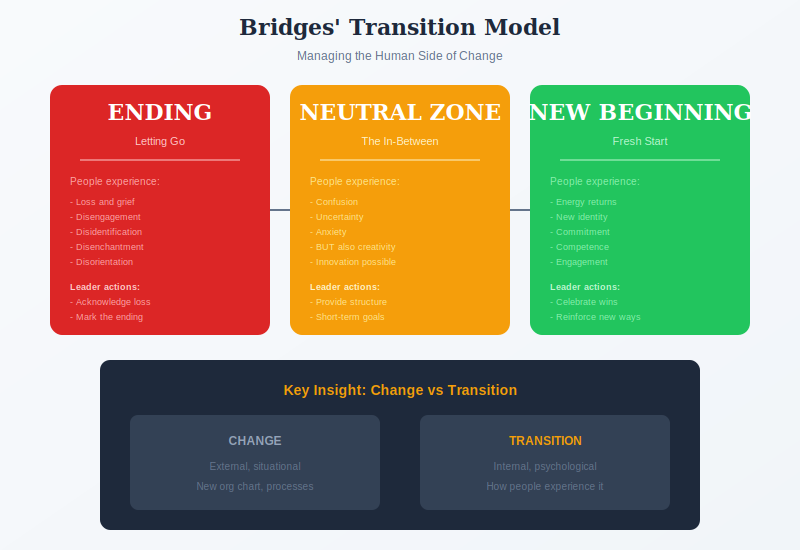
The claim is a distinction. Change is external and situational: a new system goes live, two teams merge, a site closes. It has a date. Transition is internal and psychological: the reorientation a person makes to come to terms with it. It has no date, and it does not start when the change does.
From that follows the counterintuitive part. A transition begins with an ending, not a beginning. Before anyone can work the new way they have to give up the old one, along with whatever came with it: a routine that made them competent, a relationship, a job title that meant something.
Three phases follow, and they overlap. An ending. A middle in which the old is gone and the new is not yet working, which Bridges calls the neutral zone. Then a new beginning. Most change programs manage the change and assume the transition takes care of itself, which is the failure the model exists to name.
Quick Reference
The three phases
What each phase looks like, and what helps
These are not stages people complete. They overlap, people move at different speeds, and someone can be starting a new beginning on one part of their job while still ending another.
| Phase | What you see | What actually helps |
|---|---|---|
| 1. Ending, losing, letting go | Anger, denial, and a lot of talk about how things used to work. Often read as resistance. | Name what is actually being lost, person by person. Most losses are not the obvious ones — the process, the desk, the status, the person you used to sit next to. |
| 2. The neutral zone | The old way is gone, the new one does not work yet. Output falls, absence rises, and weaknesses that had been patched over reappear. | Say out loud that this is normal and temporary. Set short-range goals so there is something to finish. This is also when people are most willing to try things, which is worth using. |
| 3. The new beginning | New habits, and a new sense of what the job is. Arrives unevenly and cannot be scheduled. | Give people a clear picture of the destination, a part to play in it, and something early that visibly works. |
The five losses inside an ending
Bridges breaks the first phase into five, and this is the part most summaries drop. Disengagement is separation from what has gone. Dismantling is the old structure coming apart. Disidentification is losing the self-description that went with it, which is why reorganizations hit long-serving people hardest. Disenchantment is discovering that something you believed about the organization was not true. Disorientation is not knowing how to behave.
The use is diagnostic. Someone stuck in disidentification needs a role they can describe to their family. Someone in disenchantment needs an honest answer about what changed, and will not be moved by enthusiasm.
Disambiguation
Bridges, Kubler-Ross, Lewin and ADKAR
Four models get used interchangeably in change work and are not interchangeable. The question that separates them is what each is a model of.
| The model | A model of | Use it for |
|---|---|---|
| Bridges this page | The internal adjustment to a change | Understanding why people have not moved. No steps, no sequence, no diagnosis per person |
| The change curve often called Kubler-Ross | Grief, adapted by others to organizational change | Little. The original stages describe bereavement; the workplace version was applied later by others |
| Lewin unfreeze, change, refreeze | The organization, not the person | Why a system settles back. Says nothing about how anybody feels |
| ADKAR | Five conditions each individual needs | Which specific condition a named person is missing, and what to do about it |
Bridges and ADKAR are the pair worth holding together
They answer different halves of one question. Bridges explains why an ending has to be worked through before anything new can take. ADKAR turns a vague sense that somebody is struggling into a specific missing condition.
Bridges gives you the reason; ADKAR gives you the intervention. Running Bridges alone tends to produce sympathy and no action. Running ADKAR alone tends to treat every gap as a communication or training problem, when the person is actually still grieving a job they were good at.
Core Features
- Change and transition are separated: one external and dated, one internal and not
- It starts with an ending: the first phase is a loss, not a launch
- Three overlapping phases: ending, neutral zone, new beginning
- Five named losses: disengagement, dismantling, disidentification, disenchantment, disorientation
- No timings and no sequence: people move at their own pace and can sit in two phases at once
- Descriptive: it explains what is happening, and prescribes almost nothing
Worked example
A closed depot in Tampere, and the phase that was mistaken for defiance
An illustrative composite. A Finnish machinery distributor merged two service depots, moving forty engineers onto a shared scheduling system. Go-live was a single Monday.
| What happened | What it turned out to be |
|---|---|
| Weeks one to four | Engineers kept paper job cards alongside the system and compared it unfavorably to the old one daily. Read as resistance and answered with more training. |
| What the loss actually was | The old system let each engineer choose their own jobs. The new one assigned them. What had gone was not a tool but a piece of autonomy, and no amount of training addressed that. |
| Weeks five to twelve | First-time fix fell about eleven points and short-notice absence roughly doubled. Nobody refused to use the system; it was not working yet, and neither were the people. |
| What was done | Managers said plainly that the next two months would get worse. Engineers were given a standing fortnightly slot to change scheduling rules, and four rules were changed. The paper cards were left alone. |
| By month six | First-time fix passed its pre-migration level. The paper cards disappeared without anyone banning them, which is about the only reliable sign that a new beginning has arrived. |
The diagnosis changed what was tried
Read as resistance, the answer was training, and training was the wrong intervention because nobody was confused. Read as an ending, the answer was to name the loss — you used to pick your own work and now you do not — and to give some of it back in a form the new system could support.
The dip in months two and three was not failure either. It is what the neutral zone looks like on a chart, and organizations that panic there usually reverse the change just before it would have taken. Saying in advance that the dip is coming is most of what the model buys you.
When to Use
- A change has gone live and adoption is worse than expected
- People are being labeled resistant and the label is not helping
- A restructure removes roles, titles or long-standing routines
- Preparing managers before a change, so the dip does not read as failure
- Explaining to a sponsor why the benefits case has not appeared yet
- After a merger, where two groups are each losing something different
When NOT to Use
- As a project plan, since it contains no steps and no sequence
- To diagnose which individual needs what, which needs a per-person model
- Where opposition is a substantive disagreement rather than an adjustment
- For changes small enough that nothing is being given up
- As a reason to wait, when what people need is a decision or a resource
- To predict how long anything will take, which the model explicitly declines to do
In practice
How the model gets misused
The model is easy to agree with and hard to act on, which produces a characteristic set of failures.
| Failure mode | What it looks like | What to do instead |
|---|---|---|
| Sympathy instead of action | Everyone agrees people are in the neutral zone; nothing is done differently | Pair it with a model that names a specific missing condition and a corrective action. |
| All objections read as grief | A well-argued case that the change is wrong, dismissed as an ending | Test the objection on its merits first. Only what survives that is a transition problem. |
| Skipping to the new beginning | Launch events and vision decks in week one, while people are still losing things | Do the ending first. Name what is going, out loud, before describing what replaces it. |
| Treated as a timetable | Six weeks allotted to the neutral zone in a plan | There are no durations in the model. Track whether people are moving, not whether they are on schedule. |
| Applied only downward | Leaders run the transition for staff, having had months to make their own | Note the head start. Leadership finished its ending before anyone else was told. |
| The dip mistaken for failure | A change reversed in month three, just as it was starting to take | Say in advance that performance will fall, and agree what level would genuinely warrant reversing. |
Sourced
Evidence, and how to cite it
The model is from 1980, and reached the workplace in 1991.
William Bridges set out the three phases in Transitions: Making Sense of Life's Changes, which was about personal change — divorce, bereavement, retirement, career shifts. Managing Transitions applied the same structure to organizations eleven years later. Bridges died in 2013; Susan Bridges has maintained the work since.
Bridges, W. (1980) Transitions: Making Sense of Life's Changes. Reading, MA: Addison-Wesley; Bridges, W. (1991) Managing Transitions: Making the Most of Change. Reading, MA: Addison-Wesley.
Its structure is borrowed from anthropology.
Bridges credits Arnold van Gennep, who described rites of passage as separation, a liminal middle, and incorporation. Ending, neutral zone and new beginning map onto those three directly, and Bridges says so. He also draws on Victor Turner on liminality and Mircea Eliade. The model is a transposition of an established anthropological pattern onto modern working life, which is a fair description of both its appeal and its limits.
van Gennep, A. (1909) Les rites de passage. Paris: Nourry; discussed directly in Bridges (1980).
There is no controlled evidence that it works.
The model comes from consulting practice, reading and reflection, not from a study. No trials show that teams led through the three phases outperform teams that are not, and no instrument scores which phase somebody is in. Its standing rests on practitioners finding the distinction useful, which is a real thing but is not evidence of effect.
No controlled outcome studies of the three-phase model are available in the management literature as of 2026.
It is not the Kubler-Ross change curve.
The two are routinely conflated. Kubler-Ross described stages she observed in dying patients in 1969; the adaptation of that to organizational change was made later by others, not by her, and the stages themselves have not held up well as a general account of grief. Bridges is a separate model with a different structure, and citing one for the other is a common error in coursework.
Kubler-Ross, E. (1969) On Death and Dying. New York: Macmillan. The organizational change curve is not hers.
How to cite it.
Harvard: Bridges, W. (1991) Managing Transitions: Making the Most of Change. Reading, MA: Addison-Wesley.
APA: Bridges, W. (1991). Managing transitions: Making the most of change. Addison-Wesley.
For the model itself rather than its workplace application, cite Bridges (1980). Later editions are co-authored with Susan Bridges; check which edition you are holding.
Key Strengths
- One genuinely useful distinction: the change has a date and the transition does not
- Reframes resistance: what looks like defiance is often an ending nobody named
- Predicts the dip: and saying so in advance stops changes being reversed too early
- Costs nothing: no license, no instrument, no certification needed to use it
- Applies to the leader too: useful on yourself, which few change models are
Key Weaknesses
- No controlled evidence: consulting practice rather than research
- No timings and no triggers: nothing says how long a phase lasts
- Nothing to measure with: the phase is whatever the observer says it is
- Almost no prescription: it explains, and then hands you nothing to do
- Invites dismissing real objections: a bad argument and a valid one both look like an ending
- Assumes the change is right: the model has no view on whether it should be happening
Sequencing
What to run before and after
The model explains what is happening to people and supplies almost no lever. Both the plan and the individual diagnosis come from elsewhere.
Before
Know who is affected and how much
A transition lens applied to everybody at once is unusable. You need to know whose job is genuinely changing and who is merely being informed.
During
Turn the phase into a specific missing condition
Knowing somebody is in the neutral zone does not tell you what to do on Monday. A per-person model converts that into a named gap with a corrective action attached.
After
Make the new beginning stick
A new beginning that is not built into how work is scheduled and measured decays back. Sustaining a change is an operating problem once the psychological work is done.
Common questions
Bridges' Transition Model: quick answers
What is Bridges' Transition Model?
A three-phase account of how people adjust internally to an external change. The phases are an ending, in which something is given up; the neutral zone, in which the old way is gone and the new one does not work yet; and a new beginning. The phases overlap and have no stated durations.
What is the difference between change and transition?
Change is external and situational: a system goes live, a team merges, a role disappears. It has a date. Transition is the internal reorientation a person makes to come to terms with it. It has no date, runs slower, and often has not started when the change is declared complete.
What are the three phases of the Bridges model?
Ending, losing and letting go, where people give up the old way and whatever came with it. The neutral zone, where the old is gone and the new is not yet working, and where productivity typically falls. The new beginning, where new habits and a new sense of the job take hold. People move through them at different speeds and can be in two at once.
What is the neutral zone?
The middle phase, where the old way has gone and the new one is not working yet. Output falls, absence tends to rise, and weaknesses that had been patched over reappear. It is also when people are most willing to try new things, which makes it the best moment to change how something works. Naming it in advance stops the dip being read as failure.
Is Bridges' model the same as the Kubler-Ross change curve?
No, and conflating them is a common error. Kubler-Ross described stages observed in terminally ill patients in 1969; the version applied to organizational change was adapted later by other people, not by her. Bridges is a separate model with three phases rather than five stages, and it is about reorientation rather than grief.
Is there evidence that the Bridges model works?
Not in the controlled sense. It came out of consulting practice and wide reading rather than research, no trials compare teams led through the phases with teams that are not, and no instrument scores which phase a person is in. Its standing rests on practitioners finding the change-versus-transition distinction useful.
Where did the model come from?
Bridges credits the anthropologist Arnold van Gennep, who described rites of passage as separation, a liminal middle and incorporation. The three phases map directly onto those. Bridges also draws on Victor Turner and Mircea Eliade. He set the model out in Transitions in 1980, about personal change, and applied it to organizations in Managing Transitions in 1991.
How long does each phase last?
The model does not say, and treats that as a feature rather than a gap. People move at their own pace, and the same change produces different timelines for different people depending on what each is losing. Any plan that allots weeks to the neutral zone has added that itself.
Deep Resources
Frameworks related to Bridges' Transition Model
- ADKAR ModelThe per-person diagnosis this model does not provide, and its natural partner…
- Lewin's Change ModelThe organizational counterpart: unfreeze, change, refreeze, with no view on people…
- Resistance Management FrameworkFor opposition that turns out to be a real objection rather than an ending…