
Kotter's 8-Step: Structured Organizational Transformation
Kotter's 8-Step Change Model is a comprehensive framework for leading major organizational transformation through eight sequential steps from creating urgency to anchoring change in culture.
What Is It?
Kotter's 8-Step Change Model, introduced in his 1996 book "Leading Change," sets out why large-scale transformation efforts stall. Based on extensive research, John Kotter identified eight critical steps and the common errors that derail transformation.
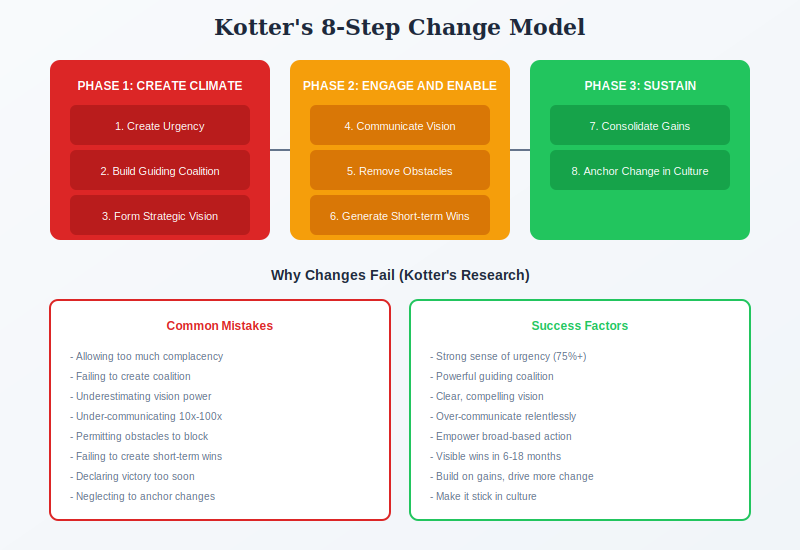
The eight steps fall into three phases: Create Climate for Change (Steps 1-3: Urgency, Coalition, Vision), Engage and Enable (Steps 4-6: Communicate, Remove Obstacles, Short-term Wins), and Implement and Sustain (Steps 7-8: Consolidate, Anchor).
This model is the gold standard for enterprise-scale transformation and complements people-focused approaches like Bridges' Transition Model and individual adoption tools like ADKAR.
Quick Reference
The 8 Steps
- Step 1 - Create Urgency: Help others see the need for change
- Step 2 - Build Guiding Coalition: Assemble a group with power to lead
- Step 3 - Form Strategic Vision: Create a vision and strategies
- Step 4 - Communicate Vision: Use every channel to communicate
- Step 5 - Remove Obstacles: Enable action by removing barriers
- Step 6 - Generate Short-term Wins: Create visible improvements
- Step 7 - Consolidate Gains: Build on wins to produce more change
- Step 8 - Anchor in Culture: Embed new approaches in culture
Before you start
Is Kotter actually your framework?
Kotter is built for one situation: a large organization that must change something significant, where the obstacle is human rather than technical. People understand what is being asked and are not doing it. That is what the eight steps address.
It is a poor fit almost everywhere else, and its reputation means it gets applied far outside that range. It has no mechanism for choosing what to change, for prioritizing, or for designing a solution. It assumes those decisions are already made and the problem is adoption.
| If your real problem is… | You probably want |
|---|---|
| We have not decided what to change yet | McKinsey 7S to diagnose, or SWOT to frame the choice Not sure which? Compare |
| Individuals need to change how they personally work | ADKAR — person-level, where Kotter is organization-level Compare Kotter and ADKAR |
| We need the simplest possible model of change | Lewin’s Change Model — three stages, far less machinery Compare all three |
| The team is small, or the change is a single team’s process | Not Kotter. A guiding coalition and a volunteer army are overhead at that scale. |
| Nobody agrees what success looks like | OKR or Balanced Scorecard Not sure which? Compare |
| Leading a large change so that it actually sticks | The organizational change playbook, where Kotter's 8 Steps is stage 2 of 5 |
| A big change is agreed, and people are quietly not doing it | Kotter — you are in the right place |
The distinction that matters
Kotter answers “how do we get an organization to actually adopt a decision?” — not “what should we decide?” Using it before the decision is made produces urgency about nothing in particular, which is worse than no urgency at all, because it spends the credibility you will need later.
Worked example
Where the eight steps actually break
An illustrative composite. A 3,000-person insurance business moving claims handling from paper-based regional offices to a single digital platform. Budget approved, vendor selected, eighteen-month program. The change was announced with a Kotter framing and stalled at month nine.
The middle column is what the program did. The right column is what the step actually required.
| Step | What they did | What it required |
|---|---|---|
| 1. Create urgency | A launch email citing competitive threat and a townhall | Urgency people feel about their own work. Regional staff saw a stable, profitable business and a head-office project. The threat was real at group level and invisible at desk level. |
| 2. Build a coalition | A steering group of eight directors | Directors gave it authority. It had no claims handler with twenty years of standing in a regional office — the people whose opinion actually moved the floor. |
| 3. Form the vision | “One platform, one process, by 2027” | Adequate. Clear, dated, and repeated. |
| 4. Communicate it | Monthly updates, intranet hub, roadshow | Adequate in volume. Nobody asked what staff thought would go wrong, so the program never learned what it was up against. |
| 5. Remove obstacles | Extra training sessions offered | The obstacle was not skill. Regional managers were still measured on same-day settlement, which the new platform slowed during transition. The measurement system punished the change. |
| 6. Short-term wins | First region live at month six, announced | Announced but not examined. That region had the newest staff and least legacy process, so the win taught the program nothing transferable. |
| 7. Consolidate | — | Never reached. |
| 8. Anchor in culture | — | Never reached. |
What the diagnosis showed
The program did steps 3, 4 and 6 competently and still stalled, because the two that mattered were done in name only. Step 5 is the one to notice: the obstacle was a measurement system, not a training gap, and offering more training against a metric that punishes the change simply demonstrates that leadership has not understood the problem.
This is the characteristic Kotter failure. The visible steps — vision, communication, celebration — are the ones a program office can evidence in a status report. Urgency and obstacle removal require changing something real, and get performed instead.
When to Use
- Major organizational transformation
- Culture change initiatives
- Digital transformation programs
- Post-merger integration
- Strategic pivots requiring broad buy-in
When NOT to Use
- Small, tactical changes (use simpler approaches)
- Crisis requiring immediate action
- Limited leadership commitment
- Individual-level change (use ADKAR)
In the room
How Kotter programs fail
Kotter is unusual in being a list of failure modes already — the 1995 article set out eight errors, later inverted into eight steps. These are the failures of running the model itself.
| What you see | What it usually means | What to do |
|---|---|---|
| Urgency is asserted from the top and not felt below | The threat is real at group level and abstract at desk level | Translate it into a consequence the individual can see in their own week. If you cannot, the urgency is genuinely not theirs and pretending otherwise costs credibility. |
| The guiding coalition is an org chart of senior titles | Authority was assembled instead of influence | Add the people others actually watch, regardless of grade. A coalition without informal authority can approve a change but cannot cause one. |
| Steps are run strictly in order, one per phase | The 1996 sequential reading is being followed | Kotter himself abandoned strict sequence in 2014 — see the evidence below. Urgency and obstacle removal in particular run continuously, not once. |
| Step 5 is delivered as training | Skill was assumed to be the obstacle because training is easy to provide | Ask what the current measurement and incentive system rewards. If it punishes the new behavior, no amount of training will move it. |
| Short-term wins are announced but not examined | Wins are being used for morale rather than for learning | Pick early wins where success would prove something transferable, and publish what made them work — not just that they worked. |
| The program ends when the system goes live | Steps 7 and 8 were treated as optional tail-end activity | Anchoring is the step that determines whether any of it survives. Budget for the year after go-live, not the year before. |
Sourced
What the evidence says
The “70% of change efforts fail” statistic has no empirical basis.
This figure appears on almost every page written about this model, including, until recently, this one. Mark Hughes of the University of Brighton traced it through five prominent published sources — Hammer and Champy, Beer and Nohria, Bain, McKinsey and Kotter — and found each either asserted the number without evidence or cited another source that did. The earliest identifiable origin is Hammer and Champy’s 1993 book, which describes its own figure as an unscientific estimate of 50 to 70 per cent, and refers to reengineering projects rather than change initiatives generally.
Hughes, M., “Do 70 Per Cent of All Organizational Change Initiatives Really Fail?”, Journal of Change Management 11(4), 2011, pp. 451–464. Paper
It began as a list of mistakes, not a method.
Kotter’s 1995 Harvard Business Review article was titled “Leading Change: Why Transformation Efforts Fail”, and set out eight errors he had observed. The eight steps are those errors inverted. That origin explains a real characteristic of the model: it is much stronger at telling you what has gone wrong than at telling you what to do next, because diagnosis is what it was built from.
Kotter, J. P., “Leading Change: Why Transformation Efforts Fail”, Harvard Business Review, March–April 1995; Leading Change, Harvard Business School Press, 1996.
Kotter replaced the sequential model himself, in 2014.
In Accelerate he recast the eight steps as eight “accelerators” that run concurrently and continuously rather than as a sequence completed once. He paired them with a “dual operating system” — a networked change capability running alongside the existing hierarchy — and replaced the appointed guiding coalition with a self-selecting volunteer army. Most training and most published summaries still teach the 1996 sequential version, which its author moved away from more than a decade ago.
Kotter, J. P., Accelerate: Building Strategic Agility for a Faster-Moving World, Harvard Business Review Press, 2014; further developed in Change, 2021.
What that means for using it.
Two practical consequences. First, do not justify your program with the failure statistic — it will not survive a senior stakeholder who checks, and the model does not need it. Second, if you are running the strict eight-phase sequence, you are running a version its author revised. Treat urgency, obstacle removal and short-term wins as continuous activities, and expect the sequence to loop rather than complete. Judge the model by whether it identified an obstacle somebody had been avoiding, which is what a framework built from observed errors is genuinely good for.
Key Strengths
- Comprehensive: Covers entire change lifecycle
- Proven: Based on extensive research
- Sequential: Clear step-by-step guidance
- Addresses Failures: Designed to avoid common mistakes
Key Weaknesses
- Time-consuming (6-12+ months)
- Resource-intensive
- Can feel rigid for agile environments
- Requires sustained executive commitment
How It Works
| 1 Primary Input | Business case for change, leadership commitment, organizational assessment |
|---|---|
| 2 Data You Need | Market data, performance gaps, stakeholder analysis, culture assessment |
| 3 Primary Output | Transformed organization, embedded new behaviors and culture |
Sequencing
What to run before and after Kotter
Kotter takes the decision as given and delivers adoption. It needs something in front of it to determine what should change, and something underneath it to handle the individuals who have to change.
Before
Decide what actually needs to change
Kotter generates urgency about a decision already made. Run it before the diagnosis and you spend organizational goodwill on a direction that may not survive scrutiny.
During
Organization-level and person-level together
Kotter moves the organization; ADKAR moves the individual. They operate at different altitudes and are routinely presented as rivals when they are complements.
After
Hold the change in place
Step 8 is anchoring, and it is where most programs are already out of budget. Something has to carry the new behavior into ordinary operating rhythm once the program office closes.
Part of a playbook: How to Manage Organizational Change. Kotter's 8 Steps is stage 2 of 5, after stakeholder analysis and before ADKAR.
Common questions
Kotter’s 8-Step: quick answers
What are Kotter's 8 steps of change?
Create a sense of urgency, build a guiding coalition, form a strategic vision, communicate the vision, remove obstacles, generate short-term wins, consolidate gains, and anchor the change in the culture. In his 2014 revision Kotter recast these as eight “accelerators” that run concurrently rather than as a strict sequence.
Is Kotter actually your framework?
It fits when a large organization has already decided on a significant change and the obstacle is human rather than technical. If you have not yet decided what to change, use McKinsey 7S to diagnose first. If the change is at the level of individual behavior, ADKAR operates at the right altitude. For a small team, the machinery of a coalition and a volunteer army is overhead.
Do 70% of change initiatives really fail?
There is no reliable evidence for it. Mark Hughes traced the statistic through five prominent published sources in 2011 and found each either asserted it without evidence or cited another source that did. The earliest identifiable origin is Hammer and Champy’s 1993 book, which describes its own figure as an unscientific estimate, about reengineering projects specifically. Treat the number as folklore rather than a finding.
Has Kotter's model changed since 1996?
Substantially, and most summaries have not caught up. In Accelerate (2014) Kotter recast the steps as accelerators running concurrently and continuously, introduced a “dual operating system” pairing a change network with the existing hierarchy, and replaced the appointed guiding coalition with a volunteer army. He developed this further in Change (2021).
What is the difference between Kotter and Lewin?
Lewin’s unfreeze–change–refreeze is a three-stage conceptual model of how change happens at all. Kotter is a prescriptive program for large organizational transformation, with far more machinery. Lewin explains; Kotter instructs. For a small or straightforward change, Lewin is usually sufficient.
What is the difference between Kotter and ADKAR?
Altitude. Kotter operates on the organization — coalitions, vision, communication at scale. ADKAR operates on the individual, tracking each person through awareness, desire, knowledge, ability and reinforcement. They are complements rather than alternatives: Kotter tells you the program is on track while ADKAR tells you whether any particular team has actually moved.
Deep Resources
Frameworks related to Kotter's 8-Step Change Model
- Lewin's Change ModelClassic 3-stage change model (Unfreeze-Change-Refreeze) explaining psychological dynamics of…
- ADKAR ModelIndividual-level change adoption model focusing on Awareness, Desire, Knowledge, Ability, and…
- Stakeholder Analysis and EngagementSystematic framework for identifying stakeholders, mapping power and interest, and developing…