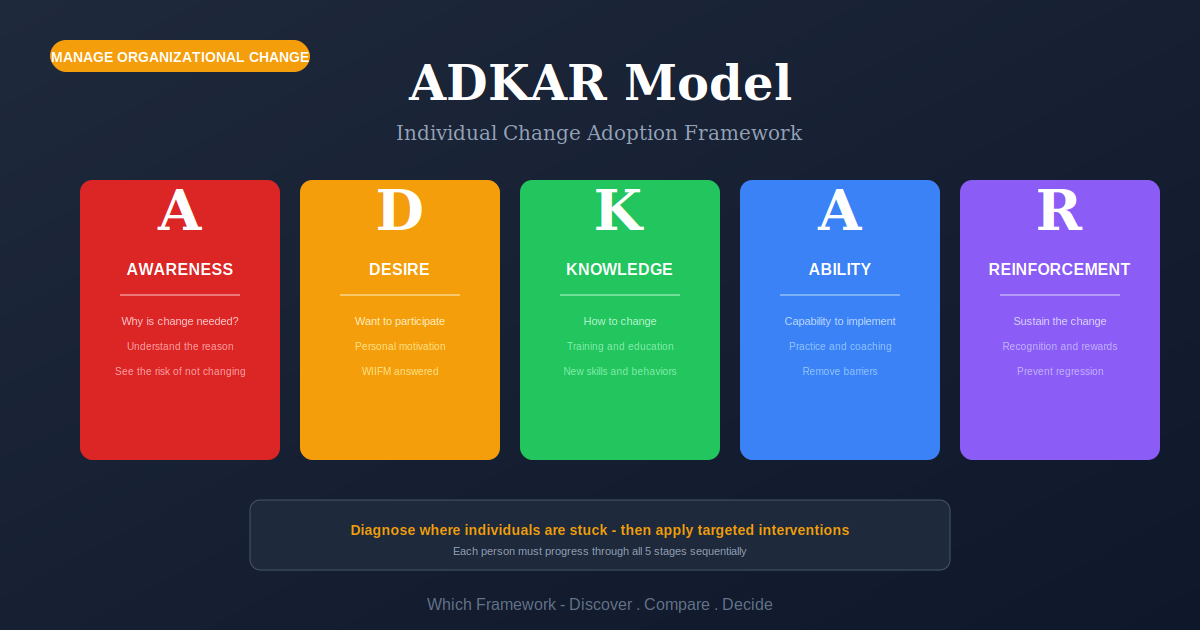
ADKAR Model: Individual Change Adoption Framework
ADKAR is an individual-level change adoption model: Awareness, Desire, Knowledge, Ability, Reinforcement. It diagnoses where people are stuck and guides targeted interventions.
Before you start
Is ADKAR your framework?
ADKAR works at the level of one person at a time. Its founding claim is that organizations do not change — individuals do, and organizational change is the aggregate. Everything else about the model follows from that, including its main limitation.
So it is the right instrument when you need to know who has adopted a change and where specifically the ones who have not are stuck. It is the wrong instrument for deciding what the change should be, sequencing a program, or handling structural obstacles that no amount of individual readiness will move.
| If your real problem is… | You probably want |
|---|---|
| We need a program to run, with phases and activities | Kotter’s 8-Step — organization-level and sequential; ADKAR measures people, not projects Compare ADKAR and Kotter |
| Adoption is high on paper and behavior reverted anyway | Lewin’s Change Model — something structural is holding the old level in place Compare ADKAR and Lewin |
| People understand it, want it, and are still grieving the old way | Bridges’ Transition Model — psychological transition, which ADKAR does not model Compare ADKAR and Bridges |
| Nobody will tell you honestly where they are stuck | Psychological Safety — an ADKAR assessment is only as good as the answers Compare the two |
| The change itself may be the wrong change | McKinsey 7S — ADKAR is silent on whether the change is a good idea |
| Ownership is unclear and decisions stall | RACI — that is a structural problem, not an adoption one |
| We need to know who has adopted, and exactly where the rest are stuck | ADKAR — you are in the right place |
The test that separates ADKAR from a five-item checklist
For a named person, can you say which of the five is the first one missing? That single answer is the entire output of the model. If the response is that awareness, desire and knowledge are all being worked on in parallel, ADKAR is being used as a list of workstreams rather than as a diagnostic.
The reason the sequence matters is that a deficit at one element cannot be repaired by working on a later one. Training somebody who does not want the change produces a trained person who does not want the change.
What Is It?
ADKAR is a change management model that describes the five things an individual must achieve, in order, for a change to stick: Awareness of why the change is needed, Desire to take part in it, Knowledge of how to change, Ability to apply that knowledge in practice, and Reinforcement to keep the new behavior in place. It was developed by Jeff Hiatt at Prosci and published in his 2006 book.
What distinguishes it from Lewin, Kotter and most other change frameworks is the unit of analysis. Those describe what an organization does. ADKAR describes what happens to a person, and treats organizational change as the sum of many individual transitions. That is why it can be scored, tracked and reported per person or per group, which most change models cannot.
The five elements are a gate sequence, not a checklist. Each one depends on the one before it, so the model’s practical output is a single finding: the barrier point, the first element where a person or group falls short. Everything downstream of that barrier is wasted effort until it is cleared.
It is also a commercial product. Prosci owns the trademark, sells certification, and publishes the benchmarking research behind it, which is worth knowing when weighing the evidence for it.
Quick Reference
The canonical structure
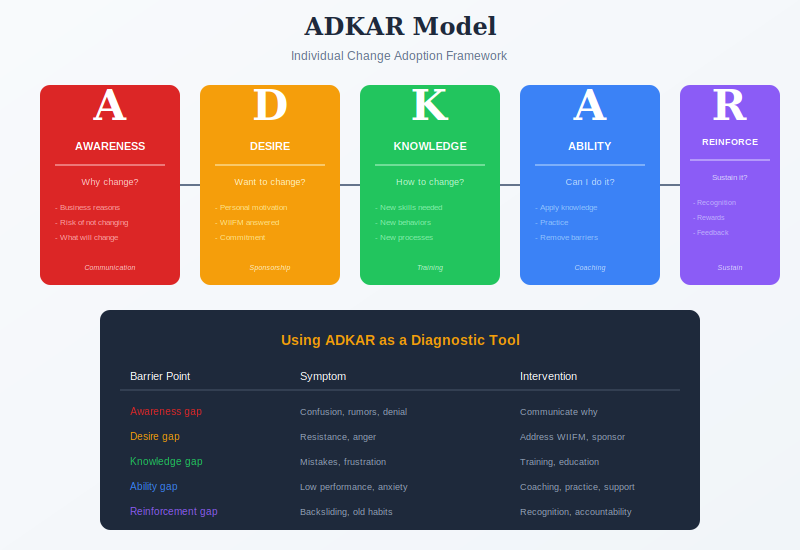
The five elements, and why the order is a gate
Each element answers a different question, fails in a different way, and needs a different intervention. The third column is the one that makes ADKAR operational — the interventions are not interchangeable, and applying the wrong one is the standard failure.
Assessments are usually scored 1–5 per element, with roughly 3 as the threshold. The first element below the threshold is the barrier point.
| Element | The question | What fixes a deficit here |
|---|---|---|
| Awareness | Do I understand why this change is happening? | Communication from someone credible about the business reason — not about the project plan. A common failure is announcing what repeatedly and never why. |
| Desire | What’s in it for me, and what does it cost me? | Removing the personal cost, or changing the incentive. Desire cannot be trained, communicated or mandated into existence, which is why it is the most common barrier point and the most commonly misdiagnosed. |
| Knowledge | Do I know how to do it? | Training, documentation, job aids. This is the element organizations reach for first, because it is the one with an obvious budget line. |
| Ability | Can I actually do it, in real conditions? | Practice, coaching, time, and removing whatever makes it harder in the live environment. Knowledge without ability is the person who passed the training and cannot do it on a busy Tuesday. |
| Reinforcement | What keeps me doing it once attention moves on? | Changing what is measured, rewarded and defaulted to. The most skipped element, because by the time it matters the project has been declared complete and the team has moved on. |
On why the sequence is not negotiable
Each element is a precondition for the next, so effort spent past the barrier point returns nothing. Run a training course for someone who has not been given a reason to want the change, and you end up with a well-trained person who still does not want it — the Knowledge score rises and nothing else moves. Put rewards in place for someone who has the knowledge but cannot yet apply it under real conditions, and you are rewarding a behavior that is not happening.
This is also why running all five as parallel workstreams — a communications stream, a training stream, a rewards stream — feels efficient and reliably underperforms. It spends most of the budget downstream of wherever the actual barrier is.
The part that does the work
Finding the barrier point
The barrier point is the first element scoring below threshold. Finding it is the whole method, and it is usually a short conversation rather than a survey — five questions, asked in order, stopping at the first weak answer.
Two things make this harder than it sounds. The first is that people rarely say “I don’t want to,” because it sounds obstructive. A Desire deficit is almost always reported as something else — a technical complaint, a timing objection, a question about training. If somebody can explain the change accurately and still is not doing it, treat the technical objection with suspicion.
The second is that different groups have different barrier points for the same change, and an organization-wide average conceals that. Frontline staff stuck at Ability and middle managers stuck at Desire need opposite interventions, and a single blended score will point at neither.
Score by group, not for the organization. An overall ADKAR score is the least useful number the model can produce.
Core Features
- Individual-level: the unit is a person, not a department or a program
- Sequential and gated: each element is a precondition for the next
- Scoreable: typically 1–5 per element, which makes adoption measurable and reportable
- Diagnostic output: one barrier point, which determines the intervention
- Intervention-specific: each element has its own remedy, and they are not interchangeable
- Group-segmented: different populations legitimately have different barrier points
- Commercial: a Prosci trademark with certification, tooling and proprietary benchmarking behind it
Worked example
A barrier point that was misdiagnosed for five months
An illustrative composite. A 900-person insurance brokerage in Omaha replacing its quoting platform. Five months after go-live, 34% of producers were using it. The response had been three rounds of additional training.
Scores are 1–5, threshold 3, assessed separately for two groups rather than as a single company average.
| Element | Producers | Service team |
|---|---|---|
| Awareness | 4.5 | 4.2 |
| Desire | 2.1 — barrier point. Commissions were calculated from a legacy report the new platform did not feed. Using it meant losing sight of their own numbers until month end. | 3.8 |
| Knowledge | 4.0 — after three rounds of training | 4.1 |
| Ability | 3.6 | 2.4 — barrier point. Quotes took eleven minutes against four on the old system during the morning peak, because three fields defaulted wrong for their most common product. |
| Reinforcement | 1.9 | 1.9 |
| Adoption before / after | 34% → 81% | 52% → 88% |
What the assessment actually did
Two groups, two different barrier points, two opposite fixes — and a company-wide average would have shown roughly 3.4 across the board and pointed at nothing. Producers needed the commission report repointed at the new platform, a two-week piece of reporting work. The service team needed three field defaults changed. Neither needed training, and training was the only thing that had been tried for five months.
Note Reinforcement at 1.9 for both groups. Nothing had been changed in what was measured or rewarded, so the earlier 34% had been held in place by attention alone. That is the number to watch six months on.
When to Use
- When a change has launched and adoption is lower than expected, and nobody can say why
- When you need adoption reported per person or per group rather than as a project status
- Before spending on training — to check that Knowledge is actually the barrier
- Where different populations are affected differently by the same change
- Alongside a program framework such as Kotter’s 8-Step, which supplies the activities ADKAR lacks
- System, process and policy rollouts, where individual behavior is what determines success
- Six months after a change is declared complete, to test whether Reinforcement held
When NOT to Use
- To decide what the change should be — ADKAR assumes the change is already correct
- As a delivery plan: it diagnoses individuals, it does not sequence a program
- When the obstacle is structural — unclear ownership (RACI) or a process that makes the new way slower
- When people cannot answer honestly; see Psychological Safety first
- As a single organization-wide score, which averages away the only finding that matters
- For the emotional side of letting go of the old way — that is Bridges’ territory
In practice
How ADKAR goes wrong
Most failures here come from treating a diagnostic sequence as a set of parallel workstreams, and from the fact that one element has an obvious budget line and the others do not.
| What you see | What it usually means | What to do |
|---|---|---|
| The answer to poor adoption is always more training | Knowledge is the only element with an existing budget and a supplier | Assess before spending. If Desire is the barrier, a fourth training round produces a well-trained population that still will not use it. |
| All five run as parallel workstreams | The model is being read as a checklist rather than a gate sequence | Find the barrier point first and concentrate there. Effort past the barrier returns nothing. |
| One ADKAR score for the whole organization | Groups have been averaged together | Score by population. Different groups routinely have different barrier points for the same change, and the average points at neither. |
| Desire never appears as a barrier | Nobody says “I don’t want to” out loud | Treat technical objections from people who clearly understand the change as candidate Desire deficits. Ask what the change costs them personally. |
| Reinforcement was never done | The project closed at go-live | Change what is measured, rewarded and defaulted to before disbanding the team. Adoption held by attention decays when attention leaves. |
| Scores collected once, at launch | Treated as a readiness survey | Re-assess. Barrier points move — a group at Desire in month one is often at Ability in month three, needing a different intervention. |
| Low scores treated as a people problem | The model is being used to locate blame | Every element has an organizational remedy. A low Ability score is a statement about conditions, not about the person. |
Sourced
Evidence, and how to cite it
Jeff Hiatt developed it at Prosci, and published it in 2006.
Hiatt founded Prosci in 1994 and built ADKAR out of its change-management benchmarking work through the late 1990s and early 2000s. The definitive statement is his 2006 book, which sets out the five elements, the gate sequence, and the barrier-point method. The name is an acronym of the five elements and nothing more.
Hiatt, J.M. (2006) ADKAR: A Model for Change in Business, Government and our Community. Loveland, CO: Prosci Learning Center Publications.
The evidence base is the vendor’s own, and that is unusual enough to state plainly.
Prosci’s benchmarking studies are large, long-running and genuinely informative, and they are also produced by the organization that sells the certification, the tooling and the consulting. There is very little independent peer-reviewed work testing ADKAR against alternatives. This does not make it wrong — practitioners report it works, and the barrier-point logic is sound on its own terms — but claims of the form “research shows ADKAR delivers X” almost always trace back to a single interested source.
It is silent on whether the change is worth making.
ADKAR measures adoption of a change that has already been decided. A population scoring low on Desire may be resisting irrationally, or may have understood something about the change that the people who designed it have not. The model gives you no way to tell those apart, and its vocabulary quietly frames the second case as a deficiency in the individual. Worth remembering when a Desire score is low across every group at once.
It complements rather than competes with the organization-level models.
Lewin explains why behavior holds in place, Kotter supplies a program to run, ADKAR tells you which individuals have adopted and where the rest are stuck. Using ADKAR alone leaves you with a diagnosis and no delivery method; using Kotter alone leaves you with activities and no way to know whether they worked. Pairing an organization-level framework with ADKAR as the measurement layer is the standard practice for good reason.
See Lewin’s Change Model and Kotter’s 8-Step.
How to cite it.
Harvard: Hiatt, J.M. (2006) ADKAR: A Model for Change in Business, Government and our Community. Loveland, CO: Prosci Learning Center Publications.
APA: Hiatt, J. M. (2006). ADKAR: A model for change in business, government and our community. Prosci Learning Center Publications.
Note on usage: ADKAR is a registered trademark of Prosci. Citing the book is fine; reproducing their assessment instruments or training material in your own work is not.
Key Strengths
- Measurable: adoption becomes a score per person or group rather than a project status
- Diagnostic precision: one barrier point, and a specific intervention that follows from it
- Prevents the default reflex: the strongest argument against reaching for training first
- Intuitive: five plain words that stakeholders retain after one explanation
- Segments well: shows that different groups need different things from the same change
Key Weaknesses
- Assumes the change is correct and worth adopting
- Evidence comes almost entirely from the organization that sells the certification
- No activities or sequence — it needs a program framework alongside it
- Self-reported scores, and Desire in particular is systematically under-reported
- Says little about structural obstacles that individual readiness cannot overcome
- Its language can frame legitimate objection as personal deficiency
How It Works
| 1 Primary Input | Individual assessments, manager observations, change readiness |
|---|---|
| 2 Data You Need | ADKAR scores per person, barrier points, intervention history |
| 3 Primary Output | Individual change plans, targeted interventions, progress tracking |
Comparison with Related Frameworks
ADKAR vs Kotter’s 8-Step
Different units, and they are complements rather than alternatives. Kotter is an organization-level program: eight phases, run in sequence, describing what leadership does. ADKAR is individual-level measurement: five elements, scored per person, describing where each one is stuck. Kotter tells you what to do next; ADKAR tells you whether it worked and for whom. Running Kotter without ADKAR leaves you reporting activity completion as though it were adoption.
ADKAR vs Lewin’s Change Model
Lewin treats the group as the unit and asks what forces hold current behavior in place; ADKAR treats the person as the unit and asks which of five conditions is missing. They diagnose different things and often agree: a Lewin restraining force and an ADKAR Desire barrier are frequently the same fact described twice. Use Lewin when adoption looks fine and behavior reverts anyway, and ADKAR when you need to know exactly who is where.
ADKAR vs Bridges’ Transition Model
Both are about individuals, and they cover different halves. Bridges describes the internal process of letting go of the old way and gradually accepting a new one — ending, neutral zone, new beginning. ADKAR describes the conditions needed for the new behavior to appear. Someone can score well on every ADKAR element and still be in Bridges’ neutral zone: competent at the new way, not yet reconciled to it.
Sequencing
What to run before and after
ADKAR is a measurement layer. It needs a change worth making before it, and a delivery method around it, and it is worth running again long after everyone considers the work finished.
Before
Check the change is sound, and that people will answer honestly
ADKAR assumes the change is correct and that scores are truthful. Neither is free. A Desire score that is low everywhere is worth reading as feedback on the change before it is read as resistance.
During
Score by group, find the barrier, intervene there only
Assess each affected population separately, act on the first element below threshold, and re-score rather than assuming the barrier stayed put. Barrier points move as the earlier ones clear.
After
Do Reinforcement properly, then re-measure at six months
Change what is measured, rewarded and defaulted to before the project team disbands. Then check again once attention has moved on — that measurement is the only one that tells you whether the change actually took.
Common questions
ADKAR: quick answers
What is ADKAR?
ADKAR is a change management model describing the five things an individual must achieve, in order, for a change to stick: Awareness of why the change is needed, Desire to take part in it, Knowledge of how to change, Ability to apply that knowledge in practice, and Reinforcement to keep the new behavior in place. Jeff Hiatt developed it at Prosci and published it in 2006. Unlike Lewin or Kotter, which describe what an organization does, ADKAR describes what happens to a person.
What does ADKAR stand for?
Awareness, Desire, Knowledge, Ability and Reinforcement. The name is an acronym of the five elements and carries no other meaning. They are a gate sequence rather than a checklist: each element is a precondition for the next, so effort spent on a later element while an earlier one is unmet returns nothing. Training someone who does not want the change produces a trained person who does not want the change.
What is the barrier point in ADKAR?
The barrier point is the first element where a person or group falls short, and identifying it is the entire output of the model. Assessments are usually scored 1 to 5 per element with roughly 3 as the threshold; the first element below threshold determines the intervention. Everything downstream of the barrier is wasted effort until it is cleared, which is why running all five elements as parallel workstreams feels efficient and reliably underperforms.
Who created the ADKAR model, and how do I cite it?
Jeff Hiatt, founder of Prosci, developed it from the company’s change management benchmarking research and published the definitive account in 2006. Harvard style: Hiatt, J.M. (2006) ADKAR: A Model for Change in Business, Government and our Community. Loveland, CO: Prosci Learning Center Publications. APA style: Hiatt, J. M. (2006). ADKAR: A model for change in business, government and our community. Prosci Learning Center Publications. ADKAR is a registered trademark of Prosci; citing the book is fine, reproducing their assessment instruments is not.
What is the difference between ADKAR and Kotter’s 8-Step?
The unit of analysis. Kotter is organization-level: eight phases run in sequence describing what leadership does. ADKAR is individual-level: five elements scored per person describing where each one is stuck. Kotter tells you what to do next, ADKAR tells you whether it worked and for whom. They are complements rather than alternatives, and running a Kotter program without ADKAR alongside it tends to produce reports of activity completion presented as though they were adoption.
Why is Desire the most common ADKAR barrier?
Because it is the only element that cannot be communicated, trained or mandated into existence, and because it is systematically under-reported. Almost nobody says they do not want the change, since it sounds obstructive, so a Desire deficit usually surfaces as a technical complaint, a timing objection, or a request for more training. A useful rule: if somebody can explain the change accurately and still is not doing it, treat the stated objection with suspicion and ask what the change costs them personally.
How do you score an ADKAR assessment?
Rate each element from 1 to 5, typically through a short structured conversation rather than a survey, asking the five questions in order and stopping at the first weak answer. Score each affected group separately rather than producing a company-wide number: different populations routinely have different barrier points for the same change, and an average will point at neither. Re-assess as the work progresses, because barrier points move once earlier elements clear.
What are the limitations of ADKAR?
Three worth knowing. It assumes the change is already correct, so it offers no way to distinguish irrational resistance from a population that has understood something the designers missed. Its evidence base comes almost entirely from Prosci, which also sells the certification and tooling, and there is little independent peer-reviewed work testing it against alternatives. And it supplies no activities or sequence of its own, so it needs an organization-level framework such as Kotter’s alongside it to function as more than a diagnosis.
Deep Resources
Frameworks related to ADKAR Model
- Kotter's 8-Step Change ModelStructured 8-step framework for leading major organizational transformation from urgency to…
- Bridges' Transition ModelPeople-centered framework managing emotional and psychological aspects of organizational…
- Resistance Management FrameworkPractical framework for understanding, addressing, and overcoming resistance to organizational…