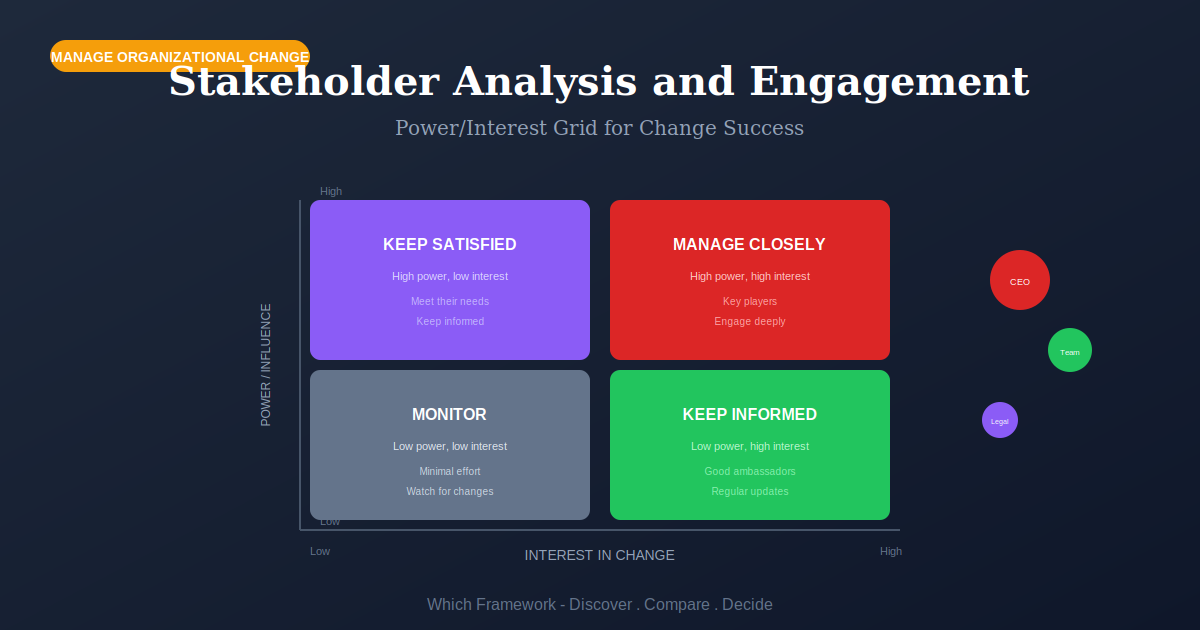
Stakeholder Analysis and the Power/Interest Grid: Four Quadrants and What Each One Needs
Stakeholder Analysis is a mapping technique that plots the people affected by a decision on two axes — their power and their interest — and reads an engagement approach from where each one lands.
Before you start
Is this your framework?
The grid answers one question: given limited attention, who gets how much of it. Everyone connected to a decision goes on a two-by-two, power on one axis and interest on the other, and the quadrant suggests how closely to work with each one.
It sorts people. It does not tell you what to say to them, it carries no view on who is right, and it records your guesses about other people's motives as though they were data. If your problem is downstream of who matters, the table below says where to go.
| If your real problem is… | You probably want |
|---|---|
| People have been mapped and are still blocking the change | Resistance Management — working out what the objection actually is, which a quadrant never tells you Compare Stakeholder Analysis and Resistance Management |
| Two people both think they own the same decision | RACI Matrix — formal responsibility per activity, which is a different question from informal power |
| The change needs a sequence, not just a stakeholder list | Kotter’s 8-Step Model — an ordered program for a large change, with stakeholder work as one part of it Compare Stakeholder Analysis and Kotter's 8-Step |
| Individuals are struggling with the change itself | Bridges’ Transition Model — the internal adjustment, which is not a function of power or interest |
| You need to know who is legitimate and who is merely loud | Mitchell, Agle and Wood's salience model, which adds legitimacy and urgency — see the comparison below |
| The organization itself needs to change shape around this | McKinsey 7S — structure, systems and staff, rather than the people around the edge of a decision |
| Too many people to consult and no basis for choosing | Stakeholder Analysis — you are in the right place |
What Is It?
List everyone who can affect the decision or be affected by it. Rate each on two things: how much power they have to help or block, and how much interest they take in the outcome. Plot them. Four quadrants fall out, and each carries a different amount of your attention.
The reason this survives is that attention really is finite. Without some basis for rationing it, consultation defaults to whoever asks loudest or sits nearest, and the quiet person who can stop the whole thing at sign-off gets found out too late.
What it is not is analysis. Both axes are your estimate of somebody else’s state of mind, made without asking them. Power is at least partly observable; interest is a guess about what a person cares about, and it is the axis that moves. A grid drawn once at kickoff is a record of what you assumed in week one.
Quick Reference
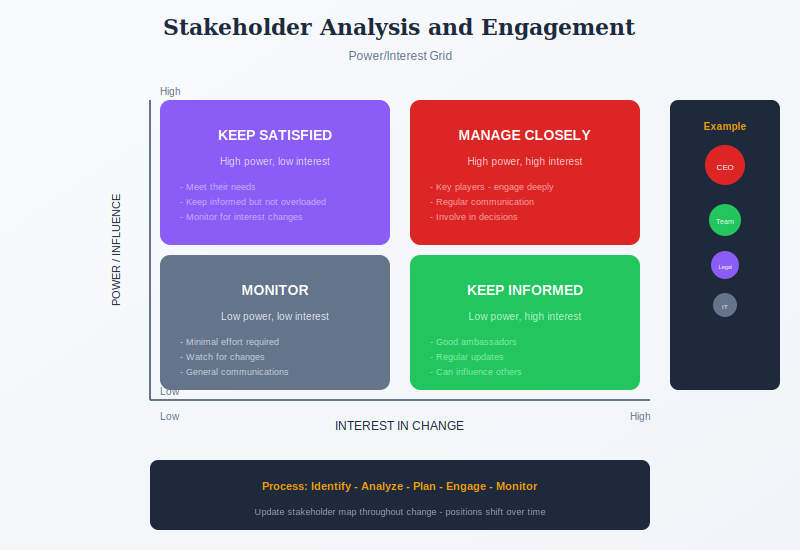
The grid
The four quadrants, and what each one needs
Two naming conventions are in circulation for the same four boxes. The engagement verbs came out of strategy textbooks; the nouns are Eden and Ackermann's. Exam questions use both, so both are given here.
| Position | What to do | What it means in practice |
|---|---|---|
| High power High interest | Manage closely Eden and Ackermann: players | Involve them in the decision itself, not in a summary of it. These people can stop the work and want to know about it, so surprises here are expensive. |
| High power Low interest | Keep satisfied Eden and Ackermann: context setters | Give them enough that they stay comfortable and no more. The risk is boring them into indifference, then waking them at sign-off with something they have no context for. |
| Low power High interest | Keep informed Eden and Ackermann: subjects | Communicate regularly and take the input seriously. They often know most about the detail, and they are the people who can make a formally approved change fail in practice. |
| Low power Low interest | Monitor Eden and Ackermann: the crowd | Minimal effort, and a periodic check that they are still there. Positions move, and this is the quadrant people move out of without warning. |
The quadrant that catches people out
High power with low interest is the one that goes wrong. The instinct is to leave them alone, because they are not asking for anything. Then the decision reaches them cold, they have authority and no context, and the safe answer from a position of no context is no.
Keep satisfied means keep them oriented, not keep them quiet. A short update they do not have to act on costs little and means the eventual approval is not the first time they have heard of it.
Disambiguation
Power and interest, or power and influence
Several grids answer to similar names and one of them is not a power-and-interest grid at all. What separates them is what the second axis measures.
| The tool | Axes | What it is for |
|---|---|---|
| Power / interest this page | Power × how much they care | Rationing engagement effort across a list |
| Power / influence | Authority × informal sway | Separating the person who signs from the person others actually listen to. Useful where the two differ |
| Power / dynamism Mendelow's original | Power × how fast their position shifts | How often to re-check a stakeholder, rather than how much to talk to them. Almost nobody uses it now |
| Salience model Mitchell, Agle and Wood | Power, legitimacy and urgency — three attributes, not two axes | Whose claim deserves attention on its merits, rather than by their capacity to cause trouble |
Power and influence are not the same axis
Power is what someone can formally do: sign, veto, fund, refuse. Influence is whether others change their minds because of them. Most organizations contain someone with no authority whose opinion decides the room.
If those two come apart in your organization, the power-and-interest grid will mislead you, because it collapses them into one axis. Run the grid on power and interest, then ask separately who the influential people are and whether any of them are sitting in a quadrant you had planned to ignore.
Core Features
- Two axes, four quadrants: power against interest, each split high and low
- An engagement level per quadrant: manage closely, keep satisfied, keep informed, monitor
- Two naming conventions: the engagement verbs, and Eden and Ackermann's players, context setters, subjects and crowd
- Positions move: interest in particular changes as the work becomes real
- Both axes are estimated: assigned by the team drawing the grid, not by the people on it
- Cheap and fast: a whiteboard and an hour, repeated at each phase
Worked example
A hospital records migration in Bergen, and the quadrant that was wrong
An illustrative composite. A Norwegian regional health trust was replacing a patient records system across four sites. The team mapped nineteen stakeholders at kickoff and worked the grid for eight months.
| Stakeholder | What happened |
|---|---|
| The clinical director | Mapped high power, high interest, and managed closely throughout. Correct, and uneventful, which is what the quadrant is supposed to produce. |
| The data protection officer | Mapped high power, low interest, and put on a quarterly summary. The summaries were not read. At pre-launch review the officer saw the cross-site access model for the first time and refused sign-off: six weeks lost, roughly NOK 2.1 million in held contractor time. |
| The ward nursing staff | Mapped low power, high interest, and kept informed. They supplied the detail that the drug chart workflow did not match how handover ran, caught in month three rather than after launch. |
| A senior consultant at one site | Mapped low power, correctly: no formal authority at all. But three of the four site leads deferred to this person, and one skeptical remark in a departmental meeting reversed a site's position for a month. |
| What changed on the second pass | The grid was redrawn at each phase gate. The data protection officer moved to a fortnightly ten-minute call. Influence was recorded as a separate note against each name, outside the two axes. |
Two failures, and only one was the grid's fault
The data protection officer was a straightforward misreading of keep satisfied as leave alone. Low interest is not permission to stop explaining; it is permission to explain briefly. The cost of the fortnightly call would have been about two hours a month.
The consultant is the harder case, because the grid was not wrong. That person genuinely had no power in the sense the axis means. What a grid cannot represent is that other people's positions moved because of them.
When to Use
- A change touches more people than you can consult properly
- Early in a project, before communication plans are written
- At each phase gate, since positions move as the work becomes real
- When a decision keeps stalling and it is not clear who is holding it
- Onboarding into an unfamiliar organization, where the map is also a learning exercise
- Where a formal approval chain exists and you need to know who is on it
When NOT to Use
- As a substitute for talking to people, since both axes are guesses until you do
- Where formal power and real influence come apart badly, unless you track influence separately
- To decide whose objection is legitimate, which the grid has no view on
- In a group small enough that everyone is being consulted anyway
- As a permanent artifact, because interest is the axis that changes fastest
- To justify excluding people whose interest is low because nobody has told them anything
In practice
How the grid goes wrong
Most failures come from treating a quadrant as a verdict on a person rather than a decision about your own attention.
| Failure mode | What it looks like | What to do instead |
|---|---|---|
| Keep satisfied read as leave alone | A powerful, uninterested person meets the decision for the first time at sign-off | Send something short and regular they do not have to act on. Orientation, not silence. |
| Drawn once | A kickoff grid still on the wall in month eight, describing week one | Redraw at every phase gate. Interest moves as the change becomes concrete. |
| Influence collapsed into power | Someone with no authority quietly reverses a decision | Note influence separately against each name. The grid has no axis for it. |
| Guessed, never checked | Interest ratings assigned in a room none of the stakeholders were in | Ask a few of them. Ten minutes each corrects more than an hour of team debate. |
| Used to dismiss objections | A valid concern discounted because its owner sits in the monitor box | The grid rations attention, not legitimacy. Judge the argument on its own terms. |
| Left where people can read it | A shared slide rating named colleagues as low interest and low power | Keep it to the working team. The map is about your effort, and it does not read that way to the mapped. |
Sourced
Evidence, and how to cite it
The stakeholder concept comes from Freeman.
Freeman's 1984 book made the case that an organization answers to any group that can affect or is affected by its objectives, not only to shareholders. That is the idea every mapping tool since has been trying to make workable, because a definition that broad leaves you with a list and no way to rank it.
Freeman, R.E. (1984) Strategic Management: A Stakeholder Approach. Boston: Pitman.
Mendelow's matrix was not a power and interest grid.
The grid is widely called Mendelow's matrix. Mendelow's 1981 conference paper proposed a grid of power against dynamism — how fast a stakeholder's situation changes — to decide how often to scan each one. The paper's own abstract says so. Interest does not appear as an axis.
Mendelow, A.L. (1981) ‘Environmental Scanning: The Impact of the Stakeholder Concept’, Proceedings of the Second International Conference on Information Systems, Cambridge, MA.
The interest axis, and a wrong date, came from a textbook.
Johnson and Scholes adapted Mendelow's model in Exploring Corporate Strategy, replacing the dynamism axis with interest. They also cited Mendelow's paper as 1991 rather than 1981, and that error has been copied into most things written about the grid since. If you have seen Mendelow 1991, this is why.
Johnson, G. and Scholes, K. Exploring Corporate Strategy; the adaptation is described in Olander, S. and Landin, A. (2005) International Journal of Project Management, 23(4), pp. 321–328.
The quadrant names are Eden and Ackermann's.
Players, subjects, context setters and the crowd come from Making Strategy, where the grid is set out as a practical mapping technique. Exam questions draw on this vocabulary as often as on the engagement verbs, and the two sets describe the same four boxes.
Eden, C. and Ackermann, F. (1998) Making Strategy: The Journey of Strategic Management. London: Sage, p. 349.
How to cite it.
For the power/interest grid: cite Eden, C. and Ackermann, F. (1998) Making Strategy. London: Sage, or Johnson and Scholes for the axis substitution.
For Mendelow, cite the 1981 ICIS proceedings and note that his axes were power and dynamism.
For the stakeholder concept, cite Freeman (1984). For the salience alternative, cite Mitchell, R.K., Agle, B.R. and Wood, D.J. (1997) Academy of Management Review, 22(4), pp. 853–886.
Key Strengths
- Rations attention explicitly: the alternative is responding to whoever is loudest
- Immediately understood: two axes, four boxes, no training needed
- Surfaces the quiet blocker: the powerful uninterested person is easy to miss otherwise
- Costs an hour: a whiteboard and the working team
- Produces a communication plan: each quadrant implies a cadence and a format
Key Weaknesses
- Both axes are guesses: ratings assigned without asking the people rated
- No axis for influence: sway without authority is invisible to it
- Silent on legitimacy: it ranks capacity to disrupt, not whether a claim is fair
- Goes stale quickly: interest moves as the change becomes real
- Tells you nothing about content: a quadrant is a cadence, not a message
- Awkward if seen: nobody enjoys reading that they were rated low power
Sequencing
What to run before and after
The grid sorts a list you must already have, and stops well short of the conversations it implies.
Before
Build the list, and know what the change is
The grid ranks names; it does not generate them. Missing a stakeholder entirely is a worse failure than misplacing one, and no quadrant will reveal an absence.
During
Find out what the objections actually are
A quadrant sets how often you talk to someone. It has nothing to say about why a person is against the change, and resistance handled as a communication problem when it is a substantive one gets worse.
After
Support the people going through it
Once the mapping is done and the change lands, the problem stops being who to talk to and becomes what the change is doing to individuals, which no axis on this grid measures.
Common questions
Power/interest grid: quick answers
What is the power/interest grid?
A two-by-two that plots each stakeholder by how much power they hold over a decision and how much interest they take in it. The quadrant a person lands in suggests how much of your attention they get: manage closely, keep satisfied, keep informed, or monitor. It is also called the stakeholder grid, the power-interest matrix, and Mendelow's matrix.
What are the four quadrants of the power/interest grid?
High power and high interest: manage closely, called players. High power and low interest: keep satisfied, called context setters. Low power and high interest: keep informed, called subjects. Low power and low interest: monitor, called the crowd. The verbs come from strategy textbooks and the nouns from Eden and Ackermann; both describe the same four boxes.
A stakeholder has high power but low interest. What is the correct engagement strategy?
Keep satisfied. Someone with authority over the decision who is not currently paying attention needs enough contact to stay oriented, and no more. The mistake is reading keep satisfied as leave alone: they then meet the decision cold at approval, hold real power, and have no context to say yes with. A finance director or data protection officer usually sits here.
What is the difference between power and interest?
Power is what someone can do to the decision: sign it, veto it, fund it, refuse it. Interest is how much they care what happens. The two are independent, which is the point of using them as separate axes, and the combination that causes most trouble is high power with low interest.
What is the difference between the power/interest grid and the power/influence grid?
The second axis. Power and interest measures how much someone cares. Power and influence measures formal authority against informal sway, separating the person who signs from the person others actually listen to. If those two differ sharply in your organization, run the power/interest grid and record influence as a separate note, because the grid has no axis for it.
Who created the power/interest grid?
It has no single author. Aubrey Mendelow's 1981 paper is usually credited, but his grid plotted power against dynamism, not interest. Johnson and Scholes swapped dynamism for interest in Exploring Corporate Strategy, and Eden and Ackermann set the grid out as a mapping technique in Making Strategy in 1998, naming the four quadrants. Johnson and Scholes also dated Mendelow's paper to 1991, which is why that year appears so widely.
Who are players, subjects, context setters and the crowd?
Eden and Ackermann's names for the four quadrants. Players have both high power and high interest. Subjects have high interest but low power. Context setters have high power but low interest. The crowd have little of either. The terms appear in coursework more often than in practice, where the engagement verbs are more common.
How often should a stakeholder analysis be updated?
At every phase gate, at minimum. Interest is the axis that moves: people who were indifferent while the change was abstract become engaged when it reaches their team. A grid drawn at kickoff and never revisited is a record of what the team assumed in week one, not a description of who matters now.
Deep Resources
Frameworks related to Stakeholder Analysis
- Resistance Management FrameworkWhat to do once mapping is done and somebody is still against it…
- RACI MatrixFormal responsibility per activity, which is a different question from informal power…
- Kotter's 8-Step Change ModelThe ordered program a stakeholder map is usually one input to…