Resistance Management: Six Responses, and How to Tell Which One Fits
Resistance Management is a set of responses to opposition during organizational change, each matched to the reason a particular person or group is opposing rather than applied uniformly.
Before you start
Is this your framework?
This answers one question: somebody is blocking the change, so what do you actually do about it. Six responses exist, they cost very different amounts, and which one fits depends entirely on why the person is opposing.
The first move is not choosing a response. It is checking whether what you are calling resistance is opposition at all, because a well-founded objection and a fear of losing status look identical from the outside and need opposite handling.
| If your real problem is… | You probably want |
|---|---|
| We need to know which specific thing each person is missing | ADKAR — five named conditions per individual, each with a corrective action Compare Resistance Management and ADKAR |
| People are not opposing, they are grieving what has gone | Bridges’ Transition Model — the internal adjustment, which looks like resistance and is not Compare Resistance Management and Bridges |
| We do not know who matters or how much attention each gets | Stakeholder Analysis — mapping before engaging |
| The change program itself has no structure | Kotter’s 8-Step Model — the ordered sequence this sits inside |
| Nobody will say what they actually think | Psychological Safety — silence is not agreement, and quiet opposition is the expensive kind |
| The change keeps sliding back once we stop pushing | Lewin’s Change Model — why a system returns to its old shape |
| Leading a large change so that it actually sticks | The organizational change playbook, where resistance management is stage 4 of 5 |
| Specific people are blocking a change and you must decide how to respond | Resistance Management — you are in the right place |
What Is It?
The useful core is a matching exercise. People oppose a change for different reasons, and the response that works for one reason is wasted or harmful on another. Explaining the logic more clearly does nothing for a person who understood it perfectly and stands to lose their job.
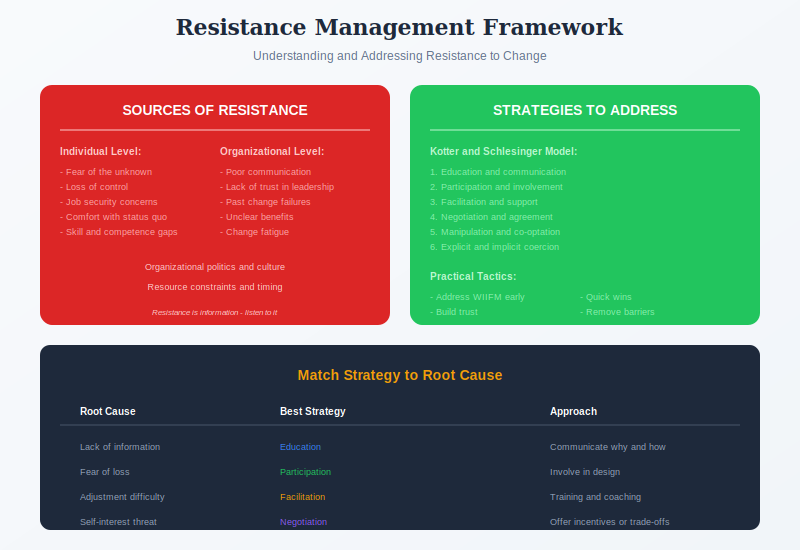
Four reasons cover most cases: self-interest, where somebody expects to lose something; misunderstanding, usually paired with low trust; a different assessment, where they have weighed the same facts and reached another conclusion; and low tolerance, where the person doubts they can work the new way.
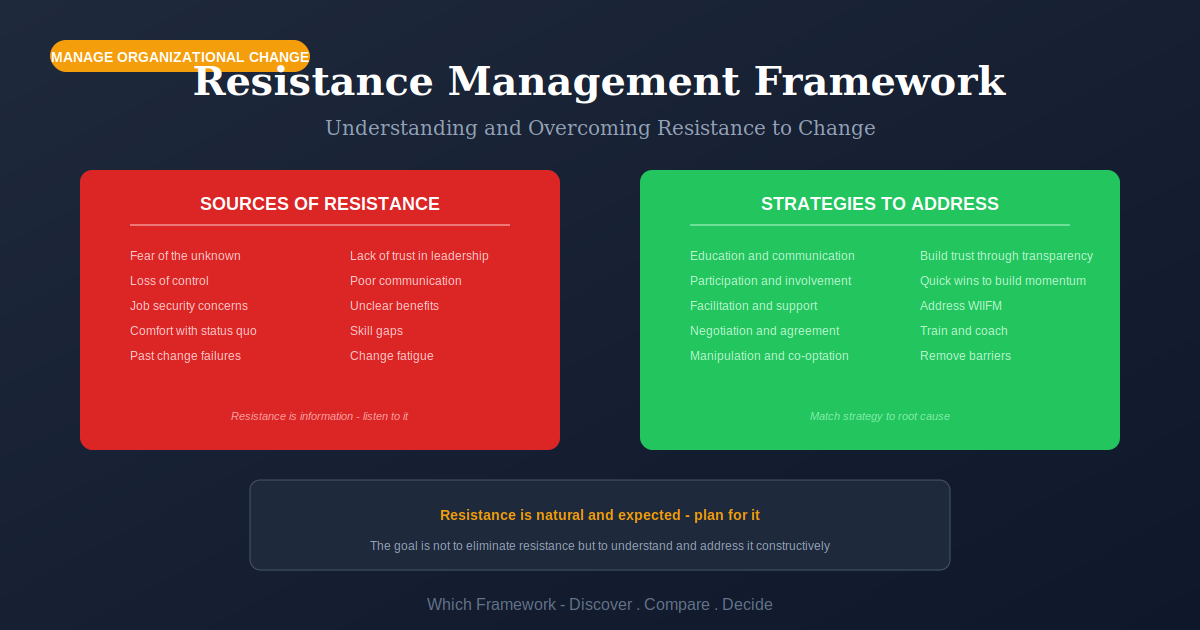
Against those sit six responses, running from education through participation, support and negotiation to co-optation and outright coercion. The last two are in the list because they are used, not because they are recommended. They are fast, and they leave people who will oppose the next change too.
Quick Reference
The six responses
What each one costs, and when it fits
Ordered from slowest and most durable to fastest and most damaging. The working rule is to use the lightest response that addresses the actual reason, and to escalate only when it fails.
| Response | Fits when | Cost |
|---|---|---|
| Education and communication | The objection rests on wrong or missing information | Slow, and useless if the information was never the problem |
| Participation and involvement | You need commitment, and the people affected know things you do not | Slowest, most durable, and the one with the best evidence behind it. You must be willing to change the design |
| Facilitation and support | People are struggling to adjust rather than disagreeing | Time and training. Nothing else works on a fear of not coping |
| Negotiation and agreement | Someone will genuinely lose out and has the power to block | Expensive, and it teaches everyone watching that blocking pays |
| Manipulation and co-optation | Nothing else is available and speed is critical | Fast and cheap until it is found out, after which nothing you say is believed |
| Explicit and implicit coercion | Speed matters more than goodwill and you hold the authority | Fast. Leaves people who will oppose the next change, and the one after that |
Why the bottom two are listed at all
They are described because managers use them, and a framework that pretended otherwise would be less useful. Both work in the narrow sense that the change goes through. Both spend trust that was accumulated slowly and is not replaced.
The cost lands on the next change, not this one, which is exactly why they keep getting chosen. Whoever runs the following program inherits an organization that has learned what consultation here is worth.
Before you respond
Is it resistance at all?
The label does a lot of quiet work. Calling something resistance places the problem in the other person and makes the change itself unexaminable. Three quite different things get the same name.
| What it might be | How to tell | What it needs |
|---|---|---|
| A valid objection | The person can state a specific consequence you had not considered, and it holds up | Change the plan. No amount of communication fixes a design problem |
| A loss | The objection shifts each time you answer it, because the stated reason is not the real one | Name what is being lost. Status, autonomy and expertise are the usual three |
| A failure by the change agent | Commitments were broken, the reasoning was never explained, or the last change went badly | Fix your own behavior first. The resistance is a reasonable response to it |
The label is doing more than describing
Research on this is unusually pointed. People do not resist change as such; they resist losing status, pay, comfort or competence, and calling that resistance to change turns a specific, addressable grievance into a personality trait. It also puts the change beyond question.
The practical test is whether the objection survives being answered. If it does, you have a design problem. If it moves, you have a loss to name. If it started after you broke a commitment, you have neither — you have a consequence.
Core Features
- Diagnosis before response: the reason decides the remedy
- Four common reasons: self-interest, misunderstanding, different assessment, low tolerance
- Six responses: education, participation, support, negotiation, co-optation, coercion
- Lightest effective touch: escalate only when something has actually failed
- Person by person: the unit is an individual or a group, not the organization
- Descriptive about coercion: the harsh options are documented, not endorsed
Worked example
A hospital rollout in Surabaya, and three responses to one change
An illustrative composite. An Indonesian private hospital group moved from paper drug charts to electronic prescribing across four sites. Opposition appeared immediately and was treated as one problem.
| Who | What was underneath it |
|---|---|
| Senior consultants | Said the system would slow rounds. It would: the workflow assumed one prescriber per patient and their rounds had three. A valid objection. The build was changed and two of them joined the design group. |
| Senior ward nurses | Objected on patient safety, then on training time, then on hardware. The reason kept moving. What had actually gone was twenty years of knowing the chart system better than anyone — a loss, not an argument. |
| What was tried first | More communication, for everybody. Three town halls. It addressed the consultants' point not at all and the nurses' point not at all. |
| What worked | Design change for the consultants. For the nurses, a super-user role that made their knowledge visible again, which cost about IDR 180 million in backfill over four months. |
| What the group learned | The pharmacy team had been coerced through a similar rollout two years earlier. Their opposition this time was not about the system at all. |
One label, three different problems
Everything above was reported to the board as resistance, and the first response was communication for all of it. That is the default, and it addressed exactly one of the three causes present, which happened to be the one nobody had.
The pharmacy case is the one worth remembering. Coercion two years earlier had worked, in that the change went through. The bill arrived on the next program, charged to somebody who had not run the first one.
When to Use
- A change is stalling and specific people or groups are visibly blocking it
- Before a rollout, to work out where opposition is likely and why
- When the default response has been communication and it has not worked
- Where different groups are objecting for reasons that are plainly not the same
- Coaching managers who reach for authority as a first move
- After a change has failed, to work out which cause was never addressed
When NOT to Use
- Before checking whether the objection is correct, since some resistance is right
- As a way to classify people, rather than to choose your own next action
- Where the real problem is that people cannot do the new work yet
- When nobody is objecting and adoption is simply slow, which is a different problem
- To justify coercion by pointing at its presence on the list
- Where the change agent's own conduct is the cause and has not been addressed
In practice
How resistance work goes wrong
Most failures are one of two moves: skipping the diagnosis, or using the label to avoid examining the change.
| Failure mode | What it looks like | What to do instead |
|---|---|---|
| Communication as the answer to everything | Town halls and newsletters aimed at people who understood perfectly and object anyway | Diagnose first. Education only fixes a shortage of information. |
| Valid objections labeled resistance | The person who found the flaw becomes the problem | Test whether the objection survives being answered. If it does, change the plan. |
| Participation that changes nothing | A working group convened after every decision is already made | Only involve people where you would genuinely act on what they say. Otherwise it is worse than not asking. |
| Negotiating with the loudest | Concessions to whoever pushes hardest, watched by everyone else | Reserve negotiation for real losses held by people who can genuinely block. |
| Silence read as agreement | No objections raised, and the change quietly fails at implementation | Absence of resistance is not consent. Go and ask, individually. |
| Coercion, then surprise next time | A forced change succeeds, and the following one meets a wall | Count the cost on the next program, since that is where it lands. |
Sourced
Evidence, and how to cite it
The six responses are Kotter and Schlesinger's.
Their 1979 article set out four reasons people resist — parochial self-interest, misunderstanding and low trust, different assessments of the situation, and low tolerance for change — and six approaches for handling them, with the trade-offs of each. Harvard Business Review reprinted it in 2008, which is why both dates appear in citations.
Kotter, J.P. and Schlesinger, L.A. (1979) ‘Choosing Strategies for Change’, Harvard Business Review, 57(2), pp. 106–114.
Participation has the oldest evidence behind it.
Coch and French ran what is still the reference experiment, at a clothing factory in Virginia. Groups that took part in designing a change in working methods recovered output faster and had markedly lower turnover than groups the change was announced to. It is the empirical root of the participation response, and it is nearly eighty years old.
Coch, L. and French, J.R.P. (1948) ‘Overcoming Resistance to Change’, Human Relations, 1(4), pp. 512–532.
The phrase itself has been challenged.
Dent and Goldberg traced how resistance to change became a fixed idea and argued it does not describe anything real. People do not resist change as a category; they resist losing status, pay or comfort. Treating it as a trait converts a specific grievance into a psychological defect and puts the change beyond question.
Dent, E.B. and Goldberg, S.G. (1999) ‘Challenging ‘Resistance to Change’’, Journal of Applied Behavioral Science, 35(1), pp. 25–41.
Change agents help produce the resistance they report.
Ford, Ford and D'Amelio argued that accounts of resistance are written by the people whose change is being resisted, and rarely mention broken agreements, poor communication or a badly handled previous change. They also make the more useful point that resistance carries information: an engaged objector is telling you something an indifferent one will not.
Ford, J.D., Ford, L.W. and D'Amelio, A. (2008) ‘Resistance to Change: The Rest of the Story’, Academy of Management Review, 33(2), pp. 362–377.
How to cite it.
Harvard: Kotter, J.P. and Schlesinger, L.A. (1979) ‘Choosing Strategies for Change’, Harvard Business Review, 57(2), pp. 106–114.
APA: Kotter, J. P., & Schlesinger, L. A. (1979). Choosing strategies for change. Harvard Business Review, 57(2), 106–114.
There is no single Resistance Management framework to cite. The name covers a practice; the six responses are the citable part, and the critique should be cited alongside them.
Key Strengths
- Stops communication being the only tool: which is the default and usually wrong
- Matches remedy to cause: a real diagnosis rather than a single tactic
- Honest about the harsh options: it names coercion and its price
- Participation has strong evidence: one of the better-supported claims in change work
- Immediately usable: six options on one page, no instrument, no training
Key Weaknesses
- The label misdiagnoses: resistance often names a loss or a valid objection
- Written from the change agent's side: their own contribution is rarely counted
- No test for a correct objection: nothing in it says when to abandon the change
- Coercion is available: and its presence on the list gets read as permission
- Diagnosis is guesswork: you are inferring a motive you cannot observe
- Little evidence beyond participation: the other five rest on experience
Sequencing
What to run before and after
Choosing a response assumes you know who is objecting and why. Both of those come from elsewhere.
Before
Know who is affected and how much power they hold
Responses cost different amounts and you cannot run the expensive ones on everybody. Knowing who can actually block the change decides where the effort goes.
During
Separate opposition from adjustment
Somebody working through the loss of a familiar way of working is not resisting, and none of the six responses is the right answer for them. The two look identical from outside.
After
Make it safe to object next time
The cheapest resistance to handle is the kind you hear early. Where raising a problem is costly, opposition goes quiet and reappears at implementation, where it is far more expensive.
Part of a playbook: How to Manage Organizational Change. Resistance management is stage 4 of 5, after ADKAR and before Bridges' Transition Model.
Common questions
Resistance Management: quick answers
What is resistance management?
The practice of diagnosing why people are opposing a change and choosing a response that fits that reason. The best-known version pairs four common causes with six responses, running from education and participation at one end to co-optation and coercion at the other.
What are the six approaches to managing resistance to change?
Education and communication, participation and involvement, facilitation and support, negotiation and agreement, manipulation and co-optation, and explicit or implicit coercion. They are ordered from slow and durable to fast and costly. The working rule is the lightest response that addresses the actual cause, escalating only when it fails.
Why do people resist change?
Four reasons cover most cases: self-interest, where somebody expects to lose something concrete; misunderstanding, usually alongside low trust; a different assessment, where they have weighed the same facts and reached another conclusion; and low tolerance, where they doubt they can work the new way. Each calls for a different response, and explaining the change again only helps the second.
Is resistance to change always a bad thing?
No, and treating it that way is the common error. An objection that survives being answered is usually a design problem you have not seen yet. An engaged objector is also telling you something an indifferent employee will not. The useful test is whether the reason stays the same each time you address it.
What is wrong with the term resistance to change?
It locates the problem in the other person and puts the change itself beyond question. Researchers have argued that people do not resist change as a category at all: they resist losing status, pay, autonomy or competence. Naming the specific loss gives you something to work with, where the general label gives you nothing.
Does participation actually reduce resistance?
It has the strongest evidence of the six. The reference study, run in a clothing factory in 1948, found groups that helped design a change in working methods recovered output faster and left at markedly lower rates than groups the change was announced to. The condition is that you must be willing to change the design, or involvement is worse than not asking.
When is it acceptable to use coercion?
It is on the list because managers use it, not because it is recommended. It works in the narrow sense that the change goes through, and it spends trust that took years to build. The cost mostly lands on the next change rather than this one, which is why it keeps getting chosen and why organizations are repeatedly surprised by the resistance to the following program.
What is the difference between resistance management and ADKAR?
Scope. ADKAR names five conditions each individual needs and tells you which one is missing. Resistance management starts from visible opposition and asks what is causing it and what response fits. They work well together: ADKAR is better at diagnosis across a population, and the six responses are better once a specific person or group is actively blocking something.
Deep Resources
Frameworks related to Resistance Management
- ADKAR ModelWhich of five conditions a named individual is missing…
- Bridges' Transition ModelFor opposition that turns out to be adjustment rather than disagreement…
- Stakeholder AnalysisWho can actually block this, and how much attention each one gets…