Lewin's Change Model: Unfreeze-Change-Refreeze
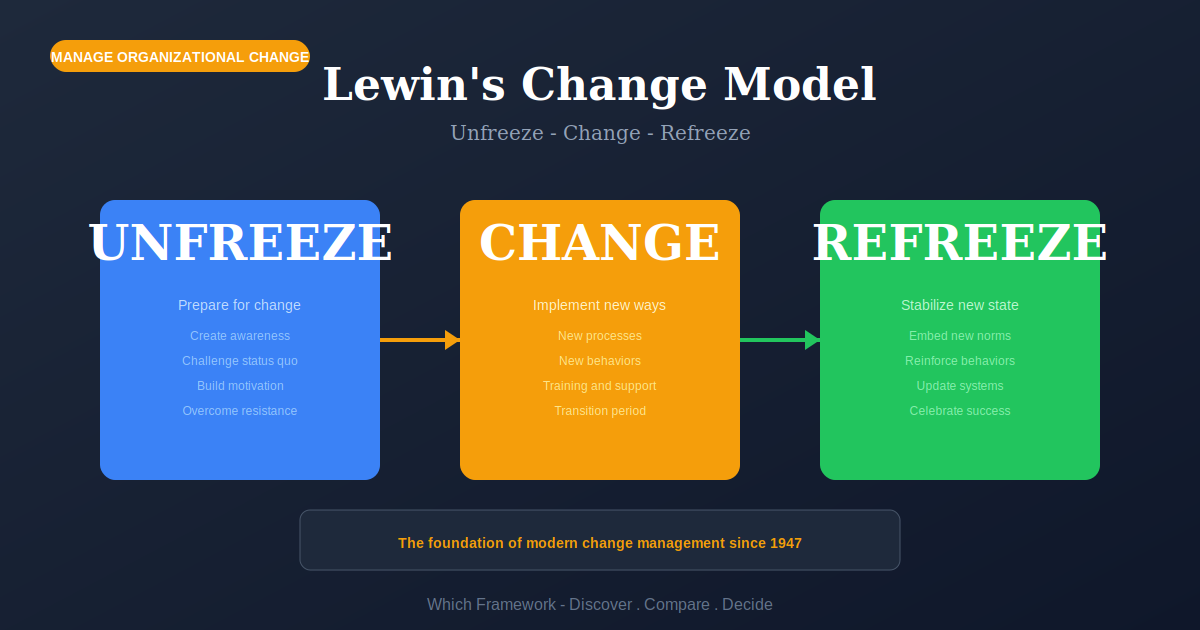
Lewin's Change Model is the foundational 3-stage framework for understanding change: Unfreeze (prepare), Change (transition), and Refreeze (stabilize).
Before you start
Is Lewin’s model your framework?
Lewin’s model explains why behavior holds steady and what it would take to shift it. It is a theory of equilibrium borrowed from physics: current practice persists because the forces pushing for change and the forces holding it in place are balanced, and nothing moves until that balance is disturbed.
That makes it a diagnostic lens rather than a delivery method. It has three named steps and no activities, no roles, no sequence of meetings and no checklist. Teams looking for a change program to run will find the model thin; teams trying to understand why the last one failed will find it unusually sharp.
| If your real problem is… | You probably want |
|---|---|
| We need a program to run, with steps and a sequence | Kotter’s 8-Step — the operational descendant, with actual activities Compare Lewin and Kotter |
| We need to track adoption person by person | ADKAR — individual-level and measurable, where Lewin is group-level and conceptual Compare Lewin and ADKAR |
| The change already happened and people are struggling with it | Bridges’ Transition Model — psychological transition, not structural change Compare Bridges and ADKAR |
| People will not say what is really blocking it | Psychological Safety — you cannot list restraining forces nobody will name |
| The change is structural and touches the whole organization | McKinsey 7S — seven interdependent elements rather than one equilibrium |
| Change is continuous and there is no stable state to return to | Kanban — the refreeze step assumes an end, and some environments have none |
| We want to understand why the last change did not stick | Lewin’s Change Model — you are in the right place |
The test that separates real Lewin from the vocabulary
Have you listed the restraining forces, and are you removing them rather than adding pressure? Lewin’s central claim is that increasing the driving forces raises tension and provokes resistance, while reducing the restraining forces moves the equilibrium at lower tension and holds better.
So a team that “unfreezes” by adding mandates, dashboards, town halls and incentives is doing the precise opposite of what the model prescribes — using Lewin’s words to describe an approach he argued against.
What Is It?
Lewin’s change model describes organizational change as the disturbance and re-establishment of an equilibrium, usually summarized in three steps: unfreeze, move and refreeze. Kurt Lewin, a social psychologist who founded the Center for Group Dynamics at MIT, set out the formulation in a 1947 paper in Human Relations, the year he died.
The idea beneath it is what Lewin called quasi-stationary equilibrium. Current behavior is not static through inertia; it is held in place by opposing forces in balance — pressures to change on one side, and constraints, habits and interests on the other. Nothing shifts until that balance is disturbed, and it settles again as soon as a new balance forms.
That framing produces one genuinely counterintuitive prescription. Because the level is held by opposing forces, you can move it either by strengthening the drivers or by weakening the restraints. Lewin argued for the second, on the grounds that adding pressure raises tension and generates resistance, while removing constraints achieves the same movement more quietly and more durably.
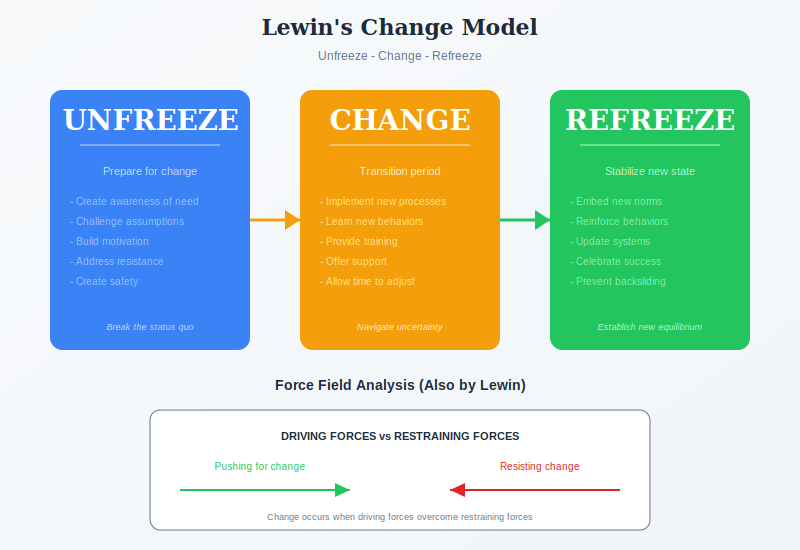
The tool that does this work is force field analysis: list the driving forces, list the restraining forces, and act on the restraints. Teaching the three steps without it is teaching the label rather than the method.
Quick Reference
The canonical structure
Unfreeze, move, refreeze — and the engine underneath
Lewin’s own wording was unfreezing, moving, and freezing. “Refreezing” and “change” as the middle step are later glosses that stuck, which is why you will meet the model under several slightly different labels — unfreeze-change-refreeze, unfreeze-move-refreeze, unfreezing-moving-freezing. They describe the same three steps.
The right-hand column is the part usually missing. Each step has a corresponding move in the force field, and that is where the actual work sits.
| Step | What it means | What you actually do |
|---|---|---|
| 1. Unfreezing | Disturb the existing equilibrium so the current level stops being self-sustaining. | List the restraining forces and start removing them. Not adding urgency — that raises tension against the same restraints and produces resistance rather than movement. |
| 2. Moving often written as Change | The level shifts. Lewin treated this as a period of exploration rather than a plan being executed. | Run it as learning: try, observe, adjust. Lewin’s companion method here is action research, which is iterative by design. |
| 3. Freezing usually written as Refreezing | A new equilibrium forms and holds the new level in place. | Change what holds behavior, not what encourages it — the forms, the defaults, the schedule, the system fields, what gets measured. If the only thing holding the new level is enthusiasm, it will decay to the old one. |
On the direction of the force
The whole model turns on one asymmetry that is almost always dropped when it is taught. Two ways exist to move the level, and they are not equivalent. Strengthening the driving forces moves it under higher tension, with resistance rising in step. Weakening the restraining forces moves it at lower tension, and the new level is more stable because less is pushing back.
Nearly every change program that quotes Lewin does the first and calls it unfreezing.
A common confusion
Did Lewin actually propose a three-step model?
This is contested in the academic literature, and the honest answer is more interesting than either simple version. Lewin died in February 1947, and the three-step passage everyone quotes is a short section of one paper published that year. It was never presented as a standalone change methodology.
In 2016 Stephen Cummings, Todd Bridgman and Kenneth Brown argued in Human Relations that the “three-step model” as taught today is largely a posthumous construction — assembled by later writers from a brief passage and gradually detached from everything around it. Bernard Burnes, who has defended Lewin’s legacy at length, takes a different line: the steps are genuinely Lewin’s, but they are inseparable from the rest of his work, and presenting them as a linear three-stage recipe is the misrepresentation.
Both agree on the practical point. Lewin’s planned approach to change had four interlocking parts — field theory (behavior as a product of forces in a field), group dynamics (the group, not the individual, as the unit of change), action research (change through iterative cycles of act and study), and the three steps. The three steps are the summary; the other three are the method.
Practical consequence: if a course teaches you unfreeze-change-refreeze and stops, you have been given the index entry rather than the book.
Core Features
- Equilibrium, not inertia: current behavior is actively held in place by balanced opposing forces
- Three steps: unfreezing, moving and freezing — commonly written unfreeze, change, refreeze
- Force field analysis as the operating tool: list drivers, list restraints, act on the restraints
- Remove rather than push: reducing restraining forces moves the level at lower tension than adding drivers
- Group-level: Lewin treated the group as the unit of change, not the individual
- Diagnostic, not procedural: it explains why change sticks or slips; it prescribes no activities
- Refreezing is structural: the new level holds through systems and defaults, not enthusiasm
Worked example
Two attempts at the same change
An illustrative composite. A 400-bed hospital system in Cleveland introducing a structured written handoff at shift change, replacing an informal verbal one. The first attempt ran for four months. The second used a force field analysis first.
Nothing about the goal changed between attempts. Only the direction of the force did.
| First attempt — adding drivers | Second attempt — removing restraints | |
|---|---|---|
| Unfreezing | Mandatory e-learning, a memo from the chief medical officer, adoption dashboards by unit | Sat with three night shifts and wrote down what actually stopped people |
| What the restraints turned out to be | Never established | The form took about six minutes against ninety seconds for the verbal handoff; it could not be opened without logging out of the medication system; and the verbal handoff was where staff flagged which families were struggling — a function the form had no field for. |
| What changed | Nothing structural — the process stayed as designed | Form cut from 23 fields to 8; single sign-on so it opened alongside the medication system; a free-text handover note added for the social context |
| Moving | Rolled out to all units at once | Two units for three weeks, adjusted twice, then extended |
| Freezing | Dashboards kept running; compliance reported monthly | Old verbal-only handoff removed from the shift checklist; the form became the default screen at shift change |
| Adoption at four months | 31% | 88% |
What the force field actually did
The first attempt was not badly run. The training was good, the dashboards worked and the CMO was genuinely supportive. It failed because every one of those actions increased a driving force while all three restraints stayed exactly where they were — and the harder it pushed, the more the restraints registered as resistance.
The second attempt added no pressure at all. It removed six minutes, a login and a missing field. Note the freezing step too: adoption held because the old path was taken off the checklist, not because anyone was still being measured on it.
When to Use
- Diagnosing why a previous change was adopted and then quietly reverted
- Before designing a change program, to find out what is actually holding current behavior in place
- When resistance is high and the instinct in the room is to push harder
- Changes to established routine work — clinical, operational, manufacturing — where habits are strongly held
- Teaching change fundamentals: it is the conceptual ancestor of most later models
- As the diagnostic layer beneath Kotter’s 8-Step or ADKAR, which supply the activities it lacks
- Any time somebody proposes solving adoption with more communication
When NOT to Use
- As a delivery plan — it has no activities, roles or sequence; use Kotter’s 8-Step
- For per-person adoption tracking, which needs ADKAR
- In genuinely continuous environments, where there is no stable state to refreeze into
- For the emotional side of transition, which is Bridges’ territory
- When people will not name the real restraints — fix that first, or the force field is fiction
- As a citation of convenience: quoting Lewin while adding pressure misrepresents the model
In practice
How Lewin’s model goes wrong
Almost every failure here is a version of the same one: the vocabulary gets adopted and the mechanism does not.
| What you see | What it usually means | What to do |
|---|---|---|
| Unfreezing consists of communication and urgency | Driving forces are being added; no restraint has been touched | Write the restraining forces down before doing anything. If the list is empty, nobody has asked the people doing the work. |
| No force field analysis was done at all | The three labels are being used as a project plan | The steps are a summary of the method, not the method. Run the analysis or you are simply naming phases. |
| The restraining forces list is all attitudes | “Resistance to change” is standing in for specifics | Push for mechanics: how many minutes, how many clicks, which system, whose approval. Attitudes are usually a rational response to a restraint nobody removed. |
| Adoption climbs during the program and falls after | Nothing was frozen — the new level was held by attention | Change what holds behavior by default: forms, checklists, system fields, schedules. Remove the old path rather than discouraging it. |
| Refreezing is skipped as old-fashioned | “Continuous change” used as a reason to skip consolidation | Even continuously changing organizations need a current default. Freezing means the new level does not require effort to sustain, not that nothing will change again. |
| Applied to individuals | The unit of analysis is wrong | Lewin treated the group as the unit — norms, not people. For individual adoption, use ADKAR alongside it. |
| Cited as a linear three-stage recipe | The model has been detached from field theory and action research | Treat moving as iterative rather than as a planned rollout, and expect to adjust twice before extending. |
Sourced
Evidence, and how to cite it
The three steps appear in a 1947 paper, published the year Lewin died.
The formulation sits in “Frontiers in Group Dynamics”, in the first issue of Human Relations. Lewin describes a successful change as involving three aspects: unfreezing the present level, moving to a new level, and freezing group life on the new level. His words were unfreezing, moving and freezing — “refreezing” and “change” entered through later writers.
Lewin, K. (1947) ‘Frontiers in Group Dynamics’, Human Relations, 1(1), pp. 5–41.
Scholars dispute whether Lewin proposed a three-step model at all.
Cummings, Bridgman and Brown argue that the model as taught was assembled after Lewin’s death from a brief passage, and that its status as his central contribution is a construction of later change-management writing rather than a reading of his work. Burnes takes the opposite view on authorship but reaches a similar practical conclusion: the steps are Lewin’s, and treating them as a standalone linear recipe strips out the field theory, group dynamics and action research that made them operable.
Cummings, S., Bridgman, T. & Brown, K.G. (2016) ‘Unfreezing change as three steps’, Human Relations, 69(1), pp. 33–60; Burnes, B. (2004) ‘Kurt Lewin and the Planned Approach to Change: A Re-appraisal’, Journal of Management Studies, 41(6), pp. 977–1002.
The most-repeated criticism attacks a version Lewin may not have held.
The standard objection — that you cannot refreeze in a world of continuous change — assumes a rigid, linear, top-down model with a defined end state. Lewin’s own framing was quasi-stationary equilibrium: a level held by forces, always liable to move, never permanently fixed. Read that way, freezing means the new behavior no longer requires effort to sustain, which is compatible with continuous change rather than opposed to it. The criticism lands squarely on the textbook version and glances off the original.
Force field analysis is the part that is unambiguously his, and the part most often dropped.
The driving-and-restraining-forces analysis, and the argument that reducing restraints is preferable to increasing drivers, are central to Lewin’s field theory and are what give the three steps something to do. A practitioner using force field analysis without ever saying “unfreeze” is doing more genuine Lewin than one who runs the three steps without it.
Lewin, K. (1951) Field Theory in Social Science. New York: Harper & Row (posthumous, edited by Dorwin Cartwright).
How to cite it.
Harvard: Lewin, K. (1947) ‘Frontiers in Group Dynamics: Concept, Method and Reality in Social Science; Social Equilibria and Social Change’, Human Relations, 1(1), pp. 5–41.
APA: Lewin, K. (1947). Frontiers in group dynamics: Concept, method and reality in social science; Social equilibria and social change. Human Relations, 1(1), 5–41.
For field theory and force field analysis, cite Lewin, K. (1951) Field Theory in Social Science. New York: Harper & Row. If you are writing about the model’s status, cite Cummings et al. (2016) and Burnes (2004) together — they disagree, and citing only one misrepresents the debate.
Key Strengths
- Explains persistence: says why behavior holds, which most change models assume rather than address
- One genuinely counterintuitive prescription: remove restraints rather than add pressure
- Memorable enough to survive: three words that a whole organization can hold in mind
- Diagnostic on failed change: unusually good at explaining why the last attempt slipped back
- Foundational: most later change models are elaborations of these three steps
Key Weaknesses
- No activities, roles or sequence — it diagnoses and does not deliver
- Routinely taught without force field analysis, which leaves only vocabulary
- Group-level, so it says little about individual adoption
- “Refreeze” reads as rigid in continuously changing environments, whatever Lewin intended
- Its authorship and scope are genuinely contested in the academic literature
- Easy to invoke while doing the opposite of what it prescribes
How It Works
| 1 Primary Input | Current state assessment, change drivers, resistance factors |
|---|---|
| 2 Data You Need | Stakeholder readiness, driving and restraining forces |
| 3 Primary Output | Change plan with stages, Force Field Analysis |
Comparison with Related Frameworks
Lewin vs Kotter’s 8-Step
Kotter’s 8-Step is the operational descendant: its first four steps expand Lewin’s unfreezing, the middle steps expand moving, and the last two expand freezing. Kotter tells you what to do on Monday; Lewin tells you why it will or will not hold. They are complementary rather than competing, and the common mistake is running Kotter’s steps without ever asking Lewin’s question about what is holding current behavior in place.
Lewin vs ADKAR
ADKAR works at the level of the individual and is designed to be tracked person by person; Lewin treated the group as the unit of change, on the argument that norms hold behavior more firmly than personal conviction does. Use ADKAR when you need to know who has adopted and who has not. Use Lewin when adoption is high on paper and behavior has reverted anyway.
Lewin vs Bridges’ Transition Model
Bridges draws the distinction that Lewin does not: change is the external event, transition is the internal process people go through afterwards. Lewin’s model is about the state of the system, Bridges’ about the state of the person. A change can be structurally frozen in Lewin’s terms while the people involved are still in Bridges’ neutral zone.
Sequencing
What to run before and after
Lewin explains the mechanics and supplies no activities. It works best as the diagnostic layer under a delivery method, not as a substitute for one.
Before
Find out what is really holding the current level
The restraining forces list is the whole exercise, and it is only as honest as the people writing it. If nobody will name the real constraint, you will get a list of attitudes instead of mechanics.
During
Remove restraints, then move iteratively
Act on the constraints rather than adding pressure, and treat moving as action research: a small group, two adjustments, then extend. A full rollout is not a moving phase, it is a launch.
After
Freeze structurally, then check months later
Change the defaults and remove the old path, then re-measure at three and six months. Reversion is the signal that the new level was being held by attention rather than by structure.
Common questions
Lewin’s change model: quick answers
What is unfreeze, change, refreeze?
It is the three-step summary of Kurt Lewin’s change model. Unfreezing disturbs the equilibrium holding current behavior in place, moving shifts behavior to a new level, and freezing establishes a new equilibrium that holds it there. Lewin’s own wording was unfreezing, moving and freezing; change and refreezing came from later writers, which is why you will see the model written as unfreeze-change-refreeze, unfreeze-move-refreeze and unfreezing-moving-freezing. All three name the same steps.
What is Lewin’s change model, in one paragraph?
It treats behavior as held in place by opposing forces in balance, a state Lewin called quasi-stationary equilibrium. Change happens when that balance is disturbed and settles again when a new balance forms. The practical tool is force field analysis: list the driving forces pushing for change, list the restraining forces holding the current level, and act on the restraints. Lewin set this out in a 1947 paper in Human Relations, the year he died.
Who was Kurt Lewin?
A social psychologist, born in 1890, who founded the Center for Group Dynamics at MIT and is widely regarded as a founder of social and organizational psychology. He died in February 1947. The three-step change formulation is a small part of a much larger body of work that includes field theory, group dynamics and action research, and it is the part that became famous almost by accident.
Did Lewin really invent the three-step model?
It is genuinely disputed. Cummings, Bridgman and Brown argued in Human Relations in 2016 that the model as taught today was largely assembled after Lewin’s death from a brief passage in one paper, and that its status as his central contribution comes from later change-management writing rather than from his own work. Bernard Burnes disagrees on authorship but reaches a similar practical conclusion: the steps are Lewin’s, and presenting them as a standalone linear recipe strips out the field theory, group dynamics and action research that made them usable.
What is force field analysis?
Lewin’s method for examining an equilibrium: list the driving forces pushing toward change and the restraining forces holding the current level, then decide which to act on. His central argument is that these two options are not equivalent. Strengthening the drivers moves the level under higher tension and provokes resistance; weakening the restraints moves it at lower tension and the new level holds better. Most change programs that cite Lewin do the first.
Is Lewin’s model still relevant?
Yes, as a diagnostic, and the usual criticism misses its target. The standard objection is that you cannot refreeze in a world of continuous change, but that assumes a rigid model with a fixed end state. Lewin’s framing was quasi-stationary equilibrium, a level always liable to move. Read that way, freezing means the new behavior no longer requires effort to sustain, which is compatible with continuous change. Where the model genuinely falls short is as a delivery method: it has no activities, roles or sequence.
What is the difference between Lewin’s model and Kotter’s 8-Step?
Kotter is the operational descendant. His first four steps expand Lewin’s unfreezing, the middle steps expand moving, and the last two expand freezing. Kotter tells you what to do; Lewin tells you why it will or will not hold. The common mistake is running Kotter’s eight steps without ever asking Lewin’s question about what is currently holding behavior in place, which is how a well-run program produces adoption that reverts once attention moves on.
How do I cite Lewin’s change model?
Harvard style: Lewin, K. (1947) ‘Frontiers in Group Dynamics: Concept, Method and Reality in Social Science; Social Equilibria and Social Change’, Human Relations, 1(1), pp. 5-41. APA style: Lewin, K. (1947). Frontiers in group dynamics. Human Relations, 1(1), 5-41. For field theory and force field analysis, cite Lewin, K. (1951) Field Theory in Social Science. If you are writing about the model’s status or authorship, cite Cummings et al. (2016) and Burnes (2004) together, because they disagree and citing only one misrepresents the debate.
Deep Resources
Frameworks related to Lewin's Change Model
- Kotter's 8-Step Change ModelStructured 8-step framework for leading major organizational transformation from urgency to…
- Bridges' Transition ModelPeople-centered framework managing emotional and psychological aspects of organizational…
- ADKAR ModelIndividual-level change adoption model focusing on Awareness, Desire, Knowledge, Ability, and…