Playbook
How to Expand into a New Market
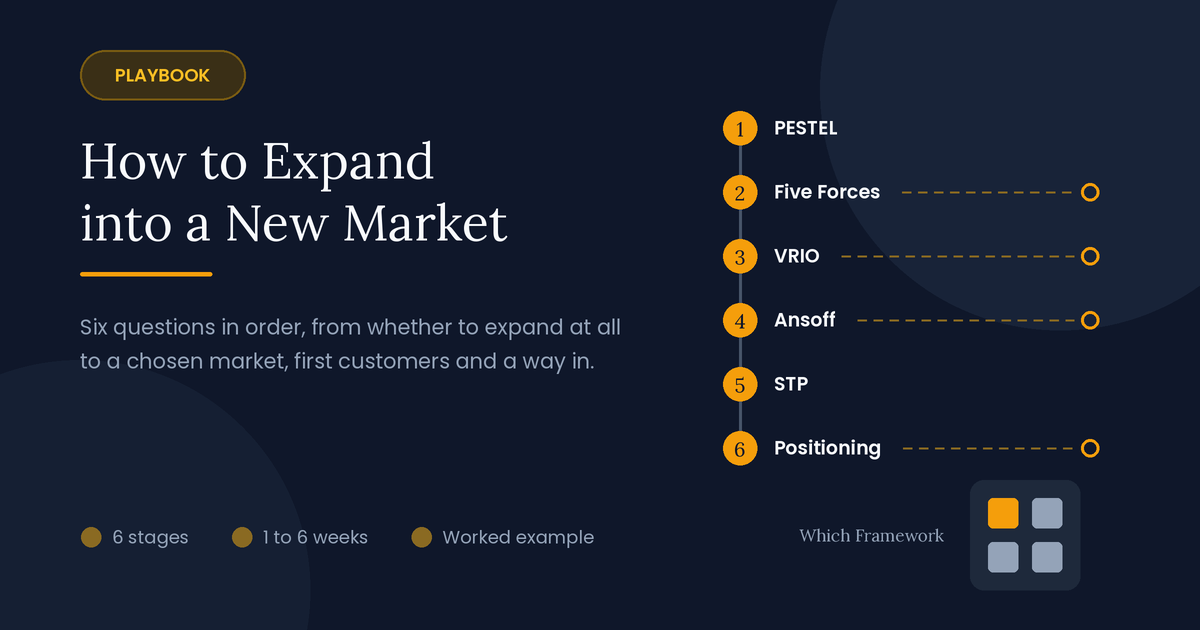
Six questions, asked in order. Each uses a proven strategy tool, and each answer feeds the next.
A market expansion playbook is a six-stage sequence of strategy tools that takes a company from wanting to grow beyond its home market to a chosen market, first customers and entry route.
The route
Six questions, in order
Each stage asks one question and uses one proven tool to answer it. The answer is a short, concrete output, and that output is the input to the next stage. Four points on the route can send you somewhere else: forward, back, or out.
Already chosen the market, and only need to win customers there? Start at stage 5.
-
What is shifting out there?Stage 1 · PESTEL Analysis
Passes on: outside forces, ranked by impact
-
Is the market worth it?Stage 2 · Porter's Five Forces
Passes on: a verdict on each market
None worth it?Carry growth at home into stage 4 as a real option.
-
What advantage travels?Stage 3 · VRIO
Passes on: the advantages that still hold there
Nothing travels?Stop, or run a small test with an end date.
- Sum it up on one pageOptional · SWOT
-
Which growth route?Stage 4 · Ansoff Matrix
Passes on: one route, with one named option
A new market named here?Take it back to stage 1 before choosing it.
-
Which customers first?Stage 5 · STP
Passes on: one segment and one promise to it
-
Is there room to stand?Stage 6 · Positioning Map
Passes on: a confirmed gap in the market
Spot already taken?Go back to stage 5.
- How do we get in?Then · Entry mode, and a plan
The example
One company, followed all the way through
To show how the stages connect, this playbook follows one company from start to finish. It is an illustrative composite, and the market details are simplified.
A mid-sized snack maker in Thailand, with about THB 1.8 billion in yearly sales. It makes seasoned seaweed snacks and baked rice crackers, sold mostly through convenience stores and supermarkets at home. Growth in Thailand has slowed to low single digits, and the board wants a plan for growth outside the country. Two markets keep coming up: the Philippines and Vietnam.
Each stage below ends with what this company produced at that step, so you can watch one stage's output become the next stage's input.
Stage 1 of 6
What is shifting in the markets we could enter?
Tool: PESTEL Analysis · Time: 2 to 5 days
Start outside the company. PESTEL scans six kinds of outside force: political, economic, social, technological, environmental and legal. Here you run it on your home market and on each market you are already considering. Keep the list short. Two or three candidates is plenty; a scan of ten markets becomes a spreadsheet nobody reads.
The point is not to fill six boxes. It is to find the few forces that would change the answer, and to rank them. A tariff, a registration rule or a habit in how people shop usually matters more than a dozen general trends.
What goes inYour home market and two or three candidate markets.
What comes outA short list of outside forces for each market, ranked by impact.
Skip it if: the new market is a new kind of customer inside your own country. The outside forces are the ones you already live with.
| Force | Philippines | Vietnam |
|---|---|---|
| Trade | Tariffs near zero under ASEAN trade rules | Tariffs near zero under ASEAN trade rules |
| Legal | Every product must be registered with the food regulator, which takes months | Product registration, and labels in Vietnamese |
| Social | Young population; many people buy single small packs from neighborhood stores | Young, urban shoppers; modern stores growing fast |
| Economic | Low price points decide most purchases | Rising incomes in the big cities |
| Environmental | Typhoon season disrupts shipping between islands | Reachable by road as well as by sea |
Handed to stage 2: for the Philippines, the small-pack buying habit ranked first and registration time second. For Vietnam, fast-growing modern retail ranked first. Tariffs ranked last in both: they don't separate the two markets.
Stage 2 of 6
Are those markets worth competing in?
Tool: Porter's Five Forces · Time: 3 to 7 days
Stage 1 told you what is changing. Five Forces tells you whether the market, as it is set up today, lets anyone make money. It looks at five pressures on profit: rivals, buyers, suppliers, new entrants and substitutes.
Run it once for each candidate, and be honest about entry barriers, because here you are the new entrant. The barrier companies most often underrate is reaching customers, not making the product.
What goes inThe ranked forces from stage 1, for each market still in play.
What comes outA verdict for each market (attractive, mixed or unattractive) and the one pressure that decides it.
Skip it if: you already sell into the market in a small way and know its structure well. That is rarer than it sounds.
| Pressure | Philippines | Vietnam |
|---|---|---|
| Rivals | Heavy in chips; lighter in seaweed snacks | Heavy; several imported seaweed brands compete on price |
| Buyers | Stores are small and scattered, so distributors hold the power | Large modern chains bargain hard |
| New entrants | The real barrier is distribution across islands | Low barrier; the shelf is already crowded |
| Substitutes | Many cheap snacks | Many cheap snacks |
| Suppliers | Weak: seaweed is sourced from home | Weak: seaweed is sourced from home |
| Verdict | Mixed: attractive if distribution is solved | Unattractive for now: a price war |
Handed to stage 3: the Philippines goes forward, rated mixed, with one condition attached: solve distribution. Vietnam moves to a later round.
Decision point
If no market is worth competing in, don't stop. Carry growth at home into stage 4 as a real option. Sometimes it turns out to be the better choice.
Stage 3 of 6
What do we have that would still be an advantage there?
Tool: VRIO · Time: 2 to 4 days
Now look inward. VRIO tests each capability against four questions: is it valuable, is it rare, is it hard to imitate, and is the company organized to use it? Only a capability that passes all four is a lasting advantage.
The twist in this playbook is where you run the test. Ask each question about the new market, not the home one. A strength at home can be ordinary abroad, and a relationship with a local retailer rarely travels at all.
What goes inA list of the company's real capabilities, and the market verdicts from stage 2.
What comes outThe advantages that still hold in the new market, and the gaps a partner would have to fill.
Skip it if: never. It is the stage companies skip most often, and the one that most often decides the outcome.
| Capability | Advantage at home? | Advantage in the Philippines? |
|---|---|---|
| Seaweed sourcing and processing know-how | Yes | Yes. Hard to copy, and it travels with the product |
| Packing lines that make small packs cheaply | No, rivals match it | Yes. It fits how people buy there |
| A flavor lab that launches new flavors in about 12 weeks | Yes | Partly. It needs local taste testing |
| Shelf deals with Thai convenience chains | Yes | No. They don't carry over |
| Brand recognition | Yes | No. Few Filipino shoppers know it |
Handed to stage 4: two advantages travel: the seaweed know-how and the cheap small packs. Reach and brand do not, so they are the gaps. Note the second row: a capability that is ordinary at home became an advantage abroad.
Decision point
If nothing travels, the move rests on execution alone. Either stop, or treat it as a small test with a capped budget and an end date.
Optional
Sum it up on one page with SWOT
By now you have outside forces, market verdicts and a list of advantages. If your team or board expects a single summary, put them into a SWOT. The advantages and gaps from stage 3 become strengths and weaknesses. The ranked forces from stages 1 and 2 become opportunities and threats.
It adds no new facts, which is why it is optional. Its value is as a one-page summary before the big choice in stage 4.
Stage 4 of 6
Which growth route?
Tool: Ansoff Matrix · Time: 1 to 3 days
This is the choice the playbook has been building toward. The Ansoff Matrix sets out four ways to grow: sell more of what you have where you are, build new products for the buyers you have, take what you have to a new market, or do something new in a new market.
Put one real option in each box, specific enough to cost. Then use what stages 1 to 3 found to strike options out. The value is in the striking out.
Growing at home is in the matrix too. If stage 2 found no market worth entering, that option is often the right one, and choosing it is not a failure of the playbook.
What goes inThe market verdicts from stage 2 and the advantages that travel from stage 3.
What comes outOne route, with one named option: the market and the product.
Skip it if: never. Without this stage, expansion is assumed rather than chosen.
Handed to stage 5: market development: small-pack seaweed snacks for the Philippines.
Decision point
If a market appears here that was never scanned, take it back to stage 1. In this example a board member proposed Indonesia at this point. It went back to stage 1 and was parked for a later round, rather than chosen on enthusiasm.
Stage 5 of 6
Which customers first?
Tool: STP · Time: 3 to 10 days
A market is too big to enter all at once. STP splits it into segments, picks the one to serve first, and states what you promise that segment: segmentation, targeting, positioning.
Pick the first segment for fit, not size. The best first segment is one your traveling advantages serve well, and one you can actually reach given the gaps stage 3 found.
What goes inThe chosen market and product from stage 4.
What comes outOne target segment, and a one-sentence promise to it.
Skip it if: the new market is small and all its buyers behave alike. Few are.
| Segment | Fit with the advantages | Can we reach them? | Choice |
|---|---|---|---|
| Students and young workers in Metro Manila buying single packs | Strong: small packs, a lighter snack | Yes, through convenience stores and one city distributor | First |
| Families buying multipacks in supermarkets | Weak: large packs, sold on price | Needs national chains; slow to win | Later |
| Health-minded professionals in the city | Good: seaweed reads as lighter | Small group; premium shelves are crowded | Later |
Handed to stage 6: the promise. For young snackers in Metro Manila: a lighter, Thai-flavored seaweed crisp at the price of a single pack of chips.
Stage 6 of 6
Is there room to stand against who is already there?
Tool: Positioning Map · Time: 1 to 3 days
Stage 5 made a promise. This stage checks it against real competitors. A positioning map is a simple chart: pick two things buyers weigh when they choose, put one across and one up the side, and place each brand where buyers see it. Then see whether your promise lands in open space.
Choosing the two axes is most of the work. Take them from how your segment actually decides, which the stage 5 research should tell you, not from what your team finds interesting. And the two must be independent: knowing where a brand sits on one should not tell you where it sits on the other. Price and quality usually fail this test, because they rise together and every brand lands on one diagonal line. If your brands bunch along a diagonal, swap one axis and try again. Two or three pairs is normal before one spreads the brands out.
In the example, young snackers said they choose on two things: what a single pack costs, and whether it feels greasy. These are independent here. Cheap chips feel heavy, but imported seaweed snacks are light and expensive, so brands spread across the map.
It is a check on stage 5, not a fresh start. Its job is to catch a position that sounds new in a meeting but is already taken on the shelf.
An empty spot raises one more question: is it empty because nobody saw it, or because nobody can make money there? The answer usually comes from stage 3.
What goes inThe segment and promise from stage 5, and the brands that segment buys today.
What comes outA confirmed gap, or a clear reason to rethink the promise.
Skip it if: there are no real competitors yet. Then plot the substitutes instead.
Handed on: a confirmed gap. The cheap, lighter corner was empty, and the cheap small-pack line from stage 3 is what makes it profitable rather than a trap.
Decision point
If the spot is taken, go back to stage 5. Choose a different segment or a different promise. Don't move the dot to make the map agree.
After stage 6
How to get in: choosing an entry mode
You now know where, for whom and with what promise. The last question is how to get in. There are five common ways, and the right one depends on what stage 3 said you have, and what you lack.
| Entry mode | Control | Cost and risk | Best when |
|---|---|---|---|
| Export through a local distributor | Low | Low | Your advantage stays at home, and you lack local reach |
| Licensing or franchising | Low | Low | Your advantage can be written down and handed over |
| Joint venture | Shared | Medium | A local partner brings what you lack, and you want more say than a distributor gives |
| Acquisition | High | High | Speed matters, and a suitable local business exists |
| Your own subsidiary, built from scratch | High | High | Your advantage only works if you run it yourself |
What the Thai snack maker chose
An exclusive distributor for Metro Manila. Both lasting advantages, the seaweed know-how and the cheap small packs, stay in its Thai factories, so exporting protects them. The distributor supplies what stage 3 said was missing: local reach.
It set a review at 18 months to decide whether to move to a joint venture.
Pace
Fast track or thorough
The same six stages can take a week or six weeks. Use the fast track to decide whether a thorough run is worth funding, not to commit serious money.
| Stage | Fast track (about a week) | Thorough (4 to 6 weeks) |
|---|---|---|
| 1. PESTEL | Desk research on the top forces only | Local expert interviews; rules checked by a lawyer |
| 2. Five Forces | A half-day team workshop | Talks with distributors and retailers in the market |
| 3. VRIO | A half-day team workshop | Each claim tested against data or customer evidence |
| 4. Ansoff | One session to strike options | A rough business case for each option left standing |
| 5. STP | Chosen from customer data you already have | Store visits and small surveys in the market |
| 6. Positioning map | Plotted from store visits and websites | Target buyers surveyed on the two axes |
Failure modes
How expansion playbooks go wrong
| What happens | What it looks like | The fix |
|---|---|---|
| Stages run side by side | Four teams write four reports that never meet | Start each stage from the previous stage's output |
| The market is chosen first | A board picks the market, and the stages are used to justify it | Keep at least two candidates alive until stage 2 |
| Advantages tested at home | VRIO says yes because the strengths are real at home | Ask every VRIO question about the new market |
| Decision points waved through | Every gate is passed, every time | Agree before stage 1 what result would stop the project |
| Stopping at the choice | A chosen market with no entry mode and no plan | Finish with the entry mode and a first-year plan |
After the playbook
From decision to plan
The playbook ends with a decision: a market, a first segment, a promise and a way in. Turning that into action is a different job. OKRs set a few goals for the first year, such as a distributor signed and a target number of stores, and KPIs track whether the move is working.
Set the first review date now. Expansion decisions rest on estimates, and the first months in the market will correct many of them.
Common questions
Market expansion: quick answers
What is the best framework for market expansion?
There isn't one. Market expansion is several questions, and each has a different best tool. PESTEL and Five Forces judge the market, VRIO judges your advantage, the Ansoff Matrix picks the growth route, and STP picks the first customers. Used in that order, each one answers what the one before it left open.
How long does a market expansion analysis take?
About a week on the fast track, and four to six weeks for a thorough run. The fast track tells you whether a thorough run is worth paying for. On its own, it is too thin to commit serious money.
Is the Ansoff Matrix enough to plan an expansion?
No. It names four growth routes and orders them by risk, but it says nothing about whether a market is attractive or whether your strengths will carry over. That is why three stages come before it.
What are the main market entry modes?
Exporting through a distributor, licensing or franchising, a joint venture, buying a local business, or building your own subsidiary. They run from low control and low cost to high control and high cost. The right one depends on whether your advantage can stay at home or has to be run on the ground.
Do I need a SWOT analysis for market expansion?
It is optional. A SWOT sums up what the first three stages found; it doesn't add new facts. It helps when a board expects a one-page summary before the growth route is chosen.
Does this work for a new customer group rather than a new country?
Yes. Skip the country scan in stage 1 if the outside forces are the ones you already face, and run the rest as written. Stage 3 still matters: an advantage with one group of customers can be ordinary with another.
Frameworks in this playbook
- PESTEL AnalysisStage 1: What is shifting in the markets we could enter?
- Porter's Five ForcesStage 2: Are those markets worth competing in?
- VRIOStage 3: What do we have that would still be an advantage there?
- Ansoff MatrixStage 4: Which growth route?
- STPStage 5: Which customers first?
- Positioning MapStage 6: Is there room to stand against who is already there?
- SWOT AnalysisOptional: a one-page summary before stage 4
- OKRAfter: turning the decision into a first-year plan