Ansoff Matrix: Growth Strategy Framework
Ansoff Matrix is a growth strategy framework presenting four strategic options based on product-market combinations: Market Penetration, Product Development, Market Development, and Diversification, arranged by increasing risk.
Before you start
Is the Ansoff Matrix your framework?
The Ansoff Matrix answers one question: you have decided to grow — in which of four directions, and at what risk? It sorts growth options by whether the product is new and whether the market is new, and it orders them by how much unfamiliarity each involves.
It says nothing about whether you should grow, which options are affordable, or what your competitors will do about it.
| If your real problem is… | You probably want |
|---|---|
| Which existing products deserve investment? | BCG Growth-Share Matrix — portfolio allocation across what you already have Compare Ansoff and BCG |
| Is this market worth entering at all? | Porter’s Five Forces — structural attractiveness, which Ansoff assumes Not sure which? Compare |
| Do we have what it takes to pull this off? | VRIO — the capability side Ansoff is silent on Not sure which? Compare |
| Can we avoid competing on these terms entirely? | Blue Ocean Strategy — rejects the existing/new market framing Not sure which? Compare |
| Which customers should we serve in the new market? | STP — the natural next step after choosing market development |
| Deciding whether and how to expand into a new market | The market expansion playbook, where the Ansoff Matrix is stage 4 of 6 |
| We are growing and must choose a direction | Ansoff — you are in the right place |
Ansoff or BCG?
Both are 2×2 grids taught in the same lecture, which is why they get confused. BCG looks backward at the portfolio you already have and asks where to put money. Ansoff looks forward at growth you have not attempted and asks which direction carries least unfamiliarity. BCG classifies; Ansoff chooses. They pair naturally — run BCG to see what you are funding today, then Ansoff to decide where the next increment goes.
What Is It?
The Ansoff Matrix, created by Igor Ansoff in his seminal 1957 Harvard Business Review article "Strategies for Diversification," is one of the oldest and most widely used strategic planning frameworks. It helps organizations systematically evaluate growth options by examining the intersection of products (existing vs. new) and markets (existing vs. new).
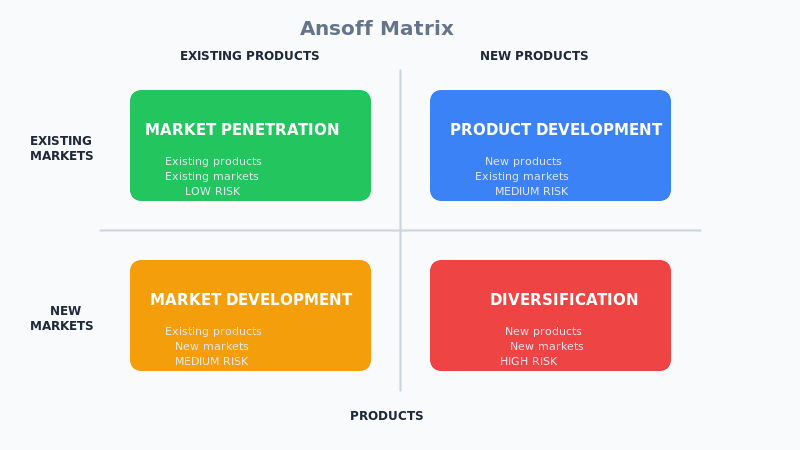
The framework identifies four distinct growth strategies: Market Penetration (existing products, existing markets)—the safest path, focusing on increasing market share. Product Development (new products, existing markets)—creating new offerings for current customers. Market Development (existing products, new markets)—finding new customer segments or geographies. Diversification (new products, new markets)—the riskiest strategy, entering entirely new businesses.
Risk increases diagonally across the matrix—Market Penetration is lowest risk because you know both your products and customers, while Diversification is highest risk because both are unfamiliar. This risk gradient helps organizations match growth ambitions with risk tolerance.
The Ansoff Matrix pairs well with BCG Matrix for portfolio decisions, SWOT Analysis for capability assessment, and Porter's Five Forces for market analysis.
Quick Reference
The core structure
The four growth strategies, and their risk levels
Two axes: is the product existing or new, is the market existing or new. Four cells. The ordering matters more than the grid — each move away from the top-left corner adds one dimension of unfamiliarity, and the risk compounds when you move diagonally.
| Strategy | Product / Market | Risk | What it actually requires |
|---|---|---|---|
| Market Penetration | Existing product, existing market | Lowest | Sell more of what you have to who you already serve: pricing, promotion, share capture, usage frequency. You know both the product and the buyer. |
| Product Development | New product, existing market | Moderate | New capability, familiar customers. The risk is execution — can you build it? You already know who will buy. |
| Market Development | Existing product, new market | Moderate | Familiar capability, unfamiliar buyers. New geography, segment or channel. The risk is demand — will they want it, and can you reach them? |
| Diversification | New product, new market | Highest | Both unknowns at once, so the failure modes multiply rather than add. Ansoff treated this as a distinct case requiring its own analysis, not simply the fourth box. |
On the risk ordering
The two middle cells are often drawn as equally risky, and for your business they may not be. The useful question is which unknown your organization is better at absorbing. A company with strong engineering and weak distribution should treat product development as the safer middle path; one with strong sales reach and thin technical capability should prefer market development. The grid gives you the ordering; only you know which axis you are weak on.
Core Features
- 2x2 Matrix: Products (existing/new) × Markets (existing/new)
- Market Penetration: Grow share with current products in current markets
- Product Development: New products for existing customers
- Market Development: Existing products for new markets
- Diversification: New products for new markets (related or unrelated)
- Risk Gradient: Clear visualization of increasing risk
Worked example
Four options, one decision
An illustrative composite. A Portland company making premium coffee equipment for independent cafes, roughly $30m revenue, growing 4% a year and under pressure from the board to accelerate. Four options were on the table, one per quadrant.
| Quadrant | The option | What made it hard |
|---|---|---|
| Market Penetration | Win share from the two incumbent equipment brands in US independent cafes | Market growing 2% a year. Gains only come out of a competitor’s hide, and both incumbents can cut price further than we can. |
| Product Development | Add a grinder line for existing cafe customers | Real engineering work, 18 months, but the customers and the sales channel already exist. Known buyers. |
| Market Development | Sell the existing machines to office and coworking spaces | Same product, unfamiliar buyer with a different purchase process and service expectation. Chosen. |
| Diversification | Launch a direct-to-consumer subscription coffee brand | New product and new customer at once. Also a different business: consumer marketing, logistics, retention. The board’s favorite. |
Why the middle beat the exciting option
Diversification was the option with a story attached, and the matrix is at its most useful precisely there — it made visible that the subscription idea required the company to be wrong about nothing in two unfamiliar domains simultaneously.
Market development won because the honest answer to “which unknown are we better at absorbing?” was demand rather than engineering. The company had a proven machine and a weak technical bench. That is the question the matrix is really asking, and it is not visible from the grid alone.
When to Use
- Strategic planning sessions for growth direction
- Evaluating expansion opportunities
- New market entry decisions
- Product portfolio planning
- M&A target assessment
- Annual planning and resource allocation
- Communicating growth strategy to stakeholders
When NOT to Use
- Detailed implementation planning (too high-level)
- Operational decisions
- When defending market position (focus on competition)
- Cost reduction or efficiency initiatives
- Crisis management situations
In practice
How the Ansoff Matrix gets misused
Four boxes and two axes make it almost impossible to get wrong on paper, which is exactly why it produces so many confident bad decisions.
| What you see | What it usually means | What to do |
|---|---|---|
| All four boxes are filled with options | The matrix was used to generate ideas rather than to choose between them | It is a decision aid, not a brainstorm. Fill it with real candidates you would actually fund, then eliminate. |
| “New market” means a new country only | The market axis was read too narrowly | A new segment, channel or use case counts. Selling the same machine to offices instead of cafes is market development even though the address has not changed. |
| Risk was assigned from the grid alone | The ordering was treated as universal | Ask which unknown your organization absorbs better. Engineering-strong firms and sales-strong firms should not rank the two middle cells the same way. |
| Diversification was chosen because it is exciting | The option with a narrative beat the options with arithmetic | Diversification requires being right about a new product and a new buyer at once. Demand a separate case for each, not one combined story. |
| Competitor response never came up | Ansoff has no competitive dimension — and it never claimed one | Penetration in a flat market means taking share from someone who will respond. Pair the matrix with Five Forces before committing. |
| Capability was assumed | The matrix asks what to do, never whether you can | Each quadrant demands different capabilities. Check with VRIO whether you hold them or must build them, and price that in. |
Sourced
Origins, and how to cite it
The primary source, in full.
If you need to reference the Ansoff Matrix in academic work, this is the paper — not a textbook and not the 1965 book, both of which came later.
Harvard style: Ansoff, H.I. (1957) ‘Strategies for Diversification’, Harvard Business Review, 35(5), pp. 113–124.
APA style: Ansoff, H. I. (1957). Strategies for diversification. Harvard Business Review, 35(5), 113–124.
Published September–October 1957. Ansoff was an applied mathematician working in the Corporate Planning Department at Lockheed when he wrote it.
The grid everyone draws is not the diagram Ansoff published.
The 1957 article contains “Exhibit 1: Product-Market Strategies for Business Growth Alternatives”, which is the ancestor of the matrix but not the clean four-box grid taught today. Ansoff’s original notation reserved further sectors for the diversification alternatives rather than collapsing them into a single cell — he treated diversification as a distinct problem requiring its own analysis, which the tidy 2×2 obscures. The familiar form was elaborated in Corporate Strategy in 1965 and smoothed further by later textbooks.
Ansoff, H. I., Corporate Strategy: An Analytic Approach to Business Policy for Growth and Expansion, McGraw-Hill, 1965.
It was written to argue that growth must be deliberate.
Ansoff’s concern was that corporate plans of the period simply targeted higher volume without distinguishing between qualitatively different ways of getting it. His contribution was separating growth into moves that require different capabilities, investments and time horizons — and insisting that diversification in particular be recognized as a different kind of decision rather than more of the same. He is widely described as the father of strategic management, and this paper is why.
What that means for using it.
Treat the matrix as a way of naming and ordering options, not as an analysis. It has no competitive dimension, no capability test and no financial model — and it never claimed any of those. That is a reasonable division of labor rather than a flaw, provided you supply the missing pieces from elsewhere. A growth decision made on the matrix alone has considered neither whether you can execute it nor what your competitors will do about it.
Key Strengths
- Simplicity: Easy to understand and apply
- Visual Clarity: Clear options and trade-offs
- Risk Communication: Intuitive risk gradient
- Universal Application: Works across industries
- Fast Decision Support: Quick strategic alignment
Key Weaknesses
- Oversimplifies complex growth decisions
- Doesn't address competitive dynamics
- No guidance on execution complexity
- Binary product/market classification can be unclear
- Ignores resource and capability requirements
How It Works
| 1 Primary Input | Current product portfolio, market definition, growth objectives |
|---|---|
| 2 Data You Need | Market size estimates, competitor analysis, capability assessment |
| 3 Primary Output | Growth strategy selection, risk-adjusted priorities, expansion roadmap |
Comparison with Related Frameworks
Ansoff Matrix vs BCG Matrix
BCG Matrix evaluates existing portfolio performance. Ansoff Matrix identifies growth directions. Use BCG to assess what you have, Ansoff to decide where to grow.
Ansoff Matrix vs Blue Ocean Strategy
Blue Ocean Strategy creates uncontested market space. Ansoff focuses on product-market combinations within competitive context. Blue Ocean transcends the matrix by creating new demand.
Sequencing
What to run before and after
Ansoff sits in the middle of a growth decision. It names the options; other tools tell you whether any of them is a good idea.
Before
Know the terrain and your own hand
The matrix assumes the market is worth being in and that you can execute. Both are assumptions worth testing, and the second is the one companies skip.
During
Name real options, then eliminate
One genuine candidate per quadrant, each specific enough to cost. The value comes from the eliminating, not the filling in.
After
Turn the direction into a plan
A chosen quadrant is a direction, not a strategy. Market development needs a segment and a position; product development needs a validated problem.
Part of a playbook: How to Expand into a New Market. The Ansoff Matrix is stage 4 of 6, after VRIO and before STP.
Common questions
Ansoff Matrix: quick answers
What are the four strategies in the Ansoff Matrix?
Market penetration (existing product, existing market), product development (new product, existing market), market development (existing product, new market), and diversification (new product, new market). They are ordered by risk: penetration is lowest because both the product and the buyer are known, diversification highest because neither is.
How do I cite the Ansoff Matrix?
Cite the original 1957 Harvard Business Review article rather than a textbook. Harvard style: Ansoff, H.I. (1957) 'Strategies for Diversification', Harvard Business Review, 35(5), pp. 113–124. APA style: Ansoff, H. I. (1957). Strategies for diversification. Harvard Business Review, 35(5), 113–124. If you are citing the fuller treatment, use Ansoff, H. I. (1965). Corporate Strategy. New York: McGraw-Hill.
What is the difference between the Ansoff Matrix and the BCG Matrix?
Direction of view. The BCG Growth-Share Matrix looks at the portfolio you already have and asks where to allocate money across it. The Ansoff Matrix looks forward at growth you have not attempted yet and asks which direction carries least unfamiliarity. BCG classifies existing products; Ansoff chooses between future moves. They pair well in that order.
Which Ansoff strategy is the riskiest?
Diversification, because it combines a new product with a new market — two unknowns at once, so the ways it can fail multiply rather than add. Market penetration is the safest for the reverse reason. The two middle quadrants are conventionally drawn as equally risky, but which is genuinely safer depends on whether your organization is stronger at building things or at reaching new buyers.
Who created the Ansoff Matrix and when?
H. Igor Ansoff, in “Strategies for Diversification”, published in Harvard Business Review in 1957. He was an applied mathematician working in corporate planning at Lockheed at the time, and later became known as the father of strategic management. He elaborated the framework in Corporate Strategy in 1965.
Is the Ansoff Matrix still relevant?
As a way of naming and ordering growth options, yes — the underlying distinction between familiar and unfamiliar products and markets has not aged. Its limits are what it never included: no competitive dimension, no capability assessment and no financial model. Used alongside tools that supply those, it remains one of the fastest ways to structure a growth conversation.
Deep Resources
Frameworks related to Ansoff Matrix
- BCG Growth-Share MatrixPortfolio strategy framework categorizing business units into Stars, Cash Cows, Question…
- SWOT AnalysisClassic strategic framework assessing Strengths, Weaknesses, Opportunities, and Threats for…
- Strategy MapVisual representation of strategy showing how objectives connect through cause-and-effect…