Eisenhower Matrix: Urgency vs Importance, and Which Priority Matrix You Need
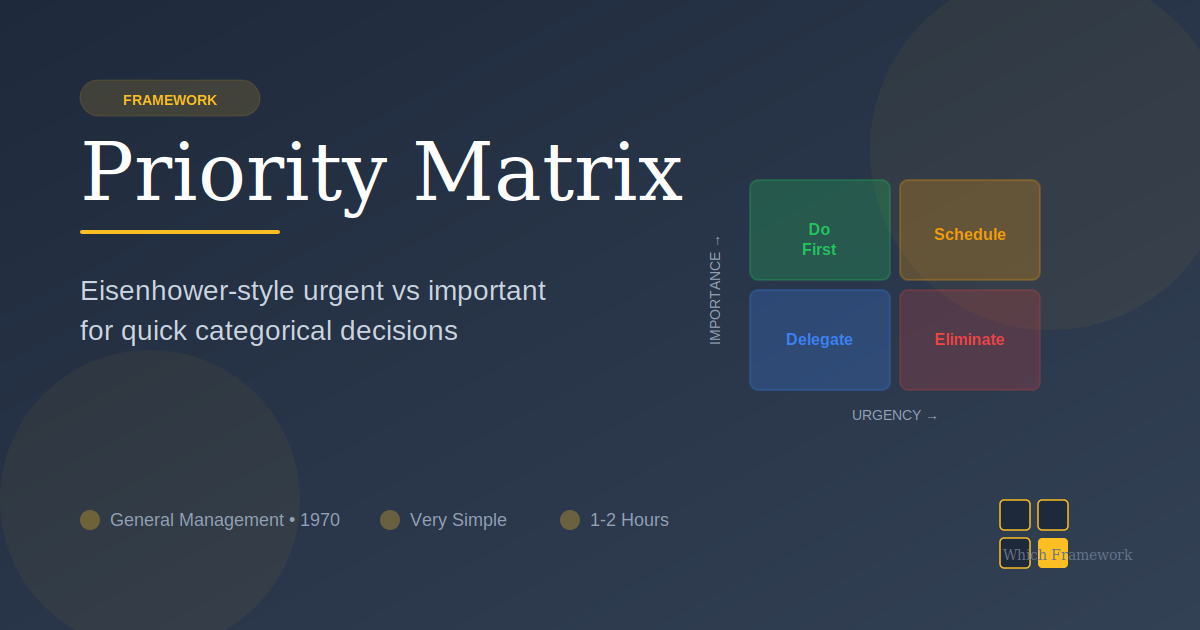
Eisenhower Matrix is a two-by-two grid that sorts work by urgency and importance into four quadrants — Do, Schedule, Delegate and Delete — each carrying a different prescribed action.
Before you start
Is this your framework?
This grid answers one question: where is your attention going, and where should it go instead. It is about time and attention, yours or your team’s, over the next week or so.
It is not a backlog tool. Nothing in it weighs benefit against cost, nothing in it produces a ranked list, and nothing in it survives contact with fifty competing features. If the work you are sorting has an effort estimate attached, you want a different grid, and the table below says which.
| If your real problem is… | You probably want |
|---|---|
| We have a feature backlog and need it ranked by likely return | RICE — reach, impact, confidence and effort combined into a score you can sort on Compare Eisenhower Matrix and RICE |
| We need to weigh what something is worth against what it costs to build | Value vs Effort Matrix — the two-by-two whose axes are benefit and work, giving quick wins and thankless tasks Compare Eisenhower Matrix and Value vs Effort |
| We need to fix what is in and out of a release | MoSCoW — categorical scope control, built for negotiating a delivery boundary Compare Eisenhower Matrix and MoSCoW |
| We are triaging incidents and tickets and need response targets attached | The impact against urgency grid used in service management, which is a different tool with the same nickname — see the comparison below |
| We know what to hand over but not to whom, or how much rope to give | Delegation Matrix — the level of authority that goes with a handover, which this grid assumes but never specifies |
| Work arrives continuously and the problem is how much is in flight | Kanban — visible flow and limits on work in progress, rather than a weekly sort |
| The same fires keep recurring and we want to stop them at source | Theory of Constraints — find what is generating the load instead of re-sorting its output |
| Our week is being eaten and we cannot tell what actually mattered | Eisenhower Matrix — you are in the right place |
What Is It?
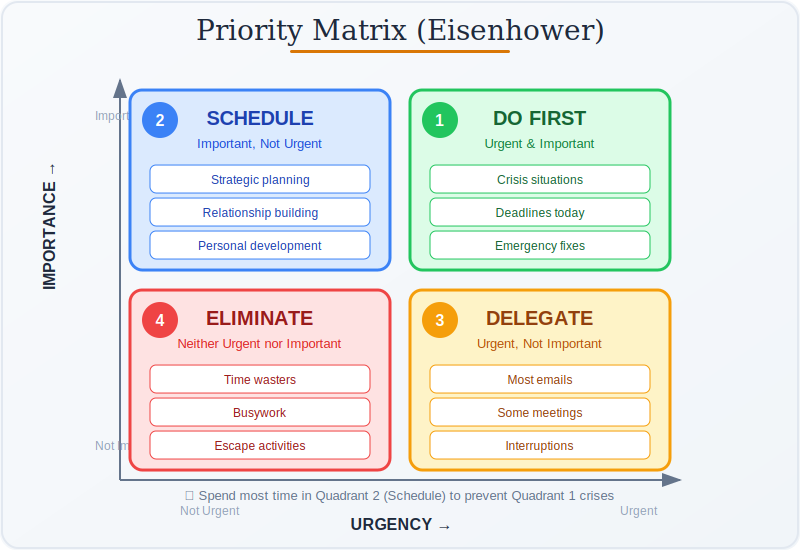
Draw two axes. Urgency runs left to right, importance runs bottom to top. Every piece of work lands in one of four boxes, and each box carries an instruction rather than a score. That is the entire mechanism, and it takes about ten minutes to learn.
The idea underneath it is that urgency and importance are independent, and that people behave as though they are the same thing. Urgency announces itself: a deadline, a ringing phone, a message marked high priority. Importance has to be worked out, usually by thinking about consequences that arrive later. Given a list and no method, most people work down it in order of how loudly each item is asking.
What the grid does about that is force the two judgments apart and make you write them down separately. The value is in the separation, not in the arithmetic, because there is no arithmetic. Nothing is scored, nothing is weighted, and two people sorting the same list will disagree.
That is the honest limit of it. Both axes are self-reported, so the grid records how work feels to whoever sorted it. Used on yourself for a week of tasks, that is exactly what you want. Used to settle an argument between two departments about which project matters more, it settles nothing, because the axes are the argument.
The Delete quadrant is also less useful than it looks, for a simple reason: work that is neither urgent nor important rarely reaches a list in the first place. In practice the interesting quadrants are the two urgent ones, and the whole exercise is really about telling them apart.
Quick Reference
The grid
What each quadrant asks of you
The instruction attached to each box is the point. A sort that ends without anything moving, being handed over or being dropped has not done anything.
| Quadrant | What belongs there | The instruction, and its catch |
|---|---|---|
| 1. Do Urgent and important | Outages, same-day deadlines, escalations, anything with a real and near consequence. | Do it now. The catch is that this box fills up with everything, because urgency is felt and importance is assumed. A first pass that puts most of the list here has measured mood, not priority. |
| 2. Schedule Important, not urgent | Planning, prevention, hiring, training, documentation, repairing a working relationship. | Give it a date and defend the date. The catch is that scheduling is not doing, and a calendar entry with no protection around it is dropped by the first Quadrant 1 item that appears. |
| 3. Delegate Urgent, not important | Routine status requests, most inbound mail, meetings whose agenda you do not shape. | Hand it over. The catch is that this assumes somebody to hand it to. Most people running this grid have nobody, and for them the real options are to automate it, batch it, or go after whatever is generating it. |
| 4. Delete Neither urgent nor important | Busywork, rework, recurring meetings that decide nothing, reports nobody opens. | Stop doing it. The catch is that almost nothing gets classified here voluntarily, because admitting an item belongs here means admitting the last six months of doing it were wasted. |
Two questions that make the sort mean something
The grid gives you no definition of either axis, which is why sorts drift. Supplying two written tests before you start fixes most of it. For importance: what happens if this is never done? If the answer is nothing much, it is not important, however loudly it arrived. For urgency: what happens if this waits a week? If the answer is nothing much, it is not urgent, however recent it is.
Apply both tests to the item rather than to the person who raised it. Most misclassification is not carelessness — it is seniority quietly standing in for consequence, so a request from a director reads as important and the same request from a customer support agent does not.
Disambiguation
One name, several different grids
Ask three people for a priority matrix and you can get three unrelated tools. They share a shape and nothing else: different axes, different outputs, different readers. The axes are how you tell them apart, so ask about those first.
| The grid | Axes | What it produces | Who uses it |
|---|---|---|---|
| Eisenhower Matrix this page | Urgency × importance | Four instructions: do, schedule, delegate, delete | Anyone deciding where their own or their team’s attention goes this week |
| Service priority matrix incident triage | Impact × urgency, usually three by three | A priority code, typically P1 to P4, each with a response and resolution target | Service desks and operations teams, applied to incidents, problems, requests and changes |
| Value vs Effort also called the action priority matrix | Value × effort | Quick wins, major projects, fill-ins and thankless tasks | Product and delivery teams working through a backlog of initiatives |
| Risk matrix part of a risk register | Likelihood × impact | A risk rating that drives whether something is accepted, mitigated or escalated | Risk, audit and compliance functions, and project managers keeping a register |
Why the confusion costs something
The two urgency-based grids look almost identical and behave completely differently. Importance is a judgment about consequence; impact is a count of who is affected. A service desk that swaps one for the other starts prioritizing by whichever caller sounds most annoyed, which is precisely the failure the priority code exists to prevent.
The other direction is just as common. Teams reach for this grid to rank a feature backlog, discover that everything on it is important and nothing is urgent until a date is invented, and conclude the framework is useless. It is not useless; it was never a backlog tool. Value and effort are the axes for that job.
Core Features
- Two independent axes: urgency and importance, judged separately and on purpose
- Four instructions, not four scores: every box tells you to do something
- No arithmetic: nothing is weighted, summed or ranked
- Self-reported inputs: the grid records judgment, so it is only as good as the judge
- Built for attention, not for backlogs: a week of work, not a portfolio
- Diagnostic as much as prescriptive: the shape of the sort is often the finding
Worked example
Two weeks of work, sorted, and what the ratio showed
An illustrative composite. A consumer-electronics distributor in Osaka, Japan, with a customer operations group of about sixty people. The group was busy, missing commitments, and could not say what it was busy with. Everyone logged every discrete piece of work for two weeks — 312 items — and sorted each one into a quadrant themselves.
| Stage | What it showed |
|---|---|
| The self-sort | Quadrant 1 took 71% of items. Quadrant 3 took 19%, Quadrant 2 took 8%, Quadrant 4 took 2%. A grid where seven items in ten are urgent and important is not a priority list. It is a description of how the work felt. |
| The re-score | Every item was re-tested by a colleague who had not raised it, against one written question: what happens if this is never done? Quadrant 1 fell from 71% to 17%. Most of what moved went to Quadrant 3, urgent but not important. |
| Where Quadrant 3 came from | Two recurring internal reports accounted for 44% of the re-scored Quadrant 3 pile. Both were compiled by hand, weekly, and had been requested years earlier by people who had since left. Staff time on them came to roughly ¥1.9 million a year. |
| The quadrant nobody was in | Quadrant 2 held 8% of items: the planning, documentation and training work that would have reduced Quadrant 1. Nothing in it had a date. Everything in it had been deferred at least twice. |
| What changed | Both reports were automated and one was discontinued. The importance question was added to the intake form, answered by the requester in writing. Quadrant 2 items were given calendar time that managers were asked to defend. At eight weeks, self-classified Quadrant 1 had fallen to 34%. |
The ratio was the finding, not the sort
Nobody needed a grid to be told that an outage matters. What the exercise produced was a number: seven in ten items felt critical to the person doing them, and fewer than two in ten survived a written test applied by somebody else. That gap is the thing worth acting on, and it is invisible without the sort.
Note what actually fixed it. Not the quadrants — the intake question and the two automated reports. The grid found the load; removing it required going after the source. A team that runs this sort every week and changes nothing upstream will produce the same distribution every week, and will reasonably conclude the framework does not work. At 34% after eight weeks, this group was better and still not fine, which is the ordinary result.
When to Use
- Your week is full and you cannot say what any of it was for
- A team is busy and missing commitments at the same time
- You want to find out how much of the load is genuinely urgent
- Something needs handing over and the argument is about what
- Personal task management, where you are both the judge and the doer
- As a ten-minute opener before a longer prioritization session
When NOT to Use
- Ranking a feature backlog, where effort and return are the real axes
- Settling a dispute between teams, since both axes are the dispute
- Triaging incidents that need response targets attached to a code
- Anywhere a decision must be defended later, because nothing is scored
- Portfolios with dependencies, which the grid cannot represent at all
- Work where importance is genuinely unknown until something is tested
In practice
How the sort goes wrong
Nearly every failure below has the same shape: the grid records what someone already believed, and returns it looking like analysis.
| Failure mode | What it looks like | What to do instead |
|---|---|---|
| Everything is Quadrant 1 | Two thirds or more of the list in the top right, and no decisions falling out of it | Re-score against a written importance test, applied by someone who did not raise the item. |
| Nobody to delegate to | A full Quadrant 3 and no direct reports, so those items quietly get done anyway | Treat the box as automate, batch or eliminate. Delegation is one option out of several. |
| Seniority read as importance | The same request rates differently depending on who sent it | Write the importance test down before sorting, and strip requester names from the list. |
| Sorted once, never again | A workshop artifact on a wall, accurate for about four days | Run it on a fixed cadence against real logged work, or do not run it at all. |
| Quadrant 2 with no date | Important work correctly identified, scheduled nowhere, deferred indefinitely | Put it in the calendar and name who defends that time when Quadrant 1 arrives. |
| Used on a backlog | Fifty features, all important, none urgent until a launch date is invented for them | Switch grids. Value against effort, or a score you can sort on. |
Sourced
Evidence, and how to cite it
The grid is Stephen Covey’s, published in 1989.
Covey set out the four-quadrant grid in The 7 Habits of Highly Effective People, under the third habit, and called it the time management matrix. He developed it further in First Things First in 1994 with Roger and Rebecca Merrill, where the argument that the second quadrant is where effectiveness actually comes from is made at length. Covey did not call it the Eisenhower Matrix; that name attached to it later, largely through productivity writing on the web.
Covey, S.R. (1989) The 7 Habits of Highly Effective People. New York: Free Press; Covey, S.R., Merrill, A.R. and Merrill, R.R. (1994) First Things First. New York: Simon & Schuster.
Eisenhower neither drew the grid nor originated the line it is named for.
Addressing the Second Assembly of the World Council of Churches at Northwestern University on 19 August 1954, Eisenhower described having two kinds of problems, the urgent and the important, and observed that the two rarely coincide. The transcript shows he was explicitly quoting an unnamed former college president rather than claiming the thought, and no matrix appears anywhere in the address. The distinction is his to popularize; the grid is not his at all.
Eisenhower, D.D. (1954) Address at the Second Assembly of the World Council of Churches, Evanston, Illinois, 19 August. Attribution traced in detail by Quote Investigator.
The bias the grid is built to correct is real and has been measured.
Zhu, Yang and Hsee ran five experiments testing whether people favor urgent tasks over important ones for good reasons or out of habit. Controlling for the sensible explanations — that urgent tasks are easier, closer to completion, or offer more certain payoffs — they still found people choosing tasks with shorter completion windows and objectively lower payoffs over tasks with better payoffs. They named it the mere urgency effect. This is the strongest available evidence for the premise the grid rests on.
Zhu, M., Yang, Y. and Hsee, C.K. (2018) ‘The Mere Urgency Effect’, Journal of Consumer Research, 45(3), pp. 673–690.
The prescription has nothing comparable behind it.
That people mistake urgent for important is established. That sorting work into four boxes fixes it is not. Covey’s advice to live in the second quadrant comes from consulting practice and argument, not from trials, and there is no body of controlled evidence showing that teams which run this sort outperform teams which do not. Treat the grid as a way of making a judgment explicit, which it does well, rather than as a tested intervention.
No controlled outcome studies of the four-quadrant sort are available in the management literature as of 2026.
How to cite it.
Harvard: Covey, S.R. (1989) The 7 Habits of Highly Effective People. New York: Free Press.
APA: Covey, S. R. (1989). The 7 habits of highly effective people. Free Press.
For the underlying bias, cite Zhu, Yang and Hsee (2018) in the Journal of Consumer Research. For the urgent-important distinction only, cite the 1954 Eisenhower address, noting that he was quoting someone else.
Key Strengths
- Separates two things people merge: urgency and importance, held apart deliberately
- Understood immediately: no training, no vocabulary, no facilitator needed
- Every box is an instruction: the output is an action, not a number
- Diagnostic: the distribution across quadrants is often more useful than the sort
- Costs nothing: a whiteboard, ten minutes, and a list
Key Weaknesses
- Both axes are self-reported: it records judgment and returns it as analysis
- No scoring: nothing to defend a decision with afterwards
- Delegation is assumed: the third quadrant presumes somebody to hand work to
- Blind to effort and dependencies: neither appears anywhere on the grid
- Degrades into one box: without a written test, most items read as urgent and important
Sequencing
What to run before and after
The grid supplies no definition of importance and no way of reducing the load it measures. Both have to come from elsewhere.
Before
Decide what importance means here
Importance is only meaningful relative to something you are trying to achieve. Without a stated objective the vertical axis collapses into preference, and the sort records whoever spoke last.
During
Handle the urgent but unimportant pile properly
Handing work over needs a level of authority attached, and a named owner, or it comes straight back. Sorting into the third quadrant is the easy half.
After
Go after whatever is generating the urgency
A sort that runs weekly and produces the same distribution weekly is measuring a problem it cannot fix. Limit work in flight, or find the constraint producing the load.
Common questions
Eisenhower Matrix: quick answers
What is the Eisenhower Matrix?
A two-by-two grid that sorts work by how urgent it is and how important it is. Urgent and important work is done now. Important but not urgent work is scheduled. Urgent but not important work is delegated. Work that is neither is dropped. It is also called the priority matrix, the urgent-important matrix and the time management matrix.
What are the four quadrants of the Eisenhower Matrix?
Quadrant 1 is urgent and important: outages, same-day deadlines, escalations. Quadrant 2 is important but not urgent: planning, prevention, training, relationships. Quadrant 3 is urgent but not important: routine status requests, most inbound mail, meetings you do not shape. Quadrant 4 is neither: busywork, rework, reports nobody reads.
Is the Eisenhower Matrix the same as a priority matrix?
Usually yes, and most people use the two names for the same grid. But at least three other tools answer to priority matrix. Service desks use an impact against urgency grid that produces P1 to P4 codes. Product teams use a value against effort grid that produces quick wins and thankless tasks. Risk teams use a likelihood against impact grid. Check the axes before assuming which one someone means.
What is the difference between urgent and important?
Urgent describes a deadline: something happens soon whether you act or not. Important describes a consequence: something matters whether or not it has a deadline. The two are independent, which is the whole reason for the grid. A useful pair of tests is to ask what happens if this is never done, which gets at importance, and what happens if it waits a week, which gets at urgency.
Did Eisenhower invent the Eisenhower Matrix?
No. In a 1954 address he described having two kinds of problems, the urgent and the important, and observed that the two rarely coincide. He attributed the observation to an unnamed former college president rather than claiming it, and he never drew a grid. The four-quadrant grid was published by Stephen R. Covey in 1989, who called it the time management matrix. The Eisenhower name attached to it much later.
What do you do when everything lands in Quadrant 1?
Treat that as the finding rather than the failure. Urgency is felt directly and importance has to be worked out, so self-sorted lists crowd into the first quadrant almost every time. Re-score the list against a written test for importance, applied by someone who did not raise the item. What survives is usually a fraction of what was claimed, and the rest is Quadrant 3 in disguise.
What is the ITIL priority matrix?
A different grid used in IT service management. It crosses impact, meaning how much of the business is affected, with urgency, meaning how fast a fix is needed, and reads a priority code out of the intersection, typically P1 through P4 or P5. Each code carries a response and resolution target. It is usually a three-by-three, and it is applied to incidents, problems, requests and changes.
How do you cite the Eisenhower Matrix?
Cite Covey for the grid, because it is his: Covey, S.R. (1989) The 7 Habits of Highly Effective People. New York: Free Press. Cite the 1954 Eisenhower address only for the urgent-important distinction, and note that he was quoting someone else. For evidence that people really do favor urgency over importance, cite Zhu, Yang and Hsee (2018) in the Journal of Consumer Research.
Deep Resources
Frameworks related to the Eisenhower Matrix
- Value vs Effort MatrixThe other two-by-two, for when the axes you need are benefit and work rather than urgency…
- Delegation MatrixWhat the third quadrant assumes and never specifies: how much authority goes with a handover…
- MoSCoW PrioritizationCategorical prioritization for fixing what is in and out of a release…