Work Breakdown Structure: Scope Decomposition and the 100% Rule
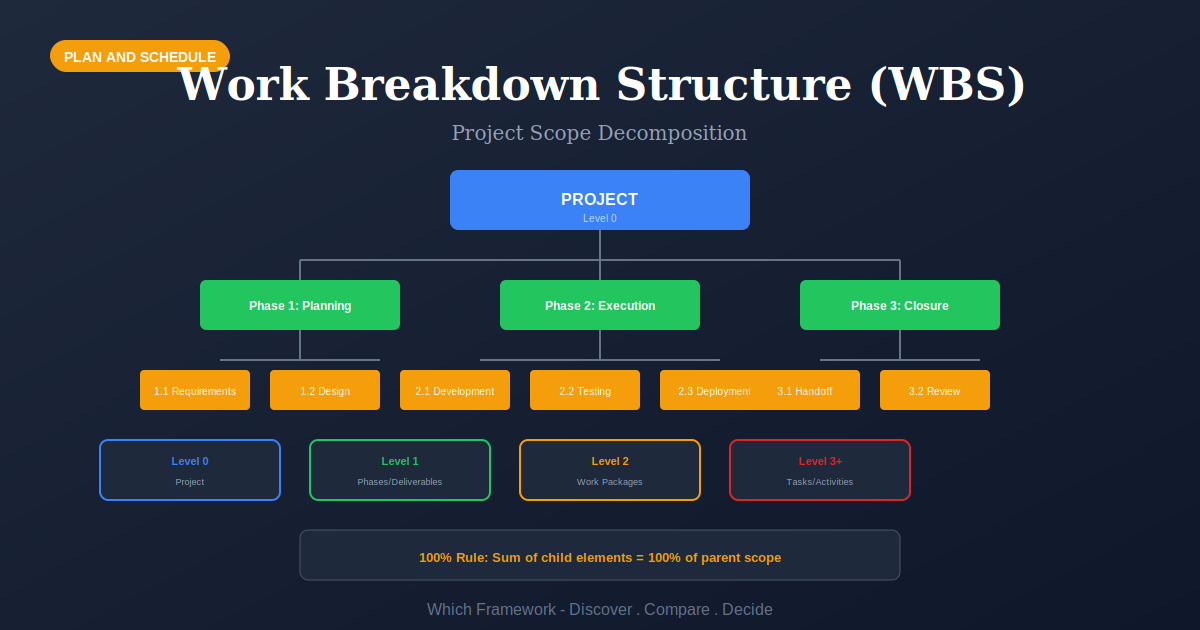
Work Breakdown Structure (WBS) is a deliverable-oriented hierarchical decomposition of the total scope of a project, dividing it level by level into work packages small enough to estimate, assign and control.
Before you start
Is this your framework?
A WBS answers one question: what, exactly, is inside this project? It is a scope instrument, not a schedule and not a plan. Everything downstream — estimates, budgets, contracts, the schedule itself — rests on it, which is why an incomplete one is expensive in a way that is invisible until late.
Its condition is that scope can be known in advance. Where requirements are expected to emerge through delivery, a full decomposition up front is a forecast dressed as a plan, and the when not to use section covers what to do instead.
| If your real problem is… | You probably want |
|---|---|
| We need dates, durations and a sequence for the work | Gantt Chart — the WBS says what; the schedule says when, and needs the WBS to exist first Compare WBS and Gantt Chart |
| We need to know which activities control the finish date | Critical Path Method — dependencies and float, computed from the activities a WBS produces Compare WBS and Critical Path Method |
| Scope is expected to emerge as the work proceeds | Sprint Planning or User Story Mapping — near-term detail with the rest left deliberately coarse |
| Nobody is clear who is responsible for which piece | RACI Matrix — responsibility mapped onto scope, which assumes the scope is already decomposed |
| We need to allocate people and equipment across the work | Resource Allocation Matrix — capacity against demand |
| The problem is uncertainty in durations rather than in scope | PERT — three-point estimation once the work packages exist |
| We need to define and agree everything the project will produce | Work Breakdown Structure — you are in the right place |
What Is It?
The standard definition, and the one worth learning, is that a WBS is a deliverable-oriented hierarchical decomposition of the total scope of work to be carried out by the project team. Each phrase in that sentence is load-bearing. Deliverable-oriented means it names outputs, not actions. Hierarchical means every element belongs to exactly one parent. Total scope means everything, including the project management effort itself.
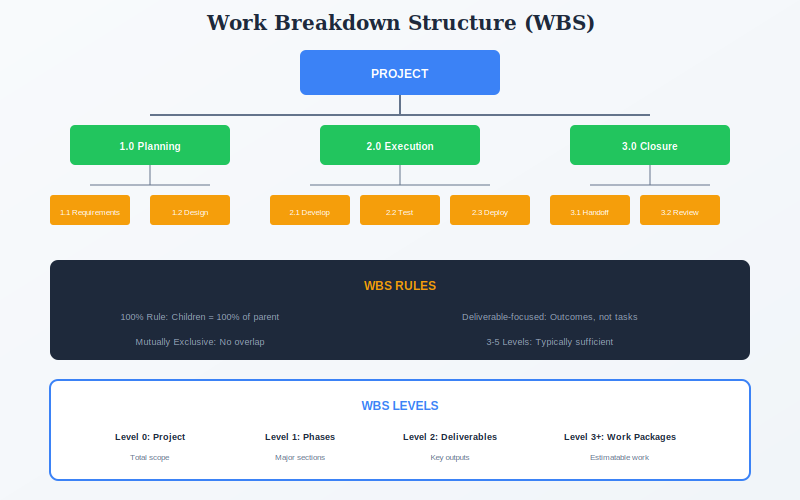
Level 0 is the project. Below it sit major components, then sub-components, then work packages — the lowest level, where decomposition stops because the piece is small enough to estimate with confidence, give to one owner, and track as a unit. Cost and schedule attach at the work package. Nothing below it appears in the WBS.
Every element gets a number, so 1.2.3 identifies a piece of scope unambiguously across the estimate, the schedule, the contract and the cost report. Alongside the diagram sits a WBS dictionary, which records for each element what it includes, what it excludes, who owns it and what evidence proves it complete. The dictionary is where most of the actual precision lives, and it is the part most often skipped.
The rule that governs the whole structure is the 100% rule: the children of any element must together account for exactly its scope, no more and no less. Anything absent from the WBS is, by definition, outside the project. That is what makes the WBS the reference for scope disputes, and why building one carefully is cheaper than arguing later.
A WBS feeds directly into Critical Path Method and Gantt Chart scheduling, and its work packages are what a RACI Matrix assigns ownership to.
Quick Reference
The design rules
The rules that make it work
A WBS is easy to draw and hard to draw correctly. Five rules separate a real one from a diagram that resembles it, and each has a test you can apply to a finished structure.
| Rule | What it requires | The test |
|---|---|---|
| Deliverable-oriented | Elements name things produced, not work performed. The single most common error is decomposing by activity, which yields Planning, Execution and Closure — a process, not a scope statement. | Is every element a noun? |
| The 100% rule | Children total exactly their parent’s scope. Applies at every level, including level 1 against the project. Gaps here become variation claims; overlaps become double-counted cost. | Could you delete the parent and lose nothing? |
| Mutually exclusive | No element appears under two parents, and no two elements cover the same work. Shared scope has to be split or assigned, not duplicated. | Does any work appear twice? |
| Stop at the work package | Decompose until a piece can be estimated confidently, owned by one person and tracked as a unit. The common heuristic is 8 to 80 hours of effort, which is guidance rather than a standard. | Can one person own it and estimate it? |
| Write the dictionary | For each element: what it includes, what it explicitly excludes, the owner, and the evidence of completion. The exclusions matter most, because that is where disputes actually arise. | Does each element say what it is not? |
Why the 100% rule is the one that pays
The other rules improve a structure. This one finds money. Scope that exists in the contract but nowhere in the WBS has no owner, no estimate and no budget line, and it stays invisible until someone has to do it. Gaps cluster in predictable places: at the seams between subcontracts, in testing and commissioning, in interfaces with third parties, and in the project management effort itself, which teams routinely forget is scope.
The practical check is to work upward rather than downward. Take the contract or scope statement and confirm each obligation lands somewhere in the structure. Building downward finds what you thought of; auditing upward finds what you did not.
Terminology
The breakdown structure family
Several structures share the WBS pattern and differ in what they decompose. They are frequently confused, and one abbreviation genuinely means two different things.
| Structure | What it decomposes | Where it is used |
|---|---|---|
| WBS Work breakdown structure | The total scope of work, as deliverables | The general standard, and the basis for estimate, schedule and cost control |
| PBS Product breakdown structure | The products themselves, without the work of making them | Central to PRINCE2, which builds the product structure first and derives activities from it |
| OBS Organizational breakdown structure | The units and teams responsible | Crossed with the WBS to produce cost accounts and assign ownership |
| RBS Two different things | Resource breakdown structure, decomposing people and equipment by type — or risk breakdown structure, decomposing risks by category | Both are in common use, so the abbreviation is unsafe without context |
| CBS Cost breakdown structure | Budget, by cost type rather than by deliverable | Finance and estimating, usually mapped onto the WBS rather than replacing it |
The WBS and OBS together are more useful than either alone. Crossing them produces control accounts: the intersection of a piece of scope with the unit accountable for it, which is the level at which cost and progress are actually measured on large projects.
Core Features
- Deliverable-oriented: elements are nouns naming outputs
- Hierarchical: every element has exactly one parent
- The 100% rule: children total their parent’s scope exactly
- Work packages: the lowest level, where cost and schedule attach
- Numbering: a code that identifies scope across every other document
- WBS dictionary: inclusions, exclusions, owner and completion evidence
Worked example
A cooling plant, and the 9% of scope that belonged to nobody
An illustrative composite. A contractor building a district cooling plant expansion in Abu Dhabi, United Arab Emirates, at around AED 220 million. Six months in, cost reporting could not explain a growing variance, and the commercial team could not tell which claims were genuine variations and which were scope they had always owned.
| Step | What it produced |
|---|---|
| The original structure | Level 1 read Design, Procurement, Construction, Commissioning. That is a process, not a scope decomposition. Commissioning of the chiller hall and of the pumping station sat in one undifferentiated bucket, so neither had an owner or a cost account. |
| The rebuild | Decomposed by physical system instead: chiller hall, pumping station, distribution network, energy transfer stations, and project management. Each system then carried its own design, procurement and commissioning scope beneath it. |
| The 100% rule audit | Working upward from the contract, about 9% of contracted scope had no element anywhere in the structure. Most of it was testing and commissioning of the electrical tie-in to the grid, which sat between two subcontract packages and had been assumed by each to belong to the other. |
| What it explained | Roughly two-thirds of the disputed claims resolved immediately. Work that appeared in the rebuilt WBS was theirs; work that appeared nowhere in the contract was a genuine variation. The argument became a document check rather than a negotiation. |
| What they overdid | The rebuilt structure ran to about 1,400 work packages, many under four hours of effort. Progress reporting against them cost more than the control it provided, and the lowest two levels were later collapsed. |
Gaps hide at the seams, and granularity has a cost
The missing 9% was not carelessness; it was structural. Scope disappears where two packages meet, because each party reasonably assumes the interface belongs to the other. Decomposing by process made it worse, since a single Commissioning bucket gave the gap nowhere to become visible. Auditing upward from the contract is what found it, and that check takes a day.
The second finding is the one people underrate. A WBS can be too detailed as easily as too coarse, and the failure is quieter: nobody complains about excessive precision, they simply stop updating it. The 8 to 80 hour heuristic exists for this reason. It is not a standard, and it should not be applied mechanically, but a structure with hundreds of sub-four-hour packages has stopped being a control tool and become a reporting burden.
When to Use
- Scope can be defined in advance and is expected to hold
- The project is large enough that no one person holds all of it
- Cost and schedule estimates need a defensible basis
- Work is contracted, so scope boundaries carry commercial weight
- Multiple teams or subcontractors need unambiguous boundaries
- Construction, engineering, infrastructure, regulated or capital projects
When NOT to Use
- Scope is emergent, discovered through delivery rather than known at the outset
- The work is continuous operations rather than a project with an end
- The project is small enough to hold in a single list
- Requirements are expected to change faster than the structure can be maintained
- It would be built to satisfy a governance template rather than to control scope
In practice
How work breakdown structures go wrong
Every failure below is cheap to fix while building and expensive to fix once estimates and contracts depend on the structure.
| Failure mode | What it looks like | What to do instead |
|---|---|---|
| Decomposing by activity | Level 1 reading Design, Build, Test — a process diagram in a WBS shape | Name every element as a noun. Sequence belongs in the schedule. |
| Gaps at the seams | Interfaces, tie-ins and commissioning owned by nobody because each party assumed the other | Audit upward from the contract, not downward from the diagram. |
| Forgetting project management | The management effort itself absent, so it has no budget and is absorbed silently | Give project management its own branch. It is scope and it costs money. |
| Decomposing too far | Thousands of tiny packages, reporting cost exceeding control value, updates quietly stopping | Stop where one owner can estimate confidently. Use 8 to 80 hours as a sanity check. |
| No dictionary | Element names with no definition, so two teams read the same box differently | Record inclusions and, more importantly, explicit exclusions for each element. |
| Built once, never revised | Approved variations never reflected, so the structure and the contract drift apart | Put the WBS under change control with the scope it represents. |
Sourced
Evidence, and how to cite it
The WBS came from defense and space programs, not from the project management profession.
The approach grew out of PERT, introduced by the US Navy in 1957 for the Polaris program, where tasks were already organized into product-oriented categories although the term was not yet used. The Department of Defense and NASA described the method at length in their joint PERT/COST Systems Design guide of June 1962, which the Secretary of Defense endorsed for adoption across all services. In 1968 the Department of Defense issued MIL-STD-881, mandating work breakdown structures for defense materiel items. The Project Management Institute documented the extension of these techniques beyond defense in 1987, and later published its own practice standard.
Department of Defense and NASA (1962) PERT/COST Systems Design. Washington DC: Office of the Secretary of Defense; MIL-STD-881, 1 November 1968.
The 100% rule is a PMI formulation, and it is the governing design principle.
The rule states that a WBS includes 100% of the work defined by the project scope, and that the decomposition of any element must represent 100% of the work applicable to its parent. It applies at every level, and it cuts both ways: nothing may be missing and nothing may be added. It is set out in PMI’s Practice Standard for Work Breakdown Structures, which is the closest thing to a general-purpose equivalent of the defense standard.
Project Management Institute (2019) Practice Standard for Work Breakdown Structures. 3rd edn. Newtown Square, PA: PMI.
The 8 to 80 hour rule is a heuristic, not a standard.
The guidance that a work package should represent between 8 and 80 hours of effort is widely repeated and often cited as though it came from a standard. It does not. It is a practitioner rule of thumb for the level at which a package can still be estimated confidently and reviewed within a normal reporting cycle. Sensible ranges vary enormously with the size of the project, and applying the figure mechanically on a large program produces the over-decomposition that makes a structure unmaintainable.
Widely used in practice; see the discussion of decomposition limits in PMI’s practice standard, which frames the stopping point in terms of manageability rather than hours.
How to cite it.
Harvard: Project Management Institute (2019) Practice Standard for Work Breakdown Structures. 3rd edn. Newtown Square, PA: PMI.
APA: Project Management Institute. (2019). Practice standard for work breakdown structures (3rd ed.).
For the origin, cite Department of Defense and NASA (1962) PERT/COST Systems Design. For the defense standard, cite MIL-STD-881 and its current revision.
Key Strengths
- Finds missing scope: the 100% rule surfaces gaps before they become claims
- Makes estimates defensible: costs build up from named, owned pieces
- Settles disputes: a numbered element is a shared reference across documents
- Assigns ownership cleanly: every package has exactly one owner
- Feeds everything downstream: schedule, budget, risk and responsibility all key off it
Key Weaknesses
- Assumes knowable scope: poorly suited where requirements emerge
- Easy to build wrongly: activity decomposition looks identical at a glance
- Over-decomposition is quiet: too much detail is not complained about, just abandoned
- Says nothing about sequence: no dependencies, no dates, no critical path
- Needs maintenance: drifts from the contract unless under change control
Sequencing
What to run before and after
The WBS sits at the start of planning. Almost everything else in project control depends on it existing and being right.
Before
Agree the scope the structure will decompose
A WBS cannot define scope, only organize it. The scope statement, contract or requirements have to exist first, because the 100% rule needs something to be 100% of.
During
Assign ownership and estimate the packages
A work package without a single owner is not finished. Crossing the structure with the organization produces control accounts, which is the level at which cost and progress are actually measured.
After
Sequence it, then keep it under change control
Work packages become the activities a network is built from, and the bars on a chart. Then approved variations have to flow back into the structure, or the WBS and the contract silently diverge.
Common questions
Work breakdown structure: quick answers
What is a work breakdown structure?
A deliverable-oriented hierarchical decomposition of the total scope of a project. It starts with the whole project and divides it into progressively smaller pieces, ending in work packages small enough to estimate, assign and control. It defines what will be produced, not the order in which work happens.
What is the 100% rule?
The design rule that governs every level of a WBS: the children of any element must together represent 100% of that element's scope, no more and no less. Anything absent from the WBS is outside the project, and anything present that is not in the scope should not be there. It is the check that finds gaps before they become claims.
What is a work package?
The lowest element in a WBS, and the point where decomposition stops. A work package is small enough to estimate with confidence, assign to one owner and track as a unit, and it is where cost and schedule are attached. A common heuristic is that it should take between 8 and 80 hours of effort, though that is a rule of thumb rather than a standard.
Should a WBS contain verbs or nouns?
Nouns. A WBS names things the project produces, so an element reads Chiller Hall or Approved Drawings rather than Install or Review. Activity-oriented decomposition is the commonest error in practice, and it produces something that looks like a WBS but is really a process diagram. The sequence of work belongs in the schedule.
What are the types of breakdown structure?
Several share the pattern. A work breakdown structure decomposes scope. A product breakdown structure decomposes the deliverables themselves and is central to PRINCE2. An organizational breakdown structure maps scope to the units responsible. A cost breakdown structure organizes budget. RBS is ambiguous and means either resource breakdown structure or risk breakdown structure depending on the source.
What is emergent scope, and can a WBS handle it?
Emergent scope is scope that becomes clear through delivery rather than being known at the start, which is the normal condition in agile work. A WBS assumes scope can be defined up front, so the two sit awkwardly together. Teams that need both usually decompose the near-term work in detail and leave later branches deliberately coarse, refining them as the work is understood.
Who created the work breakdown structure?
It came from the US Department of Defense and NASA rather than from any individual. The approach was described at length in their joint PERT/COST Systems Design guide of June 1962, and the Department of Defense mandated it through MIL-STD-881 in 1968. The Project Management Institute documented its extension beyond defense work in 1987.
How do I cite the work breakdown structure?
Harvard style: Project Management Institute (2019) Practice Standard for Work Breakdown Structures. 3rd edn. Newtown Square, PA: PMI. APA style: Project Management Institute. (2019). Practice standard for work breakdown structures (3rd ed.). For the origin cite Department of Defense and NASA (1962) PERT/COST Systems Design. For the defense standard cite MIL-STD-881.
Deep Resources
Frameworks related to Work Breakdown Structure
- Critical Path Method (CPM)Dependencies and float, computed from the activities a WBS produces…
- Gantt ChartActivities as bars against a calendar, scheduled from the work packages…
- RACI MatrixResponsibility mapped onto scope that has already been decomposed…