Porter's Generic Strategies: Cost Leadership, Differentiation, Focus
Porter’s Generic Strategies is a strategic positioning framework defining three ways to compete: Cost Leadership (lowest cost in the industry), Differentiation (unique value at a premium), and Focus (either advantage within a narrow segment).
Before you start
Is this your framework?
Generic strategies answer one question: on what basis do we intend to win, and for whom? It is a framework for choosing a position, not for analyzing an industry or auditing your own capabilities. Those are different jobs with different tools.
It also assumes a competitive market you are already in. If the interesting question is whether to enter a market at all, or how to create one that does not yet exist, this is the wrong instrument.
| If your real problem is… | You probably want |
|---|---|
| We need to know whether this industry is worth competing in at all | Porter’s Five Forces — industry structure and where profit pools sit, which is the analysis that comes first Compare Generic Strategies and Five Forces |
| We want to stop competing head-on and create uncontested space | Blue Ocean Strategy — built as a direct challenge to the choice this framework insists on Compare Generic Strategies and Blue Ocean |
| We need to know which of our resources could sustain any advantage | VRIO or Resource-Based View — looking inward at what you have, not outward at where to stand |
| We need to choose which segments to serve and how to address them | STP Framework — segmentation and targeting in far more detail than “narrow scope” |
| We need to decide where to grow: new products, new markets, or both | Ansoff Matrix — growth direction rather than competitive basis |
| We need to see how we sit against rivals on the attributes buyers care about | Competitive Positioning Map — a picture of the current field |
| We are being squeezed from both ends and cannot say what we are best at | Porter’s Generic Strategies — you are in the right place |
What Is It?
Michael Porter set out the generic strategies in Competitive Strategy in 1980. His argument was that above-average performance in an industry comes from one of two kinds of competitive advantage: either you produce at lower cost than rivals, or you offer something buyers value enough to pay more for. Everything else is detail.
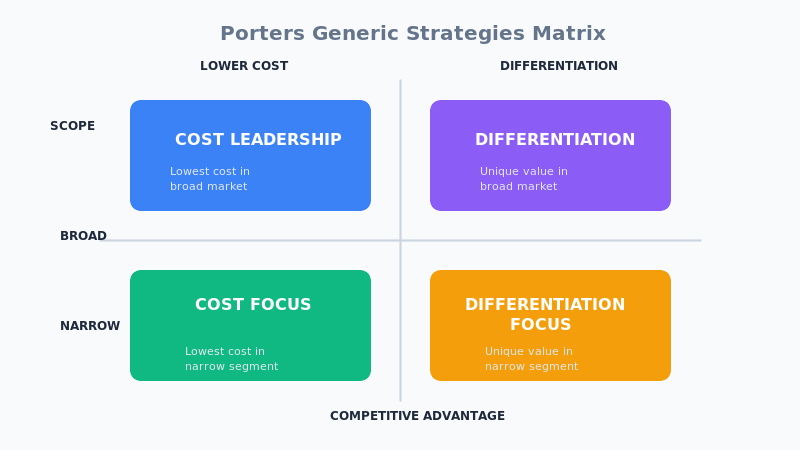
Crossing those two with a second choice — how much of the market you intend to serve — produces the strategies. Cost leadership means being the lowest-cost producer serving a broad market. Differentiation means being distinctive across a broad market. Focus means doing either of those things within one narrow segment rather than the whole industry.
The framework is best known for what it says you cannot do. Porter argued that pursuing cost and differentiation at once usually leaves a firm with neither, a condition he called stuck in the middle. Such a firm cannot win price-sensitive buyers from the cost leader, and cannot charge a premium to buyers who want something particular. The claim is contested, and the evidence section below sets out the argument on both sides.
Two points of order that cause a great deal of confusion. Porter named three strategies in 1980; the familiar two-by-two matrix appeared in Competitive Advantage in 1985 and shows four cells, because focus splits into cost focus and differentiation focus. And the five generic strategies taught in some courses are from a different textbook altogether. Both points are covered in evidence and in the questions at the end.
Generic strategies pair naturally with Porter’s Five Forces, which analyzes the industry you are choosing a position within, and with SWOT Analysis for the internal picture.
Quick Reference
The choice itself
The strategies, and the matrix
The four cells below are the 1985 matrix. Read the “what it actually requires” column before the strategy names: each position demands a particular set of capabilities, and the commonest error is choosing one the organization has no way of holding.
| Strategy | What it actually requires | Where the margin comes from | How it fails |
|---|---|---|---|
| Cost leadership Broad market, cost advantage | Scale, high utilization, tight process control, cheap inputs or proprietary technology. It requires accepting a plain product and a culture that treats every unit of cost as a target. | Selling at or near the market price while producing for less, or cutting price to take share and still clearing a margin. | A rival finds a cheaper structure, or technology resets the cost base and your scale becomes a sunk asset rather than an advantage. |
| Differentiation Broad market, uniqueness | Something buyers genuinely value and can perceive before purchase — design, brand, service, reliability, technology — and sustained spending to keep it ahead. | A price premium large enough to cover the extra cost of being distinctive, with something left over. | The distinctive thing gets imitated, or buyers stop caring and the premium collapses while the cost of providing it does not. |
| Cost focus Narrow market, cost advantage | A segment whose needs are cheaper to serve than the broad market’s, and the discipline to refuse everything outside it. | Lower cost to serve one segment than a broad competitor carrying capability that segment does not need. | A broad cost leader decides the segment is worth having, and arrives with a structure you cannot match. |
| Differentiation focus Narrow market, uniqueness | A segment with distinct needs that broad players serve badly, plus deep knowledge of what those buyers actually want. | A premium from buyers who cannot get what they need anywhere else. | The segment’s needs converge with the mainstream, or it grows large enough to attract a broad competitor. |
What “stuck in the middle” actually describes
It is not a firm that is merely average. It is a firm whose investments contradict each other. Money spent on brand and service raises the cost base, which makes the low-price position unreachable; money spent stripping cost removes the very features that would justify a premium. Each investment undoes the effect of another.
The practical test is not where you sit on a chart. It is whether you can name what you would refuse to do. A cost leader refuses features. A differentiator refuses to compete on price. A firm that will refuse neither has not chosen, whatever its strategy document says.
Core Features
- Two axes: the basis of advantage, and how much of the market you serve
- A forced choice: the framework’s value is in what it rules out
- Capability requirements: each position needs different skills and structures
- Stuck in the middle: a named failure state, not just weak performance
- Industry-level thinking: a position is always relative to rivals in one industry
- Sustainability: a position only counts if it can be defended against imitation
Worked example
A Dutch bicycle maker, squeezed from both ends
An illustrative composite. A bicycle manufacturer in Gelderland, in the Netherlands, with about €38 million in revenue, building mid-range city bikes sold through independent dealers. Operating margin had fallen from 11% to 4% over four years, and the board could not agree why.
| Step | What it produced |
|---|---|
| The diagnosis | Textbook stuck in the middle. Asian-built bikes sold through large retail chains undercut them by roughly 30%, while Dutch premium brands took the buyers who cared about design and would pay for it. The company was neither cheap nor special. |
| Cost leadership, tested | Ruled out quickly. Reaching the volume needed would have meant moving manufacturing and rebuilding the supply base, and even then they would have arrived third into a position two rivals already held. |
| Broad differentiation, tested | Ruled out on money. The brand spending required to compete with established premium names across the whole market was estimated at several years of profit, which the balance sheet could not fund. |
| The choice | Differentiation focus: cargo bikes for urban delivery fleets. That segment wanted things consumer brands were not built to supply — frames rated for daily commercial loads, same-week parts, and fleet servicing contracts. |
| What it cost | Revenue fell from €38 million to €29 million as they exited mass retail. Operating margin rose from 4% to 13%. Absolute profit roughly doubled, but only in the third year. |
The two things the framework did not tell them
It did not say the revenue would have to fall. Choosing a position means giving up the business that belongs to the position you left, and that loss arrives immediately while the gains arrive slowly. The board came close to reversing the decision in year two, when revenue had dropped and margin had not yet recovered. Most strategies that fail in practice fail in that gap rather than in the analysis.
And it undersold how quickly a focused position attracts rivals. Within three years a large European manufacturer entered fleet cargo bikes as a side venture. Porter names this risk himself: a broad competitor can decide to out-focus the focuser, and the very thing that made the segment safe — being small enough to ignore — stops being true the moment you prove it is profitable.
When to Use
- Margins are eroding and nobody can say what the company is best at
- You are being undercut on price and out-specified on features at the same time
- A business unit needs its competitive basis stated before planning starts
- Investment requests keep arriving that point in opposite directions
- Entering a new market and choosing how to compete in it
- Teaching or assessing a strategy: it is the standard vocabulary for positioning
When NOT to Use
- The industry has no stable structure to hold a position within
- The real question is which businesses to own, not how one competes
- You need an implementation plan; this framework stops at the choice
- The advantage sought is a capability rather than a market position
- The aim is to redefine the market rather than take a place in it
In practice
How the framework goes wrong
Most failures are not analytical. The matrix is easy; living with what it implies is not.
| Failure mode | What it looks like | What to do instead |
|---|---|---|
| Declaring rather than choosing | A slide naming differentiation, and a budget that still funds cost reduction everywhere | Write down what the choice means you will stop doing, and check the budget against it. |
| Choosing a position you cannot hold | Cost leadership picked by the third-largest firm in the industry, which cannot reach the volume | Test the choice against capabilities first. There is room for one cost leader, not three. |
| Differentiating on something buyers cannot see | Real engineering quality that never reaches the buyer as a reason to pay more | Differentiation only pays if it is perceptible before purchase. Otherwise it is just cost. |
| Calling a small firm a focuser | “We are a focus player” used to describe simply being small, with no segment actually chosen | Name the segment and what makes its needs different. Small is not the same as focused. |
| Abandoning it in the trough | The revenue lost by leaving the old position arrives before the margin gained by the new one | Agree the expected dip and its duration in advance, so year two is not read as failure. |
Sourced
Evidence, and how to cite it
Three strategies in 1980; four cells in 1985.
Porter set out overall cost leadership, differentiation and focus in Chapter 2 of Competitive Strategy in 1980. The two-by-two matrix that most people picture comes from Competitive Advantage five years later, and shows four cells because focus divides into cost focus and differentiation focus. Sources that date the generic strategies to 1985 are describing the diagram rather than the idea. If a course asks for three, it wants the 1980 formulation; if it asks for four, it wants the matrix.
Porter, M.E. (1980) Competitive Strategy. New York: Free Press; Porter, M.E. (1985) Competitive Advantage. New York: Free Press.
The five generic strategies are not Porter’s, and the fifth contradicts him.
Chapter 5 of Thompson, Peteraf, Gamble and Strickland’s Crafting and Executing Strategy is titled The Five Generic Competitive Strategies: broad low-cost, broad differentiation, focused low-cost, focused differentiation, and best-cost provider. That fifth position combines low cost with meaningful differentiation. It is exactly the hybrid Porter described as stuck in the middle. So a student taught from one book and examined from another is not confusing the count; they are being handed two frameworks that disagree.
Thompson, A.A., Peteraf, M.A., Gamble, J.E. & Strickland, A.J. Crafting and Executing Strategy: The Quest for Competitive Advantage. New York: McGraw-Hill Education, ch. 5.
Whether hybrids really fail has been argued for forty years.
Critics have long held that firms can pursue cost and differentiation together, pointing to manufacturers whose quality programs lowered cost and raised value at once. Porter’s reply was that such positions are usually temporary, resting on rivals’ inefficiency rather than on a defensible choice. He restated the underlying argument in 1996, distinguishing operational effectiveness — doing the same activities better — from strategy, which he defined as performing different activities, or similar activities in different ways.
Porter, M.E. (1996) ‘What Is Strategy?’, Harvard Business Review, November–December.
How to cite it.
Harvard: Porter, M.E. (1980) Competitive Strategy: Techniques for Analyzing Industries and Competitors. New York: Free Press.
APA: Porter, M. E. (1980). Competitive strategy: Techniques for analyzing industries and competitors. Free Press.
For the four-cell matrix, cite Porter (1985) Competitive Advantage. For strategic positioning, cite Porter (1996). For the five-strategy version, cite Thompson et al., not Porter.
Key Strengths
- Forces a decision: its value lies in what it refuses to let you have
- Names a failure state: “stuck in the middle” gives a board language for drift
- Ties position to capability: each choice implies a different organization
- Universally understood: the shared vocabulary of strategy teaching worldwide
- Quick to apply: the diagnosis usually takes days, not months
Key Weaknesses
- The hybrid ban is disputed: forty years of counter-examples and rebuttals
- Static: a snapshot of position, with little to say about how to move
- Stops at the choice: no guidance on execution or sequencing
- Assumes a stable industry: less useful where boundaries are dissolving
- Easily declared, rarely lived: the label is cheap, the trade-offs are not
Sequencing
What to run before and after
Generic strategies sit in the middle of a chain: understand the industry, choose a position, then test whether you can hold it.
Before
Understand the industry you are positioning within
A position is always relative to rivals and to where profit actually sits. Analyze structure first, or you may choose a good position in a bad industry.
During
Test the position against what you actually have
Choosing cost leadership without the scale to hold it is the commonest way this framework produces a wrong answer. Check the capabilities before committing.
After
Turn a position into segments, offers and growth
A chosen basis of competition still needs segments to serve and a direction to grow in. This is also where the refusals get written down and made real.
Common questions
Porter’s generic strategies: quick answers
What are Porter's generic strategies?
Cost leadership, differentiation and focus. Cost leadership means becoming the lowest-cost producer in the industry. Differentiation means offering something buyers value enough to pay a premium for. Focus means serving one narrow segment, either on cost or on differentiation. Porter set out these three in Competitive Strategy in 1980.
Are there three, four or five generic strategies?
Three in Porter's 1980 book. Four in the matrix he drew in Competitive Advantage in 1985, because focus splits into cost focus and differentiation focus. Five is a different framework altogether: Thompson, Peteraf, Gamble and Strickland's textbook adds a fifth called best-cost provider. Which number is right depends entirely on which book your course uses.
Is the fifth strategy, best-cost provider, one of Porter's?
No, and Porter argued against it. Best-cost provider means combining low cost with meaningful differentiation, and it comes from Thompson and Strickland's Crafting and Executing Strategy. Porter's position in 1980 was that a firm attempting both usually ends up stuck in the middle and earns below-average returns. So the two frameworks disagree on substance, not just on counting.
What does 'stuck in the middle' mean?
It is Porter's term for a firm that has committed to neither low cost nor differentiation, and so has neither. It cannot win price-sensitive buyers from the cost leader, and cannot command a premium from buyers who want something distinctive. Porter argued such firms earn below-average returns, and that escaping the position requires a genuine choice.
What is the difference between cost leadership and differentiation?
What you sell to the customer, and where the margin comes from. Cost leadership competes on price or on margin at the market price, and depends on scale, efficient processes or cheaper inputs. Differentiation competes on something buyers value beyond price, and depends on brand, design, service or technology. They need different capabilities, and often different cultures.
What is a focus strategy?
Serving one narrow segment rather than the whole market. The segment might be defined by geography, buyer type, or product line. A cost focus competes on price within that segment; a differentiation focus meets that segment's particular needs better than broad competitors can. Its main risk is that a broad competitor decides to serve the segment too.
What is Porter's strategic positioning, and how does it relate?
Strategic positioning is the idea Porter developed later, in his 1996 Harvard Business Review article What Is Strategy?. He argued that operational effectiveness is not strategy, and that positioning means performing different activities from rivals, or performing similar activities in different ways. He described three bases for it: variety-based, needs-based and access-based positioning.
How do I cite Porter's generic strategies?
Harvard style: Porter, M.E. (1980) Competitive Strategy: Techniques for Analyzing Industries and Competitors. New York: Free Press. APA style: Porter, M. E. (1980). Competitive strategy: Techniques for analyzing industries and competitors. Free Press. For the four-cell matrix cite Porter (1985) Competitive Advantage. For strategic positioning cite Porter (1996).
Deep Resources
Frameworks related to Porter's Generic Strategies
- Porter's Five ForcesIndustry structure analysis across five competitive forces, used to judge where profit sits…
- Blue Ocean StrategyCreating uncontested market space rather than competing within an existing industry…
- Competitive Positioning MapVisual comparison of rivals across the attributes buyers actually care about…