FreeNo sign-upYour notes stay on your computer
Market Expansion Tool
Decide which new market to enter, which customers to serve first and how to get in. Six stages, each picking up where the last left off, ending with an entry mode and a full report.
The tour runs all six stages on an example company. Nothing in it touches your own work. Allow three to six weeks in all: most of it goes on research, not on the tools.
Six stages, in order
Each stage asks one question and hands its answer to the next. You can stop after any stage: save your progress file, and pick up later on any computer. The market expansion playbook explains the method behind each one.
-
Stage 1 of 6 · PESTEL
What is shifting in the markets we could enter?
2 to 5 days of research
- You bring
- Two or three candidate markets, and what you find on the outside forces in each: rules, trade terms, how people buy, what they can spend.
- You get
- The forces that would change the answer, ranked for each market, and which market they lean towards.
-
Stage 2 of 6 · Five Forces
Are those markets worth competing in?
3 to 7 days
- You bring
- What you learn about rivals, buyers, barriers to getting in, substitutes and suppliers, rated as the new entrant.
- You get
- A verdict for each market, the pressure that decides it, and the conditions you would have to meet.
-
Stage 3 of 6 · VRIO
What do we have that would still be an advantage there?
2 to 4 days
- You bring
- Five to ten real capabilities, and a team session to ask the four questions of each, at home and in the new market.
- You get
- What travels, what is an advantage only there, the gaps a partner must fill, and an optional one-page SWOT.
-
Stage 4 of 6 · Ansoff Matrix
Which growth route?
1 to 3 days
- You bring
- One real option in each of the four growth routes, including growth at home.
- You get
- The route you choose, with a reason on record for each option that loses.
-
Stage 5 of 6 · STP
Which customers first?
3 to 10 days
- You bring
- Two to five groups of buyers who behave alike, from research, distributors or a short trip.
- You get
- The first segment to serve, chosen on fit and reach, and one sentence promising it something.
-
Stage 6 of 6 · Competitive Positioning Map
Is there room to stand against who is already there?
1 to 3 days
- You bring
- The brands your first segment buys today, placed on two things buyers weigh.
- You get
- Whether the spot is open, what makes it pay, a suggested entry mode and a first review date.
What you finish with
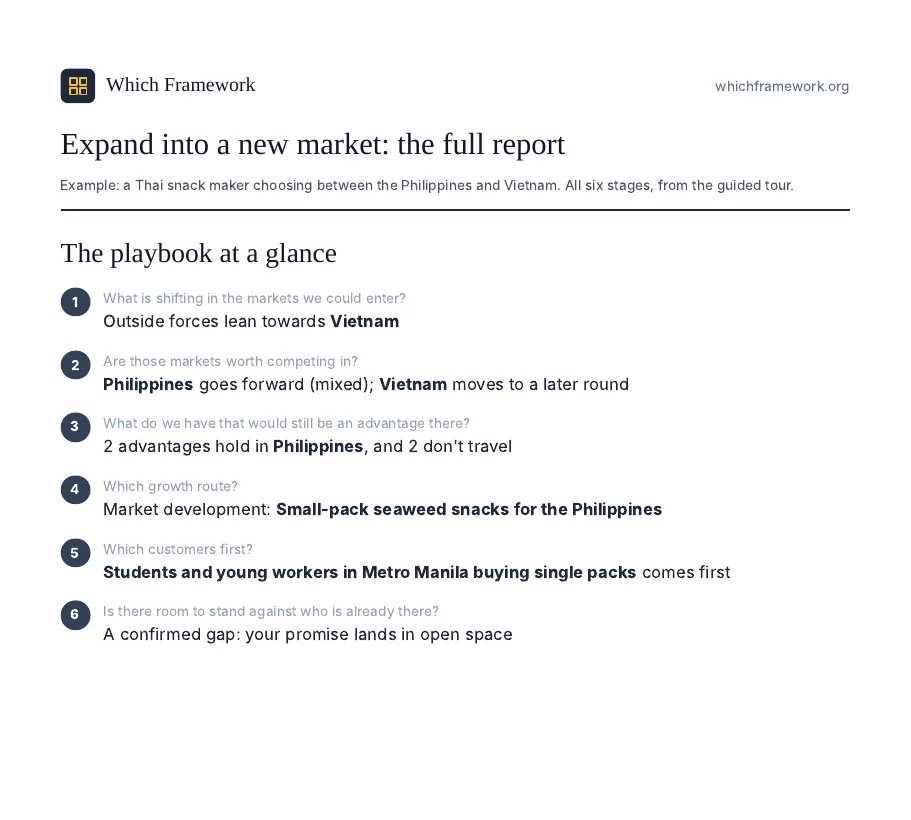
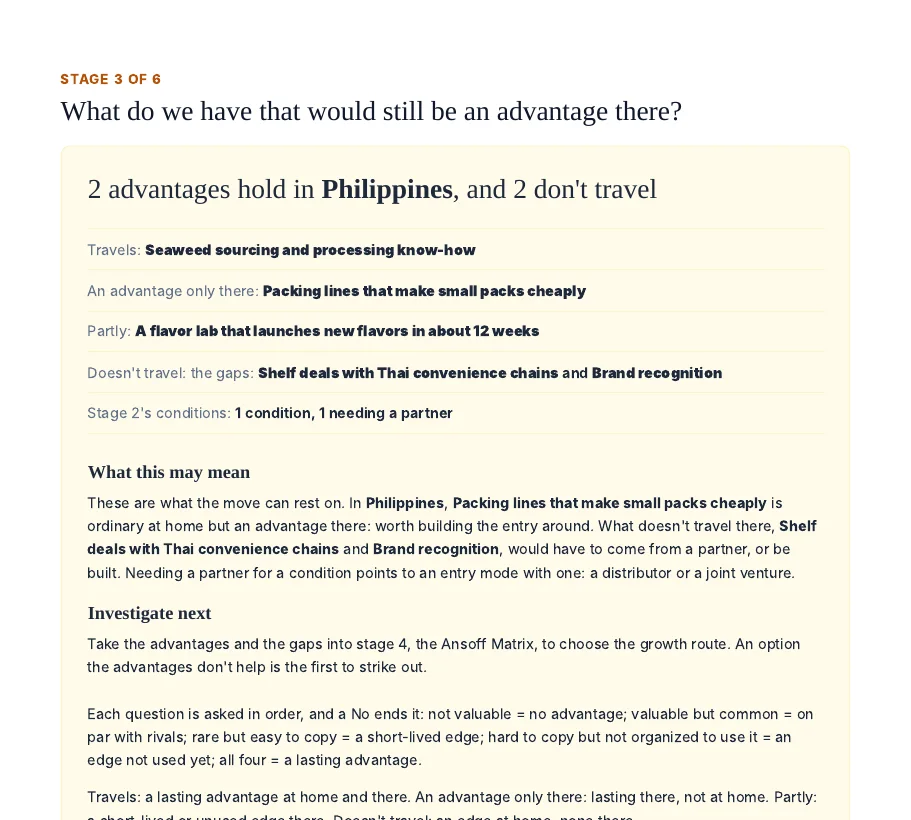
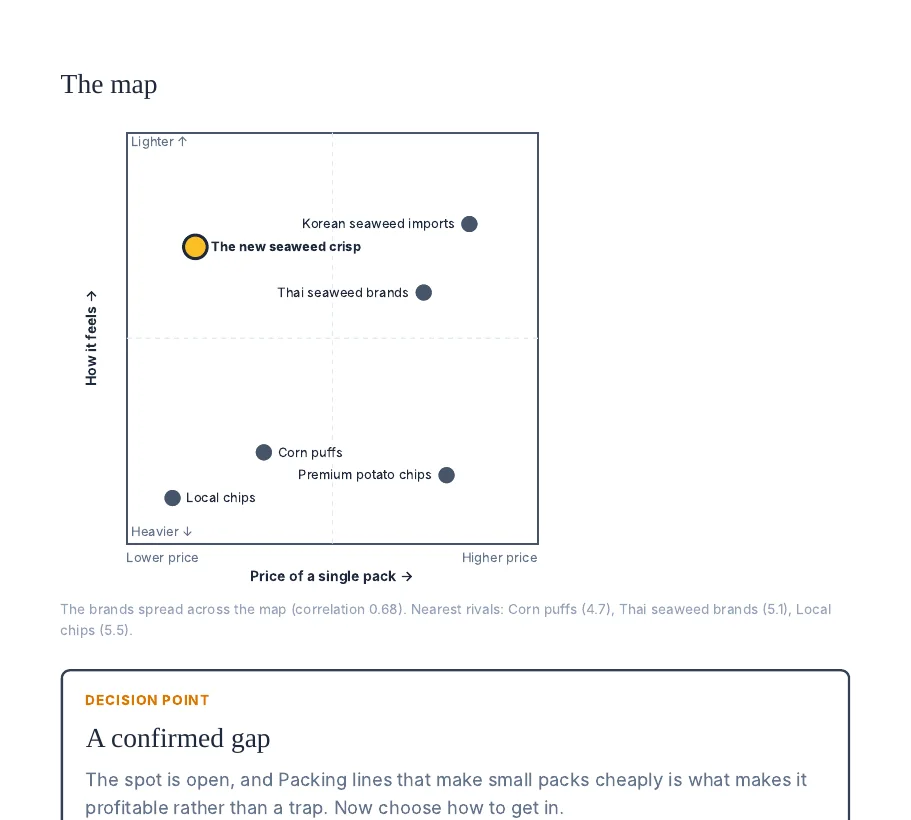
From the guided tour: a Thai snack maker choosing between the Philippines and Vietnam.
Download the example report (PDF, 9 pages)A PDF report of the whole playbook. One headline for each stage, as in the example, then each stage's diagnosis: what it found, what that means, and what to do next. It ends with the position on the map and how to get in.
A progress file you keep. An Excel workbook with a sheet for every stage, updated each time you save. It is also how you come back: choose it on this page or on any stage, and the playbook reopens where you left off.
Places to stop early. If no market is worth competing in, or nothing you have would be an advantage there, the stage says so plainly, and says what to do instead.
Questions
Is it free?
Yes. There is no sign-up. The PDF report asks for an email address; everything else works without one.
Where do my notes go?
Market names, notes and brands stay in your browser and in the progress file you download. To write each stage's diagnosis, the page sends our server only ratings and the places of items in your lists, never the names.
Do I have to do all six stages?
No. Each stage also works on its own, from the tools page. If the market is already chosen, start at stage 5. And when a stage finds no market worth entering, it says so, and what to do instead.
Can several people work on it?
Yes, by passing the progress file. Save it after a stage, send it to a colleague, and they choose it on this page to carry on from there.
How is this different from the playbook article?
The article explains the method and follows one company through it. The tool runs the same six stages on your own markets, and writes the diagnosis at each one.