Playbook
How to Plan for an Uncertain Future
Six questions, asked in order, when the future the plan assumes may not arrive.
An uncertain future playbook is a six-stage sequence that scans what is changing, builds several futures, tests the plan in each, and commits to a direction that can change.
The route
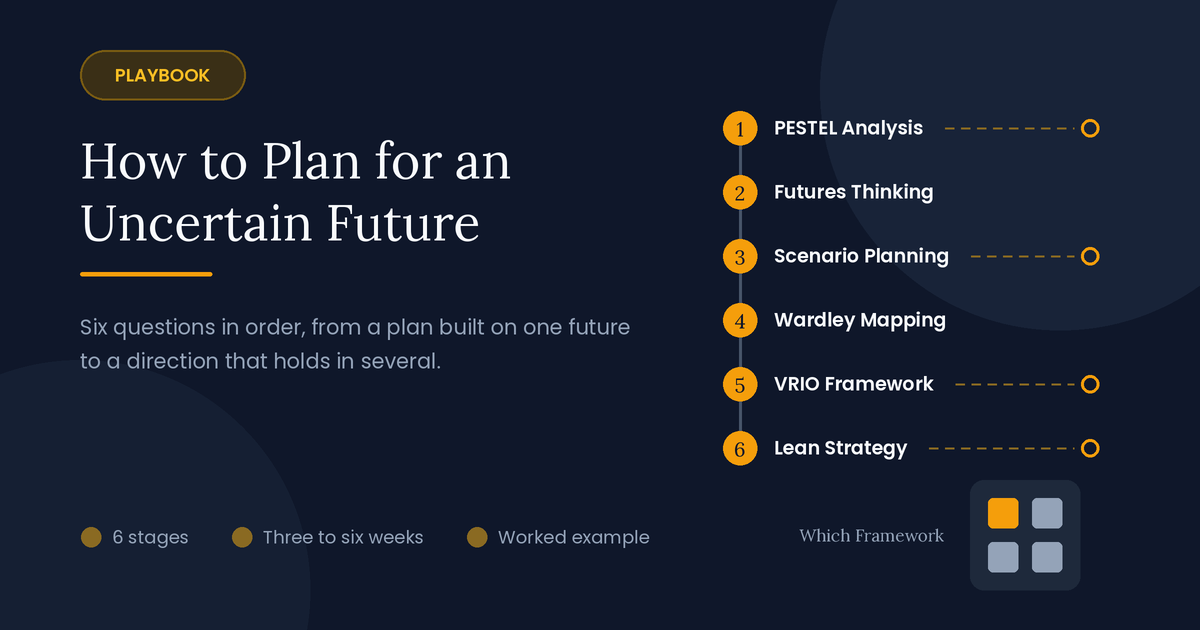
Six questions, in order
The route runs from looking outward to committing: what is changing, which futures the business ignores, how today's plan fares in each, what will change anyway, which strengths last, and what to commit to while you learn.
On timing: stages 1 to 5 take three to six weeks, mostly workshops. Stage 6 sets a direction, then keeps running, reviewed each quarter against the signposts from stage 3.
Facing one large investment rather than a whole direction? The investment decision playbook fits better.
-
What is changing around us?Stage 1 · PESTEL Analysis
Passes on: one decision to inform, and the forces acting on it
No decision for the work to inform?Name one before scanning.
-
Which futures are we ignoring?Stage 2 · Futures Thinking
Passes on: assumptions sorted, and weak signals to watch
-
How does the plan fare in each?Stage 3 · Scenario Planning
Passes on: four scenarios, and where the plan breaks
Plan works in every scenario?The axes didn't disagree enough.
-
What will change regardless?Stage 4 · Wardley Mapping
Passes on: a map of what is becoming a commodity
-
Which strengths will still count?Stage 5 · VRIO Framework
Passes on: the strengths to build on, and the ones fading
Several sustained advantages?Grade again, more strictly.
-
What do we commit to now?Stage 6 · Lean Strategy
Passes on: a boundary to work inside, and experiments to run
Scope lists nothing you'll decline?Write the exclusions first.
- Is the future arriving as expected?Then · Watch the signposts every quarter
The example
One company, followed all the way through
This playbook follows one company from start to finish. It is an illustrative composite, and the details are simplified.
A chain of 18 English-language schools in Ho Chi Minh City, Vietnam, has two kinds of customers: adults and teenagers who pay for courses themselves, and companies that pay for their staff to learn. Its plan for the next five years is to open six more schools.
Then AI tutors that hold a spoken conversation arrive, almost free. Enrolments dip at three schools. Nobody can say whether that is the start of a decline or a blip, and the owners have to decide what to build next anyway.
Each stage below ends with what the company produced at that step, so you can watch one stage's output become the next stage's input.
Stage 1 of 6
What is changing around the business?
Tool: PESTEL Analysis · Time: 2 to 3 days
Start by fixing the scope in one sentence: one market, one time horizon, one decision the work must inform. It is the step most often skipped, and without it the scan has no edge.
Then scan the six PESTEL forces: Political, Economic, Social, Technological, Environmental and Legal. For each, write what is changing and what it would do to the business, with a source. A force with no effect named is just news.
| Force | What is changing | What it would do |
|---|---|---|
| Political | More English taught in state schools | Less demand for teenagers' extra lessons |
| Economic | Foreign factories expanding in the south | More companies paying to train staff |
| Social | Young adults learn on phones, in short bursts | Fewer sign up for two evenings a week |
| Technological | AI tutors hold spoken conversations, almost free | Practice no longer needs a classroom; the rest is unclear |
| Environmental | Floods in the rainy season | Classes lost at three schools each year |
| Legal | Stricter work permits for foreign teachers | Higher costs for native-speaker classes |
Handed to stage 2: the scope “where to put the next five years' investment, looking seven years ahead”, and six forces, one of them impossible to size.
Decision point
If the work has no decision to inform, name one before scanning. Here, the owners had planned a general “future of English learning” workshop. Tying it to the six-school plan made every finding something they would have to act on.
Stage 2 of 6
Which futures is the business not planning for?
Tool: Futures Thinking · Time: a 1-day workshop, then ongoing
Planning tends to collapse onto one future: the one the business case assumes. Futures thinking keeps several open. Its best-known picture, the futures cone, sorts futures into four classes, widening as they reach further ahead.
Each class has its own use. Probable is what the plan already covers. Possible is too remote to plan around; note it and watch. Preferable is a choice, not a forecast, and comes back as the vision in stage 6. That leaves plausible: futures likely enough to test a plan against, and the raw material for stage 3.
To find them, look for weak signals: things happening at small scale now that would matter greatly at large scale.
| Weak signal | Where seen | Why it could matter |
|---|---|---|
| Students cancel after a month on an AI tutor app | 3 of 18 schools | Practice moving out of class |
| An employer pilots an AI-scored speaking test for hiring | One corporate client | Certificates could stop being the goal |
| Teachers using AI to mark homework, unasked | Most schools | Teacher time freed for speaking |
Handed to stage 3: every assumption of the six-school plan in the probable band, and an unwelcome plausible future: employers accepting AI-scored English in place of certificates.
Decision point
If the group can't name a plausible future it would find unwelcome, it hasn't started. The owners first called AI tutors a fad; the employer's pilot test, from one of their own clients, ended that.
Stage 3 of 6
How would today's plan fare in each future?
Tool: Scenario Planning · Time: a 2-day workshop
Scenario planning turns the futures into stories a decision can be tested against. Rank the forces from stages 1 and 2 by impact and by uncertainty, and make the two most uncertain the axes of a 2x2. The axes must vary independently, and the four scenarios must disagree about something that matters.
Then take today's plan into each scenario in turn and ask what breaks. This is wind tunneling. Here, the axis across the top, whether employers still want certificates, decides what students who pay for themselves do. The axis down the side, foreign investment, decides what companies spend. So each scenario covers both kinds of customer.
Separate the moves that pay in every scenario from those that need one particular future, and name signposts: early signs of which future is arriving.
Handed to stage 4: a plan that worked in one future of four, two moves that held up best across all four (coaching at employers' sites, and speaking practice that uses AI), and two signposts: employers' hiring tests and foreign investment figures.
Decision point
If the plan works in every scenario, the axes didn't disagree about anything that matters. Here, the first pair of axes, the economy and exchange rates, left the plan safe in all four; swapping one for employers' view of AI scoring broke it in three.
Stage 4 of 6
Which parts of the business will change in every future?
Tool: Wardley Mapping · Time: two half-day sessions
Scenarios cover what nobody can predict. A Wardley map covers what is fairly predictable: everything evolves toward a commodity. Start from an anchor, a user and their need (here the learner, whoever pays), then place the parts that serve it: the most visible to the user at the top, and across by how evolved each is, from genesis to commodity. Then mark which way each is moving.
The scenarios asked whether to grow; the map shows where growth should go. The six new schools would add classrooms, already a commodity, to teach grammar, which AI tutors are turning into one. The parts still gaining value, coaching and feedback on speaking, need teachers and employers, not buildings.
Handed to stage 5: a plan spending on the commodity end of the map, and the parts gaining value: coaching, feedback on speaking, and training arranged by employers.
Decision point
If the map anchors on your own organization, redraw it from a user's need. The first attempt anchored on “our courses”, which put the company's own products at the top and could not show anything as replaceable.
Stage 5 of 6
Which strengths will still count in those futures?
Tool: VRIO Framework · Time: half a day
VRIO tests whether a resource gives an advantage, with four questions in order: is it Valuable, Rare, costly to Imitate, and is the firm Organized to use it? A single no fixes the verdict and ends the row.
Test the resources behind each part of the map. The map answers much of the first question: a resource that only serves a part becoming a commodity won't stay valuable. Then ask the questions in each scenario. A resource that counts in one future and not the others is a bet, not a strength.
| Resource | Part of the map it serves | V, R, I, O | Verdict | Holds in |
|---|---|---|---|---|
| 18 schools in busy districts | Classrooms: a commodity | Yes, No | Competitive parity | Busy classrooms only |
| Grammar course materials | Grammar practice: becoming a commodity | No | Competitive disadvantage | None |
| 140 trained teachers | Speaking coaching: still gaining value | Yes, Yes, No | Temporary advantage | All but Shrinking market |
| Training contracts with 60 employers | Training arranged by the employer | Yes, Yes, Yes, Yes | Sustained advantage | All four |
Handed to stage 6: employer relationships as the one lasting advantage, and the schools themselves, the core of the old plan, at parity.
Decision point
If the analysis finds several sustained advantages, grade again, more strictly. The first pass rated the teachers inimitable; they had been recruited from the same universities as every rival's.
Stage 6 of 6
What do we commit to now, and what do we test?
Tool: Lean Strategy · Time: a week, then reviewed each quarter
Lean Strategy commits to a direction while expecting it to change. Four parts form a boundary; experiments run inside it, and their results move the boundary, not the vision.
The fixed parts of a lean strategy
- 1Vision
- Set once; the only part meant to survive what the tests find
- 2Objective
- One near-term result, concrete enough to fail
- 3Scope
- What the firm will do, and what it will decline
- 4Advantage
- How it intends to win
Write the scope's exclusions first. A scope listing only what the firm does is not a boundary, and objective and advantage are the parts teams enjoy writing. Then choose experiments that test the riskiest part of the direction, and review them each quarter alongside the signposts from stage 3.
| Part | What the owners wrote |
|---|---|
| Vision | Help people in Vietnam use English confidently at work |
| Objective | 40% of revenue from employer contracts within three years, up from 15% |
| Scope | In: working adults and employers in the south, coached in person or online. Out: new classroom schools, more teen exam classes, building our own AI tutor |
| Advantage | Employer relationships, and teachers who coach speaking, with AI practice between sessions |
| First experiments | AI practice between coaching sessions at three employers; coaching at the client's site |
Handed on: the six new schools dropped, a scope with three exclusions, and two experiments reviewed each quarter.
Decision point
If the scope lists nothing you will decline, write the exclusions first. Two months later a mall developer offered space for a new school on good terms. It was declined in one meeting, because it sat outside the scope.
Pace
Fast track or thorough
The fast track suits a small business checking its direction. The thorough run suits one facing a change it can't size, as in the example. The order of the stages stays the same either way.
| Stage | Fast track (about a week) | Thorough (six weeks or more) |
|---|---|---|
| 1. PESTEL Analysis | One page, with a scope sentence | Each force sourced, with its effect |
| 2. Futures Thinking | Assumptions sorted into the cone | Weak signals gathered from across the business |
| 3. Scenario Planning | Best, base and worst case | Four scenarios, wind tunneling and signposts |
| 4. Wardley Mapping | The value chain, roughly placed | A full map, drawn twice with different people |
| 5. VRIO Framework | Today's resources, today's market | Each resource tested in every scenario |
| 6. Lean Strategy | Objective and scope with exclusions | All four parts, with experiments and quarterly reviews |
Failure modes
How planning for uncertainty goes wrong
| What happens | What it looks like | The fix |
|---|---|---|
| A scan with no decision | A long list of trends nobody acts on | Write the scope sentence first |
| One future treated as the situation | Every assumption in the probable band | Sort them into the futures cone |
| Scenarios that agree | The plan survives all four untouched | Choose axes that disagree about something that matters |
| Strengths graded generously | Several sustained advantages | Test each in every scenario |
| A direction with no exclusions | Every new opportunity chased | Write what you will decline |
After the playbook
Is the future arriving as expected?
Review the signposts every quarter and record which scenario they point to. Keep them on one page; a simple dashboard with a threshold for each helps. When a signpost crosses its threshold, rerun stages 3 and 5, not the whole route.
In the example, after a year two more employers had adopted AI-scored speaking tests, pointing toward the Coaching boom scenario. Employer contracts had grown from 15% to 24% of revenue.
Common questions
Planning for uncertainty: quick answers
How do you plan for an uncertain future?
Fix one decision the work must inform and scan the forces acting on it. Then widen the view beyond the future your plan assumes, build four scenarios and test the plan in each. Map what will become a commodity anyway, check which strengths hold in every scenario, and commit to a direction with clear exclusions, reviewed against signposts every quarter.
What is the futures cone?
A picture that sorts futures into four classes: probable, plausible, possible and preferable, widening as they reach further ahead. It is usually credited to Joseph Voros, who traces it to Trevor Hancock and Clement Bezold in 1994. Its job is to stop planning collapsing onto the probable.
What is a weak signal?
Something happening at small scale now that would matter greatly at large scale: a few customers changing habits, or one employer trying a new practice. Weak signals are the raw material for futures and scenarios.
What is the difference between scenario planning and forecasting?
A forecast picks the most likely future. Scenario planning builds several plausible ones and tests a plan against each, looking for moves that pay in all of them. It is used when the uncertainty is too large for a single forecast to be useful.
What is a Wardley map?
A map of the parts that serve a user's need, stacked by how visible they are to the user and placed by how evolved they are, from genesis to commodity. It shows which parts will lose their value as they become commodities, whatever the future holds.
What does VRIO stand for?
Valuable, Rare, costly to Imitate, and Organized to capture the value. Answered in order, the four questions grade a resource from competitive disadvantage to sustained advantage.
What is lean strategy?
A strategy process in which a fixed vision and a deliberate objective, scope and advantage form a boundary. Experiments run inside it, and their results move the boundary while the vision stays put. The scope's exclusions do most of the work.
Frameworks in this playbook
- PESTEL AnalysisStage 1: What is changing around the business?
- Futures ThinkingStage 2: Which futures is the business not planning for?
- Scenario PlanningStage 3: How would today's plan fare in each future?
- Wardley MappingStage 4: Which parts of the business will change in every future?
- VRIO FrameworkStage 5: Which strengths will still count in those futures?
- Lean StrategyStage 6: What do we commit to now, and what do we test?
- Resource-Based ViewBehind stage 5: the theory VRIO puts to work
- Dashboarding and VisualizationAfter: watching the signposts