Playbook
How to Manage Organizational Change
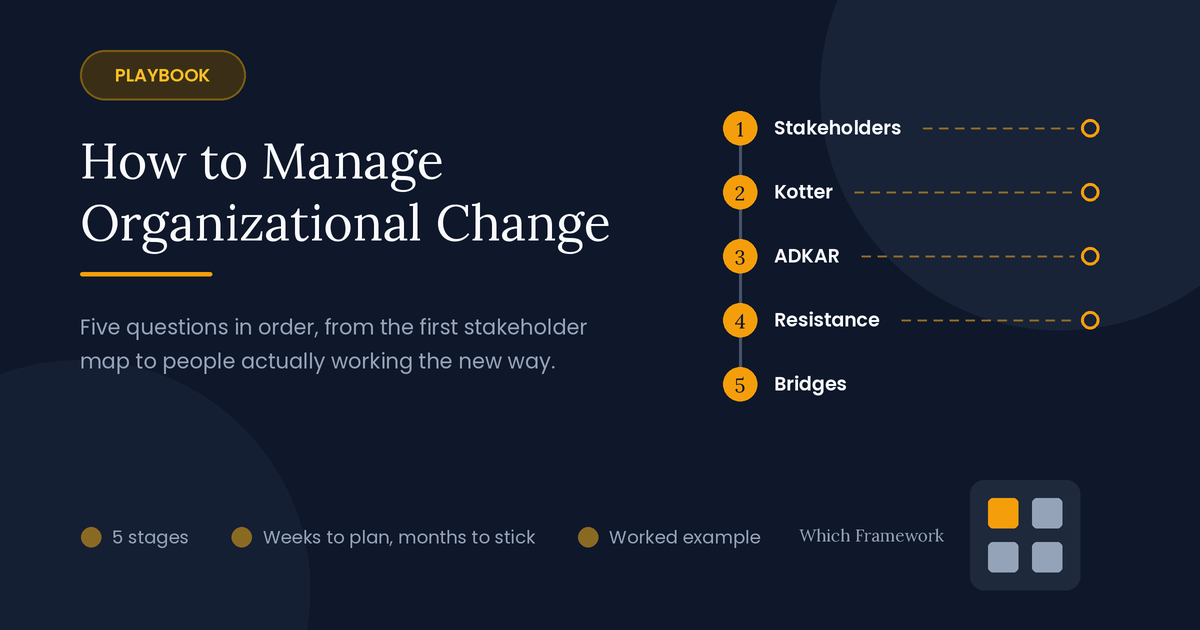
Five questions, asked in order, for a change that has to stick.
An organizational change playbook is a five-stage sequence of change management tools that takes a planned change from the first stakeholder map to people actually working the new way.
The route
Five questions, in order
Each stage asks one question and uses one proven tool. The first two plan the change for the whole organization; the last three take people through it, group by group. Four points on the route can stop or reshape the change.
On timing: stages 1 and 2 happen before the change is announced. Stages 3 to 5 start at the announcement and run side by side for months.
Already have a plan, and people just aren't adopting it? Start at stage 3.
-
Who does the change affect?Stage 1 · Stakeholder Analysis
Passes on: every group mapped by power and interest, with opponents named
A powerful opponent?Talk to them before announcing anything.
-
What is the plan for the whole organization?Stage 2 · Kotter's 8 Steps
Passes on: an eight-step plan, starting with a case for why now
No case for why now?Stop. The change will stall without one.
-
Where is each group stuck?Stage 3 · ADKAR
Passes on: each group's barrier point, and what to do about it
Stuck before Knowledge?Don't train yet. Fix the reason first.
-
Who is pushing back, and why?Stage 4 · Resistance Management
Passes on: a response matched to each reason, and any changes to the plan
The objection is right?Change the plan, and say so.
-
How do people let go of the old way?Stage 5 · Bridges' Transition Model
Passes on: support for each phase people go through
- How do you know it stuck?Then · Measure adoption, then anchor it
The example
One change, followed all the way through
This playbook follows one change from start to finish. It is an illustrative composite, and the details are simplified.
A 900-person insurer in Casablanca, Morocco, is replacing paper claims with a digital system. The bigger change is in the work itself: claims handlers will own each case from start to finish, instead of passing files along a line of desks. The system cost about MAD 40 million. The last system project, five years ago, went live on time and was quietly worked around for two years.
Each stage below ends with what the change team produced at that step, so you can watch one stage's output become the next stage's input.
Stage 1 of 5
Who does the change affect, and how much say do they have?
Tool: Stakeholder Analysis · Time: 2 to 3 days
Before planning the change, find out whom it touches. Stakeholder analysis lists every group the change affects and places each one on two scales: how much power it has over the outcome, and how much interest it has in it.
Each quadrant gets its own approach. High power and high interest: manage closely, and involve them in decisions. High power, low interest: keep satisfied. Low power, high interest: keep informed, often and honestly. Low on both: monitor.
Then mark where each group stands today: for, against or undecided. A powerful group that is against the change is the first thing to deal with, before anyone hears an announcement.
What goes inEvery group the change touches, inside and outside the organization.
What comes outEach group placed by power and interest, with its current stance marked.
Skip it if: the change touches one small team who all already know about it.
| Group | Stance today | First move |
|---|---|---|
| Head of claims | For | Lead the guiding coalition |
| IT director | For | Own the system, not the change |
| Staff representatives | Against | Meet before any announcement |
| Claims handlers | Undecided | Hear it from their own leads first |
Handed to stage 2: the staff representatives are powerful, very interested and opposed. The 240 people most affected have the least say. Both facts shape the plan in stage 2.
Decision point
If a powerful group opposes the change, talk to them before announcing it. An announcement that surprises a powerful opponent turns a disagreement into a public fight. Here, the change team met the staff representatives two weeks before anyone else heard.
Stage 2 of 5
What is the plan for the whole organization?
Tool: Kotter's 8 Steps · Time: 1 to 2 weeks to plan; the steps run for months
Now plan the change for the whole organization. Kotter's model sets out eight steps, in order, from making the case for change to making it part of how the organization works. The order matters. Most failed changes skip the first step and go straight to announcing a vision.
Choose the guiding coalition for credibility, not just rank. Include people the most affected groups already trust, even if they are junior. A coalition of senior managers alone reads as the change being done to people, not with them.
Write one concrete action against each step. The first one carries the most weight: if the leaders can't explain, with evidence, why the change has to happen now, nobody else will believe it either.
What goes inThe stakeholder map from stage 1.
What comes outAn eight-step plan with an action for each step, starting with the case for why now.
Skip it if: the change is small enough to run as a single project. Kotter is built for large ones.
- 1Create urgency
- Show the claims backlog and lost customers, with real figures
- 2Build a guiding coalition
- Head of claims, IT director and two respected senior handlers
- 3Form a vision
- Every claim owned by one person, from start to finish
- 4Communicate it
- Town halls, team meetings and a weekly note, for months
- 5Remove obstacles
- Old approval rules that would block case ownership, retired
- 6Win early
- One region goes first, and its results are shared
- 7Build on the wins
- Region by region, using what the first one learned
- 8Anchor it in culture
- Promotions start to reward case ownership
Handed to stage 3: a plan, and a coalition that includes two senior handlers. Their word carries more weight with the 180 handlers than any memo.
Decision point
If the leaders can't make the case for why now, stop. A change without a clear reason runs on authority alone, and stalls the moment attention moves elsewhere. This is what happened to the insurer's last system project.
Stage 3 of 5
Where is each group of people stuck?
Tool: ADKAR · Time: a first check 2 to 3 weeks after the announcement, then monthly
Kotter plans the change for the organization. ADKAR follows it person by person, or group by group, through five elements that come in a fixed order.
Timing matters here. ADKAR doesn't wait for the stage 2 plan to finish running. Start it once the change has been announced, Kotter's step 4, and repeat it every month while steps 5 to 7 run. Kotter tracks the organization; ADKAR checks whether each group is keeping up.
Score each group on all five, from 1 to 5. The first element scoring 3 or less is the barrier point: where that group is stuck. Work on the barrier point only. Training people who don't yet want the change is wasted, because Knowledge can't move until Desire does.
What goes inThe groups from stage 1, and the plan from stage 2.
What comes outEach group's barrier point, and one action aimed at it.
Skip it if: never, once a change reaches more than one team.
- AAwareness
- Knowing why the change is happening
- DDesire
- Wanting to take part in it
- KKnowledge
- Knowing how to work the new way
- AAbility
- Actually doing it, day to day
- RReinforcement
- Keeping it going once the push ends
| Group | Awareness | Desire | Knowledge | Ability | Reinforcement |
|---|---|---|---|---|---|
| Claims handlers | 4 | 2 | 2 | 1 | 1 |
| Team leads | 5 | 4 | 3 | 2 | 1 |
| Branch agents | 2 | 2 | 1 | 1 | 1 |
The barrier point is the first element scoring 3 or less. Work on that one first; the later ones can't move until it does.
Handed to stage 4: three groups stuck in three different places. Handlers don't want it yet, team leads want it but don't know how, and branch agents barely know it is happening. One training plan for all three would have missed two of them.
Decision point
If a group is stuck before Knowledge, don't train them yet. Find out why they don't want the change, or why they don't know about it, and fix that first. For the handlers, that question leads straight to stage 4.
Stage 4 of 5
Who is pushing back, and why?
Tool: Resistance Management · Time: from the announcement onward, alongside stage 3
Some people will push back. Resistance management matches the response to the reason. The same objection can come from fear for a job, from a real flaw in the plan, or from simply not having been told. Each needs a different answer.
Listen for the real reason behind the stated one. And treat resistance as information: the people closest to the work often see problems the planners missed. When an objection is right, change the plan and say so publicly. Nothing builds trust in a change faster.
What goes inThe groups stuck at Desire in stage 3, and the opponents from stage 1.
What comes outA response matched to each reason, and any changes to the plan.
Skip it if: nobody is pushing back. That is rare, and sometimes means people have stopped saying what they think.
| Who | What they said | The real reason | Response |
|---|---|---|---|
| Staff representatives | This is a cover for job cuts | Fear of losing jobs | A written promise: no redundancies, and retraining for all |
| Senior handlers | The system can't handle complex claims | They were right | A manual route kept for complex claims. The plan changed |
| Branch agents | Nobody told us | They hadn't been told | Briefings in every branch within two weeks |
Handed to stage 5: handlers' Desire scores rose from 2 to 4 within six weeks, mostly after the complex-claims change was announced.
Decision point
If an objection is right, change the plan, and say so. Defending a flaw to protect the plan's credibility costs far more credibility than fixing it.
Stage 5 of 5
How do people let go of the old way?
Tool: Bridges' Transition Model · Time: from the announcement, for 3 to 12 months
A change happens on a date. A transition, the inner adjustment people make to it, takes months. Bridges' model describes three phases, and each group moves through them at its own pace.
The middle phase is where changes quietly fail. Output dips, people miss the old routines, and leaders, who went through their own transition months earlier, lose patience. Plan for the dip instead of treating it as failure.
Support in the middle phase is practical: lower targets for a set period, more frequent check-ins, and someone people can ask without feeling slow. It is also when people are most open to improving the new way, so collect their ideas then.
What goes inThe groups and their progress from stages 3 and 4.
What comes outSupport planned for each phase, with the dip in output expected rather than feared.
Skip it if: never for a change that alters how people's daily work feels.
- 1Ending
- Letting go of the old way and what it meant. People feel loss, even when the old way was worse
- 2Neutral zone
- The old way is gone; the new one doesn't feel natural yet. Confusion, lower output, and room for new ideas
- 3New beginning
- The new way starts to feel like how work is done. People find their place in it
| Phase | What handlers felt | What the insurer did |
|---|---|---|
| Ending | Loss of a familiar desk and a known role in the line | Named what was ending, and thanked people for the old way |
| Neutral zone | Slower work, and doubt | Lowered targets for three months, and said so in advance |
| New beginning | Pride in owning a case from start to finish | Shared customer feedback on owned cases |
Handed on: output fell about 15% for three months, as planned, then passed its old level. Nobody panicked, because the dip had been announced.
Pace
Fast track or thorough
A change affecting one department can move fast. A change across the whole organization needs the thorough run, because skipping steps shows up months later as quiet workarounds.
| Stage | Fast track (one department) | Thorough (whole organization) |
|---|---|---|
| 1. Stakeholder Analysis | A one-hour mapping session | Interviews with each powerful group |
| 2. Kotter's 8 Steps | Steps 1, 3, 4 and 6 only | All eight, over months |
| 3. ADKAR | The manager's own read of each team | Short surveys, repeated monthly |
| 4. Resistance | Open questions in team meetings | A named person collecting objections |
| 5. Bridges | Name what is ending | Support planned for all three phases |
Failure modes
How organizational change goes wrong
| What happens | What it looks like | The fix |
|---|---|---|
| Announcing first | A vision launched before anyone sees why | Make the case for why now first |
| One message for everyone | The same training for every group | Find each group's barrier point |
| Treating pushback as disloyalty | Valid objections are overruled | Change the plan when an objection is right |
| Declaring victory early | The project team moves on at go-live | Track adoption until the new way is normal |
| Panicking at the dip | Output falls and the change is blamed | Expect the dip, and say so in advance |
After the playbook
Measuring adoption, and anchoring it
Go-live is not the finish. Track whether people are actually working the new way, not whether the system is switched on. For the insurer that meant the share of claims owned by one handler from start to finish, tracked as one of its KPIs for a year, with reviews at three, six and twelve months.
Then make the new way permanent: hiring, promotion and the stories leaders tell should all reward it. Lewin calls this refreezing; Kotter calls it anchoring the change in culture.
Common questions
Change management: quick answers
What is the best change management model?
No single model covers it all. Kotter's 8 Steps plans a change for the whole organization. ADKAR follows each group through it. Resistance management handles pushback, and Bridges' model covers the emotional transition. Used in order, each fills a gap the others leave.
What is the difference between Kotter and ADKAR?
Kotter works at the level of the organization: eight steps to plan and lead a large change. ADKAR works at the level of people: five elements each person, or group, has to pass through. Use Kotter for the plan and ADKAR to see where each group is stuck within it.
Why do most change initiatives fail?
Usually for one of three reasons. Leaders announce a vision before making the case for why now. They treat every group the same, so the effort misses the groups stuck in different places. Or they declare victory at go-live and move on before the new way has become normal.
How do you deal with resistance to change?
Match the response to the reason. Fear for a job needs a commitment, a flaw in the plan needs a fix, and not having been told needs communication. When an objection is right, change the plan and say so publicly.
How long does organizational change take?
Planning takes weeks. The change itself can happen on a single date, but the transition, people actually working the new way, usually takes three to twelve months. Expect output to dip in the middle.
What is the difference between Kotter and Lewin's change model?
Lewin describes change in three stages: unfreeze, change, refreeze. Kotter expands this into eight practical steps, most of them about getting ready to change. Lewin is a useful way to think about change; Kotter is closer to a plan.
Frameworks in this playbook
- Stakeholder AnalysisStage 1: Who does the change affect, and how much say do they have?
- Kotter's 8 StepsStage 2: What is the plan for the whole organization?
- ADKARStage 3: Where is each group of people stuck?
- Resistance ManagementStage 4: Who is pushing back, and why?
- Bridges' Transition ModelStage 5: How do people let go of the old way?
- Lewin's Change ModelAfter: refreezing the new way
- KPIsAfter: tracking adoption, not go-live