Playbook
How to Develop a New Product Idea
Six questions, asked in order, from the people you design for to one product idea worth testing.
A product idea playbook is a six-stage sequence that goes from the people a product is for to one product idea, its business model, and the first assumption to test.
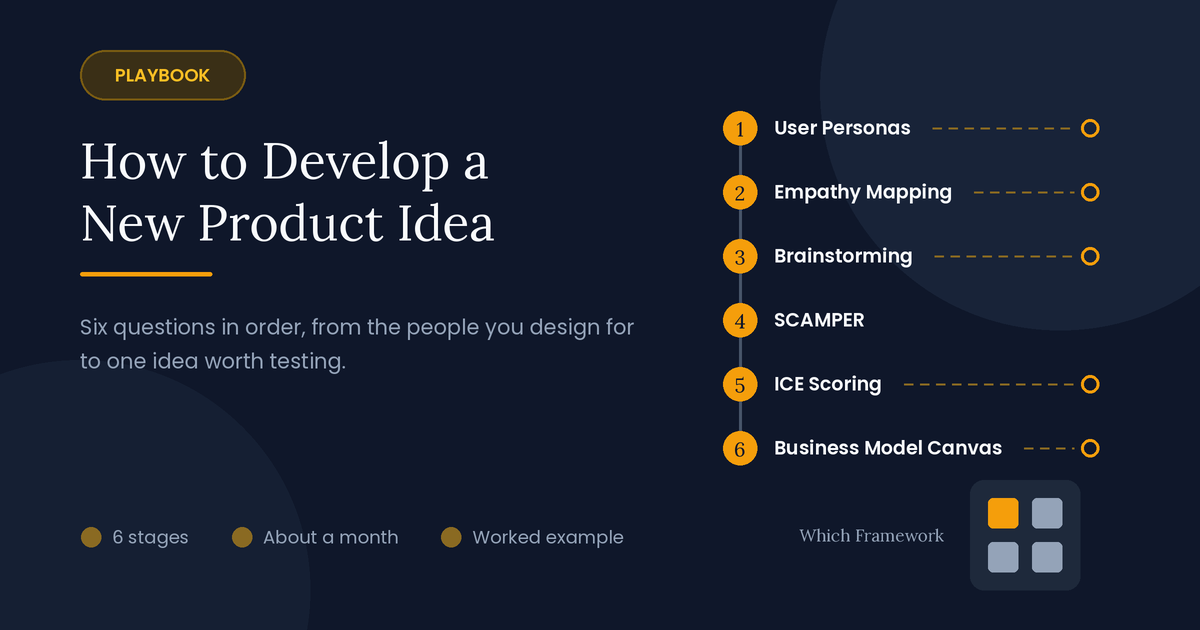
The route
Six questions, in order
The route runs from people to a product: who you are designing for, what they really struggle with, many ideas, sharper ideas, the best one, and how it makes money. The first stages follow design thinking: understand people, define the problem, then generate ideas.
On timing: stages 1 and 2 take two to three weeks, mostly interviews. Stages 3 to 6 fit in one more week.
Already have an idea and need to know whether people will buy it? Use the Validate a Business Idea playbook instead.
Free tools run each stage on your own research. The New Product Development Tool lays out all six stages and starts you off; or start at stage 1 with the User Persona Builder, or take the 15-minute guided tour first.
-
Who are we designing for?Stage 1 · User Personas
Passes on: one primary persona, drawn from interviews
No interviews yet?Talk to 8 to 12 people first.
-
What is the real problem?Stage 2 · Empathy Mapping
Passes on: the problem, written as a question
Says and Does never disagree?Watch people, don't only ask.
-
What could solve it?Stage 3 · Brainstorming
Passes on: a long list of ideas, written alone first
Fewer than 50 ideas?Run another silent round.
-
What if we change what we make?Stage 4 · SCAMPER
Passes on: ideas the room would not reach unprompted
-
Which idea goes forward?Stage 5 · ICE Scoring
Passes on: one idea, and the evidence behind it
Confidence scores far apart?Run a cheap test first.
-
Can it make money?Stage 6 · Business Model Canvas
Passes on: a business model, and its weakest link
Blocks don't connect?Fix the gap before testing.
- Will customers actually buy it?Then · Test it with the business idea playbook
The example
One company, followed all the way through
This playbook follows one company from start to finish. It is an illustrative composite, and the details are simplified.
A coffee roaster in Nairobi, Kenya, buys beans from local farms and sells roasted coffee to its customers: about 120 cafes and two supermarket chains. Sales have been flat for two years. The owner wants a first product for the people who drink coffee at home, most of whom buy instant coffee from those same supermarkets.
Nobody at the company is sure what that product should be. The marketing lead favors cold brew; the head roaster wants a premium bean range.
Each stage below ends with what the company produced at that step, so you can watch one stage's output become the next stage's input.
Stage 1 of 6
Who, exactly, are we designing for?
Tool: User Personas · Time: 2 to 3 weeks, most of it interviews
A persona is a short portrait of one kind of user, built from research. Interview 8 to 12 people first, then group them by what they do, not by age or income: two personas who behave the same are one persona.
Give each group four answers: its behavior, its goal, what stops it reaching the goal, and its skill level. Then pick one primary persona: the person a product built for anyone else would not satisfy, while the others could live with a product built for her. Naming her as a titled pattern, such as “the morning rusher”, rather than an invented person keeps the research in view.
Primary persona: the morning rusher
GoalA cup that tastes like the cafe's, made at home in the five minutes before leaving for work
- BehaviorDrinks instant coffee at home on weekdays; buys cafe coffee two or three times a week at about KES 300 (Kenyan shillings) a cup
- FrustrationsGround coffee needs a press or a machine, and washing up; instant tastes flat
- Skill levelCan boil a kettle; has never brewed coffee any other way
- Based on6 of the 14 interviews
| Behavior pattern | Interviews | What they do now |
|---|---|---|
| The morning rusher | 6 | Instant at home on weekdays; cafe coffee two or three times a week |
| The weekend brewer | 5 | Owns a French press, but brews only on slow weekend mornings |
| The office drinker | 3 | Drinks whatever the office machine makes |
Handed to stage 2: the morning rusher as the primary persona. A product fast enough for her also suits the weekend brewer on a weekday.
Decision point
If the team can't agree on one primary persona, the product will try to please everyone. Pick the group whose needs are hardest to meet with a product made for the others. Here, cold brew would suit the weekend brewer, but not someone with five minutes.
Stage 2 of 6
What is the persona's real problem?
Tool: Empathy Mapping · Time: half a day per map
An empathy map sorts what you learned about the primary persona into four quadrants. Says holds her own words and Does her actions; both are observed. Thinks holds beliefs she may not voice and Feels her emotions; both are inferred. Fill the observed ones first, then write each inference with the evidence it rests on.
Then look for contradictions. The gap between what someone says and what they do is usually where the real problem is. In the map below, the highlighted cell is the one that contradicts her words.
She says she has no time, yet queues for coffee most weeks. Time isn't the problem; equipment and effort at home are. Write the problem as a How might we question, which asks for ideas without naming a solution.
Handed to stage 3: “How might we give the morning rusher cafe-tasting coffee at home, with no equipment and nothing to wash up?”
Decision point
If the Says and Does quadrants never disagree, the map was filled from the team's beliefs. Go back and watch people, not only ask them. Here, the coffee diaries supplied the Does quadrant; interviews alone would have kept “no time” as the problem.
Stage 3 of 6
What are all the ways we could solve it?
Tool: Brainstorming · Time: a 90-minute session
Brainstorming answers the question it is given, so start with the How might we question from stage 2. Alex Osborn's four rules from 1953 still govern the session.
Osborn's four rules of brainstorming
- 1Defer judgment
- No criticism while ideas are being produced
- 2Welcome wild ideas
- It is easier to tame a wild idea than to stretch a dull one
- 3Go for quantity
- Good ideas are found among many, not aimed at directly
- 4Build on others' ideas
- Combine and extend what is already on the wall
One part of his method has failed every test since 1958: people talking in turn produce fewer ideas than the same people working alone, then pooling. So write before you talk. In brainwriting, everyone writes ideas silently for ten minutes; only then does the group read, combine and build. Count the ideas. It is the only way to know the session worked.
| Round | Format | Ideas |
|---|---|---|
| 1. Silent writing | Six people, ten minutes, one idea per card | 58 |
| 2. Read and build | Cards on the wall; people add to each other's | 14 |
| 3. Group | Cards sorted into themes, duplicates merged | 9 themes |
Handed to stage 4: 72 ideas in nine themes, among them cold brew in bottles and coffee concentrate in sachets.
Decision point
If the session produced fewer than about 50 ideas, run another silent round before moving on. The first ideas are the obvious ones. Here, the two quietest people wrote 17 of the 58.
Stage 4 of 6
What happens if we change what we already make?
Tool: SCAMPER · Time: an hour or two
Brainstorming starts from the problem. SCAMPER starts from something concrete you already make, and changes it seven ways. Point it at a real product, not a theme, and keep judging out of it, as in stage 3.
Its letters stand for Substitute, Combine, Adapt, Modify, Put to another use, Eliminate and Reverse. Give each prompt equal time. Teams add by instinct and skip Eliminate, which is often the prompt that pays.
| Prompt | The question | What came out |
|---|---|---|
| S. Substitute | What could be swapped out? | A reusable tin in place of the bag |
| C. Combine | What could be merged with this? | Coffee, milk powder and sugar in one sachet, much like instant |
| A. Adapt | What works elsewhere that we could borrow? | The tea bag: coffee steeped in the cup |
| M. Modify | What could be bigger, smaller or a different shape? | A 100-gram bag for first-time buyers |
| P. Put to another use | Who else could use this? | Offices, buying by the kilo |
| E. Eliminate | What could be removed entirely? | The brewing equipment: a paper filter of coffee that hangs on the cup, filled with hot water |
| R. Reverse | What if the order or roles ran the other way? | Coffee delivered to homes weekly, instead of bought in shops |
The idea that went forward came from Eliminate: the drip bag, a single-serve coffee filter that hangs on the cup.
Handed to stage 5: 23 more ideas, including the drip bag.
Decision point
If most ideas came from Substitute and Combine, go back to Eliminate and Reverse. Those two are the hardest to answer and the most likely to give something new. Here, the drip bag came from asking what a customer could do without.
Stage 5 of 6
Which idea goes forward?
Tool: ICE Scoring · Time: 1 to 2 hours, plus any quick tests
ICE Scoring ranks a shortlist by three factors, each scored 1 to 10: Impact (if it works as hoped, how much does it move the one outcome you named?), Confidence (what evidence says it will work?) and Ease (how little work is it?). Multiply them for the score.
Name the outcome first; here, sales to home drinkers. Then have each person score alone and compare. Confidence does the real work, and where people's Confidence scores are far apart, they are disagreeing about evidence. A cheap test settles that better than an average does.
| Idea | Impact | Confidence | Ease | ICE score |
|---|---|---|---|---|
| Drip bags (from Eliminate) | 7 | 6 | 8 | 336 |
| Steeped coffee bags (from Adapt) | 6 | 5 | 8 | 240 |
| Weekly home delivery (from Reverse) | 5 | 5 | 6 | 150 |
| Coffee concentrate sachets | 7 | 3 | 5 | 105 |
| Cold brew in bottles | 8 | 4 | 3 | 96 |
Handed to stage 6: drip bags, with Confidence raised from 6 to 7 by a one-week test, and cold brew set aside for now.
Decision point
If Confidence scores are far apart, run a cheap test before ranking. On drip bags, scores ran from 3 to 9. The company hand-filled 200 bags and put them in two office kiosks; they sold out in four days, and the score rose to 392.
Stage 6 of 6
How would the idea make money?
Tool: Business Model Canvas · Time: a day, longer to cost it
A product idea is not yet a business. The Business Model Canvas puts it on one page in nine blocks: who it is for, what it offers them, how it reaches and keeps them, what they pay, and the partners, activities, resources and costs behind it. Fill it customer first, starting with Customer Segments and Value Propositions, then cost the left side.
| Key Partnerships One importer of the paper filters, the only one in Kenya | Key Activities Roasting, grinding, filling and sealing the bags | Value Propositions A cafe-tasting cup in three minutes, with only a kettle and a cup | Customer Relationships Self-service; a code on the box links to a 30-second how-to | Customer Segments Morning rushers: office workers in Nairobi who drink instant at home | |||||
| Key Resources The roastery; a bag-filling machine, KES 2.4 million | Channels The two supermarket chains it already sells to; office kiosks; its website | ||||||||
| Cost Structure About KES 35 a bag: coffee 18, filter 12, packing 5. Supermarkets keep 25% of the shelf price | Revenue Streams Boxes of 10 at KES 650, against KES 300 for one cafe cup | ||||||||
Then draw the lines. Every revenue stream should trace back to a customer segment, and every big cost forward from a resource or activity you listed. Here they connect: each box nets about KES 137 after costs and the supermarket's share, so the machine pays for itself after about 17,500 boxes. The weak link is the one filter supplier.
Handed on: a model that pays back the machine after about 17,500 boxes, a second filter supplier lined up, and one assumption to test: that morning rushers will buy a second box.
Decision point
If the blocks don't connect, you have nine lists, not a business model. Fix the gap before spending on a test. Here, the company found a second filter supplier abroad before ordering the machine.
Pace
Fast track or thorough
The fast track suits a small team adding to a range it knows. The thorough run suits a first product for a new kind of buyer, as in the example. The order of the stages stays the same either way.
| Stage | Fast track (about a week) | Thorough (about a month) |
|---|---|---|
| 1. User Personas | Five or six interviews, one archetype | 8 to 12 interviews, grouped by behavior, one primary |
| 2. Empathy Mapping | One map from interview notes | Interviews plus watching people, inferences sourced |
| 3. Brainstorming | One silent round, then build | Several rounds with people from across the business |
| 4. SCAMPER | The three prompts that fit best | All seven, with equal time each |
| 5. ICE Scoring | Scored together in one meeting | Scored alone, gaps tested before ranking |
| 6. Business Model Canvas | Customer side only | All nine blocks, with the left side costed |
Failure modes
How product ideas go wrong
| What happens | What it looks like | The fix |
|---|---|---|
| Starting from a favorite idea | Research collected to support it | Personas and the problem come before any idea |
| Personas built in the room | Ages, hobbies and a stock photo; no behavior | Group real interviewees by what they do |
| Asking, never watching | The problem people state, not the one they have | Fill the Does quadrant from observation |
| Brainstorming out loud | The loudest few set the direction | Write silently first, then build |
| Scores as a ritual | A precise number on a guess | Compare Confidence scores; test the gaps |
| A product with no model | Customers like it; it loses money | Cost the canvas before building anything |
After the playbook
Will customers actually buy it?
The canvas ends with assumptions, not answers. Test the riskiest before spending on anything that is hard to undo; here, the bag-filling machine. The Validate a Business Idea playbook picks up from here: it names the riskiest assumption and designs the cheapest test that could disprove it.
In the example, 300 hand-filled boxes went into one supermarket chain for three weeks. They sold through, and the company watched for the number that mattered: how many buyers came back for a second box.
Common questions
Developing a product idea: quick answers
How do you develop a new product idea?
Start with people, not ideas. Interview likely users and group them by behavior into personas, map what the primary one says, does, thinks and feels to find the real problem, and write it as a question. Then generate ideas, alone first, push them further with SCAMPER, score a shortlist, and check the best one can make money.
What is a primary persona?
The one persona a product built for anyone else would not satisfy, while the others could live with a product built for her. Choosing her stops a product trying to please everyone and pleasing no one.
What are the four quadrants of an empathy map?
Says (the person's own words), Does (actions you watched), Thinks (beliefs they may not voice) and Feels (emotions and how strong they are). Says and Does are observed; Thinks and Feels are inferred, so note what each inference rests on.
What does SCAMPER stand for?
Substitute, Combine, Adapt, Modify, Put to another use, Eliminate and Reverse. Each letter is a different way of changing something you already make. Eliminate is the prompt teams skip most, and often the one that pays.
Does brainstorming actually work?
Osborn's rules do: defer judgment, welcome wild ideas, go for quantity, and build on others' ideas. The format of talking in turn does not. People working alone and then pooling their ideas produce more, which is why brainwriting starts with silent writing.
How do you calculate an ICE score?
Score Impact, Confidence and Ease from 1 to 10 and multiply them. An idea scored 7, 6 and 8 gets 336. Have people score alone first: where Confidence scores are far apart, test before you rank.
What is the difference between this playbook and validating a business idea?
This one goes from people to one product idea and its business model. Validating a business idea starts with an idea and tests whether customers will buy it. Run this playbook first if you don't yet know what to make.
Frameworks in this playbook
- User PersonasStage 1: Who, exactly, are we designing for?
- Empathy MappingStage 2: What is the persona's real problem?
- BrainstormingStage 3: What are all the ways we could solve it?
- SCAMPERStage 4: What happens if we change what we already make?
- ICE ScoringStage 5: Which idea goes forward?
- Business Model CanvasStage 6: How would the idea make money?
- Design ThinkingAround: the process these stages sit inside
- Innovation PipelineAfter: when many ideas need managing at once