FreeNo sign-upYour research stays on your computer
New Product Development Tool
Before building anything, find out who it is for and what their real problem is. Pick one primary persona from your interviews, find where what she says and what she does disagree, write many ideas before judging any, change what you already make seven ways, score the shortlist alone and test where the scores disagree, then put the best idea on a canvas and cost it. Six stages, ending with the one assumption to test first.
The tour runs all six stages on an example coffee roaster in Nairobi, Kenya, looking for its first product for people who drink coffee at home. Nothing in it touches your own work. Stages 1 and 2 take two to three weeks, most of it interviews. Stages 3 to 6 fit in one more week, plus a week for any quick test in stage 5.
Six stages, in order
Each stage asks one question and hands its answer to the next. You can stop after any stage: save your progress file, and pick up later on any computer. The new product idea playbook explains the method behind each one.
-
Stage 1 of 6 · User personas
Who are we designing for?
2 to 3 weeks
- You bring
- Notes from 8 to 12 interviews with people who might use the product: what they do now, what they want, what stops them, in their own words.
- You get
- The people grouped by what they do, each group with a behavior, goal, frustrations and skill level, and one primary persona the others could live with.
How user personas worksUse the User Persona Builder on its own
-
Stage 2 of 6 · Empathy map
What is the real problem?
Half a day
- You bring
- What the persona says and does, from interviews and from watching, diaries or data. Says and Does can be drafted from stage 1.
- You get
- The map in four quadrants, each inference with what it rests on, the places where words and actions disagree, and the problem as a question that names no solution.
How empathy mapping worksUse the Empathy Map Maker on its own
-
Stage 3 of 6 · Brainstorming
What could solve it?
A 90-minute session
- You bring
- Four to eight people from different parts of the business, and the cards from each round: silent writing first, then building on each other's.
- You get
- The ideas counted by round and by person, duplicates merged, the cards in named themes, and another silent round suggested when there are too few.
How brainstorming worksUse the Brainstorming Tool on its own
-
Stage 4 of 6 · SCAMPER
What if we change what we make?
An hour or two
- You bring
- One product you already sell, and the question from stage 2. Skip this stage if there is no product yet.
- You get
- Seven prompts with equal time each, the ideas each produced, the ones the brainstorm had not reached, and a nudge back to Eliminate and Reverse when they were skipped.
How the SCAMPER technique worksUse the SCAMPER Tool on its own
-
Stage 5 of 6 · ICE scoring
Which idea goes forward?
1 to 2 hours, plus any test
- You bring
- The one outcome the product should move, a shortlist of four to six ideas from stages 3 and 4, and three to five people to score alone.
- You get
- Impact, Confidence and Ease from each person, the ideas where Confidence is far apart, the cheap test that settles each, and the ranking it all comes to.
How ICE scoring worksUse the ICE Score Calculator on its own
-
Stage 6 of 6 · Business Model Canvas
Can it make money?
A day, longer to cost it
- You bring
- The chosen idea and the persona, carried over, and the company's costs: what one unit costs to make, its price, what resellers keep, any upfront spend.
- You get
- The nine blocks, each revenue traced to a customer and each cost to its cause, what one unit nets and when the upfront spend pays back, the weak link, and the assumption to test first.
How the Business Model Canvas worksUse the Business Model Canvas Tool on its own
What you finish with
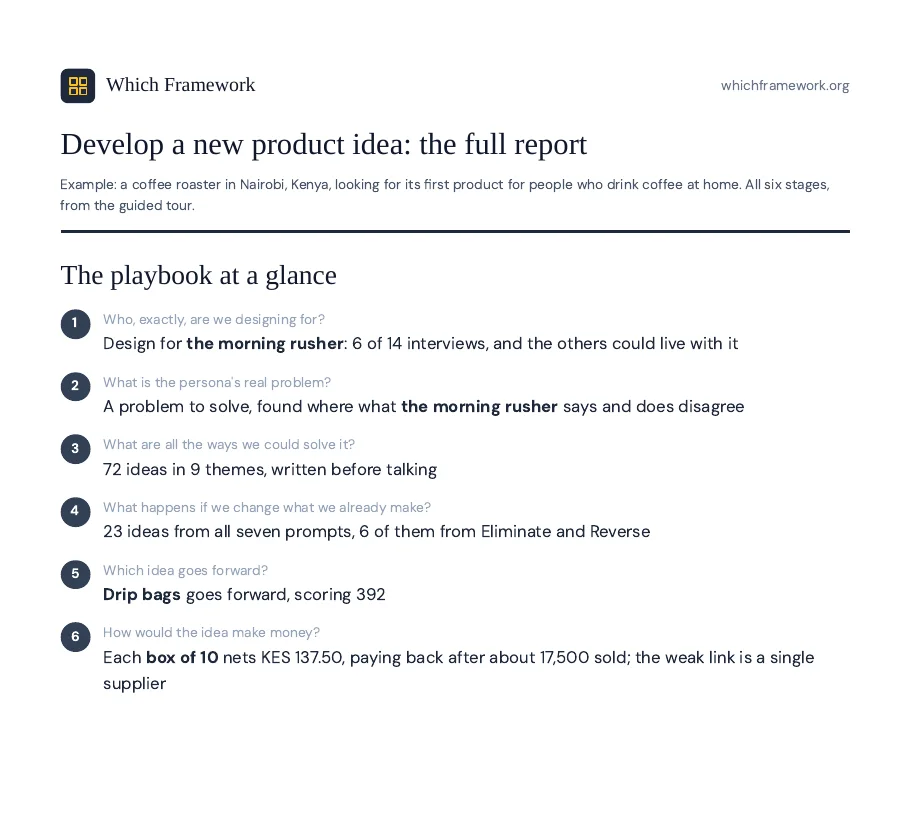
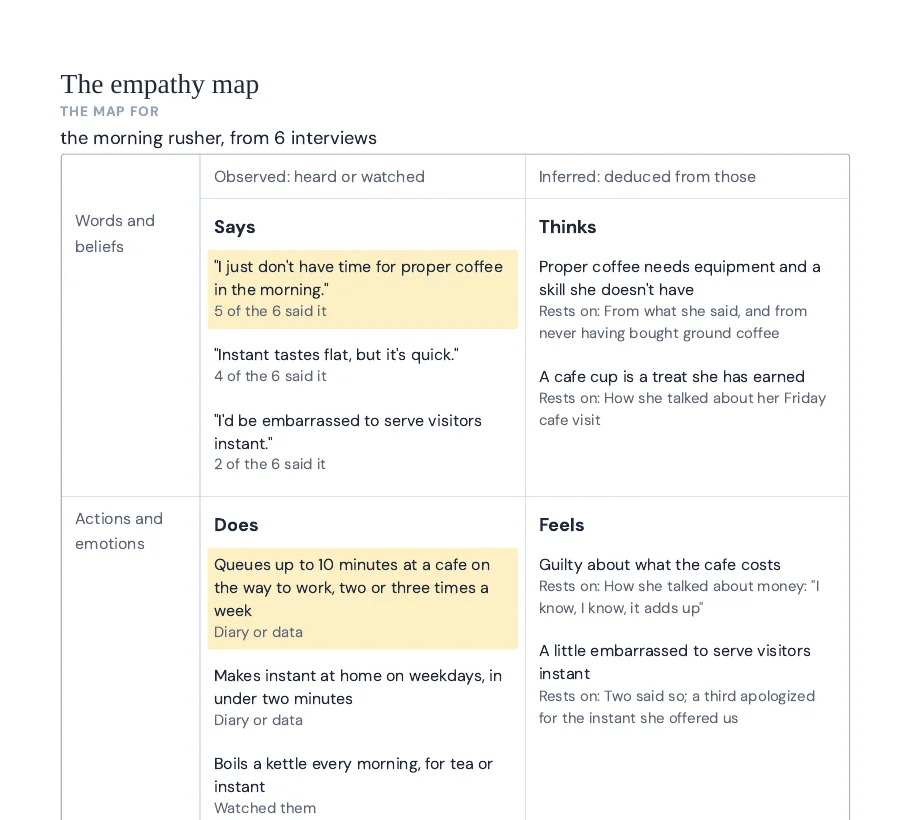
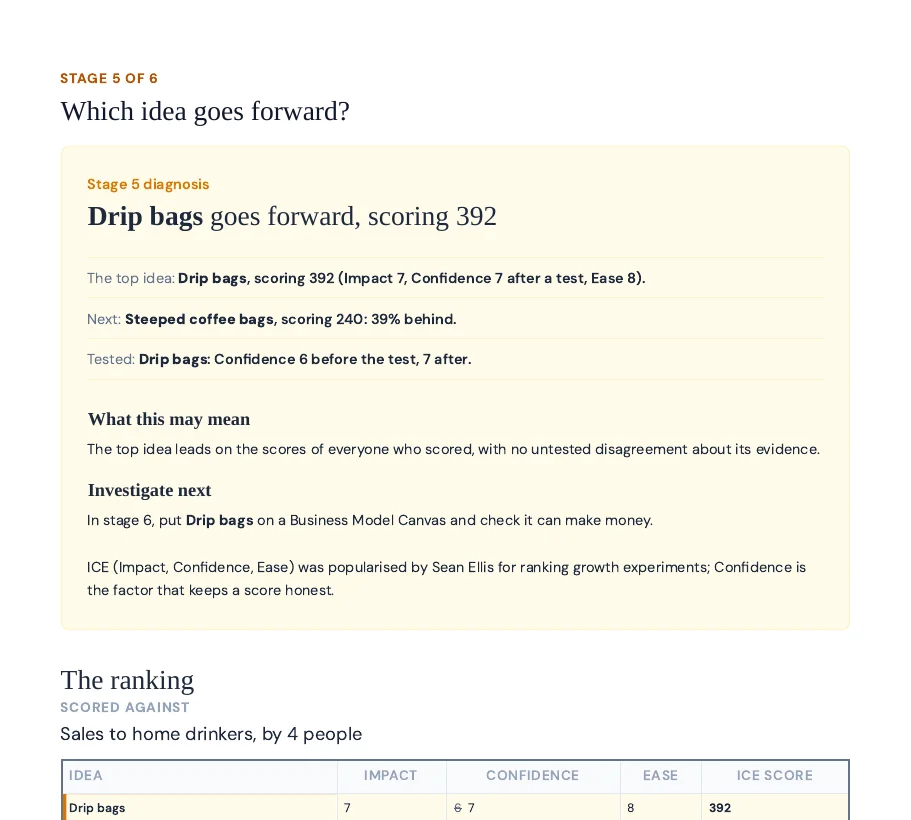
From the guided tour: a coffee roaster in Nairobi, Kenya, looking for its first product for people who drink coffee at home.
Download the example report (PDF, 20 pages)A PDF report of the whole playbook. One headline for each stage, as in the example, then each stage's full results: the personas, the map, the ideas, the scores and the canvas, with the diagnosis, what it means and what to do next. It ends with the business model, its weak link and the assumption to test first.
A progress file you keep. An Excel workbook with a sheet for every stage, updated each time you save. Choose it on this page or on any stage, and the playbook reopens where you left off.
Checks along the way. A group named for an age or an income, a map whose words and actions never disagree, a question that names its own solution, too few ideas, skipped prompts, Confidence scores far apart, and a canvas whose blocks don't connect or whose numbers lose money each stop the tool until they are settled.
Questions
Is it free?
Yes. There is no sign-up. The PDF report asks for an email address; everything else works without one.
Where does my research go?
Interviews, ideas, scores and costs stay in your browser and in the progress file you download. To write each stage's diagnosis, the page sends our server only counts, scores and the places of items in your lists, never the names or the words.
Do I have to do all six stages?
No. Each stage also works on its own, from the tools page. If the problem is already written as a How might we question, start at stage 3. Stage 4 can be skipped when there is no product yet to change; the others are kept, because each one catches a mistake the next can't.
I already have an idea. Is this the right tool?
If you need to know whether people will buy it, use the Business Idea Validator. This tool is for finding the idea, and it ends where that one starts.
Can several people work on it?
Yes, by passing the progress file. Save it after a stage, send it to a colleague, and they choose it on this page to carry on from there.
How is this different from the playbook article?
The article explains the method and follows one company through it. The tool runs the same six stages on your own research, and writes the diagnosis at each one.