FreeNo sign-upYour notes stay on your computer
Business Idea Validator
Find out whether customers have the problem, whether it hurts enough to pay for, what must be true for the idea to work, whether it is, and whether the numbers add up. Five stages, three of them places to stop, ending with break-even and a full report.
The tour runs all five stages on an example idea: fresh-produce delivery to restaurants in Accra. Nothing in it touches your own work. Allow five to eight weeks in all: most of it goes on conversations and the test, not on the tools.
Five stages, in order
Each stage asks one question and hands its answer to the next. You can stop after any stage: save your progress file, and pick up later on any computer. The idea validation playbook explains the method behind each one.
-
Stage 1 of 5 · Voice of the Customer
What do customers actually say?
2 to 3 weeks
- You bring
- 15 to 20 conversations with people you hope will pay, about the last time the problem came up, not about your idea.
- You get
- Their needs in their own words, with what they already did about the problem marked.
How Voice of the Customer worksUse the Voice of the Customer tool on its own
-
Stage 2 of 5 · Jobs to Be Done
Does the problem hurt enough?
3 to 5 days
- You bring
- The notes from stage 1, read again for what customers are trying to get done.
- You get
- The problem as customers put it, and a count of who already spends time or money working around it. Nobody in real pain? Stop here.
How Jobs to Be Done worksUse the Jobs to Be Done tool on its own
-
Stage 3 of 5 · Lean Canvas
What must be true for the idea to work?
1 to 2 days
- You bring
- Your idea, box by box on one page: customers, problem, solution, price, costs and channels.
- You get
- The assumption that would sink the idea if it were wrong, named.
How the Lean Canvas worksUse the Lean Canvas tool on its own
-
Stage 4 of 5 · Riskiest assumption test
Is the riskiest assumption true?
2 to 4 weeks
- You bring
- A cheap test, such as a pre-sale or a service run by hand, with a pass mark set before you start.
- You get
- A result judged against the pass mark, and the price and cost the test revealed. Failed? Change the idea, or stop.
-
Stage 5 of 5 · Break-even analysis
Do the numbers work?
1 to 2 days
- You bring
- Your fixed costs from quotes and bills, and one or two ways of running the business.
- You get
- The customers needed to break even, and when the money comes back. More than exist? Rework the idea, or stop.
How break-even analysis worksUse the break-even tool on its own
What you finish with
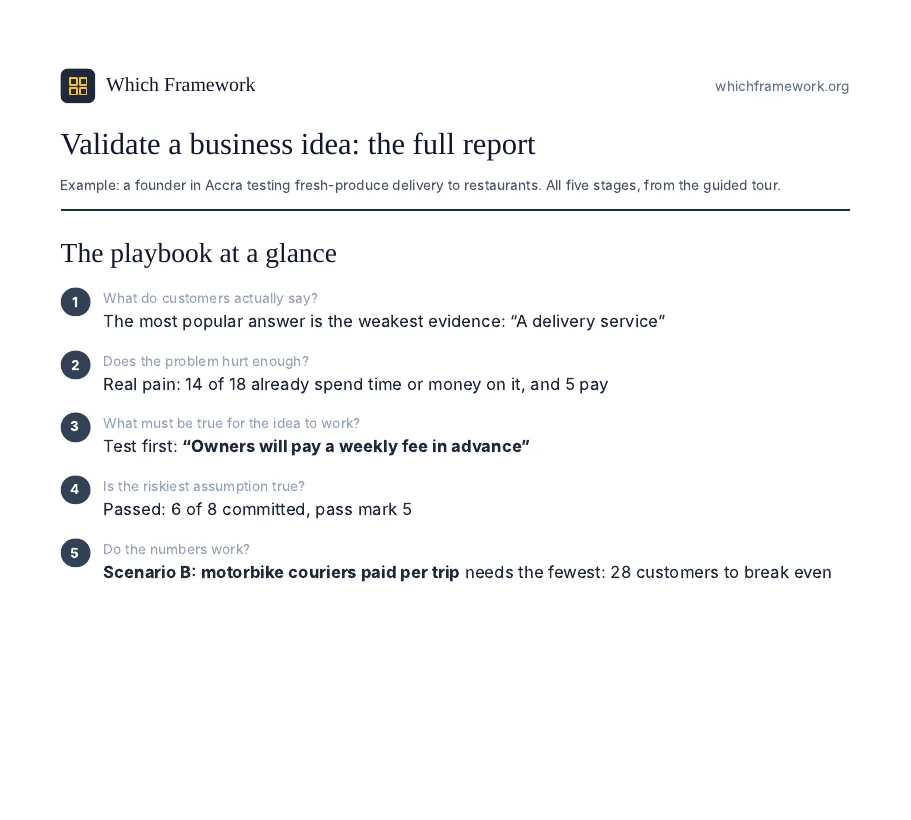
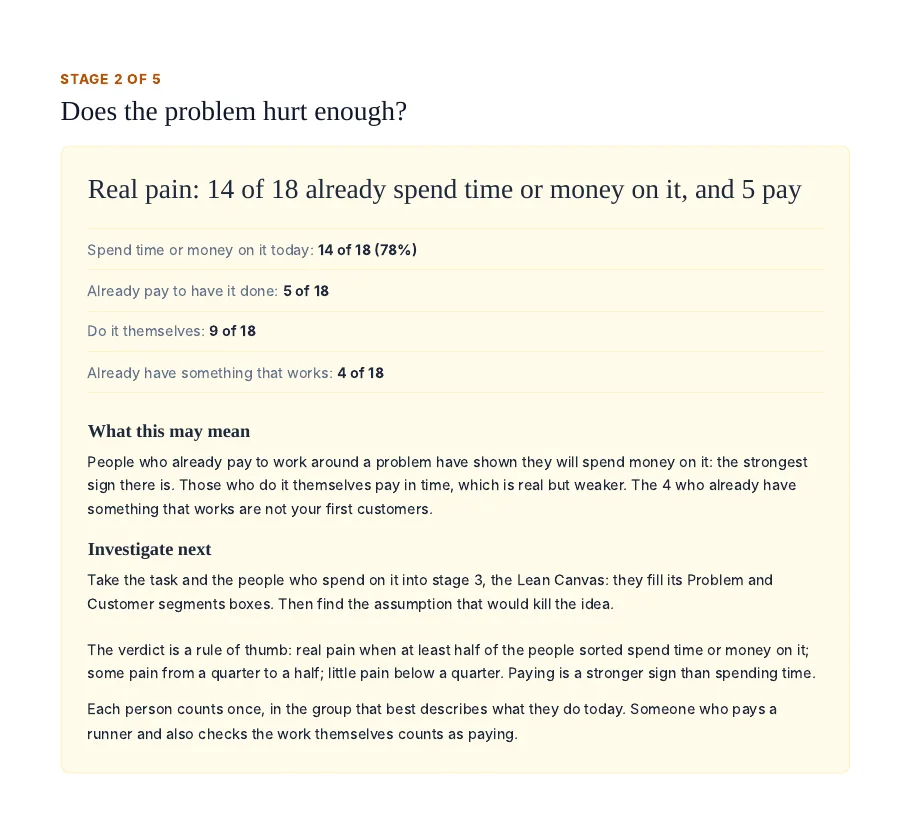
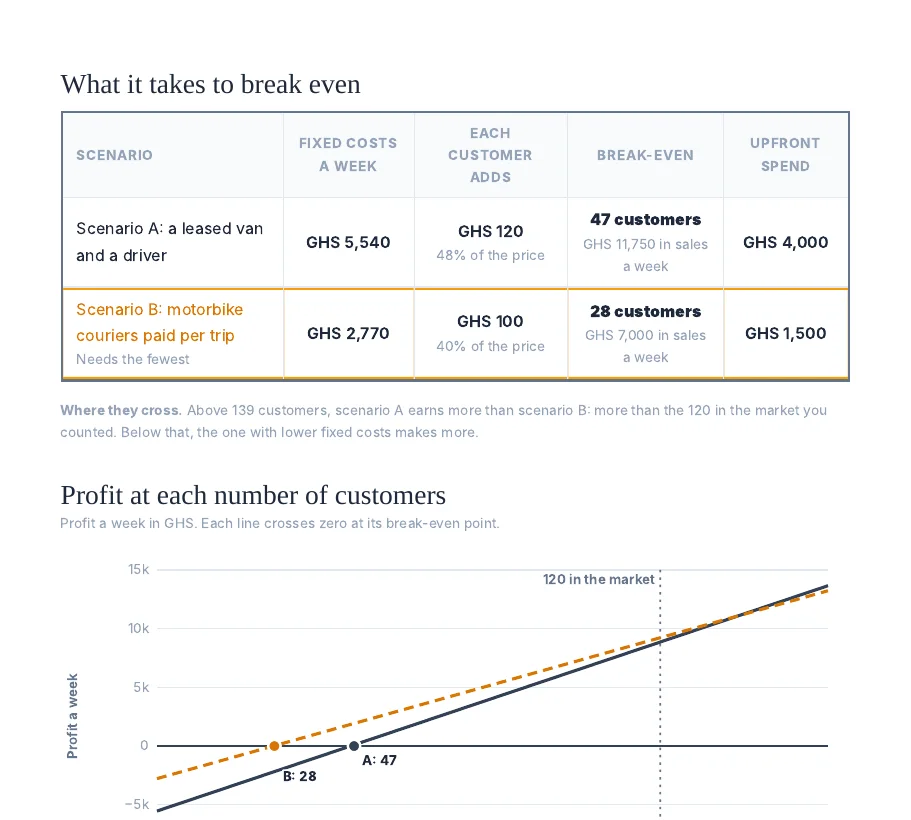
From the guided tour: a founder in Accra testing fresh-produce delivery to small restaurants.
Download the example report (PDF, 9 pages)A PDF report of the whole playbook. One headline for each stage, as in the example, then each stage's diagnosis: what it found, what that means, and what to do next. It ends with break-even for each way of running the business.
A progress file you keep. An Excel workbook with a sheet for every stage, updated each time you save. It is also how you come back: choose it on this page or on any stage, and the playbook reopens where you left off.
Places to stop. Three stages are built to stop you early: no real pain, a failed test, or more customers needed than exist. Stopping there costs far less than finding out after launch.
Questions
Is it free?
Yes. There is no sign-up. The PDF report asks for an email address; everything else works without one.
Where do my notes go?
Your idea, notes and numbers stay in your browser and in the progress file you download. To write each stage's diagnosis, the page sends our server only counts, ratings and the places of items in your lists, never your words.
Do I have to do all five stages?
No. Each stage also works on its own, from the tools page. In order, though, each stage tests what the last one found, and three of them tell you plainly when to stop.
Can several people work on it?
Yes, by passing the progress file. Save it after a stage, send it to a colleague, and they choose it on this page to carry on from there.
How is this different from the playbook article?
The article explains the method and follows one founder through it. The tool runs the same five stages on your own idea, and writes the diagnosis at each one.