Playbook
How to Validate a Business Idea
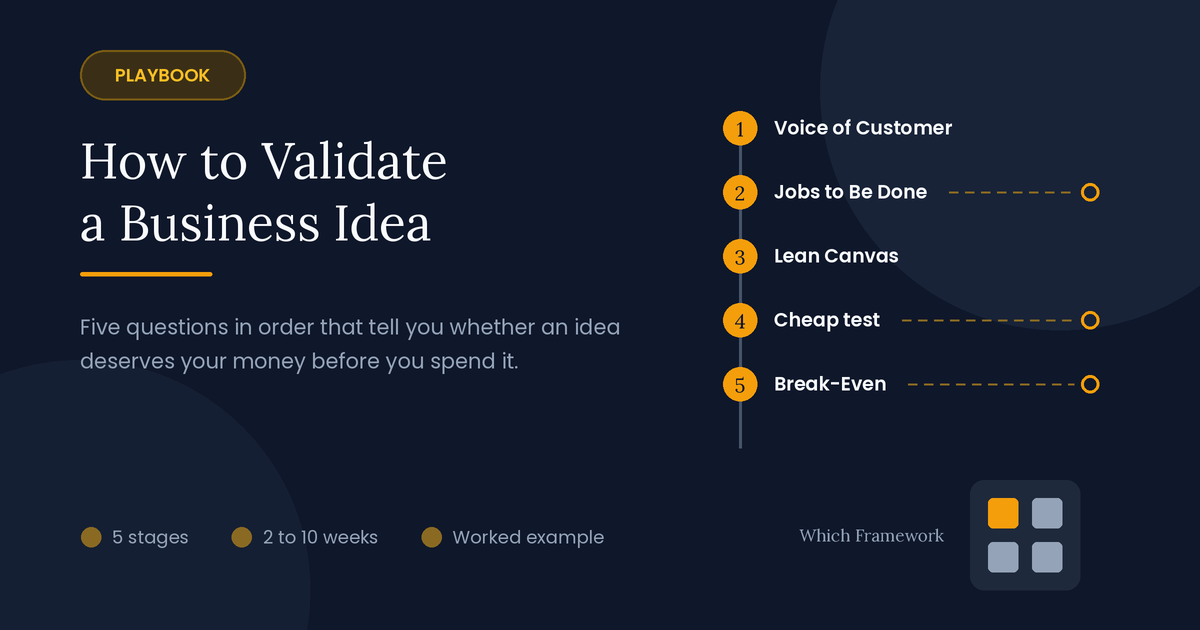
Five questions, asked in order, before an idea gets your money.
A business idea validation playbook is a five-stage sequence of tools that tests whether customers have a real problem, whether they will pay to solve it, and whether the numbers work.
The route
Five questions, in order
Each stage asks one question. Four use a proven tool; one is a small, cheap test, because no framework can tell you whether customers will really pay. What comes out of each stage goes into the next, and three points on the route are places to stop.
Stopping early is the point. An idea that fails at stage 2 costs a few weeks of conversations. The same idea failing after launch costs your savings.
-
What do customers actually say?Stage 1 · Voice of the Customer
Passes on: needs in customers' own words, with past behavior marked
-
Does the problem hurt enough?Stage 2 · Jobs to Be Done
Passes on: a problem worth solving, with evidence people already pay to work around it
Nobody in real pain?Stop here. It is the cheapest place to stop.
-
What must be true for the idea to work?Stage 3 · Lean Canvas
Passes on: the riskiest assumption, named
-
Is the riskiest assumption true?Stage 4 · No framework: a cheap test
Passes on: a result, judged against a pass mark set in advance
Test failed?Change the idea and test again, or stop.
-
Do the numbers work?Stage 5 · Break-Even Analysis
Passes on: the customers needed, checked against the customers who exist
Needs more customers than exist?Rework price or costs, or stop.
- What comes next?Then · A business model and a first-year plan
The example
One idea, followed all the way through
This playbook follows one founder from start to finish. It is an illustrative composite, and the details are simplified.
A founder in Accra, Ghana, has an idea: a weekly subscription that delivers fresh produce to small restaurants and chop bars, so their owners no longer start every day at the market. She has savings for about a year and no customers yet. Friends say it is a great idea, which tells her nothing.
Each stage below ends with what she produced at that step, so you can watch one stage's output become the next stage's input.
Stage 1 of 5
What do potential customers actually say?
Tool: Voice of the Customer · Time: 2 to 3 weeks
Start by listening, not pitching. Voice of the Customer collects needs in the customer's own words and sorts them by how much they matter. For a new idea, that means 15 to 20 conversations with the people you hope will pay.
Ask about the past, not the future. "When did you last run out of tomatoes, and what did you do?" gets a true story. "Would you use a delivery service?" gets a polite yes. Mark every answer as something people did or something they say they would do. Only the first is evidence.
What goes in15 to 20 conversations with the people you hope will pay.
What comes outNeeds in customers' own words, how often each came up, and which are backed by past behavior.
Skip it if: you have already run these conversations in the last few months, and kept notes.
Three questions that get true stories
The ruleAsk about the last time it happened, not about your idea
- Instead of "Would you use a delivery service?"When did you last run out of stock? What did you do?
- Instead of "Is this a big problem for you?"What did that cost you, in time or money?
- Instead of "Would you pay GHS 250 a week?"What do you pay today to get this done?
| What they said | How many | Did or would do? |
|---|---|---|
| I am at the market by 5 a.m. every day | 14 of 18 | Did |
| Prices change every week, so I can't plan my menu | 11 of 18 | Did |
| Some tomatoes are spoiled before I cook them | 9 of 18 | Did |
| I would use a delivery service | 16 of 18 | Would do |
Handed to stage 2: three needs backed by what owners do every day. The most popular answer, that they would use delivery, is the weakest: saying yes costs nothing.
Stage 2 of 5
Does the problem hurt enough to pay for?
Tool: Jobs to Be Done · Time: 3 to 5 days
Needs tell you what people want. Jobs to Be Done asks what they are trying to get done, and what they use to do it today. The framework calls this the customer's job, meaning a task, not employment. Write it in three parts: when (the situation), I want to (the goal), so I can (the result).
Then test the pain. The best evidence is a workaround people already spend time or money on. If customers describe a problem but do nothing about it, it isn't painful enough to pay to solve.
What goes inThe needs and evidence from stage 1.
What comes outA job statement, and proof that people already pay, in time or money, to get it done.
Skip it if: never. This is the stage that stops most bad ideas early and cheaply.
The job, as owners described it
Job statementHave tomorrow's stock without losing the morning
- WhenI need fresh produce for tomorrow's cooking
- I want tohave it arrive without going to the market myself
- So I canopen on time and keep my prices steady
| Today's workaround | How many | What it costs them |
|---|---|---|
| Goes to the market themselves | 9 of 18 | About three hours, six days a week |
| Pays a market runner | 5 of 18 | A daily fee: they already pay to have this done |
| Uses a supplier who delivers | 4 of 18 | Already solved; not the first customers |
Handed to stage 3: the problem, written as a job statement, and 14 owners who spend real time or money on it every day. Five already pay someone, which is the strongest sign in the whole study.
Decision point
If nobody is in real pain, stop. People who describe a problem but spend nothing to work around it won't pay you to fix it. Stopping here costs a few weeks. Stopping after launch costs far more.
Stage 3 of 5
What must be true for the idea to work?
Tool: Lean Canvas · Time: 1 to 2 days
Now put the whole idea on one page. A Lean Canvas has nine boxes, including the problem, the customers, the solution, how you reach them, how you get paid and what it costs. Fill the problem and customer boxes first, from stages 1 and 2, not from hope.
Every box holds an assumption. The useful step is to rank them. Ask two questions of each: if this is wrong, does the idea die? And how sure are you? The riskiest assumption is the one that would kill the idea and that you are least sure of.
What goes inThe job statement and evidence from stages 1 and 2.
What comes outA one-page model, and the single riskiest assumption in it.
Skip it if: never. The canvas takes an afternoon, and it names what to test next.
ProblemOwners lose three hours a day at the market; prices swing; produce spoils
SolutionWeekly order, bought early, delivered by 9 a.m.
Key metricsRestaurants paying for a second week
Unique value propositionYour stock at your door before you open, at a price you know on Monday
Unfair advantageNone yet. Honest answer
ChannelsWalking in, then owner referrals
Customer segmentsSmall restaurants and chop bars in two Accra neighborhoods
Cost structureTransport, cold storage, spoilage, the founder's time
Revenue streamsA weekly fee, paid in advance, on top of produce at cost
The highlighted box holds the riskiest assumption.
| Assumption | If it's wrong | How sure? | Rank |
|---|---|---|---|
| Owners will pay a weekly fee in advance | The idea dies | Not sure: they pay cash daily today | 1 |
| Spoilage on the way stays under 10% | Margins vanish | Unknown | 2 |
| We can buy early enough to deliver by 9 a.m. | Owners go back to the market | Fairly sure | 3 |
Handed to stage 4: one assumption to test first: that owners used to paying cash every day will pay a week in advance.
Stage 4 of 5
Is the riskiest assumption true?
No framework: a cheap test · Time: 2 to 4 weeks
No framework can tell you whether people will pay. Only a test can. Design the smallest, cheapest test that could prove the riskiest assumption wrong. Often that means doing the service by hand for a few customers before building anything.
Common cheap tests include taking pre-orders, asking for a deposit, or running the service by hand for a handful of customers, sometimes called a concierge test. Pick the one that makes people commit something real, such as money or time, not just a click.
Write the pass mark down before the test starts, and don't move it afterwards. A result that is judged after the fact can always be made to look like a success.
What goes inThe riskiest assumption from stage 3.
What comes outA result, judged against a pass mark you set in advance.
Skip it if: the assumption can be settled from data you already hold. That is rare for a new idea.
The test, written down before it started
AssumptionOwners will pay a weekly fee in advance
- The testThe founder runs the service by hand for three weeks for eight restaurants, buying at the market herself and delivering by taxi
- Pass mark, set in advanceAt least five of the eight pay up front for a second week
- ResultSix paid for week two and five for week three. Spoilage was 7%. Passed
Handed to stage 5: proof that owners will pay in advance, and two real numbers for the next stage: what customers pay, and what serving them costs.
Decision point
If the test fails, change the idea and test again, or stop. Don't move the pass mark. A changed idea might be a different price, a different customer or a different promise, and it gets its own test.
Stage 5 of 5
Do the numbers work?
Tool: Break-Even Analysis · Time: 1 to 2 days
The last question is whether the business can pay for itself. Break-even analysis finds how many customers you need before money stops going out faster than it comes in.
Fixed costs are what you pay whatever happens: a van, rent, salaries. Variable costs rise with each customer: fuel, packaging, spoilage. What each customer pays minus their variable cost is the contribution margin: the amount each one adds toward fixed costs. Divide fixed costs by it, and round up.
Then compare the answer with the customers who really exist. A break-even point you can't reach is a reason to change the plan, not a reason to hope.
What goes inThe price and the cost of serving each customer, from the stage 4 test.
What comes outThe number of customers needed, checked against the number available.
Skip it if: never. It is the one stage where the money is checked rather than assumed.
The formula, worked for the first plan
Break-even customersFixed costs ÷ (price − variable cost per customer)
- Plan A, with a leased vanGHS 5,540 a week ÷ (GHS 250 − GHS 130) = 46.2, so 47 restaurants
| Plan | Fixed costs a week | Contribution per customer | Break-even | Share of 120 |
|---|---|---|---|---|
| A: a leased van and a driver | GHS 5,540 | GHS 120 | 47 | 39%. Too high for year one |
| B: motorbike couriers paid per trip | GHS 2,770 | GHS 100 | 28 | 23%. Reachable |
Handed on: plan B. Paying couriers per trip raises the cost of each delivery but cuts fixed costs by half, and break-even falls from 47 restaurants to 28.
Decision point
If break-even needs more customers than exist, rework the price or the costs, or stop. Here the first plan failed and the second passed. Some ideas have no second plan, and finding that out now is cheap.
Pace
Fast track or thorough
The fast track suits a side project or a first look. The thorough run suits an idea you are about to put serious money or a career behind.
| Stage | Fast track (about two weeks) | Thorough (6 to 10 weeks) |
|---|---|---|
| 1. Voice of the Customer | Eight conversations | 15 to 20 conversations, notes kept |
| 2. Jobs to Be Done | Job written from the conversations | Workarounds and their costs counted |
| 3. Lean Canvas | One afternoon | Two versions, compared |
| 4. The test | A landing page or pre-orders | The service run by hand for real customers |
| 5. Break-even | Rough numbers | Costs taken from the test, with two plans |
Failure modes
How idea validation goes wrong
| What happens | What it looks like | The fix |
|---|---|---|
| Asking friends | Everyone loves the idea | Talk to strangers who would pay |
| Counting compliments | "I would use that" taken as demand | Count what people did, not what they say |
| Testing the easy assumption | A pretty website instead of a payment test | Test the assumption that would kill the idea |
| Moving the pass mark | Three sign-ups called a promising start | Write the pass mark down before the test |
| Skipping the numbers | Many happy customers, losing money on each | Check break-even against the real market |
After the playbook
From a tested idea to a plan
A validated idea is not a business yet. When the canvas stops changing from week to week, move it to a Business Model Canvas, which describes a model that works rather than testing whether one exists. Then set a few OKRs for the first year, starting with the break-even number.
Keep testing. Each new assumption, such as a second neighborhood, a higher price or a new kind of customer, goes back through stages 3 and 4 before it gets real money.
Common questions
Idea validation: quick answers
How do you validate a business idea?
In five steps. Talk to the people you hope will pay, about what they do today. Check that the problem hurts enough that they already spend time or money on it. Put the idea on a Lean Canvas and find its riskiest assumption. Test that assumption cheaply, with a pass mark set in advance. Then check that break-even needs no more customers than exist.
How many customer interviews do I need to validate an idea?
Usually 15 to 20 for a thorough run, or about eight for a quick first look. Stop when new conversations stop telling you anything new. What matters more than the number is asking about past behavior, not about what people would do.
Is a survey enough to validate a business idea?
No. A survey shows what people say, and people are polite about ideas. Use surveys to measure something you already understand. Use conversations to find the problem, and a test where people pay, or commit in some other costly way, to prove demand.
What is the riskiest assumption test?
A small, cheap test of the one assumption that would kill your idea if it turned out to be wrong. You write down the pass mark first, run the test, and judge the result against that mark without moving it.
What is the difference between a Lean Canvas and a Business Model Canvas?
Both have nine boxes. The Lean Canvas swaps four of them for Problem, Solution, Key Metrics and Unfair Advantage, because it is built to test whether a model exists. The Business Model Canvas describes one that already works. Start with the first and move to the second once the model stops changing.
When should I give up on a business idea?
When the evidence says so at one of three points. Nobody spends time or money working around the problem. A fair test of your riskiest assumption fails, and changing the idea doesn't fix it. Or break-even needs more customers than the market holds.
Frameworks in this playbook
- Voice of the CustomerStage 1: What do potential customers actually say?
- Jobs to Be DoneStage 2: Does the problem hurt enough to pay for?
- Lean CanvasStage 3: What must be true for the idea to work?
- Break-Even AnalysisStage 5: Do the numbers work?
- Business Model CanvasAfter: once the model stops changing
- OKRAfter: a first-year plan, starting with the break-even number