Break-Even Analysis: The Formula, the Cash Version, and What It Assumes
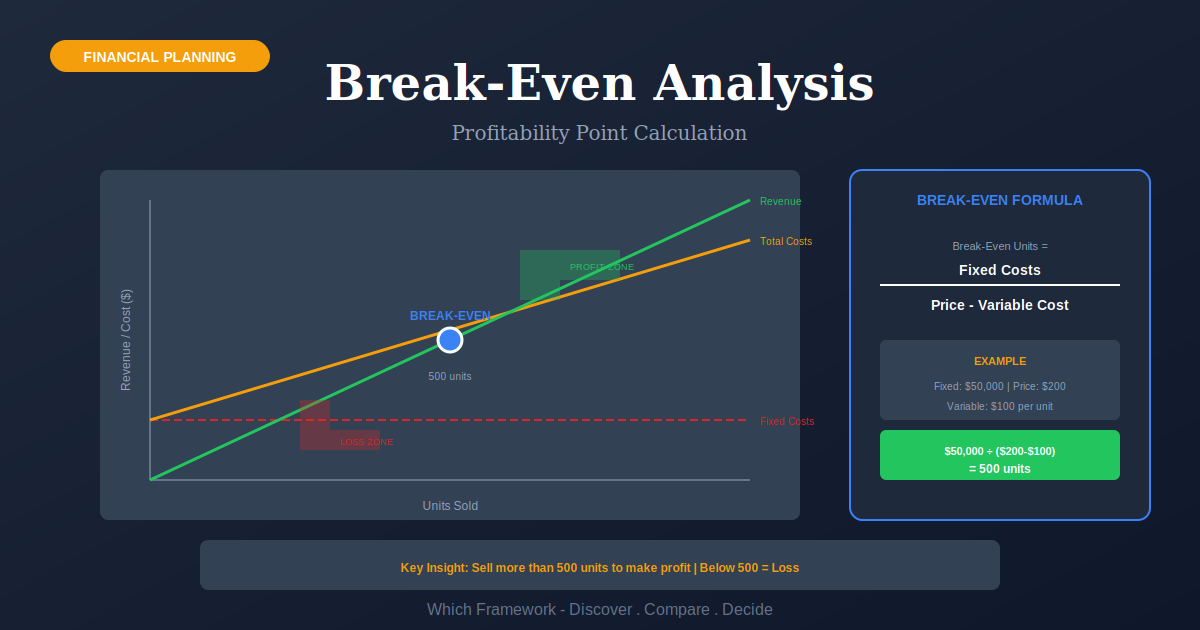
Break-Even Analysis is a calculation that finds the sales volume at which total revenue equals total cost, by dividing fixed costs by the contribution margin per unit.
Before you start
Is this your framework?
Break-even answers one question: how much do we have to sell before we stop losing money. One division gives you the number, and it is the cheapest sanity check in finance.
It also assumes a great deal. Costs behave in straight lines, the price never moves, and everything you make gets sold. Those hold over a narrow range and stop holding outside it. If your question is not about a volume threshold, the table below points elsewhere.
| If your real problem is… | You probably want |
|---|---|
| When will we run out of money, not what volume covers costs | Cash Flow Forecasting — a dated view of the bank balance. Break-even has no time in it at all Compare Break-Even Analysis and Cash Flow Forecasting |
| We missed the plan and want to know which part moved | Variance Analysis — splitting a gap into price, quantity and mix after the fact Compare Break-Even Analysis and Variance Analysis |
| Should we spend capital on this at all | Capital Budgeting — returns over years, discounted. Break-even ignores the cost of money |
| We do not know what our costs actually are per product | Activity-Based Costing — break-even needs a fixed and variable split you may not have yet |
| The whole cost base needs rethinking, not measuring | Zero-Based Budgeting — rebuilding what you spend rather than finding the volume that covers it |
| Is this business model viable in the first place | Lean Canvas — the model before the arithmetic. Break-even on a model nobody wants is a precise irrelevance |
| How many units, or how much revenue, covers our costs | Break-Even Analysis — you are in the right place |
What Is It?
Some costs stay the same whatever you sell. Rent, salaries, software. Others move with each unit: materials, packaging, the card fee. Break-even is the volume where the money left over from each sale has finally covered the costs that never move.
The money left over is the contribution margin: price minus variable cost per unit. That is the whole idea. Fixed costs divided by contribution margin per unit gives the number of units. Everything else on this page is a variation on that one division.
What makes it useful is that it is a threshold, not a forecast. It does not predict what you will sell. It tells you what you would need to sell, and you can then look at that number and decide whether it is plausible. Most of its value is in the moment somebody says out loud that the number is not.
Quick Reference
The calculation
Four numbers, one division
Every version of break-even is the same division with something changed on top. Get the contribution margin right and the rest follows.
| You want | Formula | In words |
|---|---|---|
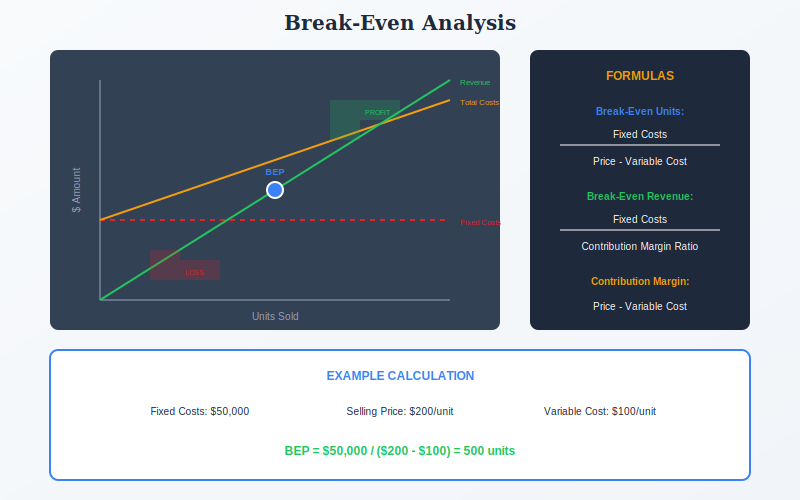
| Contribution margin per unit | Price − variable cost per unit | What one sale leaves behind to pay for the fixed costs |
| Break-even units | Fixed costs ÷ contribution margin per unit | The core one. How many you must sell before the fixed costs are covered |
| Break-even revenue | Fixed costs ÷ contribution margin ratio | The same thing in money. Use this when you sell many things and counting units makes no sense |
| Target profit output | (Fixed costs + target profit) ÷ contribution margin per unit | Volume needed to earn a specific profit, not merely to avoid a loss |
| Margin of safety | (Expected sales − break-even sales) ÷ expected sales | How far sales can fall before you are in trouble. The number worth reporting |
The contribution margin ratio is the version to learn
Units work for one product. Almost nobody sells one product. The ratio version divides by contribution margin as a percentage of revenue, which handles a whole catalogue at once and gives you a revenue target instead of a unit count.
It carries a hidden assumption: that the mix stays the same. A blended margin is a weighted average of what you sold last time. Sell more of the low-margin line and the real break-even moves up while your spreadsheet says nothing.
The cash version
Cash break-even, and why it is lower
Accounting break-even counts every fixed cost. But some of those costs never leave the bank in the period you are looking at, and a business running out of money cares about the ones that do.
| Version | Fixed costs used | Answers |
|---|---|---|
| Accounting the standard one | All of them, including depreciation and amortization | At what volume do we report a profit? |
| Cash | Fixed costs minus the non-cash ones, chiefly depreciation | At what volume do we stop draining the bank? Always the lower of the two, sometimes much lower |
Why the gap between them matters
A capital-heavy business carries large depreciation. Strip it out and cash break-even can sit well below accounting break-even. That gap is the zone where the company reports a loss and its bank balance holds steady, which is survivable for a long time and is worth knowing about before you panic.
The reverse trap is worse. Cash break-even ignores the money tied up in stock and unpaid invoices. A business can be past cash break-even on paper and still short, because the sales that got it there have not been paid for yet. The threshold is not a substitute for a dated forecast.
Core Features
- One division: fixed costs over contribution margin
- Contribution margin is the engine: price minus variable cost per unit
- Units or revenue: the ratio version handles many products at once
- A threshold, not a forecast: what you would need, not what you will get
- No time in it: the answer is a volume, never a date
- Straight lines throughout: constant price, constant unit cost, constant mix
Worked example
A coffee roastery in Lima, and the number nobody could say out loud
An illustrative composite. A Peruvian specialty roaster planned a second site: a roastery with a small cafe attached. Fixed costs came to PEN 42,000 a month, of which PEN 9,000 was depreciation on the roaster.
| Step | The number |
|---|---|
| Contribution margin | Average sale PEN 24, variable cost PEN 9. Contribution PEN 15 a sale, a margin ratio of 62.5%. |
| Accounting break-even | 42,000 ÷ 15 = 2,800 sales a month, about 93 a day. The site was open 10 hours, so roughly one sale every six and a half minutes, all day, every day. |
| Cash break-even | (42,000 − 9,000) ÷ 15 = 2,200 sales, about 73 a day. Still high, but it reframed the first year as survivable rather than fatal. |
| What the mix hid | The 62.5% ratio was the roastery's existing blend. Cafe sales skew to lower-margin food, and at the planned mix the real requirement was nearer 3,100 sales. |
| What happened | The cafe was dropped and the second site opened as roasting and wholesale pickup only. Fixed costs fell to PEN 26,000 and break-even to about 1,730. |
The value was in saying 93 a day out loud
Nobody in the room believed 93 sales a day, and nobody had said so until the division was done. The plan had been discussed for weeks in terms of footfall and ambience. One number turned an optimistic conversation into a specific claim somebody had to defend.
Note what it did not do. It gave no view on whether a cafe was a good idea, no timing, and no answer on funding the gap. It produced one threshold, and the judgment about that threshold came from people who knew the street.
When to Use
- Testing whether a new product, site or line could plausibly cover its costs
- Pricing decisions, where you need to know what a discount does to required volume
- Business plans and funding conversations, where the threshold is expected
- Deciding between making in-house and buying in, by finding the crossover volume
- Before committing to fixed costs, since every fixed cost raises the threshold
- As a fast sanity check on any plan that assumes growth
When NOT to Use
- As a forecast, since it says what you would need and not what you will sell
- When you need to know when, because there is no time in the calculation
- Where the product mix shifts a lot, which quietly moves the threshold
- Far outside your current volumes, where fixed costs step up rather than stay flat
- For multi-year capital decisions, which need discounting
- Where price varies by customer, since the formula assumes one price
In practice
How break-even misleads
The division is trivial. Every failure comes from the assumptions underneath it, and most of them are invisible in the answer.
| Failure mode | What it looks like | What to do instead |
|---|---|---|
| Fixed costs treated as flat | A threshold calculated at a volume that would need a second shift and another oven | State the volume range the answer is valid in. Outside it, recalculate with the new fixed costs. |
| Blended margin on a shifting mix | One ratio from last year's sales, applied to a plan with a different product spread | Recalculate at the planned mix, not the historical one. Or compute per line. |
| Worked backwards | Costs and prices adjusted until the threshold looks achievable | Fix the inputs first, then divide. The number is only useful if it can come out unwelcome. |
| Cash and accounting confused | Depreciation left in when the question was about the bank balance | Decide which question you are asking, then choose the version that answers it. |
| Read as a forecast | The threshold quoted in a plan as though it were the expected result | Report the margin of safety alongside it. That is the number that says whether the plan has room. |
| Working capital ignored | Past break-even and still short of cash | Pair it with a dated cash forecast. Stock and unpaid invoices are absent from the formula. |
Sourced
Evidence, and how to cite it
The chart came from an engineer in 1903.
Henry Hess published what is generally taken to be the first break-even chart, which he called a crossover chart, plotting cost, volume, revenue and profit together. Charles Knoeppel and Edgar Seybold set out the fixed and variable cost split in 1918, and into the 1960s some writers still called the chart a Knoeppel graph.
Hess, H. (1903) ‘Manufacturing: Capital, Cost, Profit and Dividends’, Engineering Magazine, pp. 892–898; Knoeppel, C.E. and Seybold, E. (1918) Graphic Production Control.
The name is Rautenstrauch's.
Walter Rautenstrauch, an engineer at Columbia, coined the term break-even point and gave the first systematic treatment of the chart as a planning tool. Adoption was fast: firms under pressure in the Depression needed to know their minimum viable sales level, and the technique was standard in business curricula within two decades.
Rautenstrauch, W. (1930) The Successful Control of Profits. New York: B.C. Forbes.
The assumptions are named, and there are five.
Standard cost accounting texts set out what the analysis takes for granted: costs and revenues move in straight lines, selling price is constant, the product mix is constant, the analysis is static with no time in it, and all of it holds only inside a relevant range of volume. None of these is hidden. They are simply ignored more often than they are checked.
Horngren, C.T., Datar, S.M. and Rajan, M.V., Cost Accounting: A Managerial Emphasis, chapter on cost-volume-profit analysis.
Fixed costs are not flat, they are steps.
The straight-line assumption is the one that fails first in practice. Rent is flat until you need a second unit. Supervision is flat until you add a shift. So the threshold you calculate is valid across a band of volume and wrong outside it, and the further your answer sits from today's volume the less it means.
The relevant range condition, stated in every managerial accounting treatment and dropped from most quick calculations.
How to cite it.
Harvard: Rautenstrauch, W. (1930) The Successful Control of Profits. New York: B.C. Forbes.
For the chart itself, cite Hess (1903).
For the method as taught today, cite a cost accounting text under cost-volume-profit analysis rather than a person; break-even is one case of CVP and has not been attributed in practice for decades.
Key Strengths
- One division: minutes to produce, and anyone can check it
- Turns a vague plan into a claim: somebody now has to defend a specific number
- Shows what a price change costs: discounts raise required volume fast
- Works before you have much data: a rough fixed and variable split is enough
- Universally understood: bankers, investors and boards all expect it
Key Weaknesses
- Straight lines that are really steps: fixed costs jump, and the formula does not
- Assumes one price: discounting and tiering break it
- Assumes a constant mix: the blended margin quietly goes stale
- No time dimension: a volume, never a date
- Ignores working capital: past break-even and still short is ordinary
- Easy to reverse-engineer: inputs get adjusted until the answer is comfortable
Sequencing
What to run before and after
Break-even needs a cost structure it can trust, and it stops at a threshold. Everything about timing and money comes from elsewhere.
Before
Split your costs into fixed and variable
The whole calculation rests on that split, and most cost systems do not record it. Getting it roughly right matters far more than precision anywhere else in the formula.
During
Ask whether the volume is plausible
The number is only useful if somebody with market knowledge looks at it and says yes or no. That judgment is the output, not the arithmetic.
After
Put a date on it
A threshold says nothing about when you reach it or whether you can fund the months before. Working capital sits outside the formula entirely.
Common questions
Break-Even Analysis: quick answers
What is break-even analysis?
A calculation that finds the sales volume at which total revenue equals total cost, so the business makes neither a profit nor a loss. You divide fixed costs by the contribution margin per unit, which is the selling price minus the variable cost of one unit. Below that volume every sale reduces a loss; above it every sale adds profit.
What is the break-even analysis formula?
Break-even in units equals fixed costs divided by contribution margin per unit. Break-even in revenue equals fixed costs divided by the contribution margin ratio, which is contribution margin as a percentage of the selling price. Use units when you sell one thing and revenue when you sell many.
What is contribution margin?
The money one sale leaves behind after its own variable costs, available to pay for costs that do not move with volume. Selling price minus variable cost per unit. If you sell at 24 and the materials and card fee come to 9, the contribution margin is 15, and every sale takes 15 off the fixed cost pile.
What is cash break-even analysis?
The same calculation with the non-cash fixed costs removed, chiefly depreciation and amortization. It answers a different question: not at what volume do we report a profit, but at what volume do we stop draining the bank. Cash break-even is always lower than accounting break-even, and in a capital-heavy business it can be much lower.
What is the cash break-even formula?
Fixed costs minus non-cash fixed costs, divided by contribution margin per unit. In practice that usually means taking depreciation out of the fixed cost figure and dividing as normal. Note that it still ignores money tied up in stock and unpaid invoices, so it is not the same as being cash positive.
How do you do a break-even analysis for a business plan?
List the costs that do not change with volume and total them. Work out the average selling price and the variable cost of one sale. Subtract to get the contribution margin. Divide the fixed costs by it. Then do the part that matters: convert the answer into something concrete, like sales per day, and ask somebody who knows the market whether it is plausible.
What are the limitations of break-even analysis?
Five assumptions carry it: costs and revenues move in straight lines, the price is constant, the product mix is constant, there is no time dimension, and it holds only within a range of volume close to today's. Fixed costs are really steps rather than flat lines, so a threshold calculated far from current volumes is usually wrong.
How do you calculate break-even with multiple products?
Use the revenue version rather than the unit version. Divide fixed costs by the blended contribution margin ratio across your whole catalogue. The catch is that a blended ratio assumes the mix holds. Sell more of the low-margin line and your real break-even rises while the spreadsheet says nothing, so recalculate at the planned mix rather than last year's.
Deep Resources
Frameworks related to Break-Even Analysis
- Cash Flow ForecastingThe dated view break-even has no time dimension for…
- Variance AnalysisFor after the period closes, when the plan and the actual differ…
- Capital BudgetingWhen the decision runs over years and the cost of money matters…