Playbook
How to Deliver Work in Agile Sprints
Six questions, asked in order, to go from a long plan that slips to something usable every two weeks.
An agile sprints playbook is a six-stage sequence that defines what customers value, orders the work, sets up Scrum, runs two-week sprints, handles interruptions and measures the result.
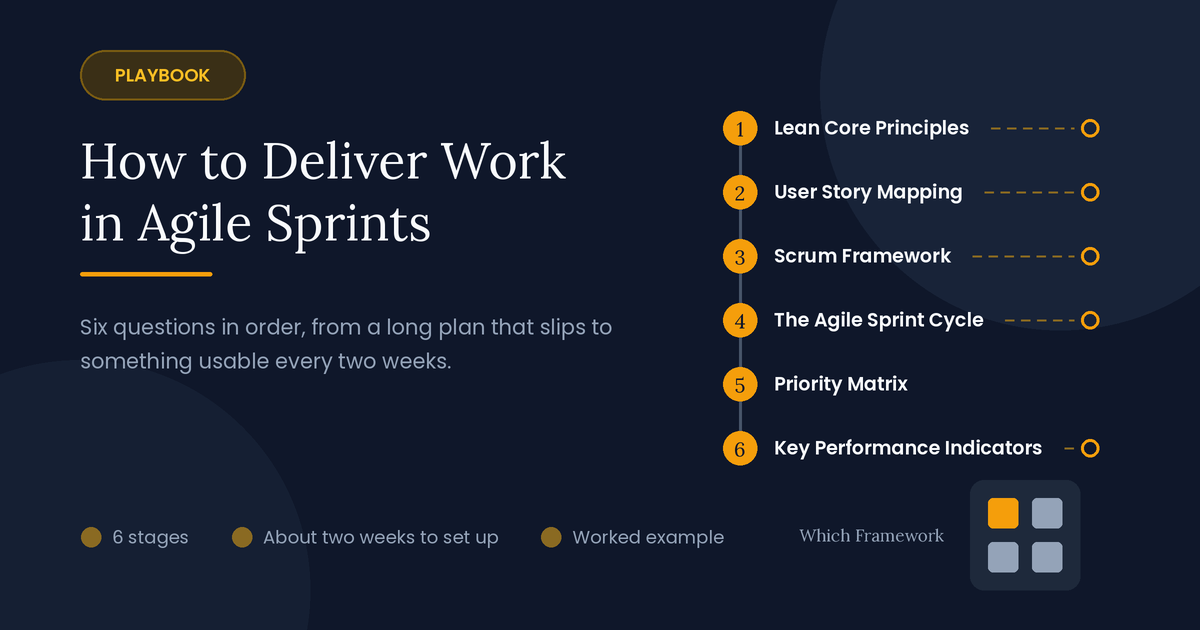
The route
Six questions, in order
The route runs from what customers value to a team that delivers it every two weeks: what matters, what to build first, who decides, how each sprint runs, what happens to interruptions, and how you know it works.
On timing: stages 1 to 3 take about two weeks, before the first sprint. Stage 4 starts the sprints; stages 5 and 6 begin in the first month.
Scope fixed and a date that can't move? The project planning playbook fits better.
Free tools run each stage on your own team's work. The Agile Project Management Tool lays out all six stages and starts you off; or start at stage 1 with the Lean Principles Tool, or take the 15-minute guided tour first.
-
What do customers value?Stage 1 · Lean Core Principles
Passes on: value in one sentence, and where the time goes
Can't say what customers value?Ask them before building anything.
-
What should we build first?Stage 2 · User Story Mapping
Passes on: a thin first release, and an ordered backlog
Backlog already small and ordered?Go straight to stage 3.
-
Who decides what?Stage 3 · Scrum Framework
Passes on: three accountabilities filled, and a Definition of Done
Nobody can say no to requests?Name a Product Owner first.
-
What happens in each sprint?Stage 4 · The Agile Sprint Cycle
Passes on: a two-week rhythm, and a Sprint Goal each time
Work can't wait for fixed cycles?Use Kanban instead.
-
What about urgent requests?Stage 5 · Priority Matrix
Passes on: a rule for every interruption
-
Is it working?Stage 6 · Key Performance Indicators
Passes on: a few measures, each with an owner
Velocity used as a target?Stop; it will inflate.
- Is it still working?Then · Review the measures every quarter
The example
One team, followed all the way through
This playbook follows one team from start to finish. It is an illustrative composite, and the details are simplified.
A chain of 40 hardware stores in Monterrey, Mexico, is building online ordering with same-day delivery. Its customers are building contractors and homeowners. An in-house team of eight builds it: five developers, a designer, a tester and the e-commerce manager.
The work started as a nine-month plan with 60 features. Four months in, it is behind, nothing has been released, and store managers send the team new requests every day. The owner wants something customers can use every few weeks instead.
Each stage below ends with what the team produced at that step, so you can watch one stage's output become the next stage's input.
Stage 1 of 6
What do customers value, and where does work wait?
Tool: Lean Core Principles · Time: a week, most of it interviews
Agile methods grew out of lean thinking, and the five lean principles explain what sprints are for. Start with the first two; the other three are what the sprints will deliver.
The five lean principles
- 1Value
- Defined by the customer, for a specific product at a specific price
- 2Value stream
- Every step taken to deliver that value, including the waiting
- 3Flow
- The steps run continuously, without batches or queues
- 4Pull
- Work starts only when the next step signals it is ready
- 5Perfection
- Go back to the first principle and round again
Value has no tool, which is why it gets assumed. Ask customers, not the sales team. Then follow one finished piece of work from request to release, and count the days it was worked on against the days it waited. The gap is usually large, and it is made of batches: work held until a set is ready to hand on.
| Step | Days waiting | Days worked |
|---|---|---|
| Approved by the steering group | 9 | – |
| Designed | 6 | 2 |
| Built | 8 | 4 |
| Tested, with everything else in the release | 12 | 2 |
| Released | 4 | – |
| Total: 47 days | 39 | 8 |
Handed to stage 2: value in one sentence, “the right parts on site before noon, at a time contractors can trust”, and a feature that spent 39 of its 47 days waiting.
Decision point
If nobody can say what customers value without guessing, ask them before building anything. Here, the plan's 60 features centered on product photos and reviews; the 12 contractors interviewed cared about the delivery time and whether the part was in stock.
Stage 2 of 6
What should we build first?
Tool: User Story Mapping · Time: a 1-day workshop
A plan of 60 features is a list. A story map puts the work in the order a customer meets it. Across the top runs the backbone: the activities a customer moves through, in sequence. Under each activity go the smaller pieces of work, the user stories, most valuable at the top.
Then cut across the map. The first release is the walking skeleton: the thinnest version in which a customer can get from one end of the backbone to the other. It should feel slightly inadequate. What people learn from using it usually changes the later slices.
| Backbone activity | Walking skeleton (release 1) | Later releases |
|---|---|---|
| Find the part | Search by name | Photos, filters, reviews |
| Check it is in stock | Stock at the nearest store | Stock across all 40 stores |
| Order and pay | Card payment only | Account credit for contractors |
| Choose a delivery time | One morning window | Hourly windows |
| Receive it on site | A text message when the van leaves | Live tracking |
Handed to stage 3: a backbone of five activities, a walking skeleton of 14 user stories, and the rest of the 60 features ordered behind it.
Decision point
If a customer can't get from one end of the backbone to the other, the first release is a subset, not a slice. The old plan would have shipped search and photos first, which no contractor could use to get a part delivered.
Stage 3 of 6
Who decides what, and what counts as done?
Tool: Scrum Framework · Time: 2 to 3 days to agree, then from the first sprint
Scrum is a short framework: three accountabilities, three artifacts, and five events, which stage 4 covers. An accountability says who answers for what. An artifact is a shared record the team works from, kept where everyone can see it. Since 2020, each artifact carries a commitment, named beside it below.
The two halves of the table below don't pair up row by row. The Product Owner looks after the Product Backlog. The Developers own the Sprint Backlog and build the Increment. The Scrum Master owns none, and helps the others use them.
Two parts matter most at the start. The Product Owner orders the backlog and must be able to say no, including to senior people. And the Definition of Done stops work being called finished when it is only built. In Scrum, the designer and tester count as Developers too: everyone doing the work.
| Kind | Part | What it is for | In the example |
|---|---|---|---|
| Accountability | Product Owner | The product's value, and the order of the backlog | The e-commerce manager, with authority to turn down store requests |
| Accountability | Scrum Master | The team's effectiveness, and removing what blocks it | The tester, given half her time for it |
| Accountability | Developers | A usable piece of product every sprint | The five developers, the designer and the tester |
| Artifact | Product Backlog, with its Product Goal | One longer-term aim the backlog is ordered against | “Contractors order online and get parts on site before noon” |
| Artifact | Sprint Backlog, with its Sprint Goal | One reason this sprint is worth running | Set at each Sprint Planning |
| Artifact | Increment, with its Definition of Done | What finished means | Reviewed by a second developer, tested on a phone, live at one store, help page updated |
Handed to stage 4: the e-commerce manager as Product Owner, a Product Goal in one sentence, and a four-part Definition of Done.
Decision point
If the Product Owner can't say no to senior people, the backlog will be ordered by whoever asks loudest. The owner put the e-commerce manager's authority in writing and told the store managers before the first sprint.
Stage 4 of 6
What happens in each sprint, and how long does it take?
Tool: The Agile Sprint Cycle · Time: two weeks per sprint, from now on
The sprint cycle is Scrum's five events in order. Each has a timebox, a maximum length, which is a ceiling, not a target.
Refinement, preparing the next items so they can be planned, has no slot of its own and gets skipped. Give it about a tenth of the team's time. The table follows the team's third sprint through every event.
| Event | Timebox | In the team's third sprint |
|---|---|---|
| Sprint Planning | Up to about 4 hours | Day 1, 90 minutes. Sprint Goal: “Contractors near two pilot stores can order, pay and choose the morning delivery.” Six user stories chosen |
| Daily Scrum | 15 minutes | Every morning. On day 4, the payment test account wasn't ready; the Scrum Master got it that afternoon |
| Refinement (not an event) | About a tenth of the team's time | Day 6, 1 hour: next sprint's user stories split to fit two days each |
| Sprint Review | Up to about 2 hours | Day 10. Two contractors and three store managers place real orders; a request for site directions joins the backlog |
| Sprint Retrospective | Up to about 1.5 hours | Day 10, 1 hour: keep testing each user story the day it is built |
| The Sprint | Two weeks | Five of six user stories done and the Sprint Goal met; the sixth went back to the backlog |
Handed to stage 5: a sprint every two weeks, and the walking skeleton live at two stores after the third.
Decision point
If Sprint Planning keeps running its full timebox, fix refinement, not the meeting. The first planning took five hours; with refinement twice a week, the third took 90 minutes.
Stage 5 of 6
What happens to requests that arrive mid-sprint?
Tool: Priority Matrix · Time: a 2-week log, then a rule for every request
A sprint protects the team's plan for two weeks, but urgent requests still arrive. The Priority Matrix, also called the Eisenhower Matrix, sorts them by two questions. Is it important: what happens if it is never done? Is it urgent: what happens if it waits until next sprint? Each of the four answers has its own action.
Log every request for two weeks and sort them together. Most misplacing is seniority standing in for consequence: a request from a director reads as important, and the same one from a store clerk doesn't. The matrix is for interruptions, not for ordering the backlog; that was stage 2. The grid below sorts the 64 requests store managers sent the team in two weeks.
Handed to stage 6: a developer on duty for the six urgent fixes, a support desk answering the 29 status questions, and sprints that kept their goals.
Decision point
If most requests land in Do, check who sent them, not just what they say. In the team's first sort, 19 requests were in Do; after asking what would happen if each waited two weeks, six were left.
Stage 6 of 6
How do you know it is working?
Tool: Key Performance Indicators · Time: half a day to set up, then a monthly look
A measure becomes an indicator when it has a target and an owner who can move it. Sort candidates into four types first, because each type has a different reader.
The four types of performance measure
- 1Key result indicator
- How the business did overall; for the board
- 2Result indicator
- What several teams produced between them
- 3Performance indicator
- What one team can be held to
- 4Key performance indicator
- The few measures that move everything else
Measure outcomes for customers and the flow of work, not activity. Velocity, the amount of work a team finishes per sprint, is a planning aid for the team itself. Made a target, it inflates: the estimates grow and nothing else does.
| Measure | Type | Owner | Start | Six months |
|---|---|---|---|---|
| Orders on site before noon | Key performance indicator | Head of logistics | – | 92% |
| Online orders a week | Result indicator | Product Owner | 0 | 640 |
| Days from request to release | Performance indicator | Scrum Master | 47 | 12 |
| Sprint Goals met, last six sprints | Performance indicator | Developers | – | 5 of 6 |
Handed on: four measures with owners and targets, a monthly review, and velocity kept inside the team.
Decision point
If a measure has no owner who can move it, it is a fact, not an indicator. “Online sales” was dropped as a team measure because pricing and stock, which drive it, sit outside the team.
Pace
Fast track or thorough
The fast track suits one small team trying sprints for a quarter. The thorough run suits a team replacing a long plan that has gone wrong, as in the example. The order of the stages stays the same either way.
| Stage | Fast track (a few days) | Thorough (about two weeks) |
|---|---|---|
| 1. Lean Core Principles | A value statement and one feature's timeline | Customer interviews, and several features traced |
| 2. User Story Mapping | Backbone and first slice in an afternoon | A full map with the people who know each step |
| 3. Scrum Framework | Names against the three accountabilities | Product Owner's authority in writing; Definition of Done agreed |
| 4. The Agile Sprint Cycle | Two-week sprints with all five events | The same, with refinement time protected |
| 5. Priority Matrix | A rule for urgent fixes | A two-week log, sorted, with a rule for each quadrant |
| 6. Key Performance Indicators | Two measures with owners | Four or five, typed, owned and reviewed monthly |
Failure modes
How agile switches go wrong
| What happens | What it looks like | The fix |
|---|---|---|
| The old plan cut into two-week pieces | Sprints that finish nothing a customer can use | Map the backbone; release a walking skeleton first |
| A Product Owner without authority | The backlog reordered by whoever asked last | Put the authority in writing, and tell people |
| Done means built | Work “finished” that fails in testing later | A written Definition of Done |
| Every request treated as urgent | Sprint Goals missed, sprint after sprint | Sort requests; only the Do quadrant interrupts |
| Velocity as a target | Estimates grow; delivery doesn't | Measure customer outcomes and time to release |
After the playbook
Is it still working?
Lean's fifth principle is to go round again. Each retrospective changes one thing; every quarter, look at the measures from stage 6 and trace one recent feature from request to release again, as in stage 1.
In the example, a feature took 12 days from request to release after six months, against 47 at the start. The next waiting point was outside the team: the steering group's monthly approval meeting, now replaced by the Product Owner's call.
Common questions
Agile sprints: quick answers
How do you switch a team to agile sprints?
Agree what customers value and see where work waits now. Map the work as a customer meets it and release a thin version that works end to end first. Name a Product Owner who can say no, write a Definition of Done, then run two-week sprints with all five Scrum events. Sort interruptions so only real emergencies break a sprint, and track a few measures with owners.
What are the three accountabilities in Scrum?
The Product Owner, answerable for the product's value and the order of the backlog; the Scrum Master, answerable for the team's effectiveness; and the Developers, everyone who does the work, answerable for a usable Increment every sprint.
How long should a sprint be?
A month or less, by the Scrum Guide. Two weeks is the most common choice: long enough to finish something usable, short enough to change course often. Keep the length fixed once chosen.
What is a walking skeleton?
The thinnest first release in which a user can get from one end of the journey to the other, with one option where there will later be many. It should feel slightly inadequate; what people learn from using it shapes the later releases.
How do you handle urgent requests during a sprint?
Sort them by importance and urgency. Only urgent and important ones, such as a broken checkout, interrupt the sprint, handled by a person on duty. Important ones go into the backlog, and urgent but unimportant ones go to someone else.
Should velocity be used as a KPI?
No. Velocity helps a team plan its own sprints. Used as a target, it grows through bigger estimates rather than more delivered. Measure outcomes for customers and the time from request to release instead.
What is the difference between agile sprints and a project plan?
A project plan fixes the scope and works out the date. Sprints fix the rhythm and let the scope change as people learn. Sprints suit work where needs shift; a plan suits a fixed scope and a fixed date.
Frameworks in this playbook
- Lean Core PrinciplesStage 1: What do customers value, and where does work wait?
- User Story MappingStage 2: What should we build first?
- Scrum FrameworkStage 3: Who decides what, and what counts as done?
- The Agile Sprint CycleStage 4: What happens in each sprint, and how long does it take?
- Priority MatrixStage 5: What happens to requests that arrive mid-sprint?
- Key Performance IndicatorsStage 6: How do you know it is working?
- KanbanAlongside: when urgent work arrives as a steady flow
- Dashboarding and VisualizationAfter: showing the measures from stage 6