Lean Core Principles: Value, Value Stream, Flow, Pull, Perfection
The five lean principles — value, value stream, flow, pull and perfection — are a sequence for organizing work around what the customer would actually pay for and removing everything else.
Before you start
Is lean your framework?
Lean is not a tool. It is the idea that organizes the tools — value stream mapping, 5S, kanban and kaizen are all lean methods, and each of them makes more sense once you know which of the five principles it serves. If you came here looking for something to run next week, one of those is probably what you want.
| If your real problem is… | You probably want |
|---|---|
| We cannot see where the time and waste actually go | Value Stream Mapping — the method behind principle two, and the usual first concrete step Compare Lean and Value Stream Mapping |
| Work piles up between steps and nobody can see the queue | Kanban — the method behind principle four, pull Compare Lean and Kanban |
| The work area is disorganized and hiding problems | 5S Methodology — conditions, and usually where organizations start |
| We want improvement to become a habit rather than a project | Kaizen — the practice behind principle five, perfection |
| Defects and variation are the problem, not delay | Lean Six Sigma — statistical work on a defined defect |
| One step is holding up everything downstream | Theory of Constraints — a different diagnosis: exploit the bottleneck rather than smooth the whole flow |
| We need a whole chain owned and managed permanently | Business Process Management — governance and ownership rather than waste |
| We want the thinking that connects all of the above | Lean Core Principles — you are in the right place |
The test that separates lean from a cost program
Ask who defines value. In lean the answer is the customer, and everything follows from it — a step is waste because the customer would not pay for it, not because it is expensive. Organizations that skip principle one and start removing cost are running a cost program with lean vocabulary, and they usually remove the things customers were paying for.
What Is It?
Lean is a way of running an operation so that as much of its effort as possible goes into things the customer would actually pay for. Everything else — waiting, moving, checking, correcting, storing — is treated as waste to be reduced, not as a normal cost of doing business.
The five principles are the practical version of that idea, and they are meant to be worked in order. Each one only makes sense once the previous one is done: you cannot judge which steps are waste until you know what value means here, and you cannot make work flow until you can see the steps.
Two things are worth knowing before the detail. The word “lean” was not coined by the people who wrote the five principles, and the five principles were not written by Toyota. Both matter, and the evidence section sets out who did what.
Quick Reference
The canonical structure
The five principles, one at a time
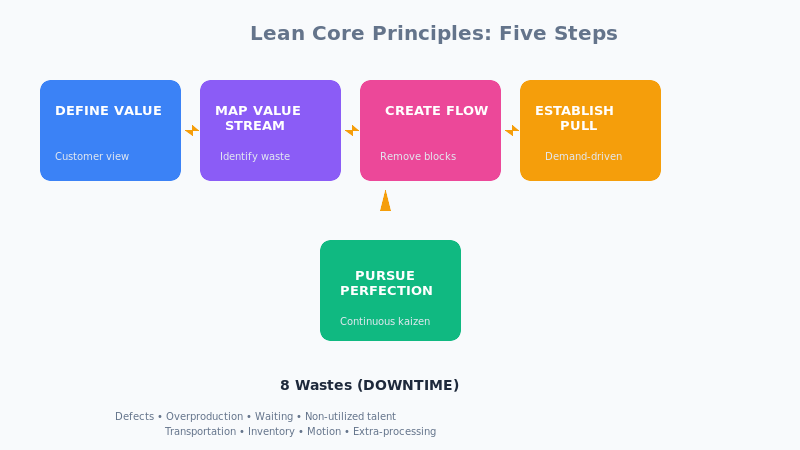
They are a sequence, not a menu. The last column tells you whether a step actually happened.
| Principle | What it requires | The test |
|---|---|---|
| 1. Value | Define value from the customer’s side, for a specific product at a specific price. Not what you are good at, and not what the business would like to sell. This is the principle most often skipped, and skipping it makes the other four meaningless. | Can you name a step you are proud of that the customer would not pay for? |
| 2. Value stream | Map every step currently taken to deliver that value, including the waiting. Sort each into three: creates value, creates none but cannot yet be removed, or creates none and can go now. | Does the map show waiting time, or only the work? |
| 3. Flow | Make the remaining steps run continuously, without batching or queuing. This usually means rearranging who does what, and is where lean stops being a technical exercise. | Follow one real item end to end. How long did it spend being worked on? |
| 4. Pull | Produce only when a downstream step signals it needs something. The point is not inventory reduction — it is that pull makes problems visible immediately, because no buffer of stock hides them. | When something breaks, how long before the next step notices? |
| 5. Perfection | Return to principle one and go round again. Each pass changes what is visible, because removing the largest waste exposes the next. As a destination it is demoralizing; as a loop it is the whole method. | When did you last redefine value, rather than just remove more waste? |
Where organizations actually enter
Almost nobody starts at principle one. They start at three or four, because flow and pull have visible tools attached. Value has no tool, which is why it gets assumed rather than established, and why so many lean programs end up efficiently producing something nobody especially wanted.
Reconciling sources
Which wording is official?
You will meet the five principles under several sets of verbs, which is why quoting them in a document is more annoying than it should be. The nouns never move. The verbs in front of them do.
| # | The fixed part | Verbs in common use |
|---|---|---|
| 1 | Value | Specify value · Define value · Identify value |
| 2 | Value stream | Identify the value stream · Map the value stream |
| 3 | Flow | Make value flow · Create flow |
| 4 | Pull | Let the customer pull · Establish pull |
| 5 | Perfection | Pursue perfection · Seek perfection |
What to quote
If you need one authoritative version, quote Womack and Jones, Lean Thinking (1996), which is where the five originate, and say so. If you are quoting a training deck or a website, name that source instead of presenting its verbs as canonical. Nothing turns on which verb set you use — but a document that mixes two of them looks careless to anyone who knows the field.
Core Features
- Customer-defined value: worth is judged from outside the organization, not inside it
- Sequential: each principle assumes the one before it has been done
- Waste as the unit of analysis: anything the customer would not pay for is a target
- Flow over utilization: a busy department and a fast process are different things
- Pull as a detector: low inventory is valuable mainly because it exposes problems
- Never finished: the fifth principle returns you to the first
Worked example
A hearing aid manufacturer, and the step nobody would defend
An illustrative composite. A mid-size hearing aid manufacturer in the Netherlands took eleven working days to turn a clinic’s order into a delivered custom device. Competitors were quoting five. The assumption in the building was that the bottleneck was the moulding cell.
| Principle | What it produced |
|---|---|
| Value | Interviews with audiologists, not the sales team. Turnaround time mattered far more than the fit adjustments the company was proudest of — those were reworked at the clinic anyway. Two upstream steps existed only to support them. |
| Value stream | Eleven days mapped. Fewer than four hours were work. The moulding cell was not the problem; it held items for three days waiting for a twice-weekly batch transfer. |
| Flow | Batch transfers replaced with continuous handover, and two quality checks merged into the step that caused the defects. Eleven days became six. |
| Pull | Component replenishment moved to signals from the cell. This is where it got uncomfortable — with the buffer gone, a supplier’s inconsistent delivery became visible within a day rather than absorbed. Two escalations in the first month looked like failure and were not. |
| Perfection | Nothing formal. Improvement stopped when the consultants left, and the six days drifted to seven over eighteen months. |
What the exercise actually found
The bottleneck everyone named was not the bottleneck. Three of the eleven days were a scheduling convention nobody had examined, and the mapping found it in an afternoon. That is the ordinary result of principle two, and it is why lean tends to start with a map rather than an investment.
The more interesting finding came from principle one. Two steps the company regarded as its craft advantage were reworked at the clinic every time, which meant customers were paying for them twice and valuing them once. No amount of flow work would have found that, because those steps were running efficiently. They were efficiently producing something the customer did not want.
When to Use
- Lead times are long and you suspect most of it is waiting rather than working
- Work moves in batches between departments that each look busy
- You are about to invest in capacity and have not checked whether flow is the constraint
- Several improvement tools are already in use with no idea connecting them
- Inventory or work in progress is high enough to be hiding problems
- The organization can sustain attention for a year or more
When NOT to Use
- The work is genuinely one-off — research, design, negotiation, case-by-case judgment
- Demand is so volatile that flow cannot be established at all
- It is being introduced as a redundancy exercise; participation will collapse and should
- Leadership wants a result this quarter
- The problem is a single bottleneck — Theory of Constraints is faster
- Quality variation, not delay, is the issue — see Lean Six Sigma
In practice
How lean goes wrong
Lean fails in ways that are visible from outside the organization, which is unusual and useful.
| Failure mode | What it looks like | What to do instead |
|---|---|---|
| Lean as cost-cutting | Headcount reduction announced in lean language; staff stop reporting problems | Commit publicly that improvement does not cost anyone their job, or expect the method to stop working within a quarter. |
| Skipping value | Straight to mapping and flow; the process gets faster at producing the wrong thing | Ask customers what they would pay for before mapping anything. It takes a week. |
| Tools without the idea | 5S boards, kanban cards and kaizen events with no shared view of value or flow | Tie every tool to the principle it serves, out loud, or it becomes local housekeeping. |
| Copying Toyota’s answers | Andon cords and takt boards imported wholesale into an office | Copy the questions, not the artifacts. Toyota’s tools are answers to Toyota’s problems. |
| Fragile, not lean | Buffers stripped without fixing what they concealed; the first disruption stops everything | Remove a buffer only after the problem it hid is solved. Pull exposes problems; it does not fix them. |
| Stopping at the project | An impressive result, then eighteen months of quiet drift back | Principle five is the whole of sustainability. Assign it to a role, not to a program. |
Sourced
Evidence, and how to cite it
Womack and Jones did not coin the word “lean”. John Krafcik did, in 1988.
The term first appeared in ‘Triumph of the Lean Production System’, published in Sloan Management Review in autumn 1988 and drawn from Krafcik’s master’s thesis at MIT. He had spent 1984 to 1986 as a quality engineer at NUMMI, the Toyota–General Motors joint venture in California, before going to MIT, where his research fed into the International Motor Vehicle Program that produced The Machine That Changed the World. Womack, Jones and Roos carried the word to a global audience in 1990; Womack and Jones added the five principles in 1996. Neither invented the name.
Krafcik, J.F. (1988) ‘Triumph of the Lean Production System’, Sloan Management Review, 30(1), pp. 41–52.
It was nearly called something else, and the alternative was arguably better.
Krafcik contrasted “lean” production with “buffered” production, where stock is built up so a stoppage in one place does not halt the rest. He noted that other researchers had described the same contrast as fragile versus robust. That older pairing is more honest about the trade: a lean system has no slack, so it works only if management fixes the problems slack used to absorb. Most lean failures are a system made fragile and called lean.
Krafcik (1988), footnote on the lean–buffered typology.
Toyota does not teach five principles.
The five are Womack and Jones’s account of what they observed, written for Western organizations with no equivalent of Toyota’s management system. Toyota’s own formulations differ: the Toyota Production System rests on two pillars, just-in-time and jidoka, and the Toyota Way, published internally in 2001 and later described by Jeffrey Liker, sets out fourteen principles under philosophy, process, people and problem solving. “The 14 lean principles” refers to Liker’s book, not Womack and Jones’s, and the two are not versions of one list.
Womack, J.P. & Jones, D.T. (1996) Lean Thinking. New York: Simon & Schuster; Liker, J.K. (2004) The Toyota Way. New York: McGraw-Hill.
How to cite it.
Harvard: Womack, J.P. and Jones, D.T. (1996) Lean Thinking: Banish Waste and Create Wealth in Your Corporation. New York: Simon & Schuster.
APA: Womack, J. P., & Jones, D. T. (1996). Lean thinking. Simon & Schuster.
For the origin of the term, cite Krafcik (1988) — not Womack. For the term’s spread, cite Womack, Jones and Roos (1990) The Machine That Changed the World. For a definition, the Lean Enterprise Institute lexicon is the standard reference; name it rather than presenting its wording as the only one.
Key Strengths
- One idea that organizes many tools: 5S, kanban, kaizen and mapping stop being unrelated initiatives
- Finds delay nobody was looking for: mapping routinely shows work is a small fraction of elapsed time
- Cheap to start: the first two principles need conversation and a wall, not capital
- Travels well: proven in factories, hospitals, banks, software and public services
- Exposes problems rather than hiding them: pull turns concealed issues into visible ones
Key Weaknesses
- Its reputation precedes it: decades of use as cover for layoffs makes participation hard to win
- Removes slack: a lean system is more exposed to disruption unless the underlying problems are fixed
- Slow: a year or more before it is a habit rather than a project
- Weak on volatile or one-off work: the flow assumption does not hold everywhere
- Easy to reduce to tools: the visible artifacts get copied and the thinking does not
Sequencing
What to run before and after
Lean is the idea. These are the things that make it concrete, in the order they usually help.
Before
Stabilize conditions, so measurements mean something
Mapping a chaotic area produces a map of the chaos. A basic 5S pass gives you a workplace where the same task takes roughly the same time twice running, which is what any later measurement depends on.
During
Map the stream, then make it flow and pull
Value stream mapping delivers principle two and normally finds the surprise. Kanban delivers principle four. If you have event-log data, process mining will build the map faster and without the arguments.
After
Give principle five somewhere to live
Perfection is a loop, and loops need an owner and a cadence. Attach it to a standing routine, or add statistical work where the remaining problem is variation rather than delay.
Common questions
Lean principles: quick answers
What are the five lean principles?
Value, value stream, flow, pull and perfection. Define value from the customer's point of view; map every step currently taken to deliver it, including the waiting; make the remaining steps flow without batching or queuing; let downstream demand pull work through instead of pushing it; then go back to the start and repeat. They are a sequence rather than a menu, and each assumes the one before it has been done.
Who created the five lean principles?
James Womack and Daniel Jones, in Lean Thinking (1996). They are a Western account of how Toyota operates, written for organizations that had no equivalent of Toyota's management system. Toyota itself does not teach five principles: the Toyota Production System rests on two pillars, just-in-time and jidoka, and the Toyota Way sets out fourteen principles, popularized by Jeffrey Liker in 2004.
Who coined the term “lean”?
John Krafcik, in a 1988 Sloan Management Review article called 'Triumph of the Lean Production System', drawn from his MIT master's thesis. He had worked as a quality engineer at NUMMI, the Toyota and General Motors joint venture, before going to MIT. The word reached a global audience through The Machine That Changed the World in 1990, and the five principles followed in 1996 — but the name is Krafcik's, not Womack's.
Is it “specify value” or “define value”?
Both, and also “identify value”. The nouns are fixed — value, value stream, flow, pull, perfection — and the verbs vary between the original book, the Lean Enterprise Institute's wording and countless training decks. Nothing turns on the choice. If a document will be checked, quote Womack and Jones (1996) and say so, and avoid mixing two verb sets in the same document.
What are the 14 lean principles?
That phrase refers to Jeffrey Liker's The Toyota Way (2004), which sets out fourteen principles grouped under philosophy, process, people and partners, and problem solving. They are not an expanded version of Womack and Jones's five, and the two lists are not alternatives to each other. The five describe how to convert an operation to lean; the fourteen describe the management system Toyota built over decades.
What is the difference between lean and continuous improvement?
Continuous improvement is one part of lean rather than a synonym for it. It is the fifth principle, perfection, and in practice it is delivered through kaizen. Lean also includes four things continuous improvement does not specify: a customer definition of value, an end-to-end map of the work, a commitment to flow, and pull. An organization doing continuous improvement without those is improving steps without knowing whether the steps should exist.
Why does lean have a bad reputation?
Because it has repeatedly been used as vocabulary for redundancy programs. Once staff associate an improvement exercise with job losses, they stop reporting problems, and lean depends entirely on problems being reported. There is a second, subtler reason: lean removes the slack that used to absorb disruption, so an organization that strips buffers without fixing what the buffers concealed becomes fragile and calls the result lean.
Does lean only work in manufacturing?
No. The principles were written from car manufacturing but apply wherever work moves through steps toward someone who wants an outcome — hospitals, claims handling, software delivery, public services. What does not transfer is the assumption of repeatability: where every item is genuinely one-off, there is no flow to establish, and the mapping effort will outrun its return.
How do I cite lean principles?
Harvard style: Womack, J.P. and Jones, D.T. (1996) Lean Thinking: Banish Waste and Create Wealth in Your Corporation. New York: Simon & Schuster. APA style: Womack, J. P., & Jones, D. T. (1996). Lean thinking. Simon & Schuster. For the origin of the term itself, cite Krafcik, J.F. (1988) 'Triumph of the Lean Production System', Sloan Management Review, 30(1), pp. 41-52. For a definition, the Lean Enterprise Institute lexicon is the standard reference.
Deep Resources
Frameworks related to Lean Core Principles
- Lean Six SigmaCombines Lean speed with Six Sigma quality using DMAIC methodology to reduce defects and waste…
- Value Stream MappingVisualize the flow of materials and information through a process to identify waste and…
- KaizenPhilosophy of continuous incremental improvement involving everyone, building sustainable…
- 5S MethodologySimple 5-step workplace organization framework (Sort, Set, Shine, Standardize, Sustain) for…