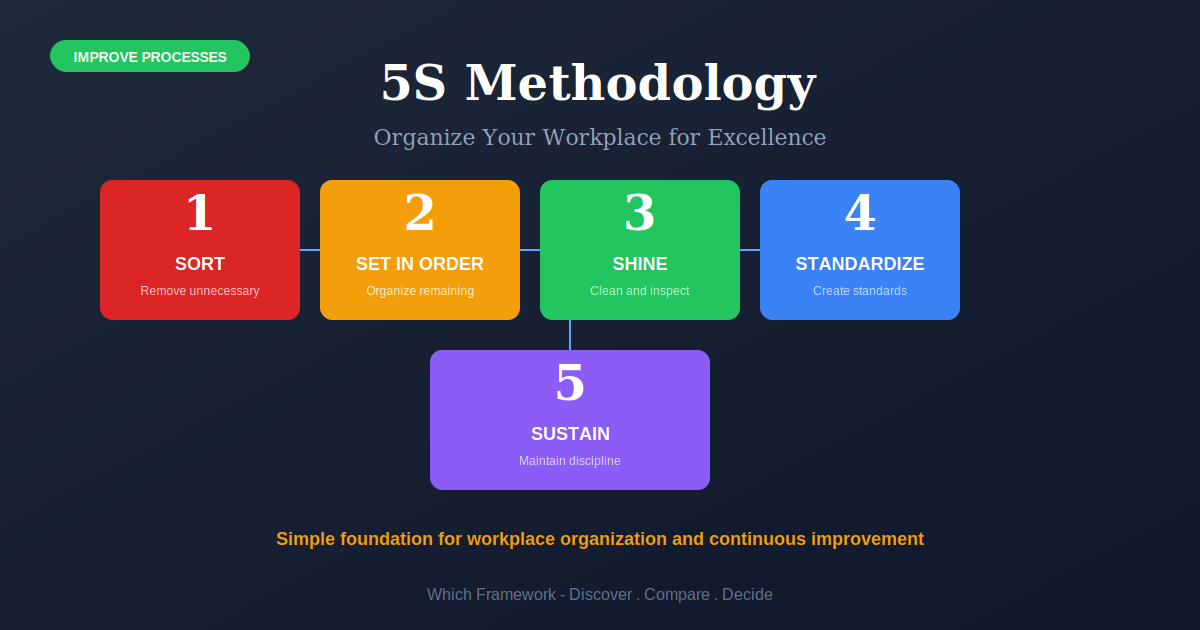
5S Methodology: Sort, Set in Order, Shine, Standardize, Sustain
5S is a workplace organization method built on five Japanese words — Seiri, Seiton, Seiso, Seiketsu and Shitsuke — usually rendered as Sort, Set in Order, Shine, Standardize and Sustain, whose shared purpose is to make anything out of place immediately visible.
Before you start
Is 5S your framework?
5S works on the state of a work area, not on the process running through it. That makes it a foundation, not a fix: it will not repair a badly designed process, but it stops clutter hiding the evidence you need to repair one. Teams that adopt it expecting improvement get tidiness; teams that adopt it expecting visibility get both.
| If your real problem is… | You probably want |
|---|---|
| The process itself is slow and we cannot see where the time goes | Value Stream Mapping — maps flow across the whole process, where 5S works on one area Compare 5S and Value Stream Mapping |
| One step is holding up everything else | Theory of Constraints — exploits the bottleneck rather than improving everywhere at once |
| Defects and variation are the problem, not disorder | Lean Six Sigma — statistical root-cause work; 5S is where its Control phase gets visual standards Compare 5S and Lean Six Sigma |
| We want improvement to become a habit, not a project | Kaizen — the continuous-improvement philosophy 5S is normally the first step of |
| We need a fast, focused burst on one problem | Kaizen Blitz — a time-boxed event format; a 5S push is often run as one |
| Work in progress is piling up and nobody can see the queue | Kanban — the same idea applied to flow rather than to space |
| Nobody agrees on how the work is even done | Business Process Management — document the process before organizing the room |
| The work area is cluttered, and problems are hiding in the clutter | 5S Methodology — you are in the right place |
The test that separates real 5S from housekeeping
After the exercise, can someone standing in the doorway tell that something is wrong? A missing tool leaves a visible gap on a shadow board; oil on a normally clean floor is an event, not background. If the answer is only “it looks better in here”, the exercise produced cleanliness without detection — and cleanliness on its own reverts, because nobody can say what it is for.
What Is It?
5S puts a work area into a known, marked, repeatable condition so that deviations from that condition are immediately obvious. The five steps are named for five Japanese words beginning with the same s sound: seiri (整理), seiton (整頓), seiso (清掃), seiketsu (清潔) and shitsuke (躾). The English translations were chosen to preserve that alliteration, which is much of why the method is so easy to teach and so easy to misunderstand.
The misunderstanding is that 5S is about cleaning. Cleaning is the third step, and even there the purpose is inspection rather than appearance: the person who wipes down a machine is the one who notices the new oil stain, the loose fitting, the vibration that was not there last week. Every step serves the same end — a workplace where normal and abnormal look different.
This is why 5S is almost always the first lean tool an organization adopts. It is cheap, needs no data, shows results within a day, and creates the stable baseline that Kaizen, Value Stream Mapping and Lean Six Sigma all assume but none establish. It is also the tool most often mistaken for the whole of lean: the easiest part to start, and the easiest part to stop at.
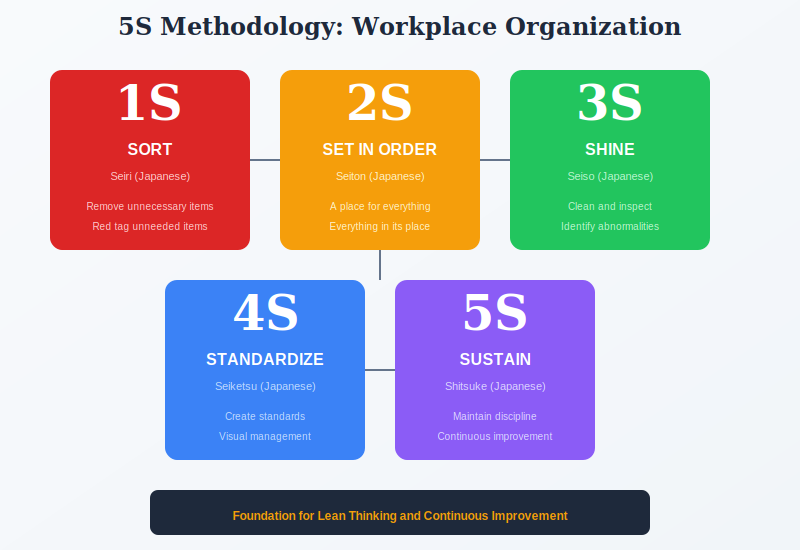
Quick Reference
The canonical structure
The five S’s, one at a time
The steps are sequential, and each assumes the one before it is done. The third column is the one to hold onto: every step has a test that distinguishes having performed it from having tidied up.
| Step | What it actually requires | The test |
|---|---|---|
| 1. Sort Seiri 整理 — put in logical order | Remove what is not needed for current work. The technique is red-tagging: doubtful items get a dated tag and move to a holding area, commonly for thirty days, after which unclaimed items leave. Record why each contested item was there — hoarded spares are usually evidence of a process problem. | Could a new starter tell which items here are in active use? |
| 2. Set in Order Seiton 整頓 — arrange neatly | Give everything remaining a marked, self-explaining location. The Japanese discipline is san-tei (三定), the three fixings: tei-i (定位) fixed position, tei-hin (定品) fixed item, tei-ryō (定量) fixed quantity — together they turn a location into a detector. Miss the quantity rule and the area stays tidy while quietly accumulating excess stock. | Can a stranger retrieve and return a named item unaided — and notice if the count is wrong? |
| 3. Shine Seiso 清掃 — sweep clean | Inspection performed through cleaning. Cleaning forces contact: a hand on every surface, a look behind every guard, so oil films, backed-off bolts and changed noises get found. It collapses the moment cleaning is delegated — a contracted crew produces a clean machine and zero findings. | Did last month’s cleaning produce any findings at all? |
| 4. Standardize Seiketsu 清潔 — cleanliness | The translation misleads: seiketsu names a condition, not an activity — the state that exists when the first three keep being performed. What holds it is visual and short: a dated photograph of normal posted at the area, named ownership by role, a restore routine tied to an existing event, and a rule that the standard changes the same day anything else does. | If the area drifted overnight, is restoring it a decision or a reflex? |
| 5. Sustain Shitsuke 躾 — instilled discipline | The character combines 身 (body) and 美 (beauty): conduct formed through training, not enforcement. Hardest because the first three deliver a visible result and the last two deliver none. Scored audits work about two quarters before areas are tidied the morning of the inspection; a daily leader walk cannot be prepared for. | What happens in the week nobody is looking? |
Why the order is not negotiable
Setting locations before sorting means giving marked homes to things that should have left — immaculate shadow boards for obsolete tooling. But the split that matters is between the first three and the last two: the first three are an event with a visible result, the last two a routine with none. Almost every 5S program that reverts did the first three well and never resourced the other half.
Reconciling sources
Set in Order or Straighten? Which list is official
The Japanese terms are fixed; the English ones are not, and the two organizations most often cited as authorities disagree. ASQ renders the second S as Set in Order. The Lean Enterprise Institute renders it as Straighten. Neither is a translation error — no English word carries seiton exactly, so translators picked different approximations beginning with S.
| Japanese | ASQ | Lean Enterprise Institute | Toyota’s four (per LEI) | Also seen |
|---|---|---|---|---|
| Seiri | Sort | Sort | Sifting | Simplify, Separate |
| Seiton | Set in Order | Straighten | Sorting | Systematize, Stabilize |
| Seiso | Shine | Shine | Sweeping Clean | Scrub, Sweep |
| Seiketsu | Standardize | Standardize | Spic and Span | Standardization |
| Shitsuke | Sustain | Sustain | — not a separate step | Self-discipline |
The trap in the Toyota column
Read that column carefully, because the words collide. In the four-step version, “Sorting” is the second S — seiton, arranging what remains — while in the five-step version everyone teaches, “Sort” is the first, seiri, throwing things out. The same English root lands on two different steps.
If you are reconciling documents and one says Sorting means arranging, it is not a typo. Work from the Japanese, which never moves. Worth noting on the balance of it: Hirano’s own book — the source most Western training descends from — introduces the steps as Sort, Set in Order, Shine, Standardize and Sustain.
Core Features
- Sequential, not parallel: each step assumes the previous one is complete
- Visual before documentary: markings, shadow boards and photographs carry the standard
- Detection, not decoration: the deliverable is an area where deviation is obvious to a passer-by
- Done by the people who work there: 5S performed on a team produces a tidy area and no ownership
- Cheap and fast: no software, no data, no statistical training; one area in a day
- Domain-neutral: a machine shop, a hospital store room, a shared drive
- Foundational: stabilizes conditions so other methods have something reliable to measure against
Worked example
A sterile processing department, and what the exercise found
An illustrative composite. A 240-bed community hospital in Ohio was losing operating-room time to instrument problems — trays arriving incomplete, occasional case delays of fifteen to forty minutes. The team ran 5S across the sterile processing department over three days.
| Step | What it produced |
|---|---|
| Sort | 317 items red-tagged. 94 were trays for procedures the hospital had stopped performing, two of them for a surgeon who retired in 2019. Clearing them freed a full rack. |
| Set in Order | The fixed-quantity rule was the one that bit. Marking maximum counts revealed 41 duplicate instruments held back “in case” — the informal buffer that had been masking the real shortage. |
| Shine | The most valuable finding of the three days. Technicians cleaning their own washer-disinfectors found a perished door gasket on washer 2, the cause of roughly two rejected wet loads a week. Nobody had connected the two. |
| Standardize | Dated photograph of each bench, count sheets, named zone ownership by shift. Restore time at shift end settled at four to six minutes. |
| Sustain | Weekly scored audit. Score rose from 42 to 88 in eleven weeks, then fell to 61 by month seven as attention moved to an accreditation visit. |
What survived, and what did not
Eight months on, the 94 obsolete trays had not come back and the gasket stayed fixed — both structural changes requiring no ongoing effort. The bench discipline did not hold, because it required someone to notice and act daily and nothing had been built into the routine to carry it. The audit measured the condition weekly and never restored it.
Case delays fell by roughly half and stayed there, but almost all of that came from the gasket and the tray clear-out. The exercise paid for itself through two abnormalities found by touching things, not through the organizing — an uncomfortable but useful thing to know before committing three days.
When to Use
- A work area is disorganized enough that people spend measurable time searching
- You are starting lean and need a visible, low-risk first move that builds credibility
- Equipment problems are being discovered late, after they have caused a stoppage
- You are about to map or improve a process and need a stable baseline first
- Safety incidents trace to clutter, obstruction or unclear storage
- A Six Sigma improvement has landed and its Control phase needs visual standards
- A new area or office is being set up and the condition can be defined from the start
When NOT to Use
- The problem is process design, sequencing or capacity — 5S will tidy around it
- Leadership wants a visible initiative rather than a change in how the area is run
- The area is due to be relocated or redesigned within months
- 5S has been run and abandoned before, and nothing about the conditions has changed
- It is proposed as the answer to a quality or delivery target it cannot plausibly move
In practice
How 5S goes wrong
The failures share a root: the visible part of the method is easy to reproduce, and the part that produces the benefit is not.
| Failure mode | What it looks like | What to do instead |
|---|---|---|
| The one-week event | An intense clear-out, before-and-after photographs, reversion within two months | Treat the first three S’s as setup and the last two as the work. Budget the ongoing minutes. |
| Reduced to housekeeping | “5S day” means everyone tidies; staff resent it as unpaid cleaning | State the detection purpose in every instruction. If a step cannot be tied to making an abnormality visible, it is not part of the method. |
| Audit theater | Elaborate scorecards and a rising number; areas tidied the morning of the audit | Prefer a short daily leader walk to a long monthly score. Immediate correction beats a measurement nobody acts on. |
| Cleaning delegated | A contracted crew cleans the equipment; the area is spotless and generates no findings | Operators clean their own equipment. Outsourcing the cleaning outsources the findings away. |
| Stale standards | The posted photograph shows a layout changed a year ago | Update the standard the same day the layout or tooling changes. An ignored standard trains people to ignore standards. |
| Stopping at 5S | An immaculate workplace producing the wrong things at the wrong time, with lean declared complete | Follow it with Value Stream Mapping or Theory of Constraints. |
Sourced
Evidence, and how to cite it
Toyota traditionally practices four S’s, not five.
The Lean Enterprise Institute’s lexicon states that Toyota refers to just four, folding the discipline of the fifth into its daily audit and management routines rather than treating it as a separate step. The reasoning is that where standards and daily checks exist, sustaining is a property of the system rather than an act of individual willpower. The fifth S was added as the method was formalized for organizations without Toyota’s routines to carry it.
Lean Enterprise Institute, Lean Lexicon, “Five S”; Smalley, A., “4S”, TPS Encyclopedia, Art of Lean.
The five-step method was codified in the 1990s, by authors who did not work at Toyota.
“5S, developed at Toyota in the 1950s” conflates two things: workplace-organization practice embedded in the Toyota Production System, and a five-step framework packaged for export decades later. Takashi Osada published the first book devoted to it, treating 5S as a total-quality instrument with a substantial philosophical component. Hiroyuki Hirano followed with a practical treatment presenting the five as sequential pillars — and it is Hirano’s version, not Toyota’s practice, that most Western training reproduces. The roots run back further still, to postwar Japanese industrial engineering influenced by the American Training Within Industry programs of the 1945–52 occupation — reason to be cautious about any single-origin story, including the one this page previously told.
Osada, T. (1991) The 5S’s: Five Keys to a Total Quality Environment. Tokyo: Asian Productivity Organization (Japanese original 1989). Hirano, H. (1995) 5 Pillars of the Visual Workplace. New York: Productivity Press.
Osada and Hirano do not describe the same thing, and the difference still shows.
Osada framed 5S as a management philosophy aimed at the working environment as a whole; Hirano framed it as an implementation toolkit. Researchers comparing 5S in Japan, the United Kingdom and the United States built their analysis around exactly that split, asking whether 5S functions as a business improvement strategy or a useful tool. Most Western programs inherit Hirano’s tool and then express surprise when it does not produce Osada’s culture.
Kobayashi, K., Fisher, R. & Gapp, R. (2008) ‘Business improvement strategy or useful tool?’, Total Quality Management, 19(3), pp. 245–262.
How to cite it.
Harvard: Osada, T. (1991) The 5S’s: Five Keys to a Total Quality Environment. Tokyo: Asian Productivity Organization. Hirano, H. (1995) 5 Pillars of the Visual Workplace: The Sourcebook for 5S Implementation. New York: Productivity Press.
APA: Osada, T. (1991). The 5S’s: Five keys to a total quality environment. Asian Productivity Organization. Hirano, H. (1995). 5 pillars of the visual workplace. Productivity Press.
For a definition, cite the Lean Enterprise Institute lexicon or the ASQ resource, and say which — they differ on the second S. For empirical work, Kobayashi, Fisher and Gapp (2008) is the standard cross-country comparison.
Key Strengths
- Immediate and visible: results within a day, which makes it a good first move in a skeptical organization
- Almost free: tape, labels and a holding shelf
- Genuinely universal: factories, wards, kitchens, laboratories, warehouses, shared drives
- Finds problems nothing else would: cleaning-as-inspection surfaces faults before they stop production
- Creates a baseline: other methods can measure against a stable condition instead of noise
Key Weaknesses
- Reverts by default: gains decay unless something in the daily routine restores the condition
- Easy to mistake for the whole of lean: a perfectly organized workplace can still produce the wrong things
- Improves conditions, not processes: no effect on sequencing, capacity, batch size or design
- Measurement corrupts quickly: scored audits get gamed, often within two quarters
- Reads as an imposition: announced rather than run by the area, it lands as criticism of their tidiness
Sequencing
What to run before and after
5S is a foundation, so its value depends almost entirely on what gets built on it.
Before
Know what the area is supposed to produce
Organizing a work area whose process nobody has agreed on locks in the current arrangement. Settle that first, or the markings encode a way of working that is about to change.
During
Run it as an event, but record the findings
A time-boxed format works for the first three S’s. What matters is that the abnormalities discovered along the way are captured as problems rather than quietly cleared away.
After
Build something on the baseline within a quarter
The organized condition is now stable enough to measure against, and that is the window to use it. Teams that stop here are the ones for whom 5S becomes a story about a tidy-up that happened once.
Common questions
5S methodology: quick answers
What are the 5S’s?
Sort, Set in Order, Shine, Standardize and Sustain — English renderings of seiri, seiton, seiso, seiketsu and shitsuke. Sort removes what is not needed; Set in Order gives everything remaining a marked place; Shine cleans as a form of inspection; Standardize holds the resulting condition; Sustain is the discipline to keep doing the first four. Some sources render the second as Straighten, and some add a sixth S for Safety.
What does Shine (Seiso) mean in 5S?
Seiso means to sweep clean, but in 5S the purpose is inspection, not appearance. Cleaning forces contact with every surface, which is how oil leaks, loose fittings and changed noises get found early. That is why operators clean their own equipment: a contractor produces a clean machine and no findings. A Shine routine that has never generated a maintenance request is a cleaning schedule wearing a lean label.
What does Standardize (Seiketsu) actually mean?
Seiketsu literally means cleanliness, and it names a condition rather than an action — the state that exists once the first three S’s are performed consistently. Standardize describes how you hold that state, and what holds it is visual and short: a dated photograph of normal posted at the area, named ownership by role, and a restore routine tied to an existing event. A posted standard that no longer matches reality is worse than none.
What is Set in Order (Seiton), and what is san-tei?
Seiton means arranging what remains so everything has a designated, marked location. The Japanese discipline behind it is san-tei, the three fixings: tei-i, fixed position; tei-hin, fixed item; tei-ryo, fixed quantity. Together they turn a location into a detector, since a wrong item, a missing item and too many items are each visibly wrong. Skipping the quantity rule is the most common failure of this step.
Is it Set in Order or Straighten? Which list is official?
There is no single official English list. ASQ publishes Set in Order; the Lean Enterprise Institute publishes Straighten. Both are authoritative and both describe the same Japanese step — no English word carries seiton exactly. You will also meet Systematize, Stabilize, Scrub and Sweep. If a document will be checked, quote a list with its source named rather than presenting one rendering as canonical.
Did 5S come from Toyota?
Partly. The practice was embedded in the Toyota Production System, but Toyota traditionally works with four S’s, folding the discipline of the fifth into daily audits rather than making it a separate step. The five-step method familiar today was codified in the 1990s by Takashi Osada, whose 1991 book was the first devoted to it, and Hiroyuki Hirano, whose 1995 book became the version most Western training reproduces.
What is Sustain (Shitsuke), and why is it the hardest S?
Shitsuke is written with the characters for body and beauty, and means discipline instilled through training rather than enforcement. It is hardest because the first three steps produce a visible result and the last two produce nothing visible at all. Scored audits work for about two quarters before areas start being tidied the morning of the inspection; a short daily leader walk is more durable, because it cannot be prepared for.
What is 6S, and does 5S work outside a factory?
6S adds Safety as a sixth step, a variation the Lean Enterprise Institute notes some practitioners use; others hold safety is already served by the original five. The steps themselves are domain-neutral and are applied routinely in hospitals, laboratories, warehouses and offices, including to shared drives. What does not transfer is the assumption of a fixed layout: where an area is redesigned every few months, the marking effort outruns its return.
How do I cite 5S?
Harvard style: Osada, T. (1991) The 5S’s: Five Keys to a Total Quality Environment. Tokyo: Asian Productivity Organization. Hirano, H. (1995) 5 Pillars of the Visual Workplace. New York: Productivity Press. APA style: Osada, T. (1991). The 5S’s: Five keys to a total quality environment. Asian Productivity Organization. For a definition, cite the Lean Enterprise Institute lexicon or the ASQ resource and name which, because they differ on the second S.
Deep Resources
Frameworks related to 5S Methodology
- KaizenPhilosophy of continuous incremental improvement involving everyone, building sustainable…
- Kaizen BlitzRapid 1-3 day intensive improvement event delivering quick wins with cross-functional teams…
- Lean Six SigmaCombines Lean speed with Six Sigma quality using DMAIC methodology to reduce defects and waste…